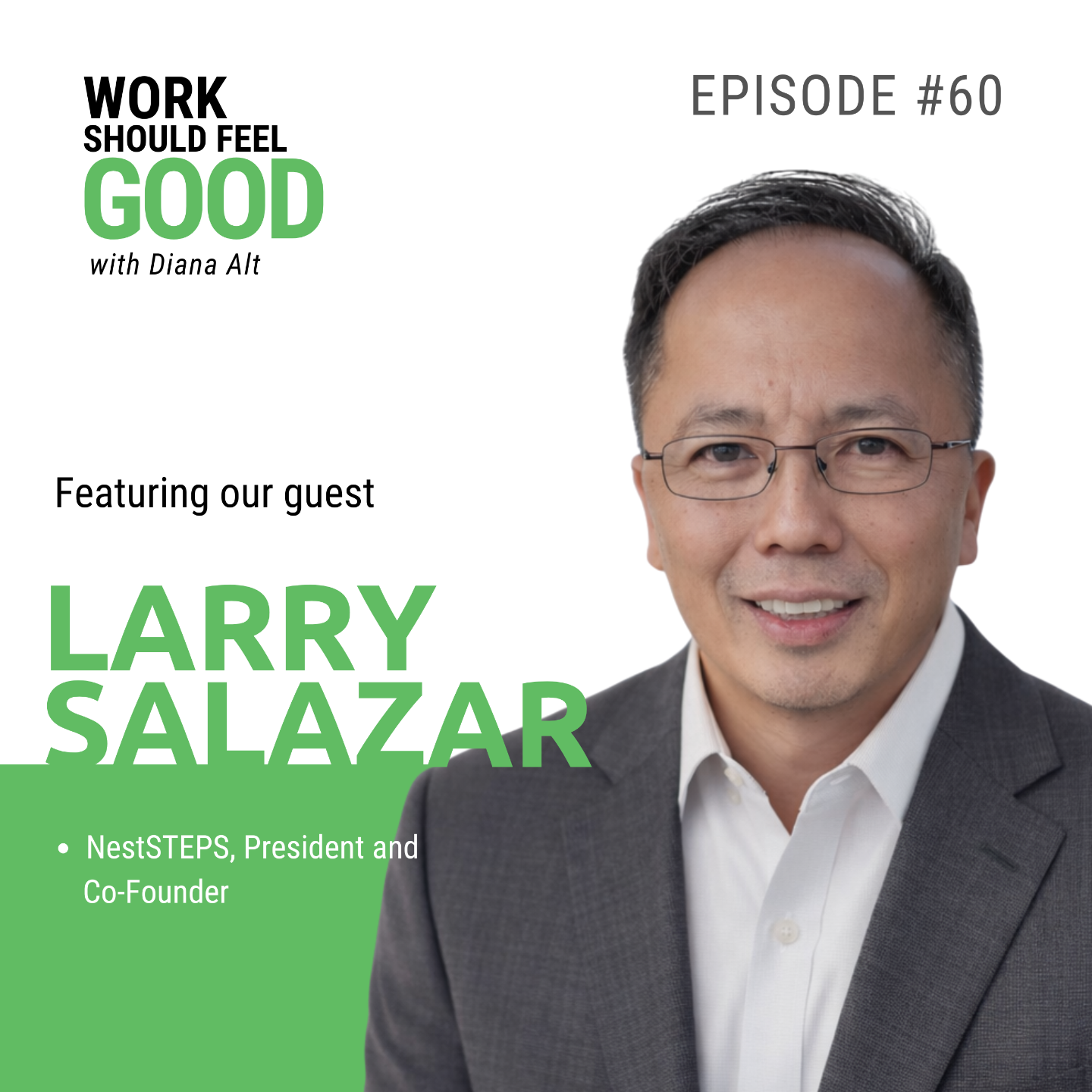
Work Should Feel Good with Diana Alt
Episode 60: Why Employee Benefits Should Help You Build a Life with Larry Salazar
Diana Alt sits down with Larry Salazar, President and Co-Founder of NestSTEPS, to explore why traditional workplace perks often fail to create lasting loyalty and what employees actually want from their employers today.
Larry shares his journey from journalism to entrepreneurship, explains how financial stress impacts workplace performance, and breaks down how homeownership support can become a powerful retention strategy. If you’ve ever wondered what truly makes work feel good, this conversation offers a fresh perspective on benefits, stability, and long-term wellbeing.
You’ll learn:
- Why financial stress directly impacts employee performance
- How employers can improve retention without simply raising salaries
- What makes some employee benefits meaningful while others fall flat
- Why homeownership support creates stronger employee loyalty
- How career decisions shape long-term financial freedom



Episode 60: Why Employee Benefits Should Help You Build a Life with Larry Salazar
Episode Description
Employee benefits are often treated as paperwork and perks, but what if they could become one of the most powerful tools for improving employee retention and helping people build the lives they actually want?
In this episode, Diana sits down with Larry Salazar to discuss why employers need to think beyond traditional benefits and invest in the whole person—not just the employee. From financial wellness and homeownership to career growth and workplace culture, they explore how meaningful benefits create stronger teams, healthier workplaces, and better lives.
-
Larry's journey from broadcast journalism to entrepreneurship
-
Why work and personal life can't be separated
-
The hidden costs of employee turnover
-
Why benefits should support the whole person
-
Traditional benefits vs. modern employee expectations
-
How financial stress impacts productivity at work
-
Housing as an employee benefit and retention strategy
-
Homeownership, financial education, and long-term wealth building
-
Building the business case for innovative employee benefits
-
The role of purpose in career decisions
-
Why following your passion often matters more than following the money
⏳ Timestamps
00:00 Welcome & introducing Larry Salazar
02:20 Larry's journalism career and desire to make a difference
05:20 From Boeing to entrepreneurship through homeownership
11:00 Building Nest Steps after a layoff
17:20 Why employers need to invest in the whole person
21:00 Which employee benefits actually improve retention?
24:30 Housing assistance as a modern employee benefit
35:10 Financial education and preparing employees for homeownership
44:30 Helping existing homeowners build long-term wealth
49:45 Why purpose beats simply following the money
💡Take Action
🔥 Subscribe for future episodes → https://www.youtube.com/@dianaalt
📖 Grab my Resume Don’ts Guide → https://www.dianaalt.com/resumedonts
❌ Avoid these common job search mistakes → https://www.jobsearchmistakes.com
🚪 Wondering if it’s time to walk away? → https://www.isittimetowalk.com
💼 Work with me → https://www.dianaalt.com
📢 Connect with Larry Salazar
🌐 NestSTEPS → https://www.neststepsbenefits.com
🔗LinkedIn / Social → https://www.linkedin.com/company/neststeps
📲 Follow Me On Social Media
LinkedIn → https://www.linkedin.com/in/dianakalt
YouTube → https://www.youtube.com/@dianaalt
Facebook → https://www.facebook.com/dianakalt
TikTok → https://www.tiktok.com/@thedianaalt
Transcript
Diana Alt [00:00:04]:
Hey, Diana Alt here. And this is Work Should Feel Good, the podcast where your career growth meets your real life. Each week I share stories, strategies, and mindset shifts to help you build a work life that works for you on your terms. Hey there, everybody, and welcome to Work Should Feel Good, the show where your career growth meets your real life. I'm your host, Diana Ault, and today my guest Larry Salazar and I are going to talk about why employee benefits should be viewed as more than just paperwork and perks, and how the right benefits actually improve retention, stability, and whether work feels good to real humans. Larry is a former journalist turned product manager turned marketer turned entrepreneur who eventually made the leap into that entrepreneurship as the co founder and president of Nest Steps, Not Next Nest. After leadership roles across multiple industries, including fintech, sas, Health, Tech, and HR benefits, he's now focused on helping employers rethink benefits as tools for retention, not just another line item during open enrollment. Welcome to the party, Larry.
Larry Salazar [00:01:19]:
It's a pleasure to be here. Thank you. Thank you for having me.
Diana Alt [00:01:22]:
Oh, I, you know, I. I like. You know what I really like? I like journalists.
Larry Salazar [00:01:27]:
Oh, is that right?
Diana Alt [00:01:28]:
Yeah. So I was in product management for a long time. I don't know how much stalking you did of me before you came on the show. I know you're hot. Shout out to Dara, Larry's PR person. I know Dara has booked you on a lot of shows, but I actually came out of SaaS. I came out of product management.
Larry Salazar [00:01:45]:
Yep.
Diana Alt [00:01:46]:
And one of the very best product managers I ever knew was a journalist. She's still in product management to this day. She was an on air journalist, then she went into production, Then she went into ed tech and did, like, content stuff. Hi, Morgan. And then she ended up in product management, and she's like, flown up the ranks. She's very talented at it. And I think it's because you know how to ask questions.
Larry Salazar [00:02:10]:
Yeah, that's what I was gonna say.
Diana Alt [00:02:12]:
Yeah. You know how to ask questions.
Larry Salazar [00:02:13]:
Yep.
Diana Alt [00:02:14]:
So let's go back. What got you into journalism? Wow.
Larry Salazar [00:02:20]:
So journalism was something that I thought was going to allow for me to help make a difference, I guess you could say.
Diana Alt [00:02:29]:
Right.
Larry Salazar [00:02:29]:
It was really altruistic. Look, I think with journalists, especially television journalists, there are really two main reasons why people go into it. One is because they want to see themselves on tv. They want to hear themselves.
Diana Alt [00:02:44]:
Yeah.
Larry Salazar [00:02:44]:
And the other is they want to make a change. They want to have some kind of impact. For me, maybe there was a little bit of both. Right. But that first part, that vanity, disappears almost instantly when you realize how. How much of a grind that is to be on television every day. Right.
Diana Alt [00:03:01]:
It's hard, but.
Larry Salazar [00:03:03]:
But the part about wanting to help people that never left, the part about wanting to make a difference, make a change, that was always part of who I am. It was part of my DNA.
Diana Alt [00:03:14]:
Same. I don't have any desire to see myself on television. I barely want to see myself on YouTube. But I'm very motivated by that. And my background was engineering and tech, so I have a bachelor's degree in chemistry and a master's degree in engineering management. And then I went into, you know, tech consulting, and the rest is history. But I always liked. I've always been a big reader.
Diana Alt [00:03:37]:
And it's weird because I know a lot of people that are in STEM that don't read that much. I'm like, how.
Larry Salazar [00:03:42]:
How.
Diana Alt [00:03:42]:
Books are like air to me, so
Larry Salazar [00:03:46]:
you have to have it.
Diana Alt [00:03:47]:
You have to have it. I. You know, food, clothing, shelter, books. Like books. Definitely. Number four, yeah. So what was your first experience being a journalist? Did you do, like, newspaper when you were in school or what was that?
Larry Salazar [00:04:02]:
It was always broadcast journalism. That's where I wanted to be. I wanted to work for the network. I wanted to work for NBC specifically at some point. And I always thought that that would be a great career, be able to, again, effectuate change in the country, a positive change in any way possible that one person can do, you know, as a journalist. But I'll tell you, like I said, the idea of doing something like that may be great, but the process of getting there, sometimes it's more difficult than you think it is, and you realize maybe you're not able to affect change the way you really want, you know what I'm saying? And that there may be other things that you could do in life that ultimately has the ability to give you that rewarding experience of, you know, making. Making a difference in life.
Diana Alt [00:04:57]:
So tell me a little bit. I agree with you completely. Tell me a little bit about your journey, the Cliffs Notes version, because I know we could probably just unpack this for a whole hour. But a little bit about the point A to point B or point A to point like M at this point, because you've done a lot since you were a journalist that took you to where you are today.
Larry Salazar [00:05:22]:
Well, after I left journalism, I went to work for a company everybody knows, Boeing. Right. I moved down to Southern California. I was renting a home with my wife down there, and we. We had this opportunity to buy brand new condos. They came online and they were, yes, cool. Could have bought some condos or a condo at the time, but we didn't know what to do with it. We didn't know if we would qualify.
Larry Salazar [00:05:48]:
Didn't understand a process. And in that nervousness, we walked away from it.
Diana Alt [00:05:53]:
And it, yeah, well, I'm over here, like, stuck. I'm looking at your LinkedIn. I promise I'm paying attention, but I'm looking at your LinkedIn 2000, a condo in Southern California purchased in 2000 in
Larry Salazar [00:06:07]:
Cyprus, next to Huntington Beach.
Diana Alt [00:06:09]:
Oh, my gosh.
Larry Salazar [00:06:11]:
I walked away from that.
Diana Alt [00:06:13]:
Yeah.
Larry Salazar [00:06:13]:
Can you believe that? I walked away from that. And less than two years later, I left Boeing. And this is the funny part, because when I decided to leave Boeing, I went to work for a company that paid a little bit more, but in a market that was much more affordable. And everybody asked me, what in the world are you doing? Because people who go to Boeing don't leave Boeing.
Diana Alt [00:06:34]:
They.
Larry Salazar [00:06:34]:
That's a career for life.
Diana Alt [00:06:36]:
You know, I don't think that's a flex, but you're right, people do stay there forever. I moved around a lot, so, like, I've never. My parents stayed the same place forever and I didn't. And to the point that, like, early in my career, I got laid off in the tech wreck and my parents were like, what have we done wrong? Like, our daughter can't hold a job, but, oh, boy.
Larry Salazar [00:06:59]:
Yeah.
Diana Alt [00:07:00]:
I mean, it was 2000, 2001, so.
Larry Salazar [00:07:04]:
Okay.
Diana Alt [00:07:04]:
But, yeah, I know a lot of people that have been at Boeing, and I know a couple that have left, and you're just added to that list. So you went to a different company to do what?
Larry Salazar [00:07:16]:
To buy a home so you could buy a home. Yeah, that's exactly. We moved here to Utah.
Diana Alt [00:07:24]:
Okay.
Larry Salazar [00:07:24]:
Yeah. And it was much more affordable. And like I said, we bought our first home there. But it was then that I realized how powerful the home really is. I mean, I've always known the home was special. This is more than shelter. Anyone who thinks that you just have to have a place to live or sleep is missing the boat. Because most people understand that this is aspirational.
Larry Salazar [00:07:50]:
And for me, for my family, that was aspirational. But that was the first real understanding that the power of home ownership is far greater than even the tug of a great career at even a global company like Boeing.
Diana Alt [00:08:10]:
Yeah, Boeing is not going to be sad like when you retire, or sad if you get hit by a bus and are no longer walking in this Plane. Your family will. So. And home and family go together. No one says home and soulless corporate office as a phrase. They say home and family.
Larry Salazar [00:08:31]:
Wow. Yeah. And I think at the end of the day, for me, I mean, I did. I don't want to. I wanted to turn it into, like, a story. You know, Bowen didn't do anything. Right. Everything right.
Larry Salazar [00:08:42]:
They were great. For, to me, the people were wonderful. It's just that I left because there was that aspiration, that desire to go own your home. And I couldn't make it happen in California, not in Southern California, near Huntington Beach. So from then on, it was just different experiences in my career. Having worked at a benefits company like Health Equity and then later on and another company that does fintech and financial services, that eventually things started coming together. Right. My wife and I, we own a brokerage, a real estate brokerage as well.
Larry Salazar [00:09:15]:
And she came to me and she said, larry, we gotta figure a way how to help more people get into homes. And that discussion led to, how do we work with employers to get involved? Because through employers, we can reach hundreds and thousands and even hundreds of thousands of people and help them prepare for homeownership. And that's sort of that journey to where we are today, how we created NEST Steps.
Diana Alt [00:09:42]:
I find that so fascinating. Number one, just as an entrepreneur, sometimes people, when you have a career where you've varied the industry that you've worked in or you vary, you know, you moved around a lot, you didn't stay in one place a long time, a lot of people are like, what are you doing? And to me, I look at it as skill accumulation. And there's always. You know, I've done career coaching for years. Like, I was just writing resumes yesterday. Part of my job is helping people craft a narrative, whether they're trying to get promoted at their current job or, you know, get a new job. And to me, it's all skill accumulation. It's like, well, you realize the passion for home ownership and how out of reach it was.
Diana Alt [00:10:25]:
You worked in benefits, you learned about SaaS, you learned about finance. How long have you had the real estate brokerage?
Larry Salazar [00:10:33]:
Four years.
Diana Alt [00:10:34]:
Okay.
Larry Salazar [00:10:35]:
Yeah.
Diana Alt [00:10:37]:
So you've just. Basically, it's like all these different skills were laying around on the ground, and you picked out the ones that resonated with you, and then, boom, here comes NEST Steps. So those are never. It's always funny because people, when they start a business, it's never like, I just started this six months ago. It's like, I started it 20 years ago, but you know, I have the LLC now, so.
Larry Salazar [00:11:00]:
But I will, I will say though, it wasn't by intent to start nesteps, right. We. There was a say more about that. Well, I got laid off from my last position and I knew it was going to happen because we were seeing a number of layoffs and so forth. But after I got laid off, I started looking for work like everyone else, right. Doing the rounds with interviews and stuff like that. And I think it was somewhere in like six months into doing this routine, I realized, what am I doing? I've always wanted to start my own business. Why not just dive in and see what we can ultimately achieve? And that's where really started, you know, changing paths for me.
Larry Salazar [00:11:42]:
No more working for other companies, but actually building my own company and in the process, you know, working on the passions that I have alongside my wife and helping people that we think really needs that assistance.
Diana Alt [00:11:57]:
Yeah. So let's nerd out about entrepreneurship as its own thing for a minute before we dig into like this benefits and housing support as a benefit. So you've had four years in the brokerage, one year in Nest Steps, which is if I read your LinkedIn, right, it's fundamentally like SaaS, education benefits, like there's a lot, there's a lot of stuff pulled together, right? What, what was the biggest difference for you? Like the biggest, oh my gosh, what have I done in difference between starting the brokerage and starting Nest Steps?
Larry Salazar [00:12:37]:
Well, I'll tell you, and I think for me it was more diverse approach to everything, right. The requirements for working in a brokerage is one thing. You work with your agents, right. And you help your agents and be to be successful and buying and selling homes and so forth. With Nest Steps, I had to think about things very differently. I had to think about technology, I had to think about the business end of things, which, meaning the employer groups. But at the end of the day the buyers are really the employees. So there's a B2B2C element to this.
Larry Salazar [00:13:16]:
I had to think about the capital that we would need to build the products. I had to think about how do we convince employers to contribute and incentivize employees to purchase homes. So there was a lot more to what we're doing on Nest Steps than what we have done in the past with the brokerage because there's just so many more facets that we had to be concerned with.
Diana Alt [00:13:43]:
Have you been working on Nest ups? Have you been self funding and bootstrapping that? Have you been going after the VC money Like, what does that side been? Because people always come to me and are like, diana, you started a business like you were in tech forever. Why didn't you start a tech firm? And I'm like, because that costs a
Larry Salazar [00:14:03]:
hell of a lot of money.
Diana Alt [00:14:04]:
And I didn't want to do that. I wanted to impact people a different way. What has that part of it been like? Because it is not cheap. Even in the age of AI where you can co vico whatever the heck that you want with Claude or lovable or whatever, it's still not cheap to do it, right?
Larry Salazar [00:14:22]:
No, it's not cheap. You could say that.
Diana Alt [00:14:25]:
What has that part been like for you?
Larry Salazar [00:14:28]:
We were engaging people in our networking groups to try to get their thoughts on it and so forth. And, and of course the, the idea was maybe we could go get some capital through angel investors and so forth. Right. But the challenge with that sometimes is they're going to look for some traction in some way, shape or form. And so it's kind of like the chicken or the egg kind of thing, right? Do I get to the point where I can have some traction? And so what we did was, okay, maybe what we need to do is rethink the capital. Instead of going to angel investor groups initially that don't really know us, maybe we can talk to friends and family. And that was actually the recommendation from several people. And that's what we did.
Larry Salazar [00:15:08]:
We went to friends and family to look for those people who might be able to invest. And that's how we were able to raise the capital that we needed to build the product that we have today. I will back up for a second here because originally we weren't going to build our own technology. We were going to use a third party platform. But having spoken with the folks over at that other platform, we realized they weren't going to give us an inch to make it more suitable for us. They had their own business model, they weren't going to take our requests for certain features and so forth, which meant we couldn't scale based on their build out.
Diana Alt [00:15:51]:
And like I've been the platform, like product management person. Like I get it. Because what you're doing is so different and which is always risky because it's like, how do I prove demand when I'm a category of one or category of a very small number. So like on one hand I'm frustrated for you because that didn't work. And on the other hand, as a person that run a platform, I get it because I like we can't, we can't change everything for one person or for one use case. So imagine that going to friends and family, which is how everybody started businesses before all the VC stuff became so sexy. So let's talk for a minute. I think it would be really cool for a second to just talk about benefits in general and what the role, you know, you said in the pre stuff you and Dara sent me, hey, let's, let's chat about what makes people actually stay.
Diana Alt [00:16:46]:
Let's chat about how to think about benefits as a retention tool, not just a random deduction on your paycheck. So what have you learned and observed through your experience both in your prior career and nest steps? Is hard for me to say and we've said it 100 times in your new company. What has, what have you learned about that. That people really need to know, especially people that are running and owning businesses,
Larry Salazar [00:17:20]:
specifically in terms of offering benefits or about driving retention?
Diana Alt [00:17:25]:
About driving retention. Especially the things that people might be surprised to hear about driving retention.
Larry Salazar [00:17:32]:
The big picture. I think the biggest thing that people need to remember is that we don't live a work life and a home life or any other lives. We live a life we have.
Diana Alt [00:17:46]:
Amen. Amen, sir.
Larry Salazar [00:17:48]:
So you go to work, you have struggles, you go home, you talk to people at home about that, whether it's your partner or your spouse or whatever. If you're at home, if you have home struggles, family struggles, personal finance struggles, you take it with you. In fact, there's a study that was done by PwC. They said three in 10 employees spend three hours every week dealing with personal financial matters during work hours.
Diana Alt [00:18:13]:
Yeah, because they can't do it otherwise. And even if you don't have to make, even if you don't have to argue with your bank, pay a bill, leave 30 minutes early to go deal with signing something. If you're stressed about it, no matter what you're stressed about, it walks into the office with you.
Larry Salazar [00:18:29]:
It walks in the office and affects your decisions. It affects your productivity.
Diana Alt [00:18:34]:
When you're in fear, you can't make good decisions.
Larry Salazar [00:18:36]:
Absolutely right. And so my point there was really that, you know, employers have invested heavily on workplace experiences, right? Better leadership, better culture. And this is the part that I bring up. And maybe this isn't such a big thing anymore, but there's a lot of companies that have really talked about pizzas, you know, being brought in every Friday. And you see ping pong tables, right. You see Zen rooms. Sometimes they focus so heavily on the workplace experience because they're Investing the. And the employee.
Larry Salazar [00:19:14]:
And I'm pointing out that what I've learned right now is that you need to invest in the whole person, not just the employee.
Diana Alt [00:19:22]:
And eap. Six sessions with EAP is not enough. So it's just not. I look at it similar. I look at it similarly. And I'm not a benefits expert. I came out of tech. I didn't come out of HR the way that a lot of people have.
Diana Alt [00:19:40]:
And to me, like, one of the things I talk about a lot is you say we have one life, which I agree with. The other thing that I talk to people so often about, especially if they're in a job search, is you have one personality. Like, yes, we have filters. We apply when we're with our best friend versus our wife versus the people at work. But you shouldn't need a personality transplant to walk into a job interview or walk into the office or walk into the new boss that just got hired. You should just be able to be yourself. And that's very much in line with what you're trying to do to bring relief on the personal side to the workplace and vice versa. So, yeah, very cool.
Diana Alt [00:20:27]:
So what are some of the benefits? The pizza parties and stuff? It still kind of happens. You don't hear it as much of a meme anymore because everybody's too busy complaining about having to go back to the office, which I have pros and cons on it. I've started hearing more and more people say, actually I'm tired of being at home. I want my next job to be a couple days in the office if I can get it. So hybrid is starting to become preferred. But what are some of the benefits other than your housing? Stuff that we'll talk about in a minute that have maybe an outsized impact on retention?
Larry Salazar [00:21:05]:
I think the two that's absolutely become the cornerstone of benefits is health care and retirement planning, like for 1K, those types of things. Right. And in both instances, they affect your life outside of work.
Diana Alt [00:21:21]:
Right.
Larry Salazar [00:21:21]:
And it just goes to confirm that when you invest in the whole person and not just workplace experience, it has a significant impact. Now, having said that, those things have been around for a long time now. Right. So they become table stakes. And so you talk to any employee who's going to an employer group that has maybe over 100 people, they're going to be expecting something like that. Right. They're going to, at the very least want some health insurance, because that's part of the culture. It's part of what their expectations are.
Diana Alt [00:21:56]:
So I would argue. There's two others that come to mind for me. One is pto, whatever form that takes and not the nonsense that you and I dealt with at the beginning of our careers of like, well, you get a week, your first year and do it now. It doesn't work. Like whether it's unlimited, whether it's at a minimum of four weeks, whatnot. Like you just have to, we gotta level up that in our society for sure. And then the other is anything related to education and development. So whether that's tuition reimbursement, really good PD budgets for going to conferences, buying books, whatever.
Diana Alt [00:22:40]:
And the benefit that I'm or the thing that I'm starting to see more and more people negotiate into their compensation packages is some form of executive coaching. They will, they'll say, okay, cool. It's actually a really interesting trick because it sometimes comes out of a different budget. So if they're like, we're capped out on salary. You can sometimes ask for, well can I get a budget for executive coaching? And it comes out of something else. But that's again educating the whole person. When companies don't, don't make good professional development available, it kind of gives the vibe like they don't ever want you to have prospects outside their four walls. And that's not a good way to treat people.
Diana Alt [00:23:22]:
So that's my little point.
Larry Salazar [00:23:24]:
And I agree with that. In fact that there's frequently done studies trying to understand what people want or why they're leaving. Right. The top three are always going to come up as, as at least in recent years. Lack of career development training. Right. Poor leadership and then of course, compensation.
Diana Alt [00:23:40]:
Yeah.
Larry Salazar [00:23:41]:
But I want to add that compensation doesn't necessarily mean just higher pay. It includes the benefits and so forth. So you're right. Those are typically the benefits that really do have huge impact on people if you can provide something that can address some of their concerns.
Diana Alt [00:23:56]:
What, what led you to. I don't even know how to frame this question and it's late on a Friday. Just talk to me about what a housing support benefit even looks like. Because when I read that I was like, I can't even picture, I can't wrap my head around it. But I've also had a paid for house for 15 years, so I'm a little bit. Life insurance, well used was a situation for me, but I haven't had to worry about trying to be in the, in the housing market is my point. So talk a little bit about how that works.
Larry Salazar [00:24:37]:
Yeah. Let me just back up for a moment. Here and explain why this is so important. There's a couple of reasons. What I don't know if you know what the average age of the first time home buyer is now.
Diana Alt [00:24:51]:
Isn't it pretty? It's four. I was going to say late 30s or early 40s.
Larry Salazar [00:24:55]:
Yeah, it's really high. And you know, it's not like the 20 somethings as it used to be. Right. It, it has gone up quite a bit because housing affordability is just a challenge for everyone right now because the, the, the, the pay, pay wage is just not catching up with the rising prices of affordable of homes. And so that's a big problem. And people want to own homes. I think it's like close to 85% of people still feel that this is part of the American dream and they want to live that American dream. Housing affordability is a driver.
Larry Salazar [00:25:33]:
And so you have companies that have been around for a long time that have actually used some level of housing assistance. I'll give you a couple examples and then I'll tell you a little bit more of what we're doing.
Diana Alt [00:25:44]:
Oh please do I want to hear this.
Larry Salazar [00:25:46]:
So Fannie Mae and then there's a health system out in Wisconsin and there's actually another one today. But back in the 90s they were offering a one time grant and in some cases forgivable loans towards the down payment of a home for employees who participate in the program. And they were able to see more than 50% improvement in the turnover rate. Right. So one of them saw over 50%, one of them saw closer to 65%.
Diana Alt [00:26:19]:
Wow.
Larry Salazar [00:26:19]:
For those who participate in the program. And so today we have other companies that are doing the same thing or trying to do the same thing, especially some of these larger organizations trying to offer these one time grants or forgivable loans. Where we come in is we've created a more scalable solution for any employer. But we also saw things a little bit differently. And that is okay, you can just provide that. But it doesn't necessarily help the employee to achieve long term financial well being if their financial habits aren't there. In fact, you can. Look, the data tells you the story, right.
Larry Salazar [00:26:59]:
Of the short sales. Right. Of all the short sales. There's a disproportionate number of those people who, who were using government backed loans. Okay. And so that's a problem. It suggests that they were able to get into the home but their financial habits weren't catching up. And so as a result they lost their homes.
Larry Salazar [00:27:20]:
Right.
Diana Alt [00:27:20]:
How much of that is due to habits and how much of it is because it is unaffordable and they stretched too far. Do you see what. There's a little bit of a small difference there.
Larry Salazar [00:27:31]:
That there is, but it's also understanding what you're capable of being afford. Right. And so that ties back to understanding your. Your limits, your financial limits. And it ties back to, are you spending too much on other things? Can you save? Even if you maximized your earnings, can you afford that home? It's kind of like me. I own this car. I don't know a lot of people even know about this. It's called, it's an Alfa Romeo.
Larry Salazar [00:28:00]:
A lot of people don't know what that car is. Okay. I bought this Carmelo.
Diana Alt [00:28:04]:
Come on.
Larry Salazar [00:28:05]:
Well, James Bond has Aston Martin. Martin.
Diana Alt [00:28:07]:
Sorry, you're right, I got that wrong.
Larry Salazar [00:28:09]:
But I have this Italian SUV and I loved it. But to be honest with you, keeping it is so much more expensive.
Diana Alt [00:28:17]:
Yeah.
Larry Salazar [00:28:18]:
And so you can get into a car, a very nice car, but managing it could be very difficult. And it's the same thing with a home. You might be able to get into the home, but. But the upkeep, managing and paying for the utilities and making sure that you don't overspend on discretionary things and so forth, that's where it becomes problematic. And so for us, we built a program that's tied to three key things. One is enablement. The enablement means we have to provide them with the technology and the income flow system that allows them to accelerate savings to get them into the home and stay in the home. So that's an important piece.
Larry Salazar [00:28:59]:
Okay. The second piece is education. So we'll go into an employer group and what we'll do is we'll run these educational workshops, a series of them that teach them how to prepare for home ownership, how to maintain the value of the home. Right. And also leverage homeownership for the purpose of possibly investing in other properties if they so choose. For the purpose of securing long term financial stability. And then along with that education, we provide the individual employees with advisors so they'll work with them throughout their journey. So we provide a home advisor, which is basically a licensed real estate professional and a equity architect.
Larry Salazar [00:29:41]:
They are licensed financial service advisors to help them manage their cash flow and help them build budgets and be more strategic. Those are the two components. And then the third component is we got to motivate them. So we've enabled them, we've empowered them, now we got to motivate them to get out of throwing money away in rentals. Right. And so we work with the employer to create a contribution strategy that doesn't necessarily dip into their bottom line. We have to look at what their turnover rates are, what they're paying to rehire somebody.
Diana Alt [00:30:17]:
And we're looking at, oh, okay, that's very cool. Because it's people. A lot of people don't really know how to build a business case. Like for all the people that think they know about business, they don't necessarily know the drivers. So you're getting into some really good stuff here. Keep going. I'm excited about what you're about to
Larry Salazar [00:30:36]:
share, but your point is very valid. Right? Because people don't think about how much they're actually paying to rehire somebody.
Diana Alt [00:30:43]:
Right.
Larry Salazar [00:30:44]:
There are studies that show that the cost of rehiring someone is somewhere between 50% to 200% of that employee salary. And that's the more realistic cost because there's soft costs and there's hard costs. And more often than not, people tend to just look at the hard cost and forget everything else. So if we could move those dollars that you've lost on hiring somebody because you keep having turnovers, what if we moved it over to investing in retention? Now you have greater productivity, you have less concerns, less stress of your on your. And more consistency and continuity in your workforce. And in that process, you're building and reinforcing your culture for the purpose of helping draw even more talent. Right. And so there's a lot of benefit in being able to move those dollars away from losing employees to an area where you can build those employees.
Diana Alt [00:31:43]:
This is really interesting because the thing that just popped into my mind is that this might be the new equivalent of IVs, IVF benefits, which didn't exist for a long time. But when you talk to families that are in the age that they want to have couples or individuals that want to have kids, when they hear that IVF benefits are available, like they are in or they will, they will narrow down and shortlist companies based on are there for or adoption benefits, that kind of stuff. Because it's freaking expensive and risky and emotional and the whole nine yards. It's like housing is almost the same thing. It sounds like you're finding housing accounts
Larry Salazar [00:32:31]:
for one third of everyone's expenditure. I mean, that's on average in different places like California, New York. I assume that's closer to 50% or even higher. Right? It could be really high. And so if someone can help you address some of those pains, you start to build some affinity toward that person or that organization. And I think that's an important piece because if you look at the way people are motivated, if you look at Maslow's hierarchy of needs, you see there's like this different levels of that pyramid diagram. And at the bottom is that's what you need. Right.
Larry Salazar [00:33:10]:
You need air, you need air, water, food, basic things. Right. But as you move up that pyramid, you have aspiration, you have self actualization. You put housing against that diagram. It matches up and aligns with every layer of that pyramid. And so there's real studies that have done that explain how people are motivated. And again, I think that housing not just being shelter, but an aspiration, part of the American dream, especially here in the United States, obviously. Right.
Larry Salazar [00:33:45]:
It does drive more than a need, it drives a desire.
Diana Alt [00:33:50]:
There's also an emotional connection that is created not just with a person in the house, but like if you work especially at a good company with a good culture and they are supporting all these facets, whether it's housing, IVF, other things above and beyond the table stakes for A1K and health care.
Larry Salazar [00:34:12]:
Yeah.
Diana Alt [00:34:12]:
That creates a different kind of connection because it's like, this isn't just a workplace. This is a workplace that helped me meet life goals that will last long after I'm gone from this.
Larry Salazar [00:34:26]:
Absolutely.
Diana Alt [00:34:27]:
Very interesting.
Larry Salazar [00:34:28]:
It anchors you to that employer because you see that as employer investing in that individual. If they're me, the employer is investing in me. Right. And I want to just share an experience. I had, I think about a month ago. Yeah, I think it's about a month ago, we had this workshop that was done and there was about 30 people who were attending.
Diana Alt [00:34:50]:
Okay.
Larry Salazar [00:34:50]:
These are all renters, every single one of them. And so this was a group of people that didn't have their employers engaged. Right. But they were participating in the NEST ESS program without their employer participating. And so I explained at one point, hey, guess what? You know, your employer could contribute to this if they sign up with nesteps. And you know what? I kid you not. This is near verbatim. One gal raised her hand.
Larry Salazar [00:35:18]:
She says, if I had a benefit like this, I would never leave that company. And then she added, she added that I would never sacrifice a benefit like that for a few dollars more. So if you think about what she just said, that is so important because one, she said I would have an anchoring effect. Right. With that employer. Two, she would forego incremental pay raises for a benefit like that. That's how much she valued it. And it wasn't just her, it was everyone in the room that suddenly nodded and said, yes, I would absolutely want to be in that organization.
Larry Salazar [00:35:53]:
And they're not alone. That group of 30 people that was stuck in that room, they're not alone. There are studies out there. There's a study done by JW Surety Bonds that suggest that 40% on average, about 41% of people who participating in the survey said that they would leave their current employer for another employer that offer housing assistance. My point of it is, it's not, it's not just a fad. Right. Because it's a real need.
Diana Alt [00:36:20]:
It's a real need. Slash desire for people. Can I, can I do something? I want to take this down to a really understandable level for individuals. So I know like on the business side, when you are talking to companies about doing this, you're talking attrition and ROI and all that kind of stuff. What I would love to understand is practically how does this show up for an individual? So let's say I am a 4, we'll call it a 40 year old professional.
Larry Salazar [00:36:52]:
Yep.
Diana Alt [00:36:53]:
That is look sick of renting. They are working at a company that has a program like this. What is the benefit cost? What does the support look like for actually attaining the home? And like what is the, what is, you know, do you have, how long do you have to stay at the company? Like, what are all those practical things? Because that's what people really want to know. Where's the gotcha? What do I have to understand about getting support for the housing needs? And then am I trapped here forever? What does that look like?
Larry Salazar [00:37:31]:
It really does depend on the employer. We try to make it as flexible as possible because different employee populations are different and have different needs. But I will tell you that most of the people that we talk to, most of the employers, they want at least one year tenure. And I think there's a reason for that. Right.
Diana Alt [00:37:46]:
They want one year tenure to join before they can.
Larry Salazar [00:37:50]:
Yeah, before they can sign up. Yeah.
Diana Alt [00:37:52]:
Okay.
Larry Salazar [00:37:52]:
And there's a reason because you typically see people leave a company somewhere around 18 months and then the second one is around three years. And so there's two critical periods. Right. So that's one of the things. I'm not saying that that's what everybody wants to do, but that seems to be reasonable on the part of most employers. And then in terms of say for instance, as an employee, they're going to, when they participate in the program, they get access to the platform, they get access to the advisors and so forth. Right. And what happens is when they leave, if they leave, and we hope that they stay with that organization for as long as possible.
Larry Salazar [00:38:33]:
But if they should leave that organization, right. They, they hold on to their platform and their access to the platform.
Diana Alt [00:38:39]:
The platform is theirs. It's not just. Okay, yeah, so I live in a neighborhood, lovely little suburban neighborhood, Olaf, Kansas, outside Kansas City. And it's, I think if I'm looking, I'm looking across the street at a house that's a four bedroom. I'm pretty sure that it was on the market last time, within the last couple of years for around 400k. Okay. So if there's a 400k situation and a first time homebuyer, you're looking at for a standard down payment, 80k, which feels scary. How does this play out for someone that might be having your program available and trying to buy the house across the street?
Larry Salazar [00:39:27]:
So I couldn't hear you very well. I think you said, did you say 80k?
Diana Alt [00:39:31]:
It's 400k for the home. When you think about, when you think about a standard, you know, we hear about the 20% down payment. That's a number that scares people. That's where I was saying 80k. Of course it doesn't have to look like that, but yeah, what, how, how might this whole thing change that transaction? Do you see what I mean?
Larry Salazar [00:39:54]:
Yeah, absolutely. I think the fact that you said 20% is an important piece because that's what most people think. They have to put 20% down. And that's just not true. There are lots of FHA loans are a lot lower and down payment, there's also some that requires zero down payment. Right. I know that sounds like it's gone, but. No, there are actually some that do provide zero down payment.
Larry Salazar [00:40:21]:
It depends. But the point of it is there's a, there's, there's education that has to be done. Right. And so that's why we do those workshops and that's why we have the one on one guidance with our licensed professionals to help them identify the property, the financing, where to get some of the financing and so forth. So it's not scary. It's not like I'm walking in, I got to come up with 80k. I might as not, might as well not walk in because I don't have 80k in my account. That's not the goal.
Larry Salazar [00:40:52]:
There's an 80k.
Diana Alt [00:40:53]:
Feels like a pipe dream.
Larry Salazar [00:40:55]:
That's right.
Diana Alt [00:40:55]:
It's not just I don't have 80k. It's like it feels Like a pipe dream, it would take me three years and by then the house is 5:30 and so I'm behind again. So.
Larry Salazar [00:41:06]:
Yeah, and we even have, and I'll tell you, there are, on the brokerage side, we have a few people that are in the early 20s that recently bought their homes and what they're doing is house hacking and we're teaching them how to do it. They're renting out their rooms and two years later they buy a second home. And so the point of it is there's some people who are able to build and secure their finances by accelerating their savings by putting it into a home, renting out part of it. And now they're on to their next home and their next home and their next home and they're basically securing their financial future. Right.
Diana Alt [00:41:48]:
They're buying the duplex and living in half and cash flowing it and then moving out and buying the next thing and all of that stuff. Yeah.
Larry Salazar [00:41:55]:
And so it doesn't have to cost that much. That's why you have early 20 something students who are now getting into the game and if they can find the right education. And that's what we're trying to do.
Diana Alt [00:42:05]:
So you are focused on educating, helping people with being creative, understanding that no, you don't have to have 80k to get into the house across the street from Diana.
Larry Salazar [00:42:16]:
I love it.
Diana Alt [00:42:17]:
I, you know, one of the most important things that happened to me very early in my career, I grew up, my parents were both teachers at the junior college level. They worked at the same place for 1 billion years. They both retired from the same junior college. My dad went and taught part time at another institution for 12, 15, long, long time after that. He was a teacher through and through.
Larry Salazar [00:42:42]:
But
Diana Alt [00:42:44]:
where was I? They basically were in the pension mode. They were in that mode of life. And they always didn't have debt when I was growing up. So we didn't talk about money because we were fine. I knew we didn't do debt. I knew we paid full price for cars. I didn't know till I was in high school that our house had been paid off for years. And so I just was not equipped.
Diana Alt [00:43:13]:
And on my very first job I was in IT consulting. My first boss had a daughter about my age that wouldn't listen to anything. And so he took me and another young, young consultant, we were 24 years old with our fresh masters and told us websites to look at, books to read. And I would never be where I am now if that man had not told me about total money. Makeover, Dave Ramsey, richest. The richest millionaire next door. Not rich dad, poor dad, millionaire next door. Some websites like Motley fool, like I subscribe to money at 24.
Diana Alt [00:43:59]:
Like what 24 year old subscribes to Money magazine? Because I got really interested in it. I was curious about it. They had pensions, like, what is this 401k thing? It was one of the biggest gifts that was given to me. And later on, when I look at how my life has unfolded, a lot of it is because I learned things when I was 25 that I didn't even need to touch until I was 35. But I knew about. A lot of people hate Dave Ramsey. Fine, like, like him or don't like him. But in the early and mid 2000s, like baby steps is all we had.
Diana Alt [00:44:39]:
So I knew at 25 that I wanted to accelerate paying off a home as part of my financial plan.
Larry Salazar [00:44:46]:
Yeah.
Diana Alt [00:44:46]:
And then my husband died when I was 34 and we had planned our life insurance so that if somebody kicked the bucket, we could pay the house off. We wouldn't have to worry about that. So that has led to the ability to walk away from crappy jobs. It's led to the ability to become an entrepreneur and choose to make less money because I didn't have that giant bill hanging over my head. So I'm very pro financial education. I love that. Sorry, it's a rambly story, but.
Larry Salazar [00:45:19]:
Oh no, it's. This is good, this is good conversation. I'll tell you a couple of thoughts that came to my mind as you were saying this. I think it's so important for people to understand one thing. If you're renting a home, you're not. You're actually buying a home. The only question is, are you buying it for yourself or you're buying it for your land? Yeah, that's the only question that has to be answered. And so you're basically giving money to your landlord to go build equity.
Larry Salazar [00:45:46]:
That's an important piece.
Diana Alt [00:45:47]:
Well, and you know, I, a lot of people, I don't consider rent money as wasted money. It's not, as some people do, like, oh, you're throwing away your money. But I do think it's important to know which way you want to go. And if you want to own a house and you're renting because you don't see possibility, then let's figure out the possibility if you just don't want to own a house. Cool. Like, I'm not going to make fun of you, but it's all about getting people to where they want to go. So I agree.
Larry Salazar [00:46:18]:
It's not, I'm not saying that it's, I'm not saying that you should never own a home. And the reality is you're not in position to buy a home then you're not in a position to buy home, period. Right. But what I'm saying is that over time, right. Over your 25 years or something. Right. You're gonna see vast difference in wealth creation.
Diana Alt [00:46:41]:
Yes.
Larry Salazar [00:46:42]:
Right. For a renter and a homeowner. Because your property, your assets that you invest in, ultimately appreciate.
Diana Alt [00:46:49]:
Yeah.
Larry Salazar [00:46:50]:
And so, and then I wanted to just address another point that you talked about. You. Because you talked about paying off a loan and so forth.
Diana Alt [00:46:57]:
Yeah.
Larry Salazar [00:46:57]:
We had spoken with one company who wanted to provide for employees that were looking to purchase a home. And so they would provide X number of dollars toward down payment. But as we were discussing this, we realized, hey, you've got somewhere around 33% of people who might fit in that group and then 60 some odd percent of people who are in a different group, meaning they own a home.
Diana Alt [00:47:22]:
Thank you for bringing this up. I was going to ask you about that.
Larry Salazar [00:47:25]:
Well, it's very simple, very simple solution which was you can contribute to helping them pay down a mortgage. And so that's what they're thinking to do right now. 750 bucks toward paying down a mortgage every quarter. Now if you just. Isn't that wonderful, Right. You look at the numbers on that. If you, if over a lifetime of a typical 30 year loan, you end up paying that loan off with $3,000 a year contribution from your employer that comes to somewhere around shaving seven years off your loan. Yeah, the employer contributes somewhere around $70,000, $72,000.
Larry Salazar [00:48:02]:
But the value to you as an employee is $250,000 because you just shaved off your interest, you've shaved off the loan. It's a tremendous multiplier for anyone.
Diana Alt [00:48:16]:
That's very cool. And it's, it's really. I have a friend who bought her first home two years ago, I think roughly. Or was it two years ago? Yeah, it's two years ago. And she had grown up poor, like I don't know when I'm gonna get food, sometimes poor. And now she's a successful entrepreneur. She actually helps provide for a couple of members of her family that need assistance. And she will sometimes, if she is feeling, comes up a couple ways and if she's weirdly feeling scarcity, she'll sometimes just throw an extra principal payment.
Diana Alt [00:48:53]:
She's like opening up her cap one. And like, I'm going to send 50 bucks to my house because I feel like I need to acknowledge that I'm not actually broke. Or if she makes a certain kind of sale in her business, like, she might just. I was sitting on the. I was sitting on her couch when I visited her, and we're watching tv, and then she tells me, I just paid something, you know, such and such amount of money on my thing. And I like watching the years go down and all this stuff. It's a very big deal. And for people that grew up with renting parents, it's like, this is not just, oh, you know, it's going to be a few years past buying a house.
Diana Alt [00:49:31]:
Past what's normal to buy a house? It's like, no, I'm the first in my family that's ever done it. It's like being the first in your family to go to college. So very cool. So I really love what you're doing. It's so different.
Larry Salazar [00:49:47]:
We love it, too.
Diana Alt [00:49:49]:
It's so different. I wish you lots of success. I hope that lots of companies are signing up for this. And you seem like a happy guy. You just seem like you enjoy talking about and doing what you're doing.
Larry Salazar [00:50:04]:
I love what we're doing. I absolutely love what we're doing because we're actually making a difference. Remember you asked me the first question was about journalism.
Diana Alt [00:50:12]:
Why'd you go into journalism?
Larry Salazar [00:50:13]:
That's right. And I.
Diana Alt [00:50:14]:
Here you are here, making a difference.
Larry Salazar [00:50:16]:
Making a difference. Yeah. Definitely make a difference.
Diana Alt [00:50:21]:
I want to close with one of my very favorite questions. I ask everybody this. What is the worst career advice you've ever received?
Larry Salazar [00:50:33]:
The worst career advice I've ever received. Oh, let's see. Probably. Let me think about this for a second. Probably to follow the money. I know this sounds kind of silly. Okay.
Diana Alt [00:50:56]:
No, you're not the first person that's giving me the answer. An answer like that.
Larry Salazar [00:51:01]:
Okay.
Diana Alt [00:51:02]:
I love. And I love asking this question because it comes into, you know, a small handful of trends. But follow the money, take the highest off, always take the highest offer, that kind of thing. Is that what you mean?
Larry Salazar [00:51:15]:
Yes. But perhaps even deeper. I ended up where I'm at because that's where I've always had a passion. Right. And sometimes the desire to accumulate wealth can lead you to making decisions that ultimately land you in positions that you may not like as much. And all these years, all of these years, I've always had a passion for the home. I didn't say this a little bit earlier. But even when I was a little kid, I wanted to be an architect because there's something special about homes.
Larry Salazar [00:51:51]:
Yeah. And I didn't know what can I do with homes. Right. Growing up, I didn't realize you could build a home, you can design a home, you can sell a home. I never thought about what we could do today. But at the end of the day, I'm back to the original passions that I have. Not worried about following the money. I'm following my passions.
Larry Salazar [00:52:10]:
So my, the worst career advice I ever had was really, you know, accumulate wealth. Yeah. How about we focus on our passions and the wealth will come.
Diana Alt [00:52:20]:
Yeah. Well, thank you so much for that, everybody. Larry has a million links. He's got an ebook. He has his website. All those types of things will be in the show notes and y' all should check it out. Especially if you own a company or you're in charge of, like, benefits and you want to try to figure out how you can, how you can keep retention, especially of your highly skilled technical people that can be hard to replace. But really, anybody.
Diana Alt [00:52:53]:
So thank you very much and we'll see you next time on Workshift. Feel good. Want some more career goodness between episodes? Head on over to DianaAlt.com and smash the big green let's connect button to sign up for my newsletter. Let's make work feel good together. And that's it for this episode of work should feel good. If something made you laugh, think, cry, or just want to yell yes at your phone, send it to a friend. Hit, hit, follow, hit, subscribe, do all the things. And even better, leave a review if you've got a sec.
Diana Alt [00:53:27]:
I'm not going to tell you to give it five stars. You get to decide if I earned them. Work should feel good. Let's make that your reality.