Work Should Feel Good with Diana Alt
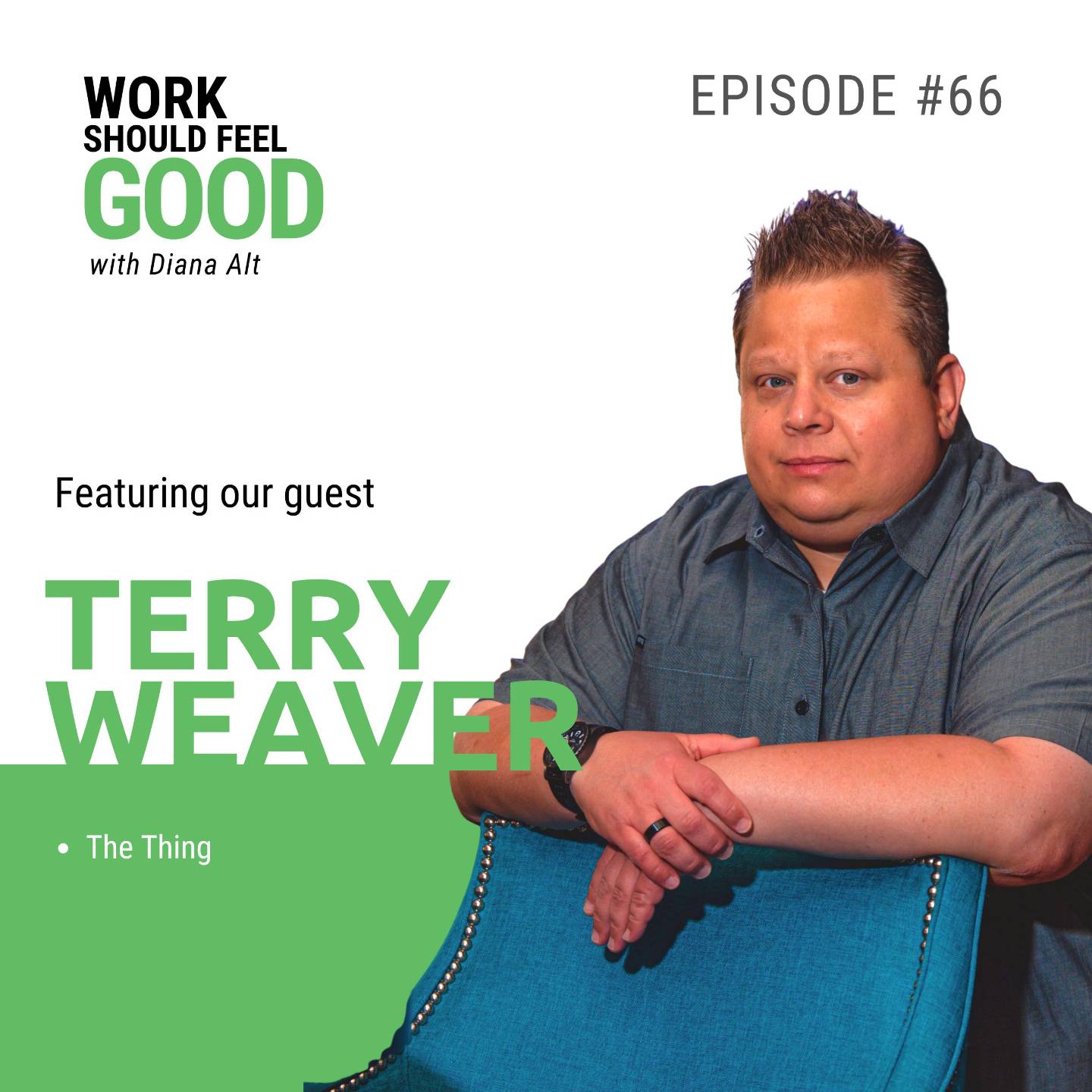
Episode 66: The Comeback That Changed Everything with Terry Weaver
Life has a way of interrupting even the best-laid plans. In this episode of Work Should Feel Good, Diana sits down with returning guest Terry Weaver to unpack the health crisis that nearly took his life during his annual conference and the lessons he learned while rebuilding his business and his priorities.
Together they explore what true resilience looks like, why community matters more than ever during difficult seasons, and how redefining success can lead to work that feels more meaningful than ever before.
You’ll learn:
- How Terry's battle with sepsis changed his approach to work and leadership
- Why building community is one of the greatest investments you'll ever make
- What it means to create a legacy through people instead of accomplishments
- How rest can become one of your most productive business strategies
- Practical lessons for rebuilding after an unexpected setback



Episode 66: The Comeback That Changed Everything with Terry Weaver
Episode Description
What happens when life completely derails the plan and forces you to rethink how you work, lead, and let other people help?
Terry Weaver returns to Work Should Feel Good to share how a sudden case of sepsis landed him in the ICU just as The Thing was beginning. Diana and Terry talk about the community that stepped in to keep the event going, his long recovery, and how the experience changed his thinking about rest, legacy, leadership, and building work that doesn’t depend entirely on you.
-
When your plans get derailed by a major life event
-
Building a community that can step up when you can’t
-
Making rest part of the work
-
Legacy, leadership, and letting other people help
-
Redesigning work around your strengths and energy
-
Choosing yourself instead of always choosing the safe path
⏳ Timestamps
00:00 Terry returns to Work Should Feel Good
02:28 When life changed in the middle of The Thing
05:47 Sepsis, septic shock, and the ICU
12:21 The community steps in
16:10 Rethinking legacy
20:59 The long road back
32:15 Redesigning work around energy and alignment
40:29 Why rest is part of the work
45:42 Letting other people lead
54:45 What does it take to pick yourself?
01:01:50 Why Terry doesn’t want to build alone anymore
💡Take Action
🔥 Subscribe for future episodes → https://www.youtube.com/@dianaalt
📖 Grab my Resume Don’ts Guide → https://www.dianaalt.com/resumedonts
❌ Avoid these common job search mistakes → https://www.jobsearchmistakes.com
🚪 Wondering if it’s time to walk away? → https://www.isittimetowalk.com
💼 Work with me → https://www.dianaalt.com
📢 Connect with Terry Weaver
🌐 Website → https://terryweaver.com/
🔗 LinkedIn → https://www.linkedin.com/in/terrytheweaver
📺 YouTube → https://www.youtube.com/terryweaver
📘 Facebook → https://facebook.com/terryweaver
📸 Instagram → https://www.instagram.com/terrytheweaver
📲 Follow Me On Social Media
LinkedIn → https://www.linkedin.com/in/dianakalt
YouTube → https://www.youtube.com/@dianaalt
Facebook → https://www.facebook.com/dianakalt
TikTok → https://www.tiktok.com/@thedianaalt
Transcript
Diana Alt [00:00:04]:
Hey, Diane Alt here, and this is Work Should Feel Good, the podcast where your career growth meets your real life. Each week I share stories, strategies, and mindset shifts to help you build a work life that works for you on your terms. Hey there, everybody, and welcome to Work Should Feel Good, the show where your career growth meets your real life. I'm Diana Alt, and today my friend and coach, Terry Weaver, is back on the show for a conversation about what happens when life turns everything upside down on you, AKA life is lifing, and the surprising lessons it can teach you about work, leadership, and community. Terry is a speaker, entrepreneur, and community builder who has spent many years helping people discover their thing and bring it to life. He's the founder of The Thing Conference, which I've been going to since 2020. I've only missed one, and it was because I was gonna have brain surgery a couple days later. And also the host of the Making Elephants Fly podcast and author of a book by the same name.
Diana Alt [00:01:13]:
They're a banger, if I do say so myself. Terry, welcome back to the show. You are only the second repeat guest.
Terry Weaver [00:01:21]:
Oh, who's the other one?
Diana Alt [00:01:23]:
Huh?
Terry Weaver [00:01:23]:
Who's the other one?
Diana Alt [00:01:24]:
Andrew Cowan.
Terry Weaver [00:01:26]:
In good company then.
Diana Alt [00:01:27]:
Yes, you are in good company.
Terry Weaver [00:01:28]:
I'm on team Angie.
Diana Alt [00:01:29]:
She was number 1, and then I said, hey, she should come back as number 50 whenever I had that earlier this year.
Terry Weaver [00:01:36]:
Yeah.
Diana Alt [00:01:36]:
So she's definitely a good egg. So the thing, we talked about the thing last time on episode, I forgot what it is, 24 or something like that. But I don't think our conversation is gonna be about that, although it may be centered a little bit around that because you had, you got lifed pretty hard in November of last year. Um, and I want to kind of walk through what happened and how that's impacted you and your family and your business. So how do you want to kick this off? I know you've talked about this on more than one podcast.
Terry Weaver [00:02:14]:
Yeah, and it's weird because I do actually think it's important to talk about. I'm trying to like not let it become my entire personality. Yeah, because when things happen to us sometimes That's a conversation everyone wants to have.
Diana Alt [00:02:28]:
Yeah.
Terry Weaver [00:02:28]:
I was in Orlando for the thing. We had done our VVIP day. We had done— the conference starts on Tuesday night. If you buy a VVIP ticket, you were part of that. We went to dinner, had a very nice dinner. We spent the day in the, in the presidential suite at the hotel doing hot seats. And then the next day, we went to the theme parks. about 3/4 way through the day, something started to feel off for me.
Terry Weaver [00:02:54]:
Um, and we were in Orlando, Florida, and I was starting to have the chills.
Diana Alt [00:03:00]:
And, uh, there's no time of year where you should have the chills in a theme park in Orlando, Florida.
Terry Weaver [00:03:05]:
It definitely wasn't. But we were like in a ride, and so I thought, well, maybe, maybe it's just real cold in this ride because that's when you were sweaty and you come in.
Diana Alt [00:03:12]:
Yeah, true.
Terry Weaver [00:03:13]:
And it wasn't, you know, November is kind of a nice time to be in Orlando, like It's highs in the 70s, 80s, not 207 degrees like it probably is right now when we're recording.
Diana Alt [00:03:21]:
Yeah.
Terry Weaver [00:03:23]:
But, um, something felt off, and it was kind of one of those things that's like I had some stuff to go do, so we left early. It was a fiasco getting me out of the park because I was clearly weak. And, um, it got to the point we got to the end of the park where I was like, let me just get a wheelchair. And you could— told my wife, you could push me out of here. Which, that could have been an entire, uh, that, that looked more like an SNL skit than anything. Um, we took the boat back to where we were because we had breakfast and then came straight to the park. So we— she nearly pushed me in the water.
Diana Alt [00:03:58]:
Oh no.
Terry Weaver [00:03:58]:
Uh, that was fun. Um, but we ended up at the next day, I, I was off through the whole night. I was having all kinds of issues. I was just not sleeping. And she's like, there's something really, really wrong. You need to go to the doctor. And of course I'm like, babe, our conference starts—
Diana Alt [00:04:16]:
1 PM.
Terry Weaver [00:04:17]:
You know, tomorrow, 1 PM. There's a 10 o'clock— people are like, people are expecting me downstairs. Um, and you know, I started to, I started to slip pretty fast, pretty quickly. Um, there are things I didn't even know that happened that she kind of shared with me. Um, It was like, ooh, yeah, no wonder you just made me go. Um, and, you know, I was just trying to power through it. And there was a point where it was like, it was clear there was no power. My body was literally powering down.
Terry Weaver [00:04:48]:
Um, and, you know, could barely walk. Something was off. So we went to— got to take a nice ride in the ambulance to a local hospital. And that, that stay was pretty quick. I was in and out of that hospital about 12 hours and moved. They almost moved me by a life flight. Um, well, it's part of the story I don't really tell.
Diana Alt [00:05:11]:
For, for a little bit of reference, Terry got pulled out into the ambulance at 10 o'clock and the event was scheduled to start at 1. And we'll get into that, but this— there was a lot of activity going on at the same time.
Terry Weaver [00:05:26]:
Well, the, the main room was being set up. We'd already loaded everything in.
Diana Alt [00:05:29]:
We'd already done the We had dozens of people in town to have a conference.
Terry Weaver [00:05:32]:
So yeah, we're, we're, we're actually just supposed to start— the pre-conference was supposed to start right at that moment. At 10 was when the pre-conference—
Diana Alt [00:05:41]:
Oh yeah, I guess that's right.
Terry Weaver [00:05:43]:
Um, that's where you—
Diana Alt [00:05:45]:
that immediately left my radar, right?
Terry Weaver [00:05:47]:
Uh, and they started like, I was in septic shock, I was in sepsis, uh, but they didn't know why. And they chased 473 things to figure out what it was. They thought I had gotten, um, something from swimming in the lake there, or pond. I was like, I haven't been in the water, I promise. Uh, but they, you know, they were, they were convinced. Um, they were convinced I had something called compartmental syndrome, which is what actually Lindsey Vonn had to deal with after her—
Diana Alt [00:06:19]:
Oh yeah.
Terry Weaver [00:06:20]:
Break after—
Diana Alt [00:06:21]:
I know people have had that.
Terry Weaver [00:06:23]:
It is not awesome. Yeah, that's like they cut parts of your leg out and stuff. They thought that's what I had. Turns out I just had the streptococcus virus, aka the same thing that gives you strep throat, inside my body, and it was just basically fighting every— all of my organs. Now granted, everything was kind of at high stress for me, and I think, you know, you look back on these things in retrospect and you kind of ask, okay, how do we get here, right? Like, how did this happen? Um, The hotel we, we were with last year was incredibly uncooperative. There was some turmoil, you know. I was in people's offices and they had their resumes up. You, you knew there was— you knew why they were stressing out on you because they were clearly under stress.
Terry Weaver [00:07:03]:
Um, and my stress just— I think my— I have a feeling that's something that had been in my body a while. My body was able to regulate it. My body was able to fight it, you know. Our bodies are pretty powerful things when they work well. Um, and I think just the stress of it all kind of came to a head on the Toy Story Mania ride at Hollywood Studios.
Diana Alt [00:07:24]:
Toy Story Mania.
Terry Weaver [00:07:25]:
And then I literally just turned around and walked out of the ride.
Diana Alt [00:07:27]:
I was like, wait, is that— okay, I only speak like remedial Disney. Is that the Slinky ride?
Terry Weaver [00:07:34]:
No, that's the ride where you like shoot little— like you pull a string and it like shoots plates.
Diana Alt [00:07:38]:
And oh, I haven't been on that one.
Terry Weaver [00:07:40]:
Yeah, it's fun. It's a little carnival. It's like a carnival game show.
Diana Alt [00:07:43]:
Okay, cool.
Terry Weaver [00:07:44]:
I'm pretty sure I've taken you on that ride.
Diana Alt [00:07:45]:
You just don't remember. Maybe I don't remember. We'll see.
Terry Weaver [00:07:49]:
Our Disney days. I drag people who— a lot of people I take to Disney are like Disney fan heads. And then there's like you who are like—
Diana Alt [00:07:55]:
I'm like, why am I here? Oh, I need a Dole Whip. I came for the Dole Whip. I'm sorry. That's my jam.
Terry Weaver [00:08:02]:
So they moved me to the other hospital in ICU. And quickly I was moved out thinking, yeah, we figured this out. Here's what you need. We're gonna load you up on antibiotics. Um, which, you know, I think half of what made the situation worse is all the stuff they were giving me.
Diana Alt [00:08:24]:
Yeah.
Terry Weaver [00:08:24]:
Between antibiotics and stool softeners, it took me a couple weeks just to get back to normal bodily functions again. Uh, don't recommend that. Did lose a lot of weight, so that was a good thing. Um, but you know, I had sepsis, and, um, which can kill you.
Diana Alt [00:08:42]:
If you watch any episode of like ER, Grey's Anatomy, any of it, like when randomly people die, it is often sepsis.
Terry Weaver [00:08:51]:
So I never, I never researched it that much because I knew how bad it was because I lived through it. Yeah, so I really didn't know that until I talked to Justin Shank.
Diana Alt [00:08:58]:
Yeah, I was gonna say Justin Shenk researched that for us.
Terry Weaver [00:09:02]:
Yeah, you like had like immediately you're like a 50% chance of survival, then like every hour from the time that you had your first symptom, you lose an hour, you, you lose a percentage. So it's like, he's like, you were probably at like a 73% chance of dying. I was like, A, I'm glad you researched that, and B, I'm glad you didn't call me. and tell me that. And like, I didn't have— Leslie had my phone. I think— I don't even think my phone was at the hospital for the first couple days.
Diana Alt [00:09:32]:
Yeah.
Terry Weaver [00:09:32]:
Um, just because let's focus on getting Terry better. Um, but quickly, quickly, once I started feeling better, um, because literally, you know, we have the best medical system in the world, but it's still not perfect. You know, I probably spent Now it took almost 10 days for my body, for my white blood cell count from the antibiotics, like from for that to be in the right place. Okay. Um, but most of those 10 days was just let's do this test, let's do this test, let's make sure it's not your lungs, let's make sure you don't have something going on in your intestines, let's make sure you don't have something going on in your kidneys, and let's scan your heart. And ever since I've been home They've done a lot of those tests again just to be like, you know, the ones they medicated me for coming out of the hospital, the doctors were like, let's check it again. And so I, you know, since then I've had every, you know—
Diana Alt [00:10:29]:
You took enough. So they, they basically had to, they had to try to get the infection under control and then see what the collateral damage was in terms of what's going on with your organs and how do you fix anything that's awry, right? And you've had enough pills that, like, if you picked up Terry and shook him, he would rattle.
Terry Weaver [00:10:51]:
Yeah. No, I'm, I'm, you know, I, I think, I think the American medical system, like, I think there's a magic number of, like, minimum pills that they want us all to be on by the time we're 50. And, you know, we have enough friends that are woo that you end up on a couple of supplements or two.
Diana Alt [00:11:10]:
So, um, between this, my over-the-counter vitamins, and, um, during your turmeric and some apple cider vinegar—
Terry Weaver [00:11:19]:
I've got my apple cider vinegar and I've got, uh—
Diana Alt [00:11:21]:
Oh, I was kidding, but I do take the— about the vinegar, but I do—
Terry Weaver [00:11:25]:
I do take the apple cider vinegar and I take the, uh— during COVID your cousin, I was like, okay, you're working through COVID in an ER and I was around people. It was about the same time we were going to do the thing. And I was like, what vitamins are you taking to keep your body well right now? And she's like, here, take this. And I was like— and I haven't stopped taking that since because I was like, you know, I've mostly stayed, you know, I've got a couple of glimpses of COVID but nothing really bad. So I'm like, I'm gonna— that, that advice worked. So it was like zinc.
Diana Alt [00:11:56]:
Yeah.
Terry Weaver [00:11:57]:
So I've got those things that I take and then just the normal like allergy pills, and then you add, you know, The, you know, blood pressure, you know, whatever, you know, whatever they start giving you. And they give you one and then they need to give you another. And then now you're calcium deficient. Now you need less, you know.
Diana Alt [00:12:14]:
Yeah. You know, you're taking medications to treat the medications.
Terry Weaver [00:12:18]:
To treat the medications.
Diana Alt [00:12:19]:
That are treating the medical condition.
Terry Weaver [00:12:21]:
That you no longer have. But, but, you know, a lot of gratitude just coming out of that, you know, that one, I survived. You know, it's a, a lot of us struggle with like, why are we here? What's our purpose? And we forget, we forget the good that we actually do. And it was, it was at the same time, and Dianna can tell you this side of the story, you know, my event went on without me, which is—
Diana Alt [00:12:49]:
Mm-hmm.
Terry Weaver [00:12:50]:
Maybe the coolest part of this story. Because that was one of the first questions I asked. Is, you know, what, what happened, you know?
Diana Alt [00:13:00]:
Yeah.
Terry Weaver [00:13:01]:
Oh yeah, Diana and Justin and—
Diana Alt [00:13:03]:
Yeah, we can go there. Um, so while Terry and his wife and assorted family members that came to town and friends that are local— Terry and Leslie live in Nashville, but we were in Orlando for the conference. They have a lot of friends down there too. But, um, 10 o'clock, Terry is carted out. And at the same time, like right there, there's a small group of us that are looking at each other going, what do we do now? And, um, Justin Schenk, who will be on the show soon, Angie Callan, who we mentioned earlier that's been on the show, Ryan and Mike Brennan, everybody's been on the show except Ian, and he's booked too. But this group of people just said, what are we going to do about this? Because you're in the, do we cancel the conference? Do we delay it and start? you know, pick it up on Saturday because we had no idea if this was Terry goes to the hospital and gets IV fluids and is all better by 10 o'clock the next morning, or if something else was going on. And we made the call, um, in part because Angie and Justin both had experience running events, um, that we needed to do it because you had basically made a commitment to people when they bought the ticket that there was going to be a conference. So we decided we were going to have a conference.
Diana Alt [00:14:25]:
And it was one of the most interesting leadership experiences we ever had, because we had 3 hours to run a VIP session, which another speaker was doing, fortunately. And then we had to figure out, how do we pivot for the slots that Terry and Leslie were speaking that day? Some of the information was on Terry's laptop that we didn't necessarily have access to, like different process things like that. But we, uh, we threw an event together, um, and it was really good and kind of a wild focusing experience for those of us that have been involved in this community for a long time, because it was clear we needed to do it. It was clear we wanted to do it. It was clear we had to make decisions really fast. And it also was clear there is not a single minute for bullshit ego shenanigans to be rearing its ugly head in the middle of this. So we just had to do the thing and check in with each other a couple times a day on what's the right thing for the next session.
Terry Weaver [00:15:34]:
How is this going to go on?
Diana Alt [00:15:35]:
How is this going? Um, the whole 9 yards.
Terry Weaver [00:15:39]:
So, and I do think as people were watching it from afar, people are like, wait, you're in the hospital and your event just happened. like without you? Like, yeah. Um, and one of the things you start talking, you know, I know you've been both, you've been both, you've been in both seats in the hospital room.
Diana Alt [00:16:01]:
Yes.
Terry Weaver [00:16:01]:
You've been the one in the bed and you've been the one on the chair going, what in the actual hell is going on right now? And what does this mean for my life?
Diana Alt [00:16:09]:
Correct.
Terry Weaver [00:16:10]:
Um, and You know, one of the things I begin to, I began to think about, and I've always, it's always been at the front of my mind, is legacy. And it was a really easy, it was a really easy thought process for me, because I'd had that thought process, and I've thought about the process. You know, one of the most uncomfortable things I've made my people do over the years is actually write their obituary.
Diana Alt [00:16:38]:
So 0 out of 10, do not recommend. It's not fun. It's, it's, it's— but also 10 out of 10.
Terry Weaver [00:16:47]:
The, the process is 0 out of 10, but the, the— because you've actually had to write your husband's obituary, so like you've had too much experience in that, you know. Yeah, I've had to write my father-in-law's obituary. Like, I— but a lot of us live life with zero intention, you know, and I really believe firmly in Stephen Covey's, you know, begin with the end in mind. And because I had done that, and because I knew what I wanted my life about, to be about, that I knew that I wanted my legacy to be in people, not things, I was actually able to see something, because I'm still here, that a lot of people, a lot of people, that will happen at their funeral, and they won't actually be there present for it.
Diana Alt [00:17:30]:
Yeah.
Terry Weaver [00:17:30]:
You guys, in a lot of ways, actually, what you were doing was was better than a funeral. Because you were showing like the impact that I'd had in your life, what you had learned from me. You, you knew that, you know, it sucked. Sure, you faced adversity of like, do we do this? Do we not do this? How do we do this? Like, and I knew I had zero ego about like, oh, they don't even need me anymore. They don't need me. Because I knew that wasn't the case. I knew that I was still needed. I knew I was still of value.
Terry Weaver [00:18:00]:
I knew, I knew the things that were not going to be the same without me in the room. But I knew that we could still deliver something. And I, I was able to really look back and see, man, this is what legacy is like. And as I build my life now, I want to create more things that look like— I want to restructure my life and my business and do some things I've been talking about doing since 2018, 2019 that I just haven't gotten around to. Because it's uncomfortable and like, it takes time and it's, you know, the technology's not always there to support some of the visions you want to do. But sometimes, sometimes you really have to realize that the legacy matters more than like getting it, the process right.
Diana Alt [00:18:41]:
Yeah.
Terry Weaver [00:18:43]:
That, you know, getting, sure, it'd be great if we could figure out the systems and get the back end of this figured out. But Sometimes you just have to do it and do it messy. And you guys definitely did that event messy. Like, as I looked at pictures there, you know, I'm sitting there going, oh, the dang— you know, the backdrop was backwards. But, you know, nobody comes to an event—
Diana Alt [00:19:03]:
I've never asked you about— like, for all the times that we talk, I've never asked you what you observed, um, as you went back and looked at pictures or video or things from that event.
Terry Weaver [00:19:14]:
So Yeah, that was, that was, that was one of the first things I noticed is like, why is the wrong— because we have a 2-sided backstage background that was wrong. And I, I think there was some stuff that the hotel was— I think there was a blue stage skirt, not a black one, that was supposed to be there. And that's a, that's an example of like, you know, you're working with the wrong people when they don't listen to what they say. They, they kind of just did what they wanted to do, not what I asked them to do.
Diana Alt [00:19:40]:
Yeah.
Terry Weaver [00:19:40]:
Which is a lot of times what happens when you work with, with people that are out of alignment for you is they— but you guys, you guys did all of the right things. I mean, the thing, the things that mattered, you know, nobody's, nobody's gonna write a complaint card about, um, a blue stage skirt, right?
Diana Alt [00:20:00]:
They will write a com— yeah, they will write a complaint card if you cancel one day of a 3-day event. Whenever they paid to come to a 3-day event, they will They will write a complaint card if everybody's running around like chickens with their head cut off, or they don't have the right communication and things like that.
Terry Weaver [00:20:22]:
So, um, I'm sure, and I'm, uh, I think everybody had a general understanding. I mean, I heard from so many people, um, and there was also a lot of people that I didn't hear from. Um, and obviously we don't always— I, I'm, I'm pretty public with my life, but there are some things I didn't share, you know, like there are struggles that we had during that time. And like, like the business is just now, you know, back where it, it needs to be.
Diana Alt [00:20:59]:
Yeah.
Terry Weaver [00:21:00]:
Like, you know, I was able to take a couple of months off without going to doctor's appointments rather than— there were times that I had 3 in a week.
Diana Alt [00:21:10]:
It's really hard too, because like I had surgery in August, August 1st of last year, and I knew I was going to have to be off. I had 3 months of medical leave, basically. I had been told 2, but my surgery got delayed and I was kind of strung out. So I didn't work that last month because I had to basically shut down a coaching practice. and figure out how I was going to handle all my clients. Um, and it takes a long time. Like, when you're in a corporate job, you file for your short-term disability, you leave before your surgery, you stay out as long as you need to stay out, you come back. You know, for people that have FMLA or, or bosses that don't suck, companies that don't suck, you walk back into your job.
Diana Alt [00:21:59]:
And your revenue, a.k.a. your paycheck, basically, if it takes a hit, it's like we're getting paid 2/3 of salary instead of full salary because that's what the short-term disability is. And for me, it took a year almost to get back to where my revenue was about where it was before the surgery.
Terry Weaver [00:22:24]:
So, you know, also my energy, one of the—
Diana Alt [00:22:27]:
True. That process for me was I feel like my energy came back 9 months in.
Terry Weaver [00:22:32]:
Yeah, mine, mine came back just right before we did the Think Nashville. I felt like I was— now granted, I still don't feel like I'm as good as I have been in the past. I'm better than I was before I went in the hospital, I'll tell you that. Um, yeah, and continuing to like get better and get healthier and pay more attention to those things.
Diana Alt [00:22:56]:
So one of the things I'm curious about is you're a very— you, you have protector vibes in general in your life. A little bit of it is that Enneagram 8, I'm going to take care of my people thing that you and I both have. But I have not seen very many times when you really had to let people help you, either in business or personally. Like you did after this whole sepsis knocked you out. Yeah. And it, it wasn't like a couple days, it's like still to a certain degree going on. What was the hardest thing for you about letting other people take care of you?
Terry Weaver [00:23:42]:
Oddly, I didn't really have another option, you know.
Diana Alt [00:23:48]:
I Did you find that— because clearly when you were in the hospital, that makes sense, but what about after you got out and, and you were like maybe a few weeks or a couple of months after you were out of the hospital? Was it difficult?
Terry Weaver [00:24:04]:
The beginning of Thanksgiving, right around Thanksgiving, before Thanksgiving, we knew, okay, let's not even try to fly back on Thanksgiving. Let's wait till Thanksgiving travels over and fly back a week later. So my good friend Logan has an Airbnb in Orlando, and we stayed there for like 10 days or a week. And that might be the best thing I've ever done in my life, of just like, you know, Leslie sat in the hot tub, I sat in a pool chair in the shade. Um, and other than getting up because that, uh, this— the stool softeners were still doing their job, um, for that week. Uh, thank you for sharing. Yeah, no, like, people like, what's the worst side effect? That I was like, that. So now if everybody says— if, if anybody offers that in the hospital for me to ever again, they're gonna probably have to Velcro me to a bed because like, like, you know.
Terry Weaver [00:25:02]:
And here's the deal, and here's like, I know like in a business professional setting that's like TMI, right? Like, but I want to be like transparent and honest as much. I mean, there's details I'm not going to share, but There's a couple things I can share because I want you to know that, like, I think people, people forget what the reality of, like, how it was. When I got, when I got out of the hospital, I had to use a walker. Super long.
Diana Alt [00:25:26]:
Yeah.
Terry Weaver [00:25:27]:
And our friend Linda, who actually has just, I think, just gotten out of the hospital with similar situation, right? Like, um, and I was actually, as I'm grabbing the walker, I'm thinking of, like, okay, If she could do it, I could do it. If she can power through, I can power through. That was literally, I mean, she was, she was inspiring to me. She's, you know, someone that's in our community that's significantly older than I am and has lived a lot of life, and she's still powering through and showing up. And so I needed a walker for about the first 10 days or so. When I came, we came back home, I used the chair rails to walk up the stairs without a walker. It was kind of the first set of stairs I've actually had to, had to use. other than like one step in and out of the house kind of thing.
Terry Weaver [00:26:14]:
Um, but I knew that like sleeping in my bed was going to be a problem because we have kind of a taller bed. So for that time that I was here, right until right before we left to go to Florida again to kind of do some sabbatical-ing and relaxing in a beach condo and to go like experience some things to kind of refill our, our mind and our spirit as well. Um, Like, I couldn't get my own bed for 6 weeks.
Diana Alt [00:26:40]:
Gosh.
Terry Weaver [00:26:41]:
Um, so there were some people like, I didn't hear from you during that time. And I'm like, I didn't have the energy to like physically get in and out of my bed. Like, I was on the couch because the couch, I could— I knew how— I knew how to get in and out of a lower— our couches, it's lower. So, you know, we had a, you know, a special mattress pad and like we bought one of those, uh foam mattress protectors and memory foam things to cut that, you know, we went X-Acto knife on that sucker. Um, because one of the worst side effects out of the hospital for me with my tailbone sitting on my, you know, the weight of my body on my butt in the hospital.
Diana Alt [00:27:20]:
Um, for days and days and days.
Terry Weaver [00:27:22]:
You know, I didn't, I didn't get out of bed for 10+ days. I was like, some people did everything for me. Um, And so like my body was fighting, but that bed was fighting against my body. That bed gave me wounds. That bed took my strength. Um, now they had upgraded me to like kind of a new robotic kind of bed, so they kind of moved so I didn't get— so it lessened some of that. But still, my, you know, sitting was painful. In fact, we had to buy me another chair because I wanted to get off the couch.
Terry Weaver [00:27:58]:
And we, we cut up a piece of that mattress pad from the— that we bought on Amazon and put it in the chair, right? So everything was padded, so there was nowhere that there wasn't. I mean, I had my own padding, but I needed more. Um, and so like a lot of that season was really hard just physically.
Diana Alt [00:28:16]:
Um, what was so interesting to me is How it took, you know, 2 weeks in the hospital and another week or 2 in Orlando, and then 6 weeks where you're sleeping on the bed and like all that stuff. But it was not very far into it that your brain lit up.
Terry Weaver [00:28:34]:
Oh, absolutely.
Diana Alt [00:28:35]:
And suddenly strategies and plans and things were just pouring out of you, which was kind of funny because—
Terry Weaver [00:28:44]:
Well, because I— you guys had just finished.
Diana Alt [00:28:46]:
We were just like I'm exhausted. I just ran your event. Also, our friend was sick. What are we doing? Yeah, what? Stop it. Stop planning the next event whenever we're not recovered from the first event.
Terry Weaver [00:28:59]:
They wanted to get me out of the hospital because I approached it with a lot of humor. You know, we're in, we're in the— it's one of my favorite stories to tell. We're in the— I'm in the ICU. And, you know, most of your nurses in the hospital are normally in the rotation are only female, well, younger female. That's, you know, as a guy, it's kind of a weird thing. But one of— this one guy was like a big— like, he looked like he would have been in like a '90s buddy comedy, you know, like big Jamaican dude, like—
Diana Alt [00:29:29]:
Oh man, priceless.
Terry Weaver [00:29:31]:
Yeah, like, you know, it's, you know, it's 5:30, they've gotten me up in the morning, and if you know me, I'm not up at 5:30 in the morning for any reason. Um, And I'm laughing about it. I was like, well, you know, there are a lot of people that would pay good money to have a sponge bath from a Jamaican at 5:30 in the morning because they didn't want to pass you on. The shift changed at 7, right? So they wanted— they didn't want, you know, literally to pass your shiz onto the next person.
Diana Alt [00:29:58]:
Yeah.
Terry Weaver [00:29:59]:
So it was his responsibility during his shift, and I slept most of it because I was right about when I was starting to kind of like And yeah, my mind did come alive. Like, I started to get— because I hadn't— I had nothing else to do.
Diana Alt [00:30:12]:
Um, I experienced the same thing whenever I was about a month into my— well, like 3 to 4 weeks after my surgery. My brain started firing on all cylinders, but my body was like, can we do more Netflix now? So, um, they've kind of fought with each other for a few weeks until I started coming out of the strength. It's, it's wild. And, um, as a person who— I live in my brain more than I live in my body. Like, I've never been sporty, not into that kind of stuff. I don't have that same kind of mind-body connection that a lot of athletes and things have. And so to actually have to pay attention to what my body could carry me to do was very interesting. And you had an even more debilitating situation because I wasn't in a hospital for 10 days unable to leave the bed.
Diana Alt [00:31:10]:
You were. So I wanna—
Terry Weaver [00:31:12]:
I was in ICU for 10 days.
Diana Alt [00:31:14]:
Yeah, that's a lot.
Terry Weaver [00:31:16]:
Like, my, my strength was, you know, like going up and down stairs required like me to grab onto something to pull me up.
Diana Alt [00:31:25]:
Yeah.
Terry Weaver [00:31:25]:
Um, like I wasn't walking the dog with Leslie until we got back from Florida.
Diana Alt [00:31:34]:
Oof.
Terry Weaver [00:31:34]:
So when we went to Florida, and you actually, you and Ryan and some other friends of ours met us down there, I actually had about 10 days to just— she sat on the balcony, looked at the ocean, and I sat on the couch, put my feet up and relaxed. And that was kind of the moment where I like, like physically, like I started to get it back. My energy was still— what's interesting, Diana, is like I found that like for during this season that people recharged my energy and not necessarily tasks. And so I've had, I had to learn to kind of shift. And most of my work I do is in, in and with people.
Diana Alt [00:32:12]:
Yeah. You've designed your work that way.
Terry Weaver [00:32:15]:
Yeah. And so as I'm coming out of this, I'm also thinking of designing, like, I also want more of, more of that, right? Like, I don't want I don't want to go back and, I don't want to go back and create more life that exists outside of more work that's not, you know, we talk a lot about alignment, you know, and for me, I know, I know my mind is the best deliverable I can give you. Yeah.
Diana Alt [00:32:54]:
Like, and it's, it's really interesting when you realize that, because I've been thinking about that a lot lately too. Um, the degree to which there's, there's so much that people love to talk about passive income, have the digital product, have the e-commerce store that sells itself, or you throw ad money behind or whatever. But the thing that I am the best at is figuring out what the right problem is, which means the deliverable ends up being my brain. And you're very much the same. You always say you draw maps.
Terry Weaver [00:33:29]:
Yeah. So, well, I, you know, but I'm also realized in this process, like you did, that I do need to have products.
Diana Alt [00:33:38]:
Yeah.
Terry Weaver [00:33:38]:
That work on my behalf when I'm not working.
Diana Alt [00:33:41]:
Yeah.
Terry Weaver [00:33:42]:
Um, and so I'm in the process of building a community, something I've been literally legitimately talking about doing since the logo is hung in my office since 2020. I think the sign for the brand came when you were at my house in 2020.
Diana Alt [00:33:58]:
Yeah.
Terry Weaver [00:33:59]:
For a VIP day. And—
Diana Alt [00:34:03]:
So let's, let's kind of go into this because one of the things, one of the things that I find really interesting when you have a major life thing, whether it's a health thing or Somebody has a baby or, you know, whatever it is that really makes you go, whoa, things are different now. Like, I need to kind of pull myself out of this. You get pulled out of the status quo. What are some things that are really different in your mindset about how to approach your work and your relationships with people? And what are some things that are still the same? After this harrowing situation you went through?
Terry Weaver [00:34:48]:
Well, for one, my tolerance for BS is pretty— it, it's gone from 0 to like -272. Right? Like, I never, I never have really wanted to deal with people's nonsense, right? Like, and so, you know, one of the unfortunate parts of like coaching people and doing consulting Our buddy Rachel Pierce and I were even talking about this the other day, that, you know, a lot of times consulting sometimes looks like you're arguing with people. You're trying to convince people to do something. And I'm just not doing that anymore. I'm not like—
Diana Alt [00:35:25]:
I can't want this for you more than you want it.
Terry Weaver [00:35:27]:
Yeah, and I've always, I've always—
Diana Alt [00:35:29]:
Is the thing you say a lot.
Terry Weaver [00:35:30]:
Yeah. I can't, I can't want this for you more than you want it for you. And I have a, you know, you talk about my ability to, you we talk, you and I talk a lot about, about maps. You know, I have an ability to see the potential that I think people could reach, right? When I see somebody, I see their gifts; I see their collective talents that they have, whether it's, you know, strategy or communication or writing or, you know, a lot of people have a mix of all of those 3, right?
Diana Alt [00:36:00]:
Yeah.
Terry Weaver [00:36:00]:
And, you know, I see the potential for them to, you know, impact a lot of people, but a lot of times they don't. And I, I find myself, you know, like, I always go back to that moment. Like, I was, you know, you and I are about our similar ages, you know, and we were, we were kind of the generation that, like, our parents dropped us off at the mall, and the mall had, like, a food court and, like, a movie theater.
Diana Alt [00:36:28]:
And a slice at the Sbarro, and you had to go to Orange Julius.
Terry Weaver [00:36:32]:
Orange Julius and Sbarro, like There was a— you, your parents could leave you at the mall and like the mall was just took care of your babysitter. Yeah, like we were, we're Gen Xers, so like we were feral. We were running around the mall. Um, you know, ours had a Bennigan's. That was kind of our like go-to place back in the day, rocking that Monte Cristo sandwich, which apparently it's making a comeback. Um, but there's always a map when you go to the mall that says you are here. There's a big giant sign on the map that says that. And, you know, one of the first things I like to do with people is like, let's assess where we are.
Terry Weaver [00:37:12]:
Because a lot of times, and you do that work with people with a career, like, we can't get you anywhere if we don't know where you're at on this map.
Diana Alt [00:37:19]:
Also, I need to plug an address into the GPS.
Terry Weaver [00:37:22]:
Right. And the next thing we've got to know is figure out where you're, right, like, you've got to know where you're going. You've got to know where you want to go. And it's not— and sometimes, sometimes the map can get really specific, right? Like you need to turn, you know, like GPS level, right?
Diana Alt [00:37:40]:
Yeah.
Terry Weaver [00:37:41]:
But in reality, most of the time us drawing— me— us drawing maps is go, you know, if you ever get like directions from a good old boy in this— in a farm community, they're like, you go down to the Jones's Red Barn and hang a left. And I'll be at that gas station and you meet me there, right? Like, yeah, that's kind of what—
Diana Alt [00:38:00]:
It's the one past the oak tree that had the lightning strike.
Terry Weaver [00:38:06]:
Yeah, you'll see it.
Diana Alt [00:38:06]:
Not the one, not the other one. Yeah.
Terry Weaver [00:38:10]:
And, uh, and a lot of it is just a series of next best steps, right? Like a series of like, you need to go, this is where you are, and you need to go to these next places. And so You know, I'm using those same skills and kind of building back what I want. I, I have this effect on people, Dianna, and I know you've, you've, you've caught wind of this, being around it enough, that I have a lot of people that I work with that end up wanting to tear it all down. Because they've come to me and they've built something and they realized, this is not what I wanted to build.
Diana Alt [00:38:48]:
Yeah.
Terry Weaver [00:38:50]:
You deal with that with people who come to you with their careers and like, I went to college for this, I planned my whole path, this was the plan, and I got here and it's not where I wanted to go.
Diana Alt [00:39:02]:
I see that a lot. And I also see people have a lot of difficulty letting go of that plan. Like, you're a lot more likely to hear someone say, I want to burn it all down, than I am to hear someone say, That they want to make a major, major, major shift because there's the— a lot of my clients are more beholden to the gold watch or the what they say I should do than entrepreneurs by nature are. So, but yeah, it's a, it's a thing in our— there's just different versions of it and different degrees of it that you and I deal with, with our people. So, um, you, you know, I remember whenever you, whenever you were getting out of the hospital, I remember thinking, well, you gotta— you have an event on the books in June. How in the hell are you going to do that? Um, because when we were researching about sepsis, we figured out, oh, um, this could take 12 to 18 months to be back in action. And yet you threw an event in June and it was arguably one of the best ones that you've ever done. What do you think made that happen? Because it was, it was damn good.
Terry Weaver [00:40:29]:
I think a couple of things. One, like you said, my mind was working well, right? And so I've learned to work from the couch, Diana. Like, part of it, I've had to have my feet up a lot.
Diana Alt [00:40:46]:
And so—
Terry Weaver [00:40:46]:
Yeah. Because I was dealing with some just like water retention and swelling from all of that. And like, thank God that stuff's kind of back under control. And like, but I learned, I learned through this process That rest might be the most important part of our work.
Diana Alt [00:41:07]:
Yes.
Terry Weaver [00:41:09]:
And I've even changed how I end my day now. I used to just work, work, work, work, work, shut the laptop and go to bed. Well, turns out that's a bad way to get sleep.
Diana Alt [00:41:20]:
For sure.
Terry Weaver [00:41:20]:
Because then you get to bed, and I still, I still get to bed and my mind's on fire, right? Don't get me, I mean, I, I put 3 or 4 things in my talk for November. I had 3 or 4 ideas walking down the stairs from upstairs to go to bed last night. I was like, daggone it! Let me get them, let me get them out of my head and get a—
Diana Alt [00:41:42]:
Yes.
Terry Weaver [00:41:42]:
Let me, let me let chat handle these until I get back to them tomorrow. And so I've shifted a lot of things like that in my life. And so that's, that's paid dividends, right? Obviously, I had the help of community, you and Ryan and a few others in different ways, much smaller ways. But you and Ryan definitely stepped up in really big ways to help and to serve. And you kind of knew my weaknesses as well. I'm good at a lot of things. There's a lot of things I'm, I'm not good at. And, you know, I tend to not be The king of systems.
Terry Weaver [00:42:23]:
Um, just because I try to run like a simple business, like that's kind of my, um, that's kind of my process. And I, you know, I, I tend to— it's funny, I've learned a lot by being on my HOA board. which I'm not sure why I said yes except for charity. People basically said, hey, if you don't run, we're going to nominate you and we're going to get you enough votes and you're going to have to do it. I was like, sweet, you know, uh, I'll do it. And what nobody tells you is you can't— is that once you, once you, you have this big meeting and everybody gets on the HOA and then you have to like rerun, what they, what they don't tell you is no one's going to ever show up for those meetings.
Diana Alt [00:43:12]:
Right.
Terry Weaver [00:43:12]:
So technically you're on the board until you basically quit. Right.
Diana Alt [00:43:16]:
And then my mom did that. She was the secretary treasurer of her HOA board for 1 billion years.
Terry Weaver [00:43:23]:
Yeah, I think that's technically my title. We all just— we all— there's no hierarchy.
Diana Alt [00:43:29]:
Yeah.
Terry Weaver [00:43:29]:
One of the things I've learned, and this is really, really interesting, is we have to hire vendors to do things, right?
Diana Alt [00:43:36]:
Yeah.
Terry Weaver [00:43:37]:
And some of them are like the good old boy that power washes stuff.
Diana Alt [00:43:40]:
Yes.
Terry Weaver [00:43:41]:
But a lot of them are like multi-million dollar landscaping companies.
Diana Alt [00:43:46]:
Yes.
Terry Weaver [00:43:47]:
For our HOA, I think our landscaping contract is like $92,000 a year. That's a lot of grass mowing.
Diana Alt [00:43:54]:
Yeah.
Terry Weaver [00:43:55]:
Um, but we're a neighborhood of like 600 homes, so—
Diana Alt [00:43:57]:
Yeah, you have a pretty big neighborhood.
Terry Weaver [00:44:00]:
You know, but they, you know, they've got all the common areas and they gotta, you know, put the flowers in the beds at the beginning and Make sure all that's done right. And so, but for the most part, most of these companies, almost every vendor we have is awful. They require a great deal of babysitting. And, you know, one of the things you got to learn, whether you wanted to or not, is that so do people that speak at events. Yeah.
Diana Alt [00:44:30]:
So for—
Terry Weaver [00:44:30]:
Adulting isn't something Yeah. That we all do very well. And so, like, my kind of way of dealing with it is just like, I'm not gonna babysit you. If I have to babysit you, we won't be friends. And so you signed up to help with that process, and you've actually made that a much richer process and more— I'm not insinuating at all that you were a babysitter. That was, that was the last thing you did. You set up systems and processes and help create an experience so that those people felt cared for and loved for, loved for. And because I'm one of those people that like when I ask, when I, my process, you know this because you've had to live through it, is I ask you to speak at the thing and I'm like, hey, can you speak at the thing? I'd love you to do this.
Terry Weaver [00:45:17]:
And you say, yeah, I'm gonna speak on this. That's cool. And I go, sweet, bro. Here are the dates. Here's the link to book your hotel room. We'll see you in Orlando. You're an adult. I, I had to do, I had to do those things, so I just assumed you could.
Terry Weaver [00:45:31]:
It turns out a lot of people can't. Um, it turns out a lot of people can't even read an email, as we had to learn the hard way. Yeah, yeah.
Diana Alt [00:45:42]:
So to catch everybody up, because I, we kind of skipped over this part, so Terry mentioned that Ryan and I had helped a lot with things for the June event and we're helping for the Nashville event, which you guys, if you are contemplating a thing, if you're already building a thing, whether it's full-time or on the side, this is one of the most interesting blends of inspiration, but also teaching practical things of any conference that I've been to. It's why I keep going to it and why I'm on the stage whenever Terry invites me to be. But Ryan managed all the tech and systems. On the backend, including completely ripping out like the registration system, the checkout system, the affiliate system, like a bunch of stuff that the average user doesn't think about whenever they sign up for a ticket. And then I, um, I worked with the speakers during the event in November, whenever, you know, somebody had to cat herd the speakers, especially the ones that were new and didn't know anybody, anybody, we had to take care of them. And I ended up taking responsibility for that, um, for the 2026 events. Um, and it is interesting to see the different mindsets that people have about working with, um, an event team and what it's like for 3 stubborn people, because Terry and I are stubborn and Ryan is stubborn in his own way. trying to make the thing work.
Diana Alt [00:47:17]:
But the mission is let's have a killer event. So we aligned on that mission. One question I have for you is, in the past, like, because of your strong belief that people should just be freaking adults, um, it wasn't just that you're not as strong at systems and processes, it was that you almost were like, I'm gonna be a little bit of the anti-event guy. Like it was almost on principle that some of the things you weren't doing because you believe people should be adults. And I gave you the information and you changed your tune on that and you really embraced it, which there are people in the world that would be surprised to hear that out of Terry Weaver. What made the difference?
Terry Weaver [00:48:04]:
I, I let people do what— if I'm going to— if you're going to come alongside me and do something, I don't want— I don't want to have to babysit you either. So if you say you want to do something, I'm gonna let you do it. If you have a— now, if I start to see where there are things I stood with on principle—
Diana Alt [00:48:25]:
Mm-hmm.
Terry Weaver [00:48:27]:
We do something that annoys the snot out of a lot of people, that we don't release the schedule in Mass. We have the different degrees. You know when a session is, but you don't always know what—
Diana Alt [00:48:42]:
You don't know that John Doe is going to be from 10 to 10:45 AM on the second day of the conference exactly. No, not even John Doe knows that.
Terry Weaver [00:48:52]:
Yeah, and we've, we've, we've done that in the past, but here's the unfor— the side effect of doing that is what happens is people will write somebody off And think, I don't need that in my business right now. And had they done that, they'd have missed out on someone that could have really— you know, ego is the thing that actually is keeping most people from succeeding. Yes. I heard somebody say that they didn't— they, they didn't— the table they sat at one day, they didn't get any connections. I was like, well, the other 2 people have done 6 figures of business together. What were you doing?
Diana Alt [00:49:32]:
Right.
Terry Weaver [00:49:32]:
Right? Like, and that's not to say that everybody's gonna get that experience. I mean, our, our, our friend Anik Singal would want me to tell you that, that these results aren't typical, right?
Diana Alt [00:49:45]:
Yeah.
Terry Weaver [00:49:45]:
Um, but people are gonna win. And, you know, one of the things that I loved about the U.S. Soccer's run that didn't turn out so well for the World Cup is, why not us? You know, why can't you be the one that goes to the event and like changes your life?
Diana Alt [00:50:04]:
Yeah.
Terry Weaver [00:50:04]:
And, um, you know, I want to be, I want to be that person. I want to be, I want to be the event that looks different. And yeah, we've, we've made some weird decisions. Um, we've made some unpopular decisions, but I've also embraced I've embraced letting it be. I know, I mean, we've been doing this 10 years. That's a long time to do one specific thing. Um, and so, um, a lot has changed in the world in 10 years.
Diana Alt [00:50:43]:
Yeah.
Terry Weaver [00:50:43]:
Um, We're a lot more adversarial toward each other. Um, the world's a lot noisier than it was 10 years ago. Um, people are more busy. There's more things calling for our attention than ever before, but also at the same time less, right? Like, you know, from a media perspective, there was, you know, 10 years ago there was You know, one, one or two social media platforms, and now there's more than we could ever count. Yeah, um, for sure.
Diana Alt [00:51:23]:
So one thing I would say is that I noticed is you— that thing that you have historically had where sometimes— and that you don't want to do anymore, like that You've acknowledged I can't believe in you more than you believe in yourself, but there was a time where you did spend a lot of your energy on that. And something I've noticed in you over the last couple years, but really in the last 7 months since the great sepsis incident of 2025, is that you are, um, not letting the people that didn't believe in themselves and didn't trust you and didn't fulfill whatever they said that they were going to do for you or themselves be a distraction. Now you're looking for the people that are going to do the thing, are going to say they're going to do the thing, and then prove that they're going to do the thing. And it earned— it earns you more of a say, more of a deeper connection in the community. I feel more connected to this group of people I've been part of since 2019 than I did 8 months ago.
Terry Weaver [00:52:36]:
I can only serve the people in front of me.
Diana Alt [00:52:41]:
Yeah.
Terry Weaver [00:52:43]:
You know, a lot of times we look almost with like— a lot of times the people that aren't there are distracting. Um, And there's always, there's always people who bought a ticket that didn't show up that I'm just like, how, how, how did that happen? Like, what in your— what, um, what made that process work? You bought a ticket, you didn't get on a plane. Or there are people who lived in Nashville that didn't come who bought tickets. Now, they had some life things happen, I found out.
Diana Alt [00:53:19]:
But, um, I missed a, I missed a conference that I bought a ticket for. Um, in June, but it was because I had too many things get stacked up and, and it was a $100 ticket and I decided that I needed to do something in my business. But don't make that a regular practice.
Terry Weaver [00:53:37]:
So, but a lot of people do. A lot of people, they do the same thing with coaching programs.
Diana Alt [00:53:44]:
Yeah.
Terry Weaver [00:53:45]:
Or they show up poorly. But, you know, I, yeah, I've had to shift. I care deeply about the work that I do. And one of the most dangerous things is I care about humans, right? Like, and I really struggle with people who— I hurt for the people that I can't help. Yeah, but I've had to put that on them, not on me.
Diana Alt [00:54:13]:
That's a change that I've been making in myself too, because I will make myself absolutely crazy if I don't.
Terry Weaver [00:54:20]:
I could, I could worry myself literally sick, and I might have, right, over people who aren't showing up.
Diana Alt [00:54:28]:
Yeah.
Terry Weaver [00:54:28]:
And so the reality is, I have to understand, it's not that they're not showing up for me. It's not that they're not showing up for the community. They're not showing up for themselves.
Diana Alt [00:54:38]:
Yeah.
Terry Weaver [00:54:39]:
And I can't fix that for them. Yeah.
Diana Alt [00:54:45]:
One question I often ask my coaching clients is, what is it going to take to get you to pick yourself?
Terry Weaver [00:54:52]:
Yeah. Oh yeah.
Diana Alt [00:54:53]:
Because so often people are picking their boss or their spouse. And I'm not saying don't pick your spouse, but like, if you are constantly picking everybody else over your own needs, you can't be a good partner or a good father or mother. sister, friend, you just can't do it. So I ask that question a lot.
Terry Weaver [00:55:15]:
So that talk that I did in 2019, which was before you were around at the thing LA, it was the last— it was actually, no, it's 2018 was when we did that— was going all in on you. You know, what would it look like if you put all the chips on the table and believed in yourself?
Diana Alt [00:55:33]:
Um, funny story, that You released as a podcast episode.
Terry Weaver [00:55:38]:
I did.
Diana Alt [00:55:39]:
And it was one of the things— so I met Terry because he was on my friend Scott's podcast, and I was like, ooh, I like what this guy has to say. So I started listening to his podcast and following him on social media and heard about his event. And then the 2 of the biggest things that made me decide I wanted to sign up for the thing when I hadn't even met anybody in person Or number one, a podcast episode you did with David Dollar, Aurora Gregory, and Chad Pennycoff, where they talked about their experience going to the thing. And they said that— I can't remember, they all kind of agreed with this, but one of the things that was said is it was the conference that you go to and you feel like you have legitimate connections with pretty much everybody that you met, instead of maybe you'll talk to one or two of the people that you met in the future. And then the other one is that you had released that talk from The Thing LA as a podcast episode, and I was like, let's do that. So the combination of that and some other things made me buy a VVIP ticket before I'd ever technically met you. So if you guys are wondering about The Thing, you can go to thethingorlando.com, um, and see more information, see what the ticket levels are, the dates for 2026 are. November 13th through the 15th for the main thing.
Diana Alt [00:57:05]:
Is that right?
Terry Weaver [00:57:06]:
That's the main thing.
Diana Alt [00:57:06]:
Um, and it's in Orlando, uh, at a Hyatt Place. So it's not like a ridiculously insanely expensive Disney resort kind of situation. If you decide to sign up, if you want to talk to either of us about it, all of our social handles will be in the show notes and you should definitely use the code I'm with Diana. And get a little extra discount, um, on your ticket for listening to the show. Um, one thing I actually—
Terry Weaver [00:57:35]:
that's another shift I've made. What I used to try to sell the event by discounting the snot out of it.
Diana Alt [00:57:41]:
Yeah, and I'm not doing that very much this year.
Terry Weaver [00:57:43]:
I'm not doing that as much because I've already— I've priced it fair.
Diana Alt [00:57:48]:
Yeah. Um, that's not to say that, you know, I don't offer There might not be a flash sale here and there, but yeah.
Terry Weaver [00:57:57]:
But I don't feel the need. What I've actually found with flash sales is the people that buy it were the people that were going to come anyways, they just hadn't bought, and that motivated them to buy it.
Diana Alt [00:58:09]:
Yeah.
Terry Weaver [00:58:10]:
So it actually cost me money. And a lot, and a lot of that comes down to like, you know, I know you have a lot of career-driven people, people who are, you know, not necessarily Or people who were thinking about, you know, who were starting to build side hustles. Um, I'm actually beginning to think less about side hustles and more about side quests, and more about like, what do you can— what can you possibly start doing?
Diana Alt [00:58:37]:
I love the— you know, the best thing about the World Cup is all the side quests. I haven't watched a single soccer game, not one. But I have watched all of the side quests that all of the people have been doing on social media.
Terry Weaver [00:58:52]:
Yeah, and they've all been amazing. And what's interesting about all of those, um, side quests is they've all been about— they've all been about people connecting with people.
Diana Alt [00:59:03]:
Yes.
Terry Weaver [00:59:04]:
Um, I can't stop watching random Brits ending up at a farm to hang out with cows in Texas.
Diana Alt [00:59:12]:
Oh, I didn't see that.
Terry Weaver [00:59:14]:
Oh yeah, the Brits and the Scots have been the ones that— and a couple of the Germans.
Diana Alt [00:59:18]:
Um, I've been watching people experience Burn Ends for the first time. Yes, because Kansas City, where I'm at, is one of the headquarters cities in the, in the U.S., and we've had 4 teams headquartered here, um, including some that wouldn't know a Burn End if it smacked them in the face, but they had to go try them.
Terry Weaver [00:59:41]:
And you've had— you had games actually in Kansas City.
Diana Alt [00:59:44]:
Yeah, we did. I think our last game is tomorrow night.
Terry Weaver [00:59:49]:
So yeah, um, we're running out of— we're running out of games that aren't in New York or LA. But yeah, um, we're getting towards the end of this thing. And that— and that's actually interesting, right? It's like, what happens when people— you know, our friend Ian actually went to the World Cup because he's like, when am I gonna get to go? And I've always wanted to go. And a lot of, a lot of what happens is like, when you think about going to a conference, or when you think about hiring a career coach, is when you finally say, you know, enough of choosing everyone else.
Diana Alt [01:00:23]:
Yeah.
Terry Weaver [01:00:24]:
Enough of following this safe path. And I'm going to start, I'm going to start picking myself and actually start doing things that actually help me get where I want to go.
Diana Alt [01:00:34]:
Because You know, well, the idea of doing this stuff by yourself or doing it by yourself with your friend Claude or doing it by yourself, but with the 14th $97 masterclass that you bought from somebody like that is— that's actually not a flex and it's not saving people as much money and time as they think. Because they're not learning from the collective wisdom of multiple people. And they don't have someone to help pick them up in the days that they want to quit.
Terry Weaver [01:01:14]:
Yeah, I had a coach tell me one time, you know, hey, I've been to the thing. The problem is, is you've set, you've set the place up where you're not the smartest. You're not the solution to everyone's problems.
Diana Alt [01:01:28]:
I don't ever want to be the solution.
Terry Weaver [01:01:30]:
I don't want to be the solution to everyone's problems. I'm okay with you hiring Diana instead of me, right? Yeah. Like, now, funny enough, I love collaborating with a lot of my people. I will co-coach and we'll tag team on somebody together, um, because that's fun.
Diana Alt [01:01:48]:
Yeah.
Terry Weaver [01:01:50]:
And I'm actually, you know, when you ask one of the things I'm thinking about as I continue my business and shift and change I'm not interested in doing anything alone anymore.
Diana Alt [01:02:03]:
I feel that. Um, I won't say I don't want to do anything alone because I do like to do some, but I've been—
Terry Weaver [01:02:09]:
I'm going to write a book and I'm going to still do— yeah, I'm not—
Diana Alt [01:02:13]:
I've been doing a lot more to do alone, as I guess. I, I see what you mean. I've been doing more collaborations lately, just even for lead gen. Yesterday I started a series that I've been calling Reality Check. Where we just kind of tackle mistakes, and it's not my death by PowerPoint. It's basically I go find a guest expert or two. We pick something that people are tripping up on. We spend 15 to 20 minutes sharing our perspective as experts, and then we open up for Q&A.
Diana Alt [01:02:43]:
Microsoft has nothing to do— Microsoft PowerPoint has nothing to do with that, but we have a lot of fun, and we're able to help a lot of people. That's, that's the kind, that's the kind of thing that I'm really enjoying doing right now.
Terry Weaver [01:02:56]:
Yeah, just because it's, it's a lot of it is like, this sounds so weird, but is this worth not doing nothing?
Diana Alt [01:03:11]:
Do that again.
Terry Weaver [01:03:12]:
Is this worth not doing nothing? I know it's a lot of stuff like this, right? But is this worth me actually— I can watch the next episode of The Mandalorian. Oh yeah, I got you. Ted Lasso's got a new season coming out. It's time to punk her up.
Diana Alt [01:03:25]:
Like, it's time to rewatch, right?
Terry Weaver [01:03:29]:
I've got to rewatch a little bit, right? In fact, I'm one of those weirdos that didn't finish because I didn't want Ted to leave. And so I never— my way of not dealing with Ted leaving is I just didn't watch the last 3 or 4 episodes of the last season. But But, you know, I— we have, you know, what, even the term side hustle now kind of makes me cringe a little bit when I say it out loud because it's like, I don't want to hustle for anything.
Diana Alt [01:03:56]:
Yeah.
Terry Weaver [01:03:56]:
I only want to do work, you know. You're— I love the work should feel good. I know people that bust some— some like smarter people have said that's not good, you know. But man, it's— it resonates with me that I don't want work to not feel good. I don't want to do anything that I, you know, it's, it's very interesting.
Diana Alt [01:04:17]:
Um, when I first came up with that phrase, it was because I'd made a Facebook page and I was like, shit, I need a graphic on the top of this. And I didn't know what I was doing. And I found something and played with Canva for literally the first time. And I was like, I gotta write something at the top. And I wrote work should feel good. And I didn't even know what it meant. I knew it wasn't I knew it as an ethos. And it took 5 years to figure out what that was actually going to be for.
Diana Alt [01:04:44]:
And it turned out to be the podcast. So we could go all day, but we're not going to. I have 2 questions I want to wrap with. The first one is, what is something that you have either delegated or just entirely stopped doing in your business that's a little more concrete than I'm not dealing with BS, that you're just never going to take back? What's something you figured out, this is not worth my time anymore?
Terry Weaver [01:05:22]:
Um, I think it really comes down to the chasing people who don't want to be helped.
Diana Alt [01:05:30]:
Okay.
Terry Weaver [01:05:31]:
You know, I, I'm not— I don't want to spend my time selling people who don't want to be sold, or who aren't already sold on themselves.
Diana Alt [01:05:44]:
Oh, say that again.
Terry Weaver [01:05:45]:
I don't want to help people, spend time helping people who don't, who aren't already sold on themselves.
Diana Alt [01:05:50]:
Okay, that's powerful.
Terry Weaver [01:05:52]:
You know, because, you know, it's funny, the last conversation I had today was with our Our friend who's a sales coach, right? You know, it's like—
Diana Alt [01:05:59]:
Julie.
Terry Weaver [01:06:02]:
You know, and I was telling her the story of somebody who, you know, I heard back from someone that someone put their credit card away at our event, right? And like, that they were gonna buy and join the mastermind community, but that the feedback from the room was too harsh and my feedback was too strong. And I'm just like, OK, you know, I thought back to the, you know, the the movie where you can't, you know, the, the courtroom movie with Tom Cruise. And, you know, you can't handle the truth.
Diana Alt [01:06:29]:
You can't handle the truth. Yeah, if you can—
Terry Weaver [01:06:30]:
And it's like, I, I, I can't handle people that can't handle the truth.
Diana Alt [01:06:38]:
Yeah.
Terry Weaver [01:06:38]:
The reason you work with coaches and you, you, you go to events and you buy products is because you want to get help and you want to get help now.
Diana Alt [01:06:46]:
Yes.
Terry Weaver [01:06:47]:
Um, unfortunately, some people go and do these things because they're looking to be validated.
Diana Alt [01:06:53]:
They're looking to be validated, or they're looking at a coach like they look at a Louis Vuitton bag.
Terry Weaver [01:07:00]:
As an accessory.
Diana Alt [01:07:00]:
It's a stat— it's an accessory or a status symbol.
Terry Weaver [01:07:03]:
I'm so— I'm not an accessory.
Diana Alt [01:07:05]:
Um, I, I am not either.
Terry Weaver [01:07:09]:
So, you know, I mean, yeah, I, I, I want to genuinely— my time is limited. I, I— one of my biggest struggles Is I'm overly generous with my help. But I'm getting to the point where I have less energy to give people help that I know aren't going to do anything with it.
Diana Alt [01:07:32]:
Yeah, I'm the same way. One of the best ways— one of the best things about being in business for a while and having created content is that it makes it easier to just send people that maybe aren't quite sure that they're needing more help or ready to invest in themselves, I can send them free things. Like, and it doesn't even have to be mine. Like, I'm not afraid to send somebody something from another coach friend of mine or another resource or a book somebody else wrote.
Terry Weaver [01:08:04]:
I actually love the wisdom from the late Dan Miller, who was like, you know, you know, was maybe the godfather of, of that, you know, work shouldn't suck, right?
Diana Alt [01:08:14]:
Yeah.
Terry Weaver [01:08:14]:
Um, and he— I always used to bust his chops, and I would bust his chops like in conversations into his face too, because if he had— if he helped somebody with something more than once, he made it a product.
Diana Alt [01:08:28]:
Yeah.
Terry Weaver [01:08:29]:
You know, he, he, um, if he was— and so I'm learning that I've done a lot of that. I'm like, oh, you should go listen to my conversation with Diana. We talked about that.
Diana Alt [01:08:43]:
Yeah.
Terry Weaver [01:08:44]:
No, I'm not going to go and find out what point in the conversation we found that. No, you can go, you know, you're an adult, you know, go be an adult.
Diana Alt [01:08:52]:
The transcripts on the website, you can have ChatGPT search that shit for you.
Terry Weaver [01:08:57]:
Yeah, like, I don't, I don't need to. Um, but yeah. We have an inherent need as humans to be loved. And, and, you know, one of the compliments that we people pay about the thing is, I felt seen here. And man, that's awesome. But man, I want you to feel seen everywhere. Stop going to places where you're not seen.
Diana Alt [01:09:28]:
Stop going to places where you're not seen and stop Trying to blend in because you're afraid to stand out.
Terry Weaver [01:09:36]:
Yes.
Diana Alt [01:09:38]:
Um, that's kind of what I say. Well, my last question before we go is, last time you were on the show, I have my question that I ask everybody, which is, what's the worst career advice you've ever received? And you said, just follow the path. Is that answer still the same, or is there anything that shifted for you?
Terry Weaver [01:09:58]:
Oh, that's That's still, that's still the worst advice for anybody is like, you know, the flip side is like, what's the best advice, right? Like, yeah, what is a good thing now that you've got repeat people? You know, I ask the same questions at the end. It's like, I've had to learn how to flip the question.
Diana Alt [01:10:16]:
It's like, um, well, I asked it that way. I asked that way because I wanted to know, because perspective change Sometimes happens.
Terry Weaver [01:10:27]:
Yeah.
Diana Alt [01:10:28]:
And I wanted to see— and what that tells me, that it's still the same advice, and I think it's been a thread through this whole conversation, is that the essentials have always been there and the essentials are the same. Who you're going to help, who you're going to invest the time in helping, is the people that are ready to be helped. That doesn't mean other people are bad, it just means that they're not ready yet.
Terry Weaver [01:10:50]:
So Yeah, I talk a lot about— I watched the podcast interview with one of my mentors, a guy named Irwin McManus, and he tells the story— I told it at the thing— that, you know, that rescue swimmers with the U.S. Coast Guard are trained to rescue people swimming towards them.
Diana Alt [01:11:08]:
Yes.
Terry Weaver [01:11:09]:
And a lot of times we want to save the whole world. Like, we want to help everybody. We want everybody to have a good career. We want everybody to have a business that thrives. We want people to have relationships that thrive. We want them to be happy. But I can only help the people that are swimming towards me.
Diana Alt [01:11:25]:
Yeah.
Terry Weaver [01:11:25]:
And, man, that has been a significant shift. And, you know, to flip that question is like, what's the, what's the advice that you wish you had gotten? Is like, that I'm, that I'm, that I'm like leaning into a lot since in this season is like, My gut was right. You know, like, believe your— believe your gut. Believe yourself when you, um, whether it's about decisions or about people. And that's not to say don't go and get counsel and advice from other trusted people, right? That's not— not to say you don't need a counsel of wisdom around you. But, you know, a lot of times when, when, when people around you— because a lot of the problems we end up struggling with are because we're in the wrong spaces or the people around us are telling us the wrong thing.
Diana Alt [01:12:27]:
Yeah, which often happens because the people around us are telling you what they think makes them sound good, not what You actually need.
Terry Weaver [01:12:37]:
Yep. And a lot of, I mean, a lot of the struggles, when we look at the leaders in our nation and we go, man, why is this happening? And a lot of it is because at a certain point in leadership, it gets progressively difficult to have people around you that feel safe telling you the truth. And part of being a great leader is allowing that to happen. And I allowed you and Ryan to come, um, help me with some things that I, I couldn't do, or I just— if I did those things, I wouldn't have been able to do the— put out—
Diana Alt [01:13:20]:
Do the things that are your genius.
Terry Weaver [01:13:22]:
Right. And, and lately I've been thinking a lot about like, what is my zone of genius? Is that my zone of genius? That doesn't mean— I always use the example of, you know, Walt Disney's zone of genius was being one of the most creative, most curious, influential people of our lifetime. Nobody picked up more trash at Disneyland than Walt Disney.
Diana Alt [01:13:47]:
That's a really great place to stop. That's a mic drop right there. Um, thank you so much, Terry, for coming on the show again.
Terry Weaver [01:13:57]:
Thanks for having me again.
Diana Alt [01:13:59]:
And guys, you should consider coming to The Thing.
Terry Weaver [01:14:02]:
Love to have you.
Diana Alt [01:14:04]:
It's a lot of fun. Well, um, happy to talk to any of y'all about it. Terry always is too. That's how I ended up buying a ticket— listened to the podcast and DM'd him on Facebook asking, what is this thing? And he said, it's The Thing. And then we went around in a circle, and then I figured out what was going on. And join the fun. So, have a great day, everybody. Want some more career goodness between episodes? Head on over to dianaalt.com and smash the big green Let's Connect button to sign up for my newsletter.
Diana Alt [01:14:37]:
Let's make work feel good together. And that's it for this episode of Work Should Feel Good. If something made you laugh, think, cry, or just want to yell yes at your phone, send it to a friend, hit follow, hit subscribe, do all the things. And even better, leave a review if you've got a sec. I'm not going to tell you to give it 5 stars. You get to decide if I earned them. Work should feel good. Let's make that your reality.