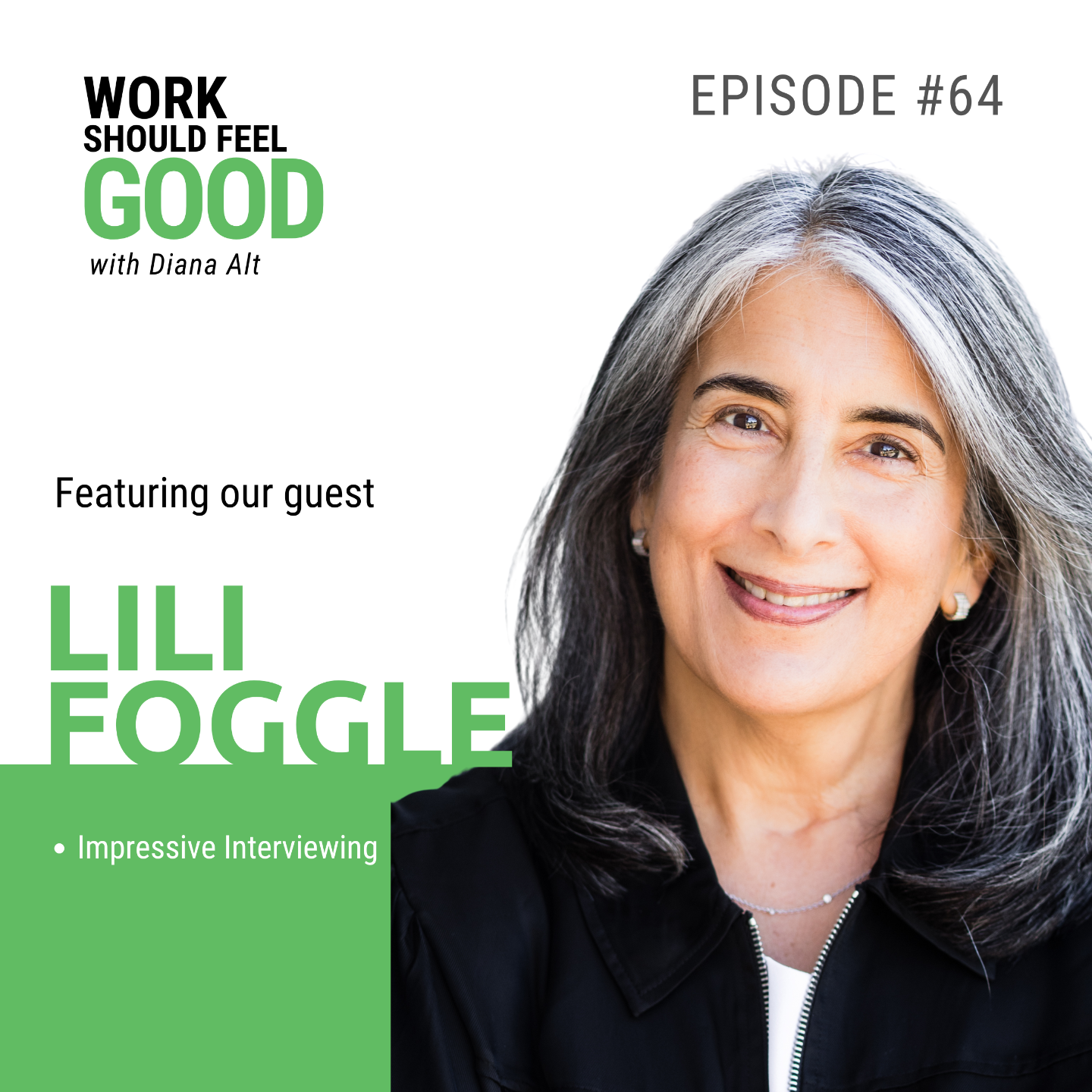
Work Should Feel Good with Diana Alt
Episode 64: The Interview Skills That Get You Hired with Lili Foggle
What separates candidates who consistently get job offers from those who don't? According to interview expert Lili Foggle, it isn't better qualifications—it's better communication.
In this conversation, Diana and Lili explore how interviews have evolved in the age of AI, why authenticity matters more than polished scripts, and how candidates can build the communication skills that create genuine connection with hiring managers. Whether you're actively job searching or simply want to become a stronger communicator at work, this episode offers practical advice you can apply immediately.
You’ll learn:
- Why interviewing is a communication skill—not a memorization exercise
- How AI is changing hiring and what employers value now
- How to prepare authentic interview stories instead of scripted answers
- Better ways to research companies before interviews
- Why strong communication continues to accelerate your career after you're hire



Episode 64: The Interview Skills That Get You Hired with Lili Foggle
Episode Description
In this episode, Diana sits down with interview expert Lili Foggle to explore why interviewing is really about strategic communication, authentic connection, and understanding what employers are actually looking for. From AI's impact on hiring to practical interview preparation strategies, this conversation is packed with insights that will help you interview with greater confidence and clarity.
-
Why communication skills matter more than ever in the age of AI
-
The difference between memorizing answers and authentic interview preparation
-
How to build strategic messaging instead of scripted responses
-
Why interview skills translate directly into career success
-
The importance of researching company values, not just company facts
-
Understanding team fit versus technical qualifications
-
How to create genuine connection and relational presence during interviews
-
Why storytelling should be flexible, not memorized
⏳ Timestamps
00:00 Welcome & introducing Lili Foggle
01:30 Lili's unexpected journey from actor to interview coach
08:45 Why great communicators often outperform more experienced candidates
14:30 Why communication skills are becoming even more valuable in the AI era
18:45 Stop memorizing interview answers
24:00 Building strategic messaging instead of scripted responses
33:00 How to research a company the right way
40:30 Understanding values, team fit, and hiring decisions
47:00 Relational presence vs. "rapport building"
54:00 Matching interviewer energy without losing authenticity
💡Take Action
🔥 Subscribe for future episodes → https://www.youtube.com/@dianaalt
📖 Grab my Resume Don’ts Guide → https://www.dianaalt.com/resumedonts
❌ Avoid these common job search mistakes → https://www.jobsearchmistakes.com
🚪 Wondering if it’s time to walk away? → https://www.isittimetowalk.com
💼 Work with me → https://www.dianaalt.com
📢 Connect with Lili Foggle
🌐 Website → https://impressiveinterviewing.com/
🔗 LinkedIn → https://www.linkedin.com/in/lilifoggle/
📲 TikTok → https://www.tiktok.com/@yourinterviewcoach
📲 Follow Me On Social Media
LinkedIn → https://www.linkedin.com/in/dianakalt
YouTube → https://www.youtube.com/@dianaalt
Facebook → https://www.facebook.com/dianakalt
TikTok → https://www.tiktok.com/@thedianaalt
Transcript
Diana Alt [00:00:04]:
Hey, Diane Alt here, and this is Work Should Feel Good, the podcast where your career growth meets your real life. Each week I share stories, strategies, and mindset shifts to help you build a work life that works for you on your terms. Hello, hello, hello, everybody, and welcome to Work Should Feel Good, the show where your career growth meets your real life. I'm your host, Diana Ault. And today, my guest, my friend Lily Fogel, and I are going to talk about why the communication skills that help you ace an interview are the exact same ones that you need to build your career or your business or anything else worthwhile doing in life. If you're into conversations like that, go do the things like hit buttons and subscribe and review and all that kind of stuff. I'd really appreciate it because it helps people find the show. Lily Fogel is the founder of Impressive Interviewing and has spent the past decade or so helping everybody from new graduates to executives communicate their value with clarity and confidence.
Diana Alt [00:01:11]:
She is the director of the Interview Institute of the Professional Association of Resume Writers and Career Coaches, a.k.a. PARK, if you hear us say that, where she trains interview coaches in modern interview techniques Going Way Behind the STAR Method. Welcome to the show, Lili.
Lili Foggle [00:01:29]:
Thanks, Diana. I'm really happy to be here talking with you about my absolutely favorite topic, interviewing.
Diana Alt [00:01:34]:
Oh, I know. It's, it's such a— the way that we nerd out about stuff. I just find such joy in understanding what other people nerd out about.
Lili Foggle [00:01:44]:
Yeah, no, I know.
Diana Alt [00:01:45]:
And when they get to make a career out of it, even better. But I love— what else do you nerd out about besides interviewing, though?
Lili Foggle [00:01:53]:
Um, making cocktails.
Diana Alt [00:01:56]:
What's your cocktail of choice?
Lili Foggle [00:01:59]:
Um, it depends. It depends on— so recently, um, I was making a lemon, uh, like candied lemon peel, and when you make it, you end up with this like lemon simple syrup. So I started experimenting with different kinds of lemon drops because I had this lemon. Oh my gosh, I haven't had lemon drops in And, and we have this chili recipe, my husband and I, that requires you to defang habaneros in like this big thing of tequila. And then the recipe calls for you to like get rid of the tequila. We're like, we're not getting rid of that tequila. And so we started experimenting with all different spices.
Diana Alt [00:02:36]:
So you have like jalapeño tequila situation? We have.
Lili Foggle [00:02:39]:
And actually it was so good, we made some jalapeño vodka next time. It wasn't jalapeño, it was habanero.
Diana Alt [00:02:44]:
Oh, sorry.
Lili Foggle [00:02:45]:
Yeah, and I love, like, I love, uh, trying to find, uh, make up new drinks. My husband and I can, like, spend half a day planning what our cocktail is going to be that night if we have the time on the weekend.
Diana Alt [00:02:57]:
I need to, I need to figure out how to hang out with you more. I'm supposed to go have dinner with my sister tonight, and we always go to this Mexican place, and I'm like, I don't drink very often at all, but I'm like Diana might have to have a little cocktail tonight. Might have to go for it.
Lili Foggle [00:03:15]:
Yeah. The problem is I don't love having cocktails out because they don't do it the way, like my husband and I would do it. Right. They always, they're usually there's like, it's too sweet. There's too much fruit juice. There's like one too many ingredients in it, or it's got a foam on it.
Diana Alt [00:03:30]:
Like, yeah. I don't need foam on much. I really, I don't love foam.
Lili Foggle [00:03:36]:
No, to me, if it's like half full of foam and half full of drink, that's half a drink. Yeah, it should be half price.
Diana Alt [00:03:42]:
You're depriving me of half of a cocktail.
Lili Foggle [00:03:45]:
Yes. Now I have to have 2.
Diana Alt [00:03:47]:
Exactly. Oh my gosh. How funny, you guys. So you guys are like hardcore mixologists. You need to list that in your skills on LinkedIn. Do you have mixology?
Lili Foggle [00:03:56]:
I do not.
Diana Alt [00:03:57]:
I do not. My funniest LinkedIn skill is sarcasm. So when you get off of here, go find my profile, dig down in the bottom and find sarcasm and click.
Lili Foggle [00:04:08]:
Can I, can I endorse? Can I endorse?
Diana Alt [00:04:10]:
You definitely, I want you to endorse me for sarcasm. sarcasm.
Lili Foggle [00:04:14]:
Okay.
Diana Alt [00:04:14]:
I've had that on there for over 10 years, and it's— I just put it on there without comment. So now I'm commenting on it. All right, everybody, anybody listening, feel free to go endorse sarcasm on my LinkedIn. So I want to talk— I like to kick things off talking a little bit about people's career journeys because I, I meet people in a certain context, you know, whether I knew them before I have them on the podcast or You know, they pitch me to be on the podcast and they tell me who they are right now, but I always like going back into the lore. And your lore is super interesting because you are this person that's working deep with people on job interviews in particular. That's your niche, that's your specialty. But you did not come out of HR, any of that kind of stuff. You came out of the nonprofit world in strategic communications.
Diana Alt [00:05:07]:
So tell us like a little bit about how you even decided to go into that world in nonprofit, and then what led you down the path to become an interview coach?
Lili Foggle [00:05:20]:
So the interview coach happened before the nonprofit because, um, I actually had, you know, I'm, I'm in chapter— I'm in the epilogue of the trilogy. Like there's the 3 careers and then there's the epilogue. This is my epilogue career. And my first one was—
Diana Alt [00:05:36]:
That is not what LinkedIn says, but okay.
Lili Foggle [00:05:39]:
Yeah, my LinkedIn doesn't talk about my first one because, um, it was as an actor and I was young. Um, and I actually went to a—
Diana Alt [00:05:48]:
This is even better than I expected.
Lili Foggle [00:05:52]:
Uh, I fell in love with acting at the age of 11. Um, and when I was 13, I started going on auditions and I did like a bunch of little teeny, I guess what they call off-off-Broadway in New York City, you know, like little 50-seat house things, children's theater, you know, you're not making a lot of money, it's not union, but I was acting. And after college, I actually went to an acting conservatory and trained for a couple of years.
Diana Alt [00:06:18]:
Wow!
Lili Foggle [00:06:19]:
And when I came out of that, I came to New York to get work as an actor. And, you know, there's the acting and the singing and the dancing, but there's also very much in that field a networking piece. And so it took me a while, but I networked my way to like my dream audition. There was a very famous Broadway director, he was casting a new Broadway show. I probably wasn't right for anything in the show, but I thought, if this director likes me, maybe he'll remember me, he'll put— like, it was my first, like, big shot.
Diana Alt [00:06:49]:
It was your first big girl interview.
Lili Foggle [00:06:51]:
It was my shot, right? And so it was gonna have 4 parts. There was the dancing, the singing, the 16 bars which you have to sing, the sides, the acting, and then if you got through that, you had an interview with the director.
Diana Alt [00:07:04]:
Okay.
Lili Foggle [00:07:04]:
So as I said, I wasn't union. I had schmoozed and networked my way to get my foot in the door to even get this audition, went to dance classes every day because dancing was not my strongest suit. I wanted to be able to nail the combination, worked on my 16 bars, worked on my sides, came in, knew that there would be an interview with the director if I made it that far, so I started asking people like, what do you do in that part? Like, no one taught you? No, I had never had any training on what to do, and of course the advice I got at the time was Just be yourself. And I thought, I'm charming, I'm funny, I have a background in improv comedy, like, I can just be myself, I'll get through this interview. So I make it to the final stage, it's me and this famous Broadway director, and at the time, I can't believe I'm telling you this story, I can't believe I'm telling you this story.
Diana Alt [00:07:50]:
I love it, this is just good, my day just got better.
Lili Foggle [00:07:53]:
So at the time, things were very not digital. You had to walk in with an 8x10 photo of your head, of your face, and on the back of it, was a list of all the theater you had ever done.
Diana Alt [00:08:05]:
Mm-hmm.
Lili Foggle [00:08:06]:
So I'm in my 20s and I hand the director my headshot with the resume and he looks at my resume and he lands on some little off-off-Broadway thing I did when I was like 13 years old. And he asked me about it. He says, I don't know this show. Tell me about the show. And me thinking I'm charming and thinking I'm funny, make a joke kind of and go, oh, that, that was like some really bad show that this, woman wrote and she funded the whole thing herself. It really wasn't very good. And he looked me dead in the eye in all seriousness and went, my mother wrote that show.
Diana Alt [00:08:41]:
Ah.
Lili Foggle [00:08:43]:
Now, his mother didn't write the show, but bombing that interview was the first step in my trajectory towards becoming an interview coach. Because fast forward a couple of years and acting wasn't paying the bills and I needed to make some money. I fell into a job working at a settlement house in my neighborhood in New York City. It was a nonprofit. And, you know, again, start loving, loving doing mission-driven work. So started doing that. And again, networked my way to get my foot in the door to interview for a position that was a little bit above where I should have been interviewing, but I knew the right people. And so I get my foot in the door and I get this interview and I'm not going to blow this one because I learned my lesson the first time.
Lili Foggle [00:09:24]:
So I go to the library with my spiral notebook and my ballpoint pen.
Diana Alt [00:09:28]:
And I'm—
Lili Foggle [00:09:29]:
because there was no Google.
Diana Alt [00:09:34]:
I'm just over here remembering interview prep in college. Because we had internet, but only kind of. There was not a lot to— There was no internet. There was no internet.
Lili Foggle [00:09:44]:
There was no computers.
Diana Alt [00:09:45]:
Al Gore hadn't invented it yet for you.
Lili Foggle [00:09:47]:
No, it hadn't been invented yet. So in addition to going to the library with my spiral notebook, I got on my landline and I called everybody I knew that might be interviewing. And I got really lucky because there was a guy I was kind of sort of seeing who was graduating from Yale Law School. And they were putting him— at the time I called him, he was going through their interview skills training that they give all their lawyers who have to interview with the big New York and LA firms. Wow. Okay. And he literally called me every night. after the course was done and was like, here's what I learned today, and put me through it.
Lili Foggle [00:10:23]:
So I walked into this interview. It was for a nonprofit in Connecticut, which is where I live now. And I absolutely— I was so prepared. Like, I had done the research. I had my story. I had done everything he told me to do. I had listened to everything I put in my spiral notebook.
Diana Alt [00:10:39]:
You're like, it's Gail. They know what they're talking about.
Lili Foggle [00:10:42]:
And I— 3 rounds of interviews, and I got the job. And my first day on the job, one of the 2 women who interviewed me said, I got to tell you, Lily. We didn't think you were going to be the top candidate. You were really the dark horse. You didn't have nearly the experience of everyone else, but we had never seen anyone interview the way you did. She's like, I gotta tell you, you just blew us away.
Diana Alt [00:11:03]:
It's so interesting to hear you say that because there's a thing that as a career— like, I had this misconception myself when I was looking for jobs before I became a career coach. Then the more I've learned about hiring, this thing where everybody thinks like there's boxes to check, and if you have all those boxes plus a shit ton of extra boxes, you're somehow the most qualified. That's not a thing. Like, having the boxes they need and communicating clearly is way better than having the boxes they need, communicating so-so, and having a bunch of extra boxes because they're not paying for the extra boxes that you check.
Lili Foggle [00:11:46]:
They don't need that. 100%, Diana. You know, candidates fail in interviews not necessarily because they can't do the job, but because they don't know how to communicate that they can do the job.
Diana Alt [00:11:55]:
Yes.
Lili Foggle [00:11:56]:
So I had a career in nonprofit, and going back to your original question, it was all about strategic messaging. So I went from the settlement house to a civil rights organization to running a domestic violence project, and it was all about How do I, how do I go into the community and talk about domestic violence? How am I educating them about domestic violence? And how do I write press releases? And how do I train these people to run a press conference? What are their talking points?
Diana Alt [00:12:23]:
That is such an interesting thing because when you think about those very uncomfortable, very like underbelly of society that everybody wants to ignore, How do you talk about that in a way that does not immobilize the people that you actually want to donate and support your cause, but also doesn't gloss over everything? Like, what a challenge.
Lili Foggle [00:12:48]:
Yeah. And particularly because what we were doing is we had gotten a grant to start a domestic violence court system in Bridgeport, Connecticut. It had never been done. And that meant I needed to educate the judges, The prosecutors, the defense attorneys, the ER doctors. People needed to know how to recognize domestic violence. They needed to understand the advocates, the actual experience of these women, and put themselves in their shoes to understand how best to support them and what they needed. So that's my kind of messaging communications background. And so I made—
Diana Alt [00:13:27]:
Nothing high stakes in there at all.
Lili Foggle [00:13:29]:
No high stakes. I may have started my interview coaching business 10 years ago, but I can tell you that in all the years from getting that one nonprofit job till then, the woman who said, you know, you were the dark horse, but we never had anyone interview, she went on to become a career coach as a side gig. And every so often she would call me and say, I've got a kid, he's a rock star on paper, he keeps bombing the interviews, could you like just tell him some of your like interview secrets? And I'd spend an hour with the guy or the girl and they'd nail it and they'd get the first person she sent me who had not gotten anything in like 6 offers got the first 2 offers that they went on interviews after working with me. So I knew— here's what I knew. It wasn't that I had anything special. It's that most people didn't know interview skills. Like, most people didn't understand that this is a set of skills. It's not rocket science.
Lili Foggle [00:14:21]:
It can be learned. It can be taught. It can be practiced. It can be mastered. And they are life-changing, right? Because the job that we have is our access to not just income, not just opportunity, but also very much dignity, right?
Diana Alt [00:14:36]:
Yes.
Lili Foggle [00:14:37]:
And that's determined by our performance in an interview-based competition. And people don't know how to train for that.
Diana Alt [00:14:44]:
I got to tell you too, like, one of the things that drives me the most crazy is when people say, well, it's just not fair that how I perform in the interview matters more than what my experience was Because interview skills don't have anything to do with the job. And I'm like, you find me the job where you don't ever have to effectively communicate with anyone, and I will agree with you. I'm not aware of a job like that that exists. I work for myself. I have one employee, and it's me. And I still have to be able— it's more important now for me to be able to do it because I've got to communicate to clients. So Like, my take has always been good communication skills. I do not care if you are actively on stage giving talks all the time, or if you are a cube dweller writing code, you still have to be able to communicate with people.
Lili Foggle [00:15:42]:
So, well, I have 2 things to say about this. I agree with you, and I've had a number of my clients come back to me and say the skills that I learned with you preparing for my interview have helped me so much in my career. Like, they helped me just be better in my career, get noticed more, have better presence. But also, you said something about a coder in a cube. Is that what you said? You got to realize now, with AI, communication skills are even more important. Yes, for sure. And every single survey shows that the things that AI can't automate, those human skills, like communication, decision-making, judgments, adaptability, all of those things. But specifically, the ability to communicate with human beings is becoming important in every single job.
Lili Foggle [00:16:30]:
Because if you don't—
Diana Alt [00:16:31]:
I would argue it never has not been.
Lili Foggle [00:16:33]:
Maybe. I mean, I guess there are some people who really do sit— an accountant who sits on their accountant stuff all day and is just working with numbers. But now AI can do that. So now what they need is an accountant who knows how to leverage AI and can talk with the stakeholders.
Diana Alt [00:16:49]:
It's funny.
Lili Foggle [00:16:49]:
And talk with the client.
Diana Alt [00:16:50]:
It's funny that you bring this up because I have a business coach, business consulting client who is a wealth manager, and he actually is my wealth manager. So it's fun. Like sometimes, sometimes when we're on a call, it's because he's doing my annual review of my finances. Sometimes we're on a call, it's because I'm his coach or his consultant that day. And he's been hiring accountants for the tax practice because he's got wealth and tax in his business. And the top thing that he's looking for right now, because baseline, like bare minimum, as Gen Z says, like bare minimum is that you like know how to do the taxes or you know how to run the program that is going to do the taxes and give it the right information. But he's like, I need accountants that can, that can communicate with the clients.
Lili Foggle [00:17:35]:
Exactly.
Diana Alt [00:17:36]:
Full stop, period. Exactly. It's not optional anymore. and that they prioritize the needs of the clients and that they can learn to think like the clients think about stuff. So, um, yeah, it's very much true.
Lili Foggle [00:17:50]:
And I'll tell you another reason why communication skills are even more important now, and it also has everything to do with AI. So AI is completely— I know you know this, Diana— completely transformed the whole hiring landscape, the whole hiring process. Um, 1 in 3 employers— the last I saw some survey that 1 in 3 employers don't even trust resumes anymore, which really sucks because the, the AIs that resume— that the resumes that AI does are like this flood of sameness, right? So the human resume writers are going to give you a much better resume, but people think they don't need that. People think that AI can write the resume. But when they go to AI for interview coaching, all AI can give them is an answer script. AI can't teach them communication skills. And if you are walking into an interview— and by the way, because employers are not trusting the resume because they're getting flooded with unqualified applications that look qualified. The interview processes are getting more intense or getting longer.
Diana Alt [00:18:51]:
Yes.
Lili Foggle [00:18:52]:
Sometimes they start with an AI-assessment. So the ability to be able to communicate is even more important to the job process and the job hiring process than it ever was. But on top of that, um, if you are relying on AI-generated answers, look, that may get you past the AI-assessed screen, Maybe you'll say enough keywords to get past that first round, but you cannot walk into the final round where everybody is qualified with generic AI-generated answers and think that you're going to be that number one candidate that they're going to pick out of all those people.
Diana Alt [00:19:27]:
There's, there's two aspects to this too. So, you know, you're, you're talking about generic answers, which is a problem, but there's also the problem of memorization. Because what a lot of people think that they need to do, and it's overwhelming, like when they think about preparing for an interview, it's really overwhelming because what they think they have to do is memorize answers to dozens and dozens and hundreds of, of questions. And that's even if they do specific stuff, it sounds stilted when really my take— I'm interested in the number. I've heard different interview coaches say different numbers.
Lili Foggle [00:20:06]:
Yeah.
Diana Alt [00:20:06]:
I think you have about 8 to 12 core stories of your career that you need to internalize so that you can speak around every facet of that, no matter what question you get asked. What's your— what's your— and you internalize is a word a client of mine gave to me.
Lili Foggle [00:20:28]:
Yeah.
Diana Alt [00:20:28]:
Because I had been saying, like, you need reps, don't rely on memorization. And she's like, I— she came back to me later and said, It's internalizing it. It's thinking about it deeply enough, and it's saying it enough in networking or out loud to whoever you're mock interviewing with. Like, I think she was talking to her husband a lot, like that kind of stuff. So what's your take? What's the library of stories that people need to have?
Lili Foggle [00:20:53]:
So I'm going to back up a minute before I give you a number and just talk about, like, the whole concept that you're talking about, which is how to prepare and recognizing that relying on scripts Um, thinking that that's the way to prepare. First of all, we don't write the— we don't speak the way we write. You're writing out scripts, or AI's writing out a script. It's going to sound like everybody else. The stress of trying to remember what you wrote when you're— interviews are anxiety-producing enough, particularly if you care about it. You know, you don't want to worry, am I going to remember my lines? And even if I do, am I going to be able to deliver them authentically? It's ineffective. It's inefficient because you're going to end up memorizing answers to a whole bunch of questions that you're never going to get? And what happens when you get a question that you didn't prepare your perfect answer for? And it also— that's the other thing, this whole idea of a perfect answer. When you're writing out answers, you're trying to memorize answers, you're trying to come up with the perfect answer to a question, you are missing the point, right? So I want to just shift the whole idea of how you prepare for an interview.
Lili Foggle [00:21:54]:
It is— interviews are not about coming up with answers.
Diana Alt [00:21:57]:
Yeah.
Lili Foggle [00:21:58]:
Interviews are about listening, about learning, doing the prep to learn what they need, and figuring out what that interviewer specifically is looking for in that interview. And making your messaging really strategic. Interviewing is about delivering strategic messages authentically, spontaneously, within a structured framework.
Diana Alt [00:22:23]:
Yes.
Lili Foggle [00:22:24]:
So I don't want you saying the same stories over and over again. That's the same thing as scripting because you're going to say it the same way every time.
Diana Alt [00:22:31]:
You need to— Keep going.
Lili Foggle [00:22:35]:
So when you say reps, I mean something very different. I mean, you want to learn the frameworks and you want to get skilled with that. The frameworks are like muscle memory. They're like, like a tennis player. How do I hit a ball no matter where the ball comes from? I've got the technique and I can use the technique no matter how the ball comes to me.
Diana Alt [00:22:53]:
Yes. And that's— I think we're saying the same thing. You're saying it better because you're the interview coach. But where I'm going with that, where I'm going with that, when I say, you know, there's X number of stories, 10, 12, whatever, what I mean is that when you think about where you're going in your career, you're targeting something, or you're probably not. You wouldn't be listening to this show probably if you didn't believe in targeting your job search. But you're targeting something. You should thoroughly understand the problems that that role is going to solve. And to your point, for the stakeholders that you're going to talk to.
Diana Alt [00:23:28]:
And then you want to make sure that you deeply internalize, understand from every angle, and own your own success.
Lili Foggle [00:23:37]:
Yes.
Diana Alt [00:23:37]:
If you do that, then you are able to identify the frameworks within your own work, and spit them out when you have thought about it that deeply. So I think we're kind of saying the same thing.
Lili Foggle [00:23:51]:
Yes. Here's the thing that I wanna— that I'm trying to— that here's the nuance of what I'm saying is not a good idea. Here's the thing I want to avoid, right? Because I think that some people hear, I need a story bank of 8 to 12 stories, and I need to practice those stories, and I need to become— be able to tell those stories. Here's the problem. So I had a client, um, and this was before he came to me for coaching. And he's an older client. So one of the things when you're working with someone who's an older client is you have to address some of the messages they need to land that maybe a younger client wouldn't, wouldn't be as important. But for an older client, they definitely want to land— one of the messages they want to land is that they're not a know-it-all, they're a learn-it-all.
Lili Foggle [00:24:34]:
They still have a growth mindset. Like, they're still eager to learn.
Diana Alt [00:24:36]:
Yes.
Lili Foggle [00:24:36]:
Because some people might assume that they don't. So that was a really important message for him to land. So he gets asked in his interview, tell me about a time you made a mistake, which is the perfect opportunity to tell a wonderful story about how you made a mistake and you learned from it, right? And demonstrate that growth mindset. But instead, what he did is he went into his story bank of 8 to 12 stories— mistake, mistake, mistake— and told a story about when someone else made a mistake and he came in and saved the day.
Diana Alt [00:25:06]:
Ah.
Lili Foggle [00:25:07]:
Tangentially, like it missed the moment of what that interview was asking. And that's the problem with, I have a story bank and I'm going to go find the story that fits the question. I'm not really paying attention.
Diana Alt [00:25:18]:
Here's the thing. I think you hit on that scenario, hits on the thing that I tell some of my clients. Um, if you have a bank of stories, it's the start. It's not the end. It's the— this is the type of project I was on. This is the thing. I want to grok that story. I want to understand all the angles that we could come at it for.
Diana Alt [00:25:44]:
I want to understand why the CIO would care, why my peer that's interviewing would care, which is entirely different from I'm trying to shoehorn in a story, like doing the keyword search for mistake. I don't have one of my own because I didn't have that in my bank. So I'm going to go pull a story about somebody else's mistake. Those are 2 entirely different ways to think about your experience.
Lili Foggle [00:26:08]:
Inevitably, in an interview, you can have 8 to 12 stories that you've internalized and you've come out from different ways, and you might need a 13th one.
Diana Alt [00:26:16]:
Yeah, right.
Lili Foggle [00:26:16]:
They're gonna ask you a question.
Diana Alt [00:26:18]:
Yeah.
Lili Foggle [00:26:18]:
And that's when, if you've practiced the skill of strategic messaging, of authentic communication, within a structured framework, then you can tell a story that you've never told before. You've got your guideposts, your beginning, your middle, and end. I'm going to touch— you know what you need to touch along the way to land that message concisely, impactfully, but you're speaking authentically with your words. And you're able, if you've practiced that, then you're able to take out that skill. So this is what I'm saying. It has to be an authentic conversation. The minute you are reciting what you practiced, you're performing. And it feels like a performance.
Lili Foggle [00:26:59]:
And that will work with an AI-assessed interview if it's just an AI assessment, if it's just an algorithm that's taking the transcription and looking for, you know, the points, the score with the keyword match or whatever. But with a human being, there has to be some relational presence. There has to be some connection. And the minute you start performing instead of communicating, instead of being in a conversation, you break that connection.
Diana Alt [00:27:21]:
Well, and this is another area where AI is changing the game because 'Cause like, I'm gonna rabbit trail to thinking about social media presence for a second. So my friend Mark LeBrun, who's been a podcast guest, has a company called Digital Influence Co. And he helps individuals and organizations build their influence online, but he's not looking for likes and followers. He's looking for authenticity and having an opinion about things. So the thing that he and I have talked about a lot is if you're trying to do something like grow a TikTok, grow a LinkedIn presence, grow a YouTube, 3 years ago, you needed a lot of polish, 3, 4 years ago. Like this background that I have wouldn't cut it. You should always be made up and all that kind of stuff. And now people don't trust that.
Diana Alt [00:28:12]:
So when you walk into any environment, whether it's a job interview or doing a video online or just talking to a human at a conference that you met, if you are too scripted, too performing, you are immediately trusted less than the exact same thing would be 4 years ago. And this is not going away.
Lili Foggle [00:28:36]:
Exactly. Although I will say, 3 years ago, I made TikToks with this background just like this, and I have 70,000 followers.
Diana Alt [00:28:43]:
Well, your background is nicer than my background.
Lili Foggle [00:28:45]:
It can be done. But I was— again, I wasn't performing.
Diana Alt [00:28:48]:
I wasn't But you were just talking. Yeah.
Lili Foggle [00:28:51]:
I was pissed. I was pissed off. Do you know why I got on TikTok? I didn't get on TikTok to get followers. I didn't get on TikTok to make money. I've never made a penny off my TikTok. I got on TikTok 3 years ago because I saw somebody giving bad advice, somebody with like 10,000 followers, and it pissed me off. They gave some answer to like, this is how you should always answer what is your weakness. And it was like spinning a straight— like, say you're a perfectionist.
Lili Foggle [00:29:17]:
And I was so mad that I picked up my phone And I had never made a TikTok. I was never going to make a TikTok. I just hit record and I went, listen, this is how you answer what is your weakness. And I said, like, my framework. And I put it down. I came back 3 days later and I had, like, a couple of thousand followers. I'm like, oh, well, there's another way to answer what is your weakness. And I did that.
Lili Foggle [00:29:36]:
And my 4th one went viral. It's got 2.5 million views. And now I have 70,000 followers. And all I've ever done is just give interview advice. I don't post every day.
Diana Alt [00:29:46]:
Yeah.
Lili Foggle [00:29:46]:
All this, you have to post 3 times a week. I don't do any of that. I just sit here with no makeup, this background, giving advice.
Diana Alt [00:29:54]:
But you're just, you're, you're speaking for when you can speak, when you can speak off the cuff, right? Or even if you've really worked very hard on what's the framework for answering these questions, when you sound like it's a real conversation, it makes people trust your expertise and your experience more. Because if you have to reach back into the database, oh, what was that? If you have to do that too many times, then people have questions in the same way they have questions about the AI software engineer resumes that all look the same. That's not to say in an interview you can't say like, hang on, look, give me a second here. Okay. You know, like, don't Don't just word vomit whenever you need a second to compose yourself. But that's—
Lili Foggle [00:30:46]:
Never, never word vomit in an interview.
Diana Alt [00:30:48]:
Do not word vomit like we are doing on our podcast. My podcast, I get to word vomit if I want to. It's fantastic. So, um, here's a— here's an interesting one. Everybody says research the company, which is quite possibly One of the most unhelpful pieces of advice that anyone can say, because when you just— okay, rabbit trail. I have a peeve when people tell you to do something and they don't explain what they mean.
Lili Foggle [00:31:22]:
Oh, that's me.
Diana Alt [00:31:23]:
So for example, whenever people— whenever you are in like the performance review and you were hoping to get promoted and your boss says, you know, you did a great job, keep doing what you're doing. To get promoted, I need you to be more strategic and more creative. And they never say what any of that shit means.
Lili Foggle [00:31:39]:
Yes.
Diana Alt [00:31:40]:
It's lazy leadership, and I don't have time for that. But research the company is often in the same bucket because people really don't necessarily know what to research or how to research for it. And they don't really know what's appropriate for different roles because, like, Gina Riley, who was on the, on the show and focuses on executive career coaching, like C-suite, she would tell you that those interviews are high stakes and you can spend dozens of hours preparing for the interview cycle for a single company when you're at that level. But when you're 23 years old and you're trying to be a marketing assistant and like, that's a different stage of your career. What is your take on what the right way to go about researching a company is like? What do people actually need to know? Whenever—
Lili Foggle [00:32:33]:
first of all, I think Gina's right. Like, you can never do— you can never do too much research on a company. It's limited by, like, how much time do you have to research the company?
Diana Alt [00:32:43]:
Yes. But if you're gonna have to be succinct, we need to know what we're doing too.
Lili Foggle [00:32:47]:
We need to know what we're doing. And frankly, you know, I've had clients that are interviewing with Amazon and Google, and you could write a PhD about some of these companies. Like, you could research them for for years. So I think that there's kind of like 3 levels of research. Okay. Level 1 is the base. By the way, when anyone hires me, I, even before they hire me, when I'm in my discovery call, I tell them that they need to do this before we meet for the first time. And if they don't hire me, like now, at least they know what to do in terms of research.
Lili Foggle [00:33:20]:
So any person who does a discovery call with me gets this information. So level 1 is—
Diana Alt [00:33:25]:
Free coaching from Liliana on discovery call. That's nice. Very nice of you.
Lili Foggle [00:33:30]:
First is basic research, right? This is the stuff everyone knows they need to do. What does the company produce? What are their services? What is their product? Who are their customers? How big are they? Who's their leadership? What are the challenges they've had? Like just a basic Google search, get to know them. AI can, you know, deep research, baby. Yeah. So that's the basic stuff, right? Level 2, you've got to understand, and this, and level 2 and level 3, are really important for the piece that I think so many people miss. Can I rabbit trail for a minute before I come back? My rabbit trail.
Diana Alt [00:34:04]:
It's a podcast. It's my show. So yeah. It's—
Lili Foggle [00:34:07]:
so here's my rabbit trail. Okay, I promise I'm going to come back to level 2. Most people, when they prepare for an interview, they know that they have to show their value, the competencies. They know they have to come up with metrics, results to prove that they have the competencies. And often They over-index on that and ignore what matters in the final round. Because when you get to the final round, everybody has the competencies.
Diana Alt [00:34:32]:
Mm-hmm.
Lili Foggle [00:34:33]:
Everybody's got the metrics. Everyone can do the job. And so this research in level 2 or level 3 is going to be really important for the things that the final round calls for, even the round before the final round, which is fit and likability. And when I say fit, Diana, I don't mean fit for the role. That's what I'm calling like competencies, value. I mean fit for the team. And I don't mean culture fit either. I don't mean that we're the same as everyone else.
Diana Alt [00:34:57]:
Culture fit gets assessed way earlier than people think it does.
Lili Foggle [00:35:01]:
Way earlier.
Diana Alt [00:35:03]:
Like recruiters. One of the things that recruiters are best at is sniffing out obvious bad culture matches in the screens. Good recruiters can sniff that out in the screen.
Lili Foggle [00:35:15]:
So I would be curious to know what you mean by culture match when you say that.
Diana Alt [00:35:20]:
Let's do a little— let's do— I'm writing down another rabbit trail.
Lili Foggle [00:35:24]:
We'll talk about it.
Diana Alt [00:35:24]:
OK. OK.
Lili Foggle [00:35:25]:
But anyway, so when I talk about fit, what I mean is, there are lots of studies that show that when an employee joins a team, if that employee is motivated by the same mission as the team, they are aligned and motivated with the values that unite and motivate that team, They are happier. They are more successful. They persevere in the face of obstacles. When there's a bad day, they're like, they get through the bad day because they care about what the team is doing. And they feel that the team has the same core values that they do. They feel that alignment.
Diana Alt [00:36:07]:
Yeah.
Lili Foggle [00:36:07]:
The opposite is also true. When a new employee on a team does not have that value alignment, when they don't feel like they care about the mission, they don't feel like everyone on the team has the same values, they don't care about the same things, They are not going to perform as well. They're not going to be as happy. And the minute something else comes along, they're out. Turnover is way higher. So when I say fit, I mean that alignment with the values that unite and motivate the team. And the only way to show that alignment is if you know what they are.
Diana Alt [00:36:38]:
Yes.
Lili Foggle [00:36:38]:
So level 2 research is to find that out. How do you find that out? You have to research the leadership. And let me tell you, I know some companies put on their website or have a page that says, these are our 6 core values. Maybe those are the core values and maybe it's branding and maybe it's marketing.
Diana Alt [00:36:57]:
Yeah.
Lili Foggle [00:36:58]:
If you really want to know what values unite and motivate the team, you have to look at what the leadership is saying publicly facing. What are they saying in podcast interviews? What things are they posting on LinkedIn? What articles have they written? Like, you're going to have to take some time to kind of look under the hood And look for the core values that everyone on the team would really say, yep, that's who we are. We all—
Diana Alt [00:37:21]:
So I'm gonna go back to my thing. Because this is— we're in agreement on everything that you just said. So to me, the way that I define culture is values in action. So it's in behavior. And I go pretty deep. Like, I've done business consulting with people where I've done culture work with them. And they'll say our value is Like inclusion. And I'm like, okay, the inclusion, where are, how does this show up in your policies? How does it show up in your benefits packages? Like that kind of stuff, you know, because you can go pretty far down.
Diana Alt [00:37:53]:
Like if you say that you value inclusion and you don't have domestic partner benefits, I have questions.
Lili Foggle [00:38:00]:
So you're getting me to, yeah, that's level 3. You literally just took me to level 3. So once So once you've done the research about what the actual core values are of the team, you want to try to think about, well, which of these are relevant for the role I'm applying for? Like, which ones are they really going to care that the person who comes into this role shares that commitment? Because there might be some that they don't, right?
Diana Alt [00:38:25]:
Like, if— all right.
Lili Foggle [00:38:27]:
So, but you want it to be relevant for the role. And you want it to be ones that actually, like, really authentically resonate with you as the candidate that you think, you know, now that I know that, Yeah. about that company, I'm actually more excited to work for that company because I care about that too. Level 3, go find examples of how the company has demonstrated that commitment. And that, that is— and I'm not talking about what I can find in 5 minutes on the homepage of the website.
Diana Alt [00:38:53]:
No.
Lili Foggle [00:38:54]:
When you do that deep research and you uncover those specific details that show that you went down a rabbit hole, that you are so interested in this company that you took the time to listen to the podcast the VP did, and you took the time to find this thing that no other candidate is bringing up, and you drop that into the why do you want to work for us answer— that is differentiating, and that makes all the difference in demonstrating that fit. Just going back to the culture fit thing, the reason why I was questioning that is a lot of times people talk about culture fit as like you're kind of the same as everyone else, right? And then there's culture add. So I just wanted to make it clear.
Diana Alt [00:39:33]:
No, we're on the same page with that. So when I think, when I think of culture fit as being values in action, what, what recruiters are really good at sniffing out maybe isn't that it's perfect alignment, like people are going to look really hard in later rounds. But if you are not— let's say, let's say there's some sort of, um, customer first that has a lot of teeth behind it. Like there's a book that was written years ago that I worked at a company where every single employee was issued this book. We were expected to read it, understand it. Like, the things from the book came up in conversation. The book was called Hug Your Customer. If it's a hug your customer culture and you talk in a way that seems in conflict with hugging your customer on the recruiter call, even if it's for a software engineering job, you didn't get— you might not have got got kicked out because you don't have enough years of Python.
Diana Alt [00:40:29]:
You might have got kicked out because you did not communicate in a way that makes it clear you give a crap about customers. So if you say something like, I just want to put— I just love working on gnarly technical problems, I want to put my head down and like, you know, marinate in the technology, and you don't say anything about so that we can serve our customers, you're going to get knocked out.
Lili Foggle [00:40:51]:
Right.
Diana Alt [00:40:51]:
That's exactly the stuff I'm talking about.
Lili Foggle [00:40:54]:
Yes.
Diana Alt [00:40:54]:
And if— and nobody wants to work with an asshole. So if you operate in a way that makes people feel like you're an asshole inadvertently, because rapport building is a whole nother topic that we should get to, but it's that kind of stuff. So when I say recruiters sniff stuff out, that's what I'm talking about. And everyone thinks, because it was this way for a long time, That recruiters were just checking boxes that you had the skills that you said you had on a resume, and that then the hiring manager was going to say if they thought you had the right technical skills, and then you were going to talk to the VP and they were going to assess culture fit. And that's not the cycle anymore, especially not as cross-functional as roles are these days. So let's talk about rapport.
Lili Foggle [00:41:41]:
Okay.
Diana Alt [00:41:41]:
This is where people fall down on the job a lot. Um, do you teach rapport building in your interview coaching? What's your—
Lili Foggle [00:41:49]:
Wait, wait, wait, wait, wait, wait, wait, wait, wait, wait, wait. So in my interview coaching with clients is different than in my, you know, I, I run the Certified Interview Coach course for PARCC. So of course we cover rapport building in that, but not every client needs every single skill taught to them, particularly not if they have an interview in a week.
Diana Alt [00:42:10]:
When you find a client.
Lili Foggle [00:42:11]:
Yeah.
Diana Alt [00:42:12]:
Let's just say, what does Lily teach in general about rapport? First off, what the heck is it? Because a lot of people think it's a weird word that doesn't mean anything. When you think about rapport building, what is that? In what place does it take in interviewing?
Lili Foggle [00:42:31]:
So I don't like—
Diana Alt [00:42:33]:
or life.
Lili Foggle [00:42:34]:
I don't, I don't like the word rapport building. Okay, what's better? Because so I think that there's, there's 2 words. First, there's likability, right, which is in my mind like 6 very distinct things in an interview context as opposed to a social context. And then one of those things is kind of relational presence, right? And that's one of the like 6 aspects of likability that I think matter in an interview. So when we talk about relational presence, We're talking about things like—
Diana Alt [00:43:08]:
I like that term, by the way.
Lili Foggle [00:43:10]:
Yeah, no, it's about connection, right? It's about that you're not just there talking at them, you're not just performing at them, that you're listening to them, that you're asking questions that show that you're actually interested in them. There's a focus on the other as opposed to just me, me, me, me, me, me, me. That's a big part of relational presence. Are there little tricks and little hacks like, you know, isopraxism, mirroring the interviewer's energy? Listen, that can be very important. I will tell you, I had a client, um, and this guy— I love this client— guy from Texas with a big, big wonderful personality. He's a finance director for a mid-sized city in Texas, and he came to me because he was moving to Oregon. That's where his sons were with their family. And he had already gotten to the final round to be a finance director at 2 different cities in Oregon.
Lili Foggle [00:44:03]:
And he didn't get the job. And that's when he looked me up and found me and said, I don't know why I'm not getting the job. This was many— this was before COVID And so, you know, I need you to tell me, like, what am I not doing? And I got to tell you, I was at first really stumped because this guy, he was so likable. He was the kind of guy that, like, If he's in the room, you know he's in the room and you're probably smiling because he's in the room.
Diana Alt [00:44:29]:
Yeah.
Lili Foggle [00:44:30]:
And he had done all the work. He was communicating well. He was telling his story well. He was authentic. And it really like, I was struggling a little bit with what is holding him back. And then it came to me. I said, when you go to these interviews, they're in person. He's like, yeah.
Lili Foggle [00:44:47]:
I'm like, what's the office like? And he's telling me, oh, it's kind of smaller than what I'm used to. And all of a sudden I'm imagining this big Texas guy with this big Texas energy walking into this small Oregon office. And it was just too much. So I taught him what my Gen Z kid would call energy matching, right?
Diana Alt [00:45:07]:
Yes.
Lili Foggle [00:45:07]:
The skill of just like, just like turn down the volume. Don't change who you are. But, and I had him practice it. I gave him the assignment. I said, in a social situation, one-on-one, I want you to be able to do this for 5 minutes without the other person knowing that you're doing it. I want you to kind of not mirror exactly, but match their physical energy, match their level of vocal energy, match their like level of animation and like how, you know, animated they are and match their volume, their tone without imitating it. And if you can do it for 5 minutes without them going, Mark, what are you doing? Why are you acting weird?
Diana Alt [00:45:47]:
Yeah.
Lili Foggle [00:45:47]:
Then you've got it. So he did it. He did it with about 3 people. And the next interview he went in, he got So for him, that, yeah, that, that, that was what he needed for rapport, right? For relational presence. But that's not what most people need. In my experience, what most people need is just to get out of their own head and really be fully present in the moment and connect. And a lot of it has to do with asking questions. That moment at the end when they say, go ahead.
Diana Alt [00:46:15]:
I can see that you're— My friend Justin Schenk. So my friend Justin Schenk, Um, who has a wonderful podcast and events that he does and all this stuff. He has access to some wild, like, people you'd never dream that he's had on a show or that he has in his texts on his phone, whatever. And he says that the key to being the most interesting person in the room is to be the most interested person in the room.
Lili Foggle [00:46:41]:
Yes, exactly.
Diana Alt [00:46:42]:
So that's kind of how I look at it because I I know that that's, that's kind of a core— curiosity is a core value for me. It's written over here on a little note taped to my monitor. This is Career Benders. It's like an Angie notepad. But—
Lili Foggle [00:46:57]:
Love that.
Diana Alt [00:46:58]:
Curiosity to me is one of my core values. And I have walked into interviews knowing I didn't want a job because I figured something out like, oh, or I got another offer that was, you know, higher tier or whatever. But my God, that 45 minutes is an opportunity for me to learn about something that maybe helps somebody else. And I think if more people could walk in with like, yeah, you want to win the competition of the interview. But if you look at it as this is never a waste, if I have—
Lili Foggle [00:47:30]:
Never.
Diana Alt [00:47:30]:
A connection.
Lili Foggle [00:47:31]:
Yes.
Diana Alt [00:47:32]:
Like no interview, not none. I don't like always never language, but there's not very many situations where an interview is a complete waste of time. There's really not.
Lili Foggle [00:47:43]:
Oh, absolutely agreed. And I think that, you know, that showing that curiosity— and by the way, I, I do think my husband— so my husband is an emergency physician and he teaches in a lot of med schools and he teaches residents, and he laments that the generation coming up now, call them Gen Z, whatever you want to call them, that they don't have that curiosity to ask questions. And that to be a good ER doc, you have to get curious.
Diana Alt [00:48:10]:
Yeah.
Lili Foggle [00:48:11]:
You have to ask questions that aren't necessarily on the form of boxes to check. Did you ask this? Did you ask that? Did you ask that? You have to get curious. That's where you get the information that actually could unlock everything. Oh, you just came back from a trip from where? Where were you? Right? And all of a sudden, that's a whole other—
Diana Alt [00:48:28]:
Yeah.
Lili Foggle [00:48:28]:
So I'm going to say the same thing. You have to show curiosity and interest. And when people walk into interviews and they give this great interview, and then it comes time for, do you have any questions for us? And they spit out the generic Google AI questions that everybody asks. That could be the questions— if you want to build that rapport, if you want to create that relational presence, you should be asking questions that are either related to something that was said in the interview, related to something you learned in your research, or at least a question that couldn't possibly be asked to any other person in any other interview. specific to this interview with that interviewer. That's how you can—
Diana Alt [00:49:10]:
What are the— other than the one that we're going to get to separately, you know which one I'm talking about?
Lili Foggle [00:49:16]:
I do.
Diana Alt [00:49:17]:
What are the 3 worst questions that people are asking that they think are really smart?
Lili Foggle [00:49:28]:
So I have to reframe the idea of worst by saying that every time you open your mouth in an interview, you're doing one of 3 things. You're either helping your candidacy, you're hurting your candidacy, or you're wasting an opportunity to help your candidacy. And most of the questions fall into the category of wasting an opportunity to help your candidacy. They're fine questions. And it's not even the worst question. I mean, obviously, this is obvious stuff. You shouldn't be asking questions about, can I take vacation? Can it be remote? Like as if you have the job trying to say— you shouldn't be asking questions like that. You shouldn't be asking negative questions.
Lili Foggle [00:50:04]:
But I'm going to go a step further. It's not even about the question that you ask as much as how you respond when they answer.
Diana Alt [00:50:11]:
Oh.
Lili Foggle [00:50:11]:
So I have seen people go in with 3 really great questions. They ask the first question, the interviewer answers the question, and they go, thank you, here's my next question. Instead of like— they just like— okay, here's an example. Fine question. I would say that to make it better, You would put something specific in there, specific to the role and your research. But what are some of the challenges this team is having right now? Or what are some of the challenges you expect for someone in this position in the first 3 months?
Diana Alt [00:50:40]:
Right.
Lili Foggle [00:50:40]:
I think that's a really good question. They give you an answer, you know, here's the challenges we're facing.
Diana Alt [00:50:45]:
And you go like, noted. Right?
Lili Foggle [00:50:49]:
Like, no, talk about the challenges. Talk about what you could do to help the challenges. Land a couple of strategic strategic messages, like ask more questions, like to let— so don't let the ball drop. Like think of it, you know, and I often— so I do work with a lot of people who are neurodiverse and people on the spectrum. And one of the things that people on the spectrum often struggle with is small talk. Now luckily with virtual interviewing, it's not such a big deal. But sometimes I used to have them when back when it wasn't virtual interviewing, back when it was in-person interviewing. And this was the coaching I gave them around small talk.
Lili Foggle [00:51:23]:
And the same is true for questions. Think of it like a little gentle ping pong game. And when somebody asks a question, they have served you the ball. When they say, do you have any questions for us? They have served you the ball. And now you're going to serve the ball back and you're going to give them a question. And when they answer, if you just let that ball drop—
Diana Alt [00:51:43]:
They scored the point. You didn't score the point.
Lili Foggle [00:51:45]:
Exactly. Ask anything. And that's small talk, right? And it doesn't— with small talk, It doesn't have to be like a big— doesn't have to be something earth-shattering. You don't need to be brilliant or funny. It could be as simple as, you know, you're walking to the office and they say, did you have any trouble finding the building? If you go, yes, no, the directions were great, ball drop. If you go, the directions were great, is the parking lot always so full? Boom, you've sent it back. It doesn't have to be earth-shattering. That's how you build relationships.
Diana Alt [00:52:15]:
That's so good. Thank you so much for talking about that because I think people are so afraid of saying the wrong thing that they leave a lot of opportunities to say the right thing on the table. And a conversation I've been having with people a lot lately is, are you playing to win or are you playing to not lose? And whenever you take a stand, have an opinion, are bold, you're playing to win. Now, you don't win every time that you play to win.
Lili Foggle [00:52:47]:
Right. That's right.
Diana Alt [00:52:48]:
But you win more than if you just play to not lose, if that makes sense.
Lili Foggle [00:52:55]:
I love that. I love that.
Diana Alt [00:52:57]:
Uh, and I like— I literally— that same gentleman that's the wealth manager that I said is my client, I had a financial review with him this morning and I was struggling with something and I had the aha. I was like, oh my gosh, right now I'm playing to not lose. So how should I think about managing these financial resources in my business and all that differently if I'm playing to win. And it was such a— I mean, this whole, the whole conversation may have, it may, that could change the trajectory of my business.
Lili Foggle [00:53:30]:
Yeah.
Diana Alt [00:53:31]:
Just by having that kind of conversation. So you are leading the Interview Institute at PARC. You've mentioned it a couple of times. You're responsible for the Certified Interview Coaching Program. Which is a great program. I mean, if you're a career coach listening to this, I highly suggest that you look into this and not just any certificate. Like, you want to get trained by Lily Fogel, guys. You definitely want to get trained by Lily Fogel.
Diana Alt [00:53:57]:
I haven't gotten to take this cert yet, but I've taken other trainings with Lily and they're mind-blowing. But here's the thing.
Lili Foggle [00:54:03]:
Thank you.
Diana Alt [00:54:04]:
There's so little trust. Like, people get very nervous about hiring a coach. And a lot of people may be a good interview coach, but they haven't gotten your certification. And a lot of people may have your certification, but maybe they aren't quite as good of an interview coach. What are the things, not just the letters behind the name, that you should look for if you're going to hire an interview coach to make sure that you're getting a good one?
Lili Foggle [00:54:33]:
Mm-hmm. Wow. Uh, well, first of all, um, I think you want to be really clear about what your expectations are, and they should be really clear with you what their expectations are. So anytime I do a discovery call, I make clear that there's going to be work in between the sessions, because interviewing— this is a set of communication skills, and you can't learn skills without practicing skills.
Diana Alt [00:54:57]:
Right.
Lili Foggle [00:54:57]:
Um, so if you're doing my 3-session course, There's going to be work to do in between the sessions. That's different from like my one-time emergency. I have a one-time emergency prep session for people who are like, I have an interview in 2 days. Um, I think that, you know, ethical coaches don't make promises of outcomes that they can't guarantee. So anyone that's telling you, I guarantee that you will get a job, um, they can't control that because you could be the most qualified candidate, they could be the best coach in the world, you could give the best interview and I can think of 5 million reasons why—
Diana Alt [00:55:33]:
The CEO's nephew could get hired.
Lili Foggle [00:55:35]:
Right, exactly. Or the, or the position gets eliminated, or they change the scope and the requirements, or somebody— yeah. So, so, you know, number one is that they're not promising anything. Number two, I'm a big believer in data. You know, I have data. I think it's fine to ask for data. Um, you know, with the interview coaching, it's hard to say X percentage of people got the job, because very often when I work with somebody, they may not get that job, but they get the next job, right? Or that it—
Diana Alt [00:56:05]:
Or they get a job 6 months later.
Lili Foggle [00:56:07]:
Right.
Diana Alt [00:56:08]:
You know, because of what they learned. Yeah.
Lili Foggle [00:56:11]:
But I do take data. I have an intake and I have an outcome, and people self-assess their confidence level with different interview capacities. And I can show the data. that they have improved, that they feel more confident. I have data that says 100% of my clients feel more confident. 100% of my clients said it was valuable. 100% of my clients over 10 years said they would recommend it to a friend. Right.
Lili Foggle [00:56:34]:
So whatever data somebody might have, always, you can always ask for references. You know, I always have people that are happy to talk about what it's like to work with me. Why? What do you think, Diana? What am I missing? I think no one's ever asked me that before.
Diana Alt [00:56:46]:
This is why I'm a good podcaster. So my thoughts are this, like, I come out of tech, the tech industry, which is so certification addicted without actually considering whether you've learned anything in those certifications that I get really fuzzy about people getting excited about certifications. Like, if you go to my LinkedIn, you don't see like alphabet soup behind my name.
Lili Foggle [00:57:15]:
Yeah.
Diana Alt [00:57:16]:
Because I don't, I don't truck on that. You know, I mean, I have my, I have my stuff listed like in my licenses and certs section. I don't hide that I have certifications, but I don't lead with it. I would rather lead with, this is my approach. So I think if a client had— a coach should, number one, on not promising. Absolutely. Um, the FTC would like a word with every coach out there that is saying that they guarantee that you're going to land a job in 90 days or what the hell ever. So not promising, setting realistic expectations.
Diana Alt [00:57:51]:
Also, I love the thing about data, but another thing I would say is, does the person have a method to their madness that they can explain to you and explain why they do it? And that doesn't mean that I have to have the same process with my interview coaching as you have. Not saying that at all. I'm saying you got to have A thing, which could be a framework. Like coaches love to talk about frameworks. It could be, it could just be like, hey, I know you want a mock interview, but it doesn't make sense for us to just do a mock interview. I want to do a call where we talk about where you're at. Like it doesn't matter, but they need to have a method to their madness. And then I, I prefer coaches that are really clear about what they don't do.
Diana Alt [00:58:32]:
So for me, when I work with people on interviews, I am mostly focusing on Behavioral and hypothetical interviews, because those are where, like, a lot of the communication skills we've been talking about the whole time shine. I'm very clear that I do not do technical interviews. Same.
Lili Foggle [00:58:52]:
I don't do technical interviews.
Diana Alt [00:58:53]:
I don't do technical interviews. The closest I come is that— so I was in product management for many years, and in big tech, there's some very specific kinds of interviews like product sense interview and this, that, and the other. I can do some of those, but I actually prefer not to because I think that if your brain knows how to do the thing that they want for product sense, but we have done behavioral interviewing preparation, you're going to be able to translate that into other interviews. So I would rather focus on, you know, kind of the more traditional stuff. Now, that's my take.
Lili Foggle [00:59:35]:
Yeah, no, I, I know, I absolutely agree with you. I don't do tech interviews. I don't do case interviews. Anything that requires industry-specific expertise, I'm going to refer out, right? I mean, you can do that kind of interview because you've worked in that industry. Yeah, I work with people in every industry. I've had, I, I, you know, finance, tech, healthcare, education, fashion, architects. I even had a zookeeper. I've had firefighters.
Lili Foggle [01:00:00]:
Like, I literally work with people In every single industry, I am not an expert in these industries. My expertise is in communication, communication skills. Exactly.
Diana Alt [01:00:10]:
I have done. I've done a number of times. I've worked with people on presentations, which is like sometimes adjacent to a case study. Sometimes it's something else. But I'm pretty sharp at if you're going to be doing the 15-minute presentation to the people, like let's unpack what that is and who the. But so much of it is about who is the audience.
Lili Foggle [01:00:32]:
Yeah.
Diana Alt [01:00:32]:
Like, let's— I— it's— there's this— there's a quote out there that's like, if you give me an hour to cut down a tree, I'm gonna spend 50 minutes sharpening the axe kind of thing. I'm gonna spend time understanding the audience that's gonna be in the room and what they're actually trying to evaluate from a presentation, and then figure out how to help you refine the structure of your presentation or critique, that kind of thing. I actually like doing those. Um, I should talk more about that because there's more and more of those. There's more and more of those.
Lili Foggle [01:01:06]:
I will tell you what else I don't do. Thinking about your question, like what to ask, I think that you should stay away from any interview coach that says they're going to give you answers or give you scripts about what to say. I think that's a big, big red flag. You should look for somebody—
Diana Alt [01:01:22]:
Oh, that's such a good segue into one of my favorite topics.
Lili Foggle [01:01:25]:
Let's go. Let's go.
Diana Alt [01:01:27]:
STAR.
Lili Foggle [01:01:29]:
Ha! OK.
Diana Alt [01:01:32]:
I think STAR is training wheels. I think 20 years ago, if you were a candidate that— and for, for those of you that aren't familiar with STAR, STAR is a framework, one of several common frameworks for answering behavioral interview questions. Behavioral interview questions are about your past. What example did you do? And it stands for situation, task, action, result. And in 2002, when I was looking for a job and I knew how to answer questions in STAR, that was innovative because nobody was teaching that. But now—
Lili Foggle [01:02:06]:
Actually, STAR started in 1974.
Diana Alt [01:02:09]:
No, it was not prevalent. It wasn't as prevalent. No, like you were not You could actually distinguish yourself as a candidate more. And now people are acting like it's the holy grail of everything.
Lili Foggle [01:02:23]:
No, no, no.
Diana Alt [01:02:24]:
And it's not. It's no longer a differentiator because it's become almost a cliché that you should learn your STAR answers for questions. And I think that if you want to differentiate, that's not enough anymore. Like, it's not bad to know it. What are your thoughts on this?
Lili Foggle [01:02:43]:
My thoughts on STAR are that there are some situations where it has to be STAR. So with the military, sometimes they do require you to put things in a STAR scenario format in your interview. You're, you're actually, you're scored on that. There are some AIs, not so much anymore, but in the beginning with AI-assessed interviews where they did use more of a STAR structure for the scoring. There are some companies that will say, we want your answers, particularly for more like lower-level jobs. They will specifically say, we want your answers in a STAR format. And then there's all the STAR variations, the STORE, the RSTAR, the CAR, the PAR, the CORE, the STORE. And they're, you know what, honestly, Diana, it's all the same thing.
Lili Foggle [01:03:24]:
And they're fine because the important thing is they're fine at a certain point. The important thing is they're giving you a beginning, middle, and end. They're focusing on the 2 important things, which is what did you do and what happened as a result of what you did. And then it adds in like, how are you going to explain the context? And it's important to have some guideposts because people tend to spend way too much time setting the scene and not enough time talking about what they do.
Diana Alt [01:03:46]:
Yes.
Lili Foggle [01:03:46]:
But here's the real problem with STAR. STAR completely misses the mark when you talk about executives and you talk about leadership, because STAR and all the STAR variations focus on execution, actions. What did you do?
Diana Alt [01:04:01]:
They do not focus on the method to the madness.
Lili Foggle [01:04:04]:
That it's not what, what you need to be able to communicate when you're at an executive leadership level is judgment, decision-making, critical thinking, things that are not conducive to the STAR format, is not conducive to showing those things. If you walk into, and particularly, you know, I see a lot of women who are coming from manager and they're trying to get into a leadership role. And they've accomplished a lot. They've executed a lot. But they're positioning themselves not as a leader when you come in with STAR stories because you start talking about what you executed, what you did. And that puts you in a very different position than talking about the decisions that you made and how those decisions— the trade-offs you made, how those decisions impacted the company, What was the importance of that change? That's the kind of story that somebody going into an executive or leader— so for me, you know, I have a go-to STAR-adjacent framework that I use as kind of like my baseline, but I'm flexible. I have a whole bunch of different narrative frameworks, and I think an interview coach has to be flexible. Whenever I hear an interview—
Diana Alt [01:05:11]:
Yeah.
Lili Foggle [01:05:11]:
Matter of fact, I'll tell you, everything is flexible. The best thing an interview coach— if an interview coach is being accurate, the answer to the most questions are, well, it depends, right? We have to be flexible.
Diana Alt [01:05:24]:
We have to be flexible. And adaptability. And so alongside, like, the judgment trade-offs, like all of those things that you just said, one of the top sought-after skills, whether people are saying it or not, is adaptability because of the pace of change. So when you're able to, to give responses that show you have a method to the madness of how you're thinking about it, but also you're able to flex, you're going to win. I have, I have worked with people on taking, especially if they're told in a process, because I have had clients where the recruiter literally said, answer all your stuff in STAR. I have worked with them on how to infuse their thinking into the response as well. So one of the common ones that I do is say, okay, you got are. But before that, you're going to say the framework that you use to deal with situations like this.
Diana Alt [01:06:18]:
So if you have 3 steps that are how you think about making a decision, and then you say, let me tell you an example, and you go through a specific story from a project, that sets you way apart, especially when you're not trying to go executive, when you're like a principal, whatever. That, that does— I find that to be very effective with people. Let's talk about the worst question that you can ask. And then I'm going to ask you the thing I ask everybody and we'll close. So— Oh, I don't know what that is. At the very end of the interview, we've riffed on a lot. Lily and I were like BSing for half an hour before I even turned the recorder on today. So one of the questions that you and I both hate with the white-hot fire of 10,000 burning suns that Ineffective TikTok interview coaches of questionable quality are telling people to do is ask the people, do you have any reservations about me, as your last question in the interview, some flavor of that.
Diana Alt [01:07:20]:
Why does this suck so much?
Lili Foggle [01:07:22]:
Would you like me to tell you all the reasons why you should not do this?
Diana Alt [01:07:25]:
I mean, I might have to cut the episode in 2 if you go on too long, but—
Lili Foggle [01:07:30]:
No, no, I'll be, I'll be, I'll be quick.
Diana Alt [01:07:31]:
All right. So give me, give me a few of them. Yes.
Lili Foggle [01:07:34]:
Here's the, here's the thing. There may be out there a recruiter or a hiring manager who likes that question, but for the most part they don't. And if you look at the comments of any of these social media posts, you will see recruiters and hiring managers saying, please don't ask this. It makes them very uncomfortable. And one of the reasons why it makes them very uncomfortable, 2 big reasons. Number one, they probably are not going to tell you the truth. Like they're not going to tell you the real reason. And the reason why they're not going to tell you is because legal is telling them not to.
Lili Foggle [01:08:03]:
Right? Because the minute they tell you, yeah, you know, you, you know, our reservation is XYZ, that could open the door to a discrimination complaint.
Diana Alt [01:08:13]:
Yeah.
Lili Foggle [01:08:14]:
Right? That could— they, they are trained. They don't— and you're not entitled to feedback. It is not their job to give you feedback. And when you end the interview— and first of all, and then number 2, you should know going into that interview where your gaps are. And if you have not addressed those gaps by the time you get to the end, to put that on them and be like, you tell me what gaps you see, shows a lack of self-awareness. It again makes them uncomfortable. So almost every recruiter and hiring manager I have ever spoken to hates that question. It can take a really wonderful interview and leave someone with a bad taste in their mouth because it makes them uncomfortable because they're not going to answer it.
Diana Alt [01:08:56]:
Yeah. Is there a better question?
Lili Foggle [01:09:00]:
Well, I told you my idea of better questions. And it's not just even the question.
Diana Alt [01:09:05]:
I meant as a swap, like, because that's the question that people are going to have. Well, if I shouldn't ask that, is there another version of that? And I think the answer is no. I think the answer is ask questions.
Lili Foggle [01:09:18]:
Ask questions, get into a conversation. Your questions should be specific about them. It should reflect your research. It should pick up on something in the conversation. It should be something that can't be asked to anyone else. When they answer, ask more, like show interest, turn it into a conversation. And if you must have a closing question, the only one I can think of that I'm okay saying is, what are the next steps in the process? Like to ask more.
Diana Alt [01:09:41]:
I think that's the one people are afraid to ask. And I'm like, why? I can't tell you how often I talk to someone, I'm like, what's the next step? And they're like, well, I didn't ask. I was not sure I should ask. And I'm like, you should always ask.
Lili Foggle [01:09:55]:
You should always ask that.
Diana Alt [01:09:56]:
You should always—
Lili Foggle [01:09:56]:
that's a great ending question. What is the next step of the process? Jeez Louise.
Diana Alt [01:10:00]:
All right. Well, before we close, Lily, my question I ask everybody, what is the worst career advice you've ever received?
Lili Foggle [01:10:09]:
Oh, I already told you.
Diana Alt [01:10:10]:
It's just going into an interview.
Lili Foggle [01:10:12]:
Just be yourself. That's where we started was the bad advice I got. Right?
Diana Alt [01:10:18]:
Is that the worst career advice though, or is that the worst interview advice?
Lili Foggle [01:10:24]:
Well, that's the worst interview advice which impacted my career. Um, uh, I, um, no, I'm gonna have to say that's the only thing I can think of. I'm sorry, I didn't think— I would have given this some thought if I realized this was the—
Diana Alt [01:10:41]:
I mean, you did claim that you listened to the show, so you should know.
Lili Foggle [01:10:44]:
I didn't claim that I got All the way to the end, though.
Diana Alt [01:10:46]:
Oh, okay. That is true. You did not. So. All right. Well, Lily, thank you so much. This has been an absolute treat today. And if y'all like, if you are in a job search, contemplating being in a job search, just want to learn how to communicate better, y'all must follow Lily on LinkedIn for sure.
Diana Alt [01:11:08]:
I checked her TikTok. She hasn't posted there recently, but there's still a whole lot of good stuff on there if you just want to go and look at some of her stuff. All her socials will be in the show notes. So, have a wonderful day, everybody, and we'll see you next time on Work Should Feel Good. Want some more career goodness between episodes? Head on over to dianaalt.com and smash the big green Let's Connect button to sign up for my newsletter. Let's make work feel good together. And that's it for this episode of Work Should Feel Good. If something made you You laugh, think, cry, or just want to yell yes at your phone, send it to a friend, hit follow, hit subscribe, do all the things.
Diana Alt [01:11:50]:
And even better, leave a review if you've got a sec. I'm not going to tell you to give it 5 stars. You get to decide if I earned them. Work should feel good. Let's make that your reality.