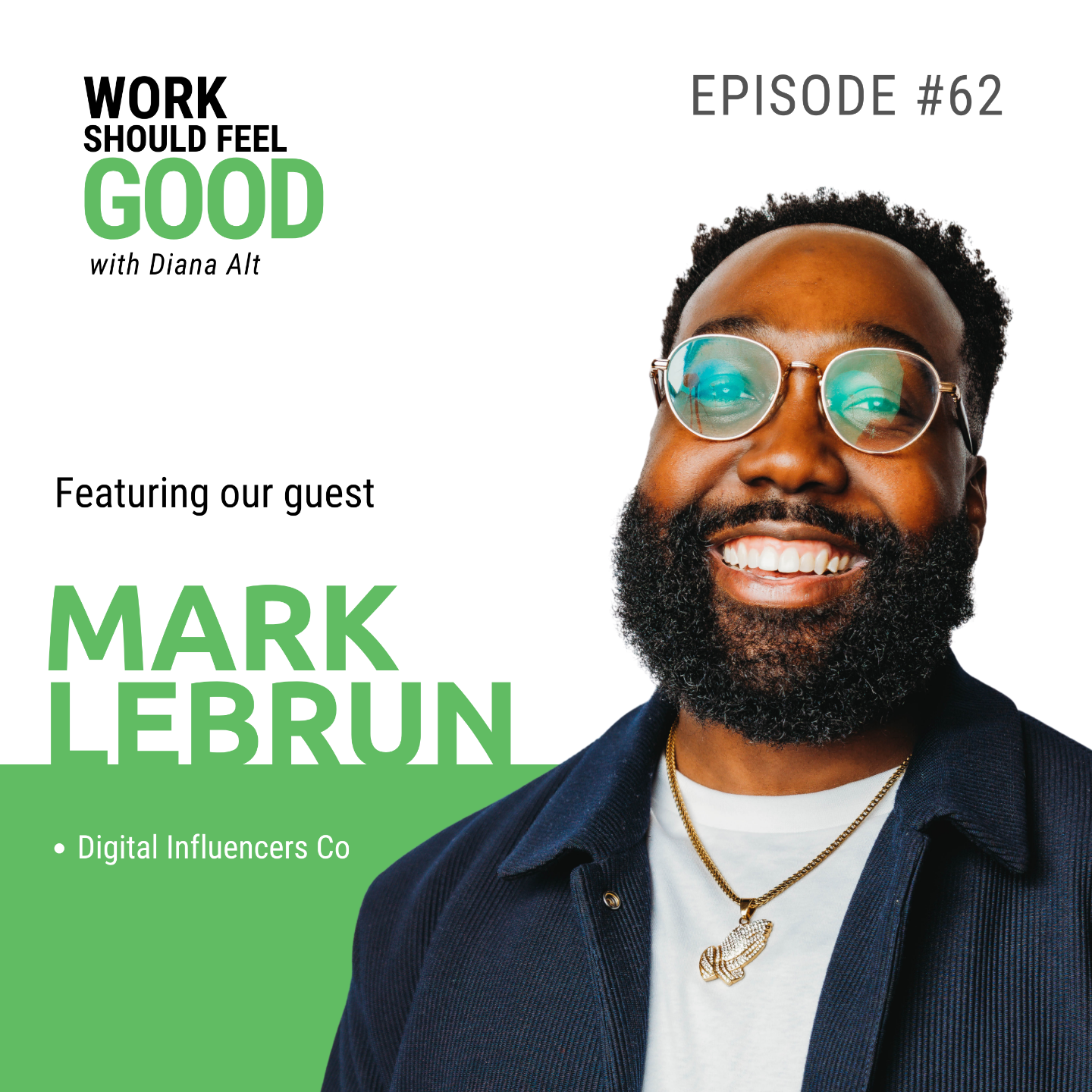
Work Should Feel Good with Diana Alt
Episode 62: How to Build Influence Without Becoming an Influencer with Mark Lebrun
Building influence doesn't require becoming a full-time content creator or internet celebrity.
In this episode of Work Should Feel Good, Diana Alt sits down with digital strategist Mark Lebrun to discuss how professionals can build meaningful influence online by serving others, creating value, and earning trust. Together they unpack common misconceptions about personal branding, social media, and online credibility while sharing practical advice for leaders, business owners, and professionals at every stage of their careers.
Whether you're growing a business, advancing your career, or simply trying to become more visible in your industry, this conversation offers a refreshing perspective on what influence really means.
You’ll learn:
- Why influence begins with service—not followers
- How professionals can build credibility while working full-time
- The biggest mistakes people make on LinkedIn, YouTube, and TikTok
- How to choose the right platform for your goals
- Practical ways to grow trust before growing an audience



Episode 62: How to Build Influence Without Becoming an Influencer with Mark Lebrun
Episode Description
What does it actually mean to have influence and do you really need to become an "influencer" to make an impact? In this episode, Diana sits down with digital strategist Mark Lebrun to unpack why genuine influence has far more to do with trust, service, and credibility than follower counts or viral content.
Whether you're a corporate professional, business owner, or aspiring thought leader, you'll learn practical ways to build a digital reputation that creates opportunities without sacrificing your authenticity.
-
Why influence is about impact, not popularity
-
Building trust before building an audience
-
Creating a digital reputation that opens career opportunities
-
How professionals can show up online without becoming "influencers"
-
Choosing the right platform for your goals
-
Why consistency doesn't mean posting every day
-
Common mistakes on LinkedIn, TikTok, and YouTube
-
Protecting your online reputation while growing your visibility
-
How digital credibility creates career and business opportunities
-
Mark's entrepreneurial journey from educator to digital strategist
⏳ Timestamps
00:00 Intro & why "influencer" isn't the goal
04:15 How Mark accidentally built a digital influence business
10:45 From hope dealer to digital strategist
14:25 Why so many professionals resist social media
18:10 Redefining influence through trust and impact
23:40 Audience building vs. trust building
28:55 Building a professional reputation without risking your career
36:45 Platform strategy: LinkedIn, TikTok & YouTube
44:20 What actually builds credibility online
48:35 What happens if social media disappears tomorrow?
53:00 Handling criticism, haters & protecting your online reputation
1:00:10 The worst career advice Mark ever received
💡Take Action
🔥 Subscribe for future episodes → https://www.youtube.com/@dianaalt
📖 Grab my Resume Don’ts Guide → https://www.dianaalt.com/resumedonts
❌ Avoid these common job search mistakes → https://www.jobsearchmistakes.com
🚪 Wondering if it’s time to walk away? → https://www.isittimetowalk.com
💼 Work with me → https://www.dianaalt.com
📢 Connect with Mark Lebrun
🌐 Website & Socials → https://hoo.be/marklebrun
🎁 Free Resources → https://hoo.be/marklebrun
📲 Follow Me On Social Media
LinkedIn → https://www.linkedin.com/in/dianakalt
YouTube → https://www.youtube.com/@dianaalt
Facebook → https://www.facebook.com/dianakalt
TikTok → https://www.tiktok.com/@thedianaalt
Transcript
Diana Alt [00:00:04]:
Hey, Diana Alt here. And this is Work Should Feel Good, the podcast where your career growth meets your real life. Each week I share stories, strategies and mindset shifts to help you build a work life that works for you on your terms. All right, everybody. Good morning and welcome to Work Should Feel Good, the show where your career growth meets your real life. I'm your host, Diana Alt, and today my guest Mark Lebrun and I are going to talk about how to build influence without going into full influencer mode, AKA Kardashian mode. Mark is the founder of Digital Influencers Co, where he helps leaders and organizations grow their influence online. But what really has always caught my attention about Mark, who I met at a conference a couple of years ago, is his belief that influence is not about chasing followers and subscribers.
Diana Alt [00:01:03]:
It is about serving people well. So, Mark, welcome to the party.
Mark Lebrun [00:01:08]:
I am so glad to be here. I am excited to be here.
Diana Alt [00:01:11]:
As if we didn't already talk for,
Mark Lebrun [00:01:15]:
you know, you are basically a good friend of mine, basically a coach of mine.
Diana Alt [00:01:22]:
Yeah, say that louder.
Mark Lebrun [00:01:25]:
I do need to say it louder because Diana is a business coach and I glean from her wisdom all the time. So I'm super excited to be here to serve your audience. We should have done this a long time ago.
Diana Alt [00:01:38]:
Well, you know, I have a lot of people I want to interview. It's so wild. Being a. Being a podcast host is interesting. Have you ever hosted a podcast, Mark?
Mark Lebrun [00:01:46]:
I have, and I turned and I closed it down. I should have kept it going, but I had a podcast in 2020 during COVID days and was that like your
Diana Alt [00:01:56]:
equivalent of learning how to make sourdough bread or.
Mark Lebrun [00:02:00]:
I wish I could learn how to make sourdough, but yeah, that was. That was one of the equivalents. I was learning and figuring it out and I was really early in the game with that. I wouldn't say I'm the earliest with podcasting because there was a lot of great podcasters going, doing some great things, but I did start one. I didn't know what I was doing and I told myself, you know, I'm eventually get back to it, and I will eventually.
Diana Alt [00:02:26]:
But guess what? I don't know what I'm doing either. I have a process and I release stuff every week. I feel like that's, you know, I
Mark Lebrun [00:02:34]:
saw how many episodes you have? Over 100.
Diana Alt [00:02:38]:
No, I don't have 100 episodes.
Mark Lebrun [00:02:40]:
What? What did I see then? I must.
Diana Alt [00:02:42]:
You just probably clicked on my YouTube and saw that there's over 100 videos.
Mark Lebrun [00:02:46]:
There's definitely over 100 videos on YouTube.
Diana Alt [00:02:49]:
Yeah, we're going to work on that some more. To Mark and I work together on some YouTube. He was teaching me what buttons to press on YouTube because when you open the back end of YouTube it's just like you want to close the back end of YouTube.
Mark Lebrun [00:03:01]:
Yes. Any sense get complicated?
Diana Alt [00:03:04]:
But no, I had, I started the, I started the podcast 16 months ago, 17 months ago, something like that. I've got 60 episodes out as of the day we're recording. And it's really interesting when people start figuring out that you have a podcast because everybody and their brother pitches you.
Mark Lebrun [00:03:26]:
Yep.
Diana Alt [00:03:27]:
Most of the pitches are terrible and they are to serve the guest that is trying to get on the show, not to serve the audience. And I don't need pitches because I have a Monday board full of like 50 people that I already want to talk to. So yeah, I mean I've taken pitches, but I think you have a digital. You basically have a digital agency though. Did it help you when you decided to do the podcast yourself? Did that help you feel good about that lane in your agency or do you do podcast production in your agency?
Mark Lebrun [00:04:04]:
I do podcast production in my agency and it has, it definitely helped me now. But fun fact, I didn't have a agency when I was doing the podcast.
Diana Alt [00:04:15]:
I feel like you've always had an agency. What was how you just seem like you've been in business forever. Mark, how did you get into this place of digital influence?
Mark Lebrun [00:04:27]:
So what happened was I mistakenly became the go to person for a lot of people in my network to glean and learn all social media marketing, content marketing, video marketing. And I was just giving game to people that were ministry leaders, non profit leaders, for profit leaders in my community and just sharing what's been working for me. At the time I was growing exponentially on TikTok and YouTube. I remember within four months I got over a hundred thousand subscribers on TikTok. What? And you know, people started asking me questions like, how are you doing this? Can you help me? Can I pick your brain? And I was just giving out the free value at the time.
Diana Alt [00:05:19]:
That's what we all knew. I feel like the people that are the most, like, I don't, I don't like when people don't get paid for their expertise. Yeah, I don't like that. But I think those of us who are in this space, a lot of the people that are the most credible did do that because they knew it was important for their own development. Yeah, like, you know, we felt like we had to earn the right to be paid well, but we wanted to learn the craft a little bit before we started going too hard. What were you doing for a day job before you had the agency?
Mark Lebrun [00:05:52]:
I was an educator. So I worked as a program manager for a non profit called City Year. So I worked in education. I was helping business, not businesses. Now I help businesses, school principals and district leaders and helping under resourced students, keeping them on track with graduation through sel learning and social emotional learning, math, reading, preparing them for the state, state standardized testing and fun fact. I used to be a teacher. So I went from teaching, then I went from, from teaching to working with school principals and district leaders and that was really fun. And what happened was I quit.
Mark Lebrun [00:06:40]:
And I think that was one of the scariest.
Diana Alt [00:06:43]:
Did you start the agency? Like were you already building your social, your YouTube and TikTok presence but before you quit? Like yeah, timeline there I was already building.
Mark Lebrun [00:06:55]:
I was already doing everything that you probably see me doing now. I was growing on social media, helping businesses and doing some coaching. I didn't even know I was doing coaching on the side. Not now. I know I was doing that. I was already doing that. But to be transparent, I quit because I, I had another opportunity that I thought was a great opportunity, but it happened to that door. That door closed on me and I was stuck like Chuck.
Diana Alt [00:07:28]:
So then you're like, I gotta eat and I do like living indoors to figure something out. So you basically took the skills that you'd been building in online influence and that you've been teaching for free and decided to make an agency out of it.
Mark Lebrun [00:07:44]:
That's exactly what happened. And, and what to be. I never told you this, to be honest with you. All throughout that time while I was building my platform and coaching people for free, and then I started, I started charging people eventually. Throughout that time, I was still applying for jobs. Oh, so, okay, so 2021 and 2022. I probably applied to over 300 job applications.
Diana Alt [00:08:14]:
Too bad you didn't know me.
Mark Lebrun [00:08:16]:
I wish I did because every interview I went through, and I went through second round, third round, four rounds, I never got the job. And at that time it was very discouraging. And I know you could talk and speak into this and I never spoke to you about this.
Diana Alt [00:08:38]:
I didn't know that. Yeah, I thought you were living the entrepreneur life earlier.
Mark Lebrun [00:08:46]:
Well, I was. I, I forced myself to do it because there was no money coming in.
Diana Alt [00:08:51]:
Yeah, I thought you were doing that for your full living earlier than what you're telling me that you were doing. So let me poke at the content that you were making. So you're working with these school systems. Yep. Who are not always well known or dealing with people that are in any way edgy.
Mark Lebrun [00:09:13]:
Yeah.
Diana Alt [00:09:14]:
But building on social media, especially when you build quickly to 100k TikTok followers.
Mark Lebrun [00:09:22]:
Yes.
Diana Alt [00:09:22]:
Involves taking a stand.
Mark Lebrun [00:09:24]:
Yes.
Diana Alt [00:09:25]:
So what were you actually talking about? Were you talking about business? You have pastoral background too. Like, were you talking about business? Were you talking about Jesus? Were you talking about education? What were you talking about to people when you were building that first YouTube and tick tock presence back then?
Mark Lebrun [00:09:45]:
Well, simply, I just wanted to be a voice of encouragement to people that were living their life through business or professional parenting. Just daily life decisions that people have to make. I just felt like people need hope, especially during the time that we were in. Yes, this is Covid time. Yeah, COVID 19 was very prominent during that time. It's. And I just felt like I needed to share and share some, shed some light and give people hope.
Diana Alt [00:10:18]:
So that you basically were a hope dealer.
Mark Lebrun [00:10:20]:
I was a hope dealer. I was still there. I was a whole dealer.
Diana Alt [00:10:27]:
I heard that term years ago, and I love it. So I feel like someday I'm gonna have merch that says hope dealer. I have a lot of merch ideas that I never end up making the merch, but that would be one of them.
Mark Lebrun [00:10:38]:
That would be great. I can see you wearing a hat.
Diana Alt [00:10:40]:
Said, yeah, I feel like that would be good. I feel like a pin would be good too.
Mark Lebrun [00:10:45]:
Yes.
Diana Alt [00:10:46]:
Little home dealer pin. When did you realize that you were onto something and that you wanted to make digital influence your career?
Mark Lebrun [00:10:56]:
I realized that when my phone kept ringing and so many people kept asking me, bro, teach me how. How you're doing what you're doing. And then I said, bingo, let me stop applying for these jobs. Because I. I applied and I said, I'm just gonna take this on and. And make this a thing.
Diana Alt [00:11:17]:
Yeah.
Mark Lebrun [00:11:18]:
I didn't know what I was doing, but I made it a thing. I said, you know what? Every time somebody asks me, I'm gonna charge you $50 an hour or. Or things of that. And I can't believe I used to charge.
Diana Alt [00:11:28]:
I wish I could get you for $50. That.
Mark Lebrun [00:11:34]:
And that was in 2021. Yeah. The end of 2021 and 2022 is when everything changed for me.
Diana Alt [00:11:47]:
Did you find that you were loving it? Because there's a lot of people making a lot of money and their phone are ringing a lot, and they don't like what they're doing. So what are you. What do you find that actually lights you up about your work?
Mark Lebrun [00:12:01]:
I found that what really made me very happy and that it really lit me up was when I was able to help pull out people's brilliance. To be honest with you, I noticed that I was attracting a lot of gifted, amazing, talented business leaders, communicators, but they didn't know how to translate that digitally.
Diana Alt [00:12:31]:
Okay.
Mark Lebrun [00:12:31]:
And what made. What excited me was I get to help these brilliant men, men and women show up online digitally, to impact people digitally. So that's what really kept me. Kept me excited because I. I saw how people's eyes were lighting up and how much fulfillment, if that. That's the word, fulfillment, when they were able to bring what was inside of them to a digital platform.
Diana Alt [00:13:04]:
When you. So it sounds to me like what you're really like. Your company is called Digital Influence. You talk about digital influence. I've seen you on stages talking about digital influence. But what you're actually selling is impact and fulfillment.
Mark Lebrun [00:13:20]:
That's exactly what I'm selling.
Diana Alt [00:13:22]:
I hope that's on your webpage. I have your website. I haven't looked at it lately. That's really good.
Mark Lebrun [00:13:29]:
We're positioning people to win online, to. To earn income and to build trust with people that they would have never built trust with in their local reach. And digitally speaking, it creates an opportunity for them to do that without even doing anything, because you can just. You can share three posts in one week, and that thing is working for you without you doing anything. And I think that's the beauty of having a digital platform. I think if we were to double down on taking what we know and putting it on the Internet and allowing the Internet to do what the Internet does with the algorithm and putting it in front of people, that resonates with it, this thing could tremendously impact our business and change our lives.
Diana Alt [00:14:24]:
I think that's what I was doing for people. I want to talk a little bit about, because there's a lot of people that are going to hear you say that. And, like, I like the Internet. It's cool. You like the Internet. You think it's cool we both eat and live indoors because we have a reasonably healthy relationship with the Internet. But there's a lot of people listening to this, and they think it sounds horrifying. Yeah, they think it sounds not just hard, like, I don't know what to say, but, like, I.
Diana Alt [00:14:55]:
I don't want to be a Kardashian. I want to do this. And so where do you think that comes from? Like, what do you have to say to somebody that's like, I. I have no interest in building a digital footprint? Everything that Mark is saying sounds gross.
Mark Lebrun [00:15:10]:
As a matter of fact, I have a perfect story for that because.
Diana Alt [00:15:13]:
Let's hear it.
Mark Lebrun [00:15:14]:
One of the. One of the people that I helped said the same thing where they didn't want to be on social media. And this person was a former professor at a prestigious university. I won't name the name. A prominent producer. And they wanted nothing to do with social media until they met me. I kept having that conversation and saying, hey, what if you brought what you know to your cell phone? Like, what if you picked up your cell phone and shared what you know with people all over the world by posting it on Tick Tock and posting it on Instagram? And there was a lot of resistance because of what people deem social media to be just noise?
Diana Alt [00:16:07]:
I was gonna say, like, tell me a little bit about what some of this person's objections were.
Mark Lebrun [00:16:12]:
Oh, it's a waste of time. You know, I don't want. I don't want. I don't want to waste my time listening to other people's voices. I don't even know how to work this thing. You know, this is for the kids. Like, those were some of the. Some of the comments that I was hearing.
Diana Alt [00:16:34]:
Yeah.
Mark Lebrun [00:16:36]:
And then one day he listened to. And six months later, 200,000 subscribers on TikTok.
Diana Alt [00:16:47]:
What did that do for you?
Mark Lebrun [00:16:48]:
Five years, a million followers across multiple platforms.
Diana Alt [00:16:53]:
Good grief. What did that do for the person, though? Because again, some people might feel like, I don't need that many eyes on me.
Mark Lebrun [00:17:02]:
Yeah.
Diana Alt [00:17:03]:
They don't necessarily see the benefit of it. So what. What did that do for that person?
Mark Lebrun [00:17:08]:
Well, it brought their message to the masses. It brought. It created income opportunities where now that individual is able to not only. Not only fully focus on the work that he was doing full time, but. But also not having to rely on other sources of income like before. Now he's relying on income that he created based on the audience that he generated.
Diana Alt [00:17:36]:
So if he. If he were. You didn't. If he. If he continues to be a professor, it's cause he wants to be a professor, not because he has to be a professor.
Mark Lebrun [00:17:44]:
That's exactly right.
Diana Alt [00:17:46]:
Basically created options. The word influence and especially the word influencer is super loaded. It is. What do you think people get wrong about influence? And I mean, above and beyond, you know, social medias for the kids type stuff. That we just discussed. What are people getting very wrong about influence?
Mark Lebrun [00:18:12]:
First of all, I, I get very frustrated because when I hear the word influence. And the only reason why is because I feel like social media has diluted that word and made that word about likes and followers. And we both know that likes and followers is not what deems somebody to be influence or influential.
Diana Alt [00:18:34]:
Right?
Mark Lebrun [00:18:34]:
Because nowadays you can go and pay for that and all you have to do is pay it. Probably $800 and 60,000 followers and likes could be drawn to your Instagram page. And that's what's literally happening of the. And I get frustrated by that because that's what is happening now. When I think about influence, I think about impact. I think about the lives who are being transformed by your work, by what you do, what you contribute to this world.
Diana Alt [00:19:10]:
I think about it, you're hitting on something really interesting because you're right. The way people think about influence is how many followers, how many LinkedIn, Substack, whatever. Pick your platform of poison and you should be on whatever. Like if you're going to be on social, if you're building a brand, build it wherever you want to build it. Right where other people tell you to build it.
Mark Lebrun [00:19:33]:
Right.
Diana Alt [00:19:33]:
If you like YouTube cool, you like Insta, cool. But we use this term to mean I have hundreds of thousands of people and I can get a brand deal for whatever. But if you ask somebody like that college essay question, come on, who has been the biggest influence in your life? Come on, it's not somebody that they're following on Instagram. It's a teacher, it's a parent, it's a best friend. It's something like that. So if you think about, you think about influence that way. So how do you scale the impact like a good parent had on you?
Mark Lebrun [00:20:11]:
Exactly.
Diana Alt [00:20:12]:
You can be that kind of trusted voice for other people. That's what you're getting at.
Mark Lebrun [00:20:16]:
That's exactly what I'm getting at.
Diana Alt [00:20:17]:
And cool episode.
Mark Lebrun [00:20:21]:
I believe everyone has the potential of being influential on and offline, but it has to start with how are you impacting people? How are you meeting a need and solving a problem for other people? Like for example, like you shared. Like, I know teachers that I can name that has influential. Like they, they had so much influence in my life and they don't even have a social media following.
Diana Alt [00:20:47]:
Have you ever gone to a funeral of a lifelong teacher?
Mark Lebrun [00:20:53]:
Ah, don't do that. I haven't. My dad young enough to. All of my teachers are still alive.
Diana Alt [00:21:04]:
So my dad taught and my mom did too, but my mom's still alive and kicking. But my dad taught school for almost 50 years.
Mark Lebrun [00:21:14]:
Okay.
Diana Alt [00:21:14]:
He was mostly. He did a couple years in high school, then he went to community college for 30 years. Close to 30 years. And then he did another 15 as his retirement gig where he worked pretty much part time for a university as a lecturer. Thousands of people were taught by my father and he was a very good teacher. And when he died, it was like wrapping around the funeral home, like just to get in to pay respects whenever they were doing the visitation stuff because. And there were people I knew. There was a person I went to high school with that had had him in community college and drove hundreds of miles to go to my dad's funeral.
Diana Alt [00:21:59]:
That to me that's what that kind of impact is like. No one's getting exactly a car and driving hundreds of miles to see the random person that does brand deals on Instagram.
Mark Lebrun [00:22:11]:
Come on, man. That and I have a special love and a heart for teacher. What, what, what did your father teach?
Diana Alt [00:22:18]:
My dad taught pre engineering courses. Nice community college. So he taught math from college algebra up to differential equations. He taught physics, he taught electrical circuits, like stuff like that. He taught chemistry in the high school. They didn't teach that at college because they had other professors for that. He could only teach so many things.
Mark Lebrun [00:22:38]:
That's amazing.
Diana Alt [00:22:39]:
That's what he taught. And he made a career out of helping people get a very strong academic foundation at the community college level before they transferred into a four year program to get their bachelor's degree.
Mark Lebrun [00:22:52]:
So that is so beautiful.
Diana Alt [00:22:54]:
Yeah, he was good at what he did for sure.
Mark Lebrun [00:22:58]:
He's very influential and it is obvious that he's very. He made an impact on those students life because they were able to honor him.
Diana Alt [00:23:09]:
Yeah. Yes. And my mom, same would be the same thing for her because she taught English at the community college level for 1 billion years, roughly. She taught all the things. So yeah, it's, it's interesting. So your framing of what can you impact people by teaching them is a really different framing than what a lot of people are trying to do when they think about influence. So when you think about what I think most people, especially most ethical people, which is the only kind of people you and I like to work with, they want to build trust. As much trust as they can.
Mark Lebrun [00:23:55]:
That's right.
Diana Alt [00:23:56]:
But a lot of the, the word, the, A lot of the conversation around online influence is about audience. What is the difference to you when you think as an agency owner and an expert in this what is the difference to you between audience building and trust building? And how do you, as an agency owner, understand which thing a person is doing? How can you tell that they're building trust in their content?
Mark Lebrun [00:24:28]:
It's gonna sound crazy how I said it, how I'm about to say this, but I know somebody is really good at building trust based on the, the community that they're building. And the reason why I say that is because people, when people trust you and they trust your voice or your content in their life, they will follow you. They will buy into your ideology, your framework, your way of thinking. And the person who has a very great way to build trust with people on the other side of a screen are gonna almost have. They're gonna always almost have a big number of people following them.
Diana Alt [00:25:22]:
This is interesting because I asked about trust and we went back to number of followers, and I can see a correlation. But a couple other things actually come up for me too, that I'm interested in. Your take on. One of them is, are people teaching their friends the thing that you taught them?
Mark Lebrun [00:25:43]:
Hmm.
Diana Alt [00:25:45]:
Which I mean, in the conversation of social media, it's. Did they hit repost? Yeah. Comment and elaborate, you know?
Mark Lebrun [00:25:54]:
Yeah.
Diana Alt [00:25:55]:
How? I guess, I guess that's like. That's an angle. That's what I do when I trust somebody that I follow. Yeah.
Mark Lebrun [00:26:03]:
That is the ripple effect when you, when you trust someone. If, if you don't trust somebody, you're not going to trust them with your friends.
Diana Alt [00:26:12]:
Let me ask this question a different way.
Mark Lebrun [00:26:14]:
Yeah.
Diana Alt [00:26:14]:
Getting at how do you tell the difference between someone that has 60,000 followers because they built trust and someone that has 60,000 followers because they bought 59,000 of them?
Mark Lebrun [00:26:29]:
Easy by, by their consistency.
Diana Alt [00:26:35]:
Okay.
Mark Lebrun [00:26:36]:
Someone who bought it, they're not going to be consistent with their, their showing their values. They're not going to be consistent in their content. But somebody who, who earned someone's trust and earn somebody's attention, digitally speaking, they've invested the time.
Diana Alt [00:27:00]:
So they're going message first.
Mark Lebrun [00:27:02]:
Yep.
Diana Alt [00:27:03]:
And it draws the people.
Mark Lebrun [00:27:04]:
Yep.
Diana Alt [00:27:05]:
Rather than just simply presence first, buying the people and then doing what they think the people want.
Mark Lebrun [00:27:13]:
Yes. And just to go a little bit deeper, they're. They're really meeting a need.
Diana Alt [00:27:18]:
Okay.
Mark Lebrun [00:27:18]:
They're really solving a problem.
Diana Alt [00:27:20]:
Okay.
Mark Lebrun [00:27:21]:
Like, there are, There are people that I follow personally. I follow them because their content, it meets a need.
Diana Alt [00:27:30]:
Okay.
Mark Lebrun [00:27:31]:
And I think that's the differentiator. I. I don't know if people would follow any of us, Diana, if we didn't impact Them meet a need if, if our content doesn't resonate with them on a social, emotional, professional level. Why, what's the, what's the point?
Diana Alt [00:27:55]:
Those are the people that when their birthday comes on Facebook, you're like, I don't know who that is anymore. Why did I follow them Unfollow. So. So one of the other things that makes people have a tough relationship with online influence or online personal brand is another thing that gets thrown around a lot that makes many people that I work with just go, is they're worried about the professional impact. Like they can't see how to build an online presence and have an opinion and not get in trouble with the people that are making it so they can eat and live indoors. For most of my people, they are working at corporations. Some of the people could be worried about polarizing because they're business owners. How do you help people navigate that? Because just saying don't worry about it is not good enough.
Diana Alt [00:28:58]:
I agree that's a very shallow way to say just don't worry about it. You're allowed to have an opinion. But realistically, we live in a world where we, most of us have, have ourselves and potentially family members that insist on eating three times a day.
Mark Lebrun [00:29:13]:
Yeah.
Diana Alt [00:29:14]:
And we want to be able to feed them. So what do you tell the people to help them navigate through that?
Mark Lebrun [00:29:21]:
I tell them to enter into conversations, to share their perspective and to really add value. I take LinkedIn for example. I know a lot of people on LinkedIn. The culture on LinkedIn is to share a lot of achievements. Like, this is what we're doing. This is what we've accomplished. I just got a promotion. I just finished this certificate.
Mark Lebrun [00:29:44]:
I just spoke at this conference. All those great things. That's amazing. But if you want to build and really have influence among different organizations, maybe you're a professional that's listening. If you start adding value, if you focus on being a valuable resource on the Internet, I think that's what will, will help create some guardrails and will keep you, keep you in this, in this lane of building trust, building influence online and, and potentially getting business and, and, and new opportunities. However, you gotta be okay with you. You have to be okay with how that you. Adding value can attract a lot of people to your content.
Diana Alt [00:30:42]:
Yeah. So there's a lady that I follow, she works for a company. I actually had her on the podcast. Her name is Bonnie Dilver. She works for Zapier as a recruiter. And this woman just posts about recruiting at Zapier and Zapier is kind of a cool company. Most people know about them because they make everything talk to each other and they're very transparent about how they do business, including how they hire. And she's amassed over a half million followers along the way.
Mark Lebrun [00:31:10]:
What platform?
Diana Alt [00:31:11]:
Oh, LinkedIn.
Mark Lebrun [00:31:12]:
That's amazing.
Diana Alt [00:31:13]:
And she's got plenty. Probably 80k on TikTok.
Mark Lebrun [00:31:17]:
Like, she's got amazing.
Diana Alt [00:31:18]:
She's got a lot of. But some people don't want that. So what I would say the thing that I tell people, I'm interested in your take on it because you're the expert and I'm just the lady that does stuff. I like to tell people if they're very first getting started and they don't even know what their voice is, to go find people talking about this stuff that you're interested in talking about, which could be your expertise. So if you're in product marketing for SaaS, go find people that are in SaaS technology leadership or SaaS product marketing and comment on their stuff.
Mark Lebrun [00:31:52]:
Yep.
Diana Alt [00:31:53]:
Comments are magic.
Mark Lebrun [00:31:54]:
Yep.
Diana Alt [00:31:56]:
And the amount of influence you can build in the comments without even messing around with posting your own stuff is really great. At the beginning, you can get content on your voice. Do you. The other thing I'll tell people is stop listening to the idiots that say be consistent. When they mean post daily. They are not the same thing.
Mark Lebrun [00:32:18]:
That's correct.
Diana Alt [00:32:21]:
You don't have to post daily.
Mark Lebrun [00:32:23]:
You don't have to post daily. Nope.
Diana Alt [00:32:25]:
On a lot of platforms, it can backfire.
Mark Lebrun [00:32:28]:
That's true.
Diana Alt [00:32:30]:
So when I think about people building influence, there's two ways people can be trying to do it that are in corporate and I'm interested in your take on this. So some people are staying in their lane. These are the people that may ultimately exit their company to be a consultant in the same general field. And so they can talk about the thing that they're doing every day. But then there's the people that kind of have a split identity, especially if LinkedIn is one of their platforms, because you only can have one LinkedIn profile. It's not like some of the other ones where you can have multiple. But they. Maybe they're a product marketer in SaaS, but the thing that they want to build is something completely different.
Diana Alt [00:33:17]:
What do you. What kind of guidance do you give to people that are wanting to build the next thing while they have to still do the current thing and eat and live indoors?
Mark Lebrun [00:33:27]:
Oh, I think. Oh, that's a very good question. The guidance that I would, I would say is if you're a professional and you are within a career, it's important that you, and you're using LinkedIn, for example, to build digital influence. I think it's important that you stay in alignment, create content in alignment with your career of choice because you don't want to be scattered and you don't want to communicate to your audience something that you're not currently doing or you're not currently in. Like, because I know for, for me, when I'm on LinkedIn and I, and I check somebody's profile, one of the first things I do is go and see where they work. And I don't know why we do this, but hey, we do it and, and it's just good for your potential prospect or somebody who wants to follow you. They know that, hey, you're speaking about things that you're actually living, you're doing the work.
Diana Alt [00:34:36]:
Can I say something?
Mark Lebrun [00:34:38]:
Yeah.
Diana Alt [00:34:39]:
I want to say this a different way and see if it is in the right lane of what you're talking about. What I'm hearing is, especially for people where LinkedIn is a primary, let's say you're building maybe your product marketer and SaaS.
Mark Lebrun [00:34:53]:
Yes.
Diana Alt [00:34:53]:
But you're building an E commerce brand. Those are pretty different.
Mark Lebrun [00:34:56]:
That's good.
Diana Alt [00:34:57]:
So if you're doing things that are that different, the more different it is, the more it might be that you actually consider picking a different platform for the secondary. And so you can decide LinkedIn is for, you know, if I, if I know no matter what I do with my E commerce business, I need to work at least a few more years in industry, then make LinkedIn primarily about industry.
Mark Lebrun [00:35:23]:
Yes.
Diana Alt [00:35:23]:
Choose another platform for E commerce brand. Does that make sense?
Mark Lebrun [00:35:28]:
Yep. Or choose another platform for your personal stuff. Maybe you got your foodie or maybe you are into cookies like myself. Choose another platform for that. Don't put it on LinkedIn.
Diana Alt [00:35:41]:
So what I would say too, what I'm also hearing is there's some things that kind of go along with almost anything. So let's say that you are a product marketing leader in SAS and you have a goal to coach and mentor leaders in tech. You can more easily talk about both of those things because if you're talking about product marketing and SaaS, you're probably going to naturally talk about leading in some way in that. And so if you intend to build a coaching business like that, it's easier to have some of that content stay on LinkedIn. Yes.
Mark Lebrun [00:36:20]:
Yes.
Diana Alt [00:36:20]:
What do you think? Okay.
Mark Lebrun [00:36:21]:
I love that.
Diana Alt [00:36:22]:
Okay, so basically, where we got to, for the people that are not used to this influence world is understand what your goals are. If they're disparate, consider picking other platforms and then being clear and consistent on what you're talking about per platform.
Mark Lebrun [00:36:40]:
Yes. Be very clear and consistent. Yep.
Diana Alt [00:36:43]:
Okay. And consistent doesn't mean daily. What are you seeing? So you're, we talked about LinkedIn. You also are a big YouTube person. You're a big TikTok person. What are the biggest mistakes that you're seeing people make on each of those platforms other than just not doing it
Mark Lebrun [00:37:04]:
specifically LinkedIn and what else?
Diana Alt [00:37:06]:
I said LinkedIn. Let's do LinkedIn, YouTube and TikTok. So let's start with LinkedIn. What mistakes are you seeing people make?
Mark Lebrun [00:37:13]:
I think, I'm not gonna lie to you. I think a lot of people are sleeping on the video platform on LinkedIn.
Diana Alt [00:37:21]:
Oh.
Mark Lebrun [00:37:21]:
Because LinkedIn is copying other platforms now and it's okay. But honestly, they are pushing out video more and more. And obviously we all know that LinkedIn is a writing platform, but you don't want to not utilize the feature that they are pushing out because it creates higher chance of you creating more business opportunity visibility.
Diana Alt [00:37:52]:
I think, I think the thing on LinkedIn I would have said is don't be afraid to show your face from time to time.
Mark Lebrun [00:38:00]:
Yeah.
Diana Alt [00:38:01]:
And I don't think that means that every single post, like, needs a cheesy selfie. But it's the, when you think about the trust gap.
Mark Lebrun [00:38:10]:
Yes.
Diana Alt [00:38:11]:
There's something about seeing a face, even if it is not a face that looks like a supermodel.
Mark Lebrun [00:38:17]:
Yes.
Diana Alt [00:38:17]:
That makes people trust you more. And so the video, it's interesting that you bring that up because before I hit record, we were talking about how some of my business has shifted this year and I didn't realize why. And then our friend Ryan said, Diana, it's because of the podcast. Because now you're putting clips from the podcast all over, especially on your primary platform of LinkedIn. I think sleeping on video. Okay, now let's talk tick tock. What is the biggest mistakes people are making on TikTok?
Mark Lebrun [00:38:47]:
Biggest mistakes is people aren't stepping into the conversations that are happening culturally. Like there are cultural there. We live in a. We live in a
Diana Alt [00:39:06]:
how interesting time.
Mark Lebrun [00:39:07]:
I see cultural time right now where honestly, if, if there's anything that I've realized is that we let a lot of negativity fuel these conversations that are happening in the culture. And I think professionals, because it's impacting professionals, is impacting the Workplace AI is impacting that stuff. It's impacting our families. We need to step into those conversations and speak into those things as well. And what I'm seeing is the same voices, but not really product managers and HR professionals.
Diana Alt [00:39:51]:
And you know what? I see them there, but let me tell you, there's not enough of them. And where I was going to go with TikTok, which I'm very new to TikTok, and I'm not trying to maximize it for explosive group growth like you managed to do a few years ago. But my take is that people are telling themselves that nobody, only Gen z is on TikTok. Nobody's talking about professional stuff on TikTok. And that does not create number one. It's not true. Like, there's baby boomers on TikTok just talking about their grandkids. I mean, there's people of all ages on TikTok now, just like there are on other platforms.
Diana Alt [00:40:31]:
Yeah, but not talking about things that are important, where you can have nuance and be gritty in the conversation is the mistake I see on TikTok. So. And part of the gritty is let's not be afraid to talk about how whatever is happening culturally, whether it's a Supreme Court decision that came down this week or how is AI impacting your business or whatever.
Mark Lebrun [00:40:57]:
Yeah.
Diana Alt [00:40:58]:
Is important. So what about YouTube? What are people messing up on YouTube?
Mark Lebrun [00:41:03]:
Oh, man. YouTube
Diana Alt [00:41:06]:
Thumbnails is the real answer.
Mark Lebrun [00:41:10]:
But live streaming, and live streaming is a big deal on YouTube, guys. I want to encourage you to utilize the. The Shorts live stream feature, meaning going on your cell phone to go live on YouTube. If you have a YouTube platform, there are other tools and platforms that you could. You can go live on YouTube on. But if you don't know those platforms, you can use your cell phone. Just make sure you have the YouTube app. But that is a really powerful platform for people.
Mark Lebrun [00:41:45]:
And I know for some people, going live can be intimidating, but if you would position your live stream as a place where people could add value and find community, you would do really great.
Diana Alt [00:41:59]:
So what does that actually look like for someone? Like, let's say you are. Let's keep with this. Product manager, product marketing leader in a tech. And that's where they want to be. They want to be like in something adjacent to that or coaching leaders in that they have a YouTube that they just opened. They opened it six years ago and has 12 subscribers. They posted three videos. So they're kind of starting clean and they feel like, why would I go live? Because who is even watching this? What do I even say? Walk us through.
Diana Alt [00:42:37]:
What is a worthwhile live look like for someone starting not for you with 78,000 followers, but for somebody that's just. I want to start using YouTube. I feel like that's my platform. I can, I do not want to do TikTok. I want to. I picked YouTube. What does that live look like for them when they first start doing them?
Mark Lebrun [00:43:02]:
I think it looks like rallying their people. Rallying like minded individuals who align with product management, SAS tools and leveraging was hot as well.
Diana Alt [00:43:17]:
Is it a rant is like a good way to start rants? I'm asking a serious question.
Mark Lebrun [00:43:24]:
Okay.
Diana Alt [00:43:27]:
This is a thing that I think is a problem in the industry or a thing that a lot of people aren't getting and I just wish they got it. And here's what it is. Is that a good place to start?
Mark Lebrun [00:43:35]:
Ranting has its place.
Diana Alt [00:43:37]:
Not like super negative ranting, but basically like, come on guys, let's, let's get this right.
Mark Lebrun [00:43:44]:
That, that is good. I agree. And even demonstrating, just being honest with your audience what's working for you and sharing how you can add value to them, those are gold.
Diana Alt [00:43:57]:
Okay, cool. So that's. I like that if people want to have more of a positive spin. So one of the things I've seen more in the last like 18 months than I had seen any other time was I don't even want to build a personal brand. And it goes along with this I don't want to be a Kardashian influencer thing. So to me, this says what we're really doing is building credibility.
Mark Lebrun [00:44:23]:
That's correct.
Diana Alt [00:44:24]:
What are the ingredients to credibility online?
Mark Lebrun [00:44:30]:
You need to be. So you, you, you're. You have the. Because you spoke about personal branding, one of the things that you need to become is a go to person for a set topic.
Diana Alt [00:44:49]:
Okay.
Mark Lebrun [00:44:49]:
A set subject, or specifically meeting a need and solving a problem. And within your industry. Now, one of the things I would say is your personal brand is like a digital resume, okay. Where you are known for an expertise professionally and you want to build off of that. Not necessarily, you know, some number of following or you want to build off of who you are, what you do and why you do it.
Diana Alt [00:45:26]:
Okay, got it. So what I'm hearing, the way I've started thinking about brand because it's such a loaded thing and everybody loves to talk about brand. We even have like just regular people who aren't trying to build a brand saying, well, that's on brand. Whenever like their brother's late to the picnic or whatever. We just say that's on brand. I think of a brand as what people say about you when you're not in the room.
Mark Lebrun [00:45:56]:
That's how I think of it as well.
Diana Alt [00:45:59]:
Cool. Yeah, we agree. That's awesome. So what you're saying is if you want people that are not in the same room as you to talk about how great you are at XYZ Thing, you have to actually talk publicly about XYZ Thing.
Mark Lebrun [00:46:19]:
Yes.
Diana Alt [00:46:20]:
Hiding behind. I don't like being online is not going to do that. You might build a personal brand at work because the people that work with you or your clients and your business are going to get it. But you can't scale that. Okay. That makes a lot of sense.
Mark Lebrun [00:46:37]:
Yep. And scaling that. And if you were intentional about scaling that, it actually creates, potentially creates opportunity for you. Because let's say you want to get in a new job or you want to start building relationships with new businesses. One of the things that people are going to do is they're going to look you up, they're going to search for you and check out your profiles. And before somebody can trust you with an opportunity, they want to know how you think, what you look like, what you're about. So your Internet, the Internet, your LinkedIn profile, your social media profile, that is now your first impression.
Diana Alt [00:47:16]:
Okay.
Mark Lebrun [00:47:16]:
And I think a lot of us need to take that very seriously. And if you do, what's going to happen is you will create more opportunities for you. So if I'm not influencing you to do that, I guess I'm not doing my job.
Diana Alt [00:47:37]:
I'm asking you a lot of questions that I know. Like I am being a little hard on you because people usually when, when they come to mark, they're self selecting in like if they've already figured out that they want a digital footprint. But what I'm trying to do is make it clear to people that, yes, it's good because, you know, you talked about person that built over a million followers and now they work on their own terms and all of those things. But I'm trying to throw all the objections that I hear at you and what are the ways to start and are there small ways to start? Do I have to be doing a million pieces of content a day? And what I'm hearing is no, you just need to start and be clear.
Mark Lebrun [00:48:17]:
That's right.
Diana Alt [00:48:18]:
And not be afraid to talk about the thing. What if every social platform that you are on right now went away? What would happen to you and your business and how would you recover from it?
Mark Lebrun [00:48:37]:
Honestly, I don't think anything would happen to my business because I'm personally, I'm gonna pivot. And the way that I believe that I will pivot is into speaking to an actual audience, like real people in front of me. And I, and I want to do a quick disclaimer. The way I personally treat social media is I believe that the person that's looking at me through their digital screen, I believe that person is a real person. So I, I treat it as if they are a real, actual person that's in front of me.
Diana Alt [00:49:18]:
Okay.
Mark Lebrun [00:49:19]:
But for me, it's simple. Just do what I was doing digitally in person. And how do you find those people? Where you go, where those people are.
Diana Alt [00:49:32]:
This is really cool though. I love that I, I, this is a question I just came up with to like, I plan some ideas for questions before I jump on the podcast, but I did not have that one. I pulled that out of my ear because we hear so many people in business talk about, oh, you don't want to build on rented land and you don't have a real business if you don't have a big website and blah, blah, blah. You're saying I built relationships because of being online and I built credibility because I was online. And if all my platforms went away, then I'm just going to start calling people.
Mark Lebrun [00:50:04]:
That's exactly what I'm going to start
Diana Alt [00:50:05]:
showing up in rooms.
Mark Lebrun [00:50:06]:
Yep. If I help people do that digitally. Right. Helping them build credibility digitally.
Diana Alt [00:50:12]:
Right.
Mark Lebrun [00:50:13]:
And I'm going to help them do that physically.
Diana Alt [00:50:15]:
Yeah. So here's my take. For people that are like, I don't, I'm not, I'm still not sold on why I would want to do stuff digitally, which is a real thing. Because right now with AI taking more and more hold, we're seeing a growth in people wanting analog and in person. Like board game shops and like board game, I don't know, like bars, restaurants, club people where, places where people just show up to play Monopoly and drink beer. Those are growing in a lot of, in a lot of areas. So if you feel weird about doing any of the stuff we're talking about online, just go do it in person first. That's where I got confidence.
Diana Alt [00:51:00]:
Now granted, there wasn't really social media except for LinkedIn when I really started becoming known for professional expertise through in person associations and stuff. But if you just still don't feel ready, pick the thing that you want to be known for and go to the meetup that has 17 people.
Mark Lebrun [00:51:18]:
Exactly.
Diana Alt [00:51:19]:
And talk about it there. And whether it takes you a week or a year or five years to get the confidence to go digital with it, you will have been building your voice while you. Exactly so.
Mark Lebrun [00:51:31]:
And that's what social media is about. It's about getting people to find you. At the end of the day, I leverage social media for the sake of people discovering all that I have to offer. Yeah, it's a tool to get people to know who I am and to see what I could offer them. And I think that's how you got to think about your digital platform. Like, you have to ask yourself, how am I creating a image, a. A way of thinking, a platform for people to say, ah, this is what he does. Maybe they can help me.
Diana Alt [00:52:17]:
It.
Mark Lebrun [00:52:17]:
This person can help me with this. And that. That's. That should be your goal. That should be your mindset. It's not. It's not just about the likes and followers. It should be about ensuring that your reputation can travel further than you can online.
Diana Alt [00:52:31]:
Reputation is one of the things, like when people think about personal brand, especially as it pertains to being online. I like to use the term digital reputation instead because I think people can understand reputation management sometimes a little bit more than some of these influencer words. So where do you stand on, like your family and you're on social media a lot.
Mark Lebrun [00:53:01]:
Yep.
Diana Alt [00:53:02]:
And you have a presence. And one thing I hear about, I don't have these kind of numbers. I have a decent following on LinkedIn, but I don't have the numbers you do on any platform. Do you deal with hate in the inbox?
Mark Lebrun [00:53:16]:
Heck yeah.
Diana Alt [00:53:18]:
This is the thing I think people are afraid of. So what is that like? And if somebody decides I really want to double down and try to grow, I want to have 100k followers on TikTok or on YouTube in the future. Talking about my domain, you have sold me on the idea that this can help me. What do people need to look out for? That's the dark side of building a following.
Mark Lebrun [00:53:44]:
Yeah, they do need to look out for hackers and haters. Those are the two things. And proper online etiquette is for you to have security processes and measures in place to protect not only your assets, but to also protect you. So the block. Block button is very much my favorite button to click when I sense that somebody is hating. I took a. I just simply block people.
Diana Alt [00:54:15]:
It took a long time for me to decide that I was going to use the block button.
Mark Lebrun [00:54:18]:
Oh yeah, I used that thing and
Diana Alt [00:54:20]:
the first place I used it was LinkedIn, which is where I have the biggest following.
Mark Lebrun [00:54:24]:
Yep.
Diana Alt [00:54:24]:
But I've decided because I value. I value discourse with people who don't agree with me, and I'm a freaking enneagram. 8. Conflict is my love language. So I don't mind getting like a little dust up, but I have seen some stuff in my inbox. I have seen some stuff in the comments, and so I ended up moving towards, I can have the disagreement, but I cannot have the disrespect. That is the line for me if you're disrespecting me. And the bar is pretty high for that.
Diana Alt [00:55:00]:
Like, I can handle some stuff, but when you start calling me names, insulting my gender or my age or my Whatever. Like, when you get personal with insults, we're mostly done. I'm not gonna. I don't need to deal with a stranger telling me that I'm just a stupid woman, which I have had happen. So, yeah.
Mark Lebrun [00:55:21]:
Comments.
Diana Alt [00:55:22]:
Yeah.
Mark Lebrun [00:55:22]:
And I've learned to ignore it and just block. I have no. No time arguing.
Diana Alt [00:55:28]:
I delete. I've. I also delete comments. Same that. Not add to the conversation.
Mark Lebrun [00:55:35]:
Yeah. You can delete them too. It's your platform. You have to remember. It's your. It's your reputation. So if there's anything that could hurt you from building trust with somebody, please do not allow that to prevent you from creating opportunities and building trust with potential client. It's all right.
Diana Alt [00:56:00]:
Do you know what I'm saying? Are the comments I'm the most likely to block.
Mark Lebrun [00:56:04]:
Which one?
Diana Alt [00:56:05]:
It's the ones where someone is attacking someone else in a comment thread on my content.
Mark Lebrun [00:56:10]:
Yeah.
Diana Alt [00:56:11]:
Because I view that as protecting my community.
Mark Lebrun [00:56:16]:
Yes. And that's a value, even if I don't know any.
Diana Alt [00:56:20]:
Like, I might not know the person, but I'm like, if you're been following me on LinkedIn for a while, like, you're my tribe, whether I know you personally or not. Are you more likely to block somebody for picking on someone else in the comments or for picking on you?
Mark Lebrun [00:56:34]:
Believe it or not, I'm likely to remove the entire video. And as you know, those videos create a lot of more views and more visibility because for some strange reason, the algorithm loves.
Diana Alt [00:56:49]:
The algorithm loves drama.
Mark Lebrun [00:56:54]:
And honestly, there's a. More. There's a. We're not even gonna go down that rabbit hole. But I removed entire videos because I said this is not good for the soul of the individuals that are arguing.
Diana Alt [00:57:07]:
Yeah.
Mark Lebrun [00:57:08]:
Let me not be a stumbling block. Let's remove this entire video period, that's.
Diana Alt [00:57:13]:
That's interesting. I haven't had to do that very often. The one time, there was one time that I went super viral with a post post on LinkedIn and I did not have that on my bingo card. It was about three or four years ago. And I posted something. I actually reposted something from like six months before that got like, decent engagement. I'm like, this is fine, it's fine. It took off.
Diana Alt [00:57:37]:
And it took off while I was driving from Kansas City to Nashville for our friend Terry's event a few years ago. I get out of my car at a quick trip or whatever to go to the bathroom and get a drink, pull up my phone. I don't like red bubbles. So I'm not the person with like 42,693 unread emails. I'm not that person. There's literally over a thousand in the bubble on LinkedIn. And I'm like, what in the world happened? And that post got well over half a million views.
Mark Lebrun [00:58:11]:
I'm not surprised.
Diana Alt [00:58:13]:
And like 500 comments or something. And I went through, through and I responded to a lot of stuff. And it. There was some hateful stuff that I just took out, but I was. The discussion was so good that I couldn't bring myself to pull the post down.
Mark Lebrun [00:58:26]:
You know, if I were you, I would repost that today.
Diana Alt [00:58:33]:
Like, hit repost just on the.
Mark Lebrun [00:58:36]:
Create a brand new post. Brand new post and create and go ahead and post that same thing.
Diana Alt [00:58:43]:
See if it happens again. It was controversial because it was perceived as me telling job seekers that they were stupid in some way and I was not. I was actually telling them a mistake that they were making.
Mark Lebrun [00:58:55]:
Yeah.
Diana Alt [00:58:56]:
And how to fix it. I was kind enough to tell them how to fix it too. So I love this. I could nerd out about influence with you all day, but I do think it's really important. I almost, you know, whenever you look at a podcast and you're like, oh, we're 57 minutes in. I do think it's really important for people to understand you can protect yourself online from stuff. So there's a tendency when people, I think are first trying to build online that they want to pull in all the opinions, all the engagement, all the things, and they don't feel comfortable. They don't feel somehow like it's their right to clean out the comments of the nonsense or to pull the video down or whatever.
Diana Alt [00:59:42]:
And you can, and it's in your best interest, especially if you work in a sensitive industry.
Mark Lebrun [00:59:49]:
Yeah.
Diana Alt [00:59:50]:
So that's pretty wild. Did you ever get called on the carpet or have any problems when you were working at that education company that we talked about at the beginning, or. Fine. Because you were a Hope dealer?
Mark Lebrun [01:00:01]:
I never got any. And he called out, nope.
Diana Alt [01:00:05]:
Okay, well, I'm gonna close with a question that I ask everybody.
Mark Lebrun [01:00:11]:
Okay.
Diana Alt [01:00:12]:
And that is, what is the worst piece of career advice you've ever received? Mark?
Mark Lebrun [01:00:17]:
Oh, career advice. I have to say it because I'm. I am a millennial, so I'm going
Diana Alt [01:00:29]:
to say, let's hear it.
Mark Lebrun [01:00:31]:
Popular. But the worst career advice that I've ever received, now that I think about it, is go to school, get a degree, and land a great job.
Diana Alt [01:00:44]:
And.
Mark Lebrun [01:00:45]:
And the reason why I have to say that is because it did not work like that for me and a lot of my peers, colleagues that are around the same age as me. I feel like I was sold a lie. Not only that, I racked up loans for a degree that I was told to take that will earn me money that doesn't necessarily fuel or feed my family today. So that was the worst advice. And. And I can't say that for every individual because there are certain professions and certain degrees that can lead to success. But that wasn't my story.
Diana Alt [01:01:28]:
And I have to say that I think that. I think people are finally figuring out that automatically going straight from high school to college is a good path for fewer people than we thought it was in the past, not for nobody. That was the right thing for me. And if I was the same kind of brain growing up now, it would probably still be the right kind of thing for me. Yeah, but it's. It's a little. There's so many other ways to figure out how to learn than there were when I went to college. So, Mark, thank you for coming and hanging out with me.
Mark Lebrun [01:02:05]:
Thank you for having me.
Diana Alt [01:02:07]:
All right.
Mark Lebrun [01:02:08]:
And I appreciate it.
Diana Alt [01:02:09]:
All right, I'll see you guys next time. Want some more career goodness between episodes? Head on over to DianaAlt.com and smash the big green let's connect button to sign up for my newsletter. Let's make work feel good together. And that's it for this episode of Work should feel good. If something made you laugh, think, cry, or just want to yell yes at your phone, send it to a friend. Hit follow, hit subscribe. Do all the things. And even better, leave a review if you've got a sec.
Diana Alt [01:02:41]:
I'm not going to tell you to give it five stars. You get to decide if I earned them. Work should feel good. Let's make that your reality.