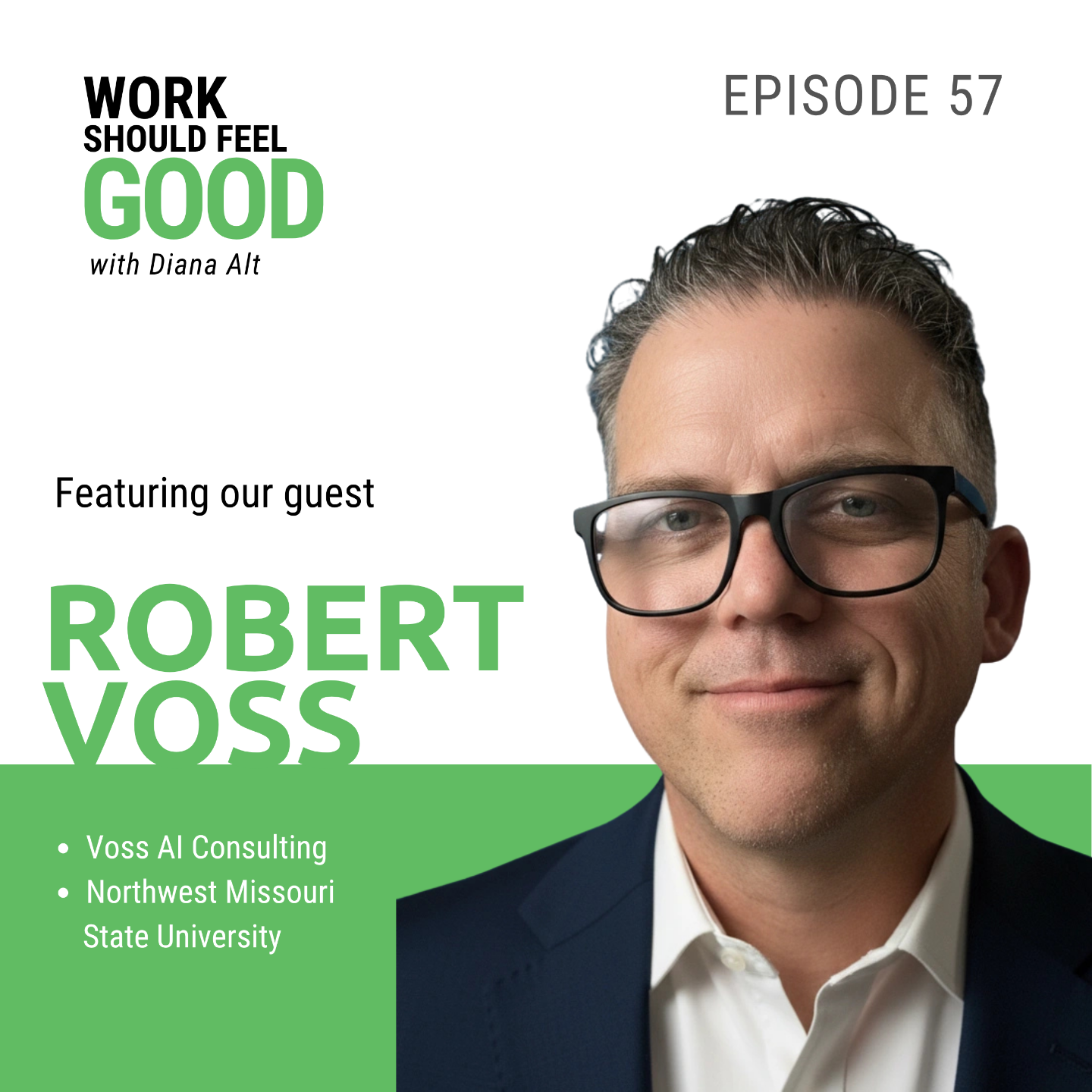
Work Should Feel Good with Diana Alt
Episode 57: Real World AI, Work, and the Future of Thinking with Rob Voss
Diana Alt sits down with Rob Voss, historian, professor, and founder of Voss AI Consulting, to explore what AI actually means for the future of work. From the history of capitalism and railroads to AI governance and workplace transformation, Rob brings a unique perspective on how technology reshapes human behavior and organizations.
They discuss AI adoption in education, why both students and faculty fear losing critical thinking skills, and how businesses can move beyond AI hype into practical implementation. If you’ve been trying to make sense of AI’s impact on your career or organization, this episode offers a grounded and thoughtful conversation.
You’ll learn:
- Why AI adoption is happening differently than past technological revolutions
- How AI can augment human expertise instead of replacing it
- What schools and businesses are getting wrong about AI implementation
- Why AI literacy and governance matter for modern workplaces
- How educators are teaching students to use AI responsibly



Episode 57: Real World AI, Work, and the Future of Thinking with Rob Voss
Episode Description
What happens when a historian becomes an AI consultant? In this episode, Diana Alt sits down with Rob Voss to explore the real-world impact of AI on work, education, business, and how we think. Rather than focusing on futuristic hype, Rob shares practical insights on how AI is already changing the way people learn, make decisions, and solve problems.
Whether you're AI-curious, leading a team, or wondering how to stay relevant in a rapidly changing workplace, this conversation will help you think more strategically about the future.
-
Why AI adoption is happening differently than past technologies
-
What history can teach us about technological change
-
The rise of AI in education and its impact on critical thinking
-
How businesses can move from AI experimentation to implementation
-
AI as an augmentation tool rather than a replacement tool
-
Data centers, public perception, and the infrastructure behind AI
-
The importance of AI literacy for employees and leaders
-
How AI is changing the pace and intensity of work
-
Practical examples of using AI as a thinking partner
-
Ethical considerations for AI adoption in schools and organizations
⏳ Timestamps
00:00 Intro and Rob's unique path from historian to AI consultant
07:11 Why AI adoption is different from previous technological revolutions
13:28 Data centers, infrastructure, and public perception
20:53 From professor to AI consultant
22:34 Digital humanities and the power of AI
30:11 What faculty and students really think about AI
34:56 Why organizations are failing employees on AI training
37:48 Bringing AI into the classroom
43:25 Student reactions to AI-assisted learning
49:36 How businesses can use AI more effectively
💡Take Action
🔥 Subscribe for future episodes → https://www.youtube.com/@dianaalt
📖 Grab my Resume Don’ts Guide → https://www.dianaalt.com/resumedonts
❌ Avoid these common job search mistakes → https://www.jobsearchmistakes.com
🚪 Wondering if it’s time to walk away? → https://www.isittimetowalk.com
💼 Work with me → https://www.dianaalt.com
📢 Connect with Rob Voss
🌐 Website → https://www.vossaiconsulting.com
🔗 LinkedIn → https://www.linkedin.com/in/ai-robvoss/
📱 X (Twitter) → https://x.com/ai_voss53755
🎁 AI Tools & Resources → https://vossaiconsulting.com/pages/labs.html
📲 Follow Me On Social Media
LinkedIn → https://www.linkedin.com/in/dianakalt
YouTube → https://www.youtube.com/@dianaalt
Facebook → https://www.facebook.com/dianakalt
TikTok → https://www.tiktok.com/@thedianaalt
Transcript
Diana Alt [00:00:04]:
Hey, Diana Alt here. And this is Work Should Feel Good, the podcast where your career growth meets your real life. Each week I share stories, strategies and mindset shifts to help you build a work life that works for you on your terms. Hey there everybody, and welcome to Work Should Feel Good, the show where your career growth meets your real life. I'm your host, Diana Alt, and today my guest Rob Voss and I are going to chat about real world AI, not just weird, esoteric techy stuff. Rob is a history professor. History. And an AI consultant who helps organizations move from talking about AI to actually using it.
Diana Alt [00:00:50]:
With 25 plus years in education and a background studying the history of capitalism, he brings a unique lens to how work is evolving, focusing on practical AI that saves time, reduces risks, and actually drives results instead of just being a shiny object. Rob, what's going on?
Rob Voss [00:01:08]:
Hey, thanks for having me.
Diana Alt [00:01:09]:
This is great capitalism. Like, let's just go there because I have a lot of Gen Z, you know, like nieces and nephews that are kind of like, capitalism is for the birds, because a lot of the young people feel that way. What got you into a history of capitalism as a niche area?
Rob Voss [00:01:28]:
Oh, that, that's great. Okay, let's. Let's talk history. So history of capitalism is fascinating for me because my area of research interest is United States first, so I'm an Americanist. And then narrowing it down to a tighter and tighter subfield. So then I started, started studying the Gilded Age, the era after Civil War, before World War I.
Diana Alt [00:01:56]:
What's the timeframe for that?
Rob Voss [00:01:58]:
So that's 1865 through about 1907, 1914, depending on our.
Diana Alt [00:02:04]:
And how does that line up with reconstruction? Is it fully inclusive or totally overlaps with Reconstruction?
Rob Voss [00:02:10]:
Gilded Age tends to go a little bit after Reconstruction. When we come to like timelines, they call it the Gilded Age and Progressive Era when it comes to us historians. But it all overlaps, at least in the area that I study. So I was studying Gilded Age. I've always been interested in railroads. Railroads have been the area of the American West. That is something that's right down my, my interest area. And then I started digging into railroads and the history of rail and rail and capitalism.
Rob Voss [00:02:42]:
Go.
Diana Alt [00:02:43]:
My dad and my uncle were very like, they were model trained guys.
Rob Voss [00:02:48]:
Yeah, my dad's, my dad was a, is a rail fan. The way I like to talk about this. My dad's a rail fan and I'm a railroad historian, which is not the same. Not the same level of nerd, but definitely a level of nerdiness. I can talk. Talk shop with my dad and his friends. At the same time, my level of interest is more of an academic direction. And so I was taking.
Rob Voss [00:03:12]:
I was looking at the history of railroads and digging into that more and more. And when it came time to work on my dissertation, when I was at the University of Nebraska, I was looking at a map of the United States. And what I was drawn to was the state of Oklahoma, which wasn't a state yet in 1865, but by 1870, there are railroads all over the place and. And yet here is Oklahoma. That had no railroads in it at all. And that got me asking the question, well, why not? If Oklahoma was Indian territory and Native Americans were totally taken over by. Were supposedly totally taken over by railroads, why weren't railroads crisscrossing Oklahoma? And what I found was in Oklahoma, there was actually an inversion of power in the Indian Territory that Native Americans had more control over railroads than railroads had control over them. And so that.
Rob Voss [00:04:10]:
It's a backward story compared to what we've been told. And so that is my manuscript that I'm shopping around. It's called, tentatively titled Tribal Capitalism, to look at how Native Americans were able to utilize capitalism in a very different structure. Because of course, you have a tribal structure and some communal identity, but then also capitalism because it's railroads. And they're going to leverage rail and access to coal and access to timber and other resources in the American West. So that's my. My area of expertise. That's the area that I.
Rob Voss [00:04:48]:
I study. And I'm actually going to be presenting this summer out in Sacramento at the Sacramento Railroad Museum as part of the Native Americans and Railroad Symposium presented by the Union Pacific Railroad and California Railroad Museum. That's wild. It's going to be fantastic.
Diana Alt [00:05:07]:
I always love when I ask a question that leads to. I'm presenting at a symposium in Sacramento on Native Americans and the railroad or whatever the equivalent for.
Rob Voss [00:05:18]:
Yeah, it's something. Something totally different. This is my.
Diana Alt [00:05:21]:
I love it. I think it's great because, you know, one of. One of the things, I believe for a very long time, you and I are both Gen Xers. We're really close in age, if I remember right. And we kind of started. At least I did. I don't know what it was like for you because we were in different fields, but I started my career with this whole idea of you got to have like a work Persona and then like your regular person. I'm like, you can't do that.
Diana Alt [00:05:44]:
And the minute the Internet became A thing. Especially when we were naming ourselves on the Internet instead of it all being anonymous bulletin boards. Like this is all out the window. Just bring. So I love knowing what. I love knowing kind of what people are into outside of their normal day job, which I guess this is sort of like your normal day job, but not. I think it's really cool. One gal who was a VP of data engineering and AI at a company that I used to work with.
Diana Alt [00:06:14]:
Like the most recent certification she had on her LinkedIn was in like wine tasting. So we kicked off with wine taste. Do whatever it is. When did you. So I heard a presentation from you back in February. We're recording this in mid May for people that are listening. But I'm listening to you talk back in February and you started getting into some of what you've learned about history and then how AI lays into it. And I honestly got confused.
Diana Alt [00:06:46]:
And it's part of the reason why I invited you on because I think that there's a line between. Of how we communicate that is sort of the thread. The history of how we communicate and interact with each other. So can you run us through a little bit of that history and kind of what you see, how you see AI making sense in that. Because you said it kind of makes sense what we're doing in that conversation.
Rob Voss [00:07:11]:
We have these changes in how we do our work, right. And what does it mean to do work? And I love the idea of this podcast of work should feel good the way that we change our work. And what does it mean to be working? AI can be leveraged in so many different ways, not just to make work faster, but also to be able to do more with less. To be able to. Which is of course the history of work. How much can we get by with the least amount of investment things along those lines. But then AI and education, that part of the world that I also work in, AI and education is this wild unknown because it comes from the middle out rather than from a top down. We don't have a government stepping in and saying, you need to do this.
Rob Voss [00:08:05]:
This is the new standard. Or we don't have a business. Which would be like my history of railroads. Railroads were only able to be possible because of the large investments from outside agencies. AI goes the other direction. It starts from middle out. And so it changes the way that we are understanding this technology. And that's a really different way of approaching a technology.
Rob Voss [00:08:32]:
Think about like automobile. Automobile was for the wealthy first. Railroads for the wealthy first. But AI is not. It is not for the wealthy first. It is for the average person first. And now it's just. That's why I think it upends so much of it.
Diana Alt [00:08:47]:
Is that right though? Because I. I'm like, yes, but no, because on the one hand, what a lot of people listening to this know of AI is what was it November 22nd is that when chat GPT went GA, they know that they know $20, you know, they know $20 a month, which is like freaking Netflix cost $20 a month now. So we're into that. But I went to graduate school in engineering management at Missouri S T in the mid to late 90s and we were talking about AI and artificial neural nets back then and there's been use in military. So when you say. When you say it's going from the inside out, like, so it's not. It's not computing or middle out. It's not computing for me.
Rob Voss [00:09:38]:
Quite right. So okay, so the AI that we were talking about in the late 90s or mid to late 90s, we were talking about machine learning, we were talking about the computer doing work for you rather than. And I'm falling into my own trap, which I rally against this all the time, is being generic. What we're talking about, specifically talking about large language models and gen AI that is a different beast than machine learning and AI as applied to data centers, applied to the various compute levels that we've had. Of course there has been machine learning. Of course there's been some other levels, other levels of AI. What was different for November of 22nd is that it became public. OpenAI released ChatGPT3, but there had been some of us who had access to previous models.
Rob Voss [00:10:35]:
I had been playing around with GPT2 before beforehand, so I knew that this was coming. I had also played around with some image generation models and they were quite frankly, terrible. I mean, not like, remember when Mid
Diana Alt [00:10:47]:
Journey first came out and you're like, why does everyone have seven fingers?
Rob Voss [00:10:51]:
Oh. Oh. It was, it was really, really bad. So I do obviously railroads in Native America and what I was working with, I actually gave that prompt into what I think. I'm not sure which. Which image generation model it was. I don't think it was even really named yet. And what it put out was a sort of an image that had some images kind of of a railroad that was going backwards that didn't seem to be connected to anything else that had some browns and reds to represent Native America.
Rob Voss [00:11:24]:
And yet it, it really did not make much sense. And then of course, even Mid Journey A couple months later is coming out with images. And yes, those are images, but they're not good images at all. They're. They're not accurate. And then now we have just some incredible image generation and not just images, but cinema, cinema graphic filmmaking from Notebook LM and some other tools like that. That is just pretty amazing. And then throw in there the other Higs field and some of the other really advanced AI film generation.
Rob Voss [00:12:02]:
That is pretty wild.
Diana Alt [00:12:04]:
But the idea talking basically. So when we're saying AI middle out and we can just, we can just say for the rest of this podcast that this is what we mean because most of the time this is what people mean. You are specifically talking about the generally available LLMs that people have been. And this is like the generally available ones were available before the enterprise ones because they base the enterprise ones like Copilot and Claude for enterprise on basically on what they went GI with for $20. So I think that this middle out thing is super interesting though when you look at how communities are reacting to data center builds. That is so wild because my hometown is Pacific, Missouri. It's outside St. Louis and there's been a lot of hot topics about like wanting to build a data center and these little like, you know, the board of aldermen in these little tiny towns, they don't necessarily know how to think about this and nor the citizens.
Diana Alt [00:13:14]:
But it's wild. You hear more, you hear more of these getting killed because of popular sentiment. Then you hear other types of factories or rezoning that people understand. Right.
Rob Voss [00:13:28]:
And I think that one of the major, major missteps that has gone on with AI has with gen AI. Right. Large language models. There have been a couple. One is that because it has been a middle out approach, there has not been consistent messaging and there hasn't been enough. There hasn't been the right kind of messaging to kind of get the public on board. Some of us who have studied it or have been tech forward, I've always been tech forward. I've been well aware of this for a long time.
Rob Voss [00:14:06]:
However, colleagues of mine don't want to pay attention to computers or people in, in the business world that they have
Diana Alt [00:14:15]:
to have an email account. Some of them, yeah, pretty much.
Rob Voss [00:14:17]:
Right. I mean that, that kind of thing happens.
Diana Alt [00:14:19]:
Exaggeration.
Rob Voss [00:14:21]:
Exactly. And so when you get that kind of a situation, then now you get a company that wants to build a data center. Well, there's an automatic association that a data center is going to be like the worst examples that are out there. Colossus One might be the best, worst example, Colossus 1 being in Memphis that was built in less than a year by Xai and Elon's Elon Musk Company. It is notoriously located in a poor location. It has noise factors. It does put out noise because it does have major cooling processes that are not done in an efficient manner. They leveraged all sorts of energy deals to be able to get energy for the data center, which then in turn drove up or is helping to drive up some of the energy costs for consumers, which again, that's not fair.
Rob Voss [00:15:17]:
This is a massive multi billion dollar investment that should, if done right, should benefit the community that it's being built in. Data centers, as you know, they've been around for a long time. We've had them since the early 90s, even before that. The difference now is that data centers are being associated with AI. And where I live in Northwest Missouri, we have a opportunity to have a $4 billion data center to, to come in. We have no zoning in parts of this, in this part of the state. No zoning whatsoever. It's farmland that's being purchased.
Rob Voss [00:15:56]:
Yeah, I mean you would think in any other time a $4 billion investment would be something that most other taxpayers would be interested in because now you have a major company that's willing to pay taxes. And yet we are getting such pushback because there's fear. Again, the data center has done a bad, the data company has done a bad job of informing customers, informing the public, getting the public on board with them. And so those of us in the AI space are having to.
Diana Alt [00:16:28]:
It's a really interesting thing because when people are building like an industrial park or you know, a giant shopping, you know, the giantest of the super store whatevers or a regular ass factory, people understand and can grasp what those things are.
Rob Voss [00:16:47]:
Exactly.
Diana Alt [00:16:47]:
And they don't, they don't understand this thing. And then you're also dealing with entities that have not had to have nearly as much oversight and coordination with the government to begin with because they're exploding. It's super interesting. I could nerd out about this all day. I should find somebody to talk about this. But here's. Yeah, go ahead.
Rob Voss [00:17:11]:
One more, one more thing on that. We have, where we are, we have major wind farms around here that have a lot of excess electricity, that. We also have some natural gas pipelines that go nearby. We also have fiber lines. So all of these are the infrastructure desired by a data center. And so, and then it's. Oh, and that's land. And there's no zoning.
Rob Voss [00:17:32]:
And so you would think that the land has already been sold. You would think that there would be some interest in this. And yet there's such fear of water consumption. Although we have golf courses all over Missouri, nobody is concerned about the water consumption of a golf course. It's just kind of obvious that golf. What golf courses do. Right. Data centers are mysterious.
Rob Voss [00:17:58]:
Yeah. I actually was able to. To visit a data center a couple months ago here in the Kansas City region and they talked about how everything's recycled, recycled water, recycled electricity.
Diana Alt [00:18:09]:
We learned the water cycle when we were in fourth grade. Right. It still applies.
Rob Voss [00:18:14]:
Yeah. And so you can capture that and, and incorporate it inside the data center, which most of them do. And you just have those bad stories bike about, like about Colossus early. Yeah. Or the, the stories about energy use and water consumption by AI based on a ser. Based on a piece of data that came out in January of 2023. So it's only two months after chat GBT came out and based on that data, people are still using that information to. To label AI as.
Rob Voss [00:18:52]:
As harmful or expensive. Yeah. Which it's just not the same.
Diana Alt [00:18:56]:
And so let's do you. That. That would actually be a really. I would like to learn more about that because when I, when I read a lot of the stuff about that, it doesn't pass the sniff test for me. But I also am not a sustainability expert, so.
Rob Voss [00:19:11]:
Well, yeah, you, you get people that, that are. They don't realize how the speed of change for AI and those of us in the AI space, it's just so massively changing. I'm sure something's going to come out today because I'm on a podcast talking about AI, that there's going to be another change probably today because that's the rate of change and it's amazing. It's fascinating. As a historian, there's been nothing that's changed as a technology in such a short time of frame. A short time frame.
Diana Alt [00:19:46]:
Anything in history that you can think of that's been this like technology or otherwise?
Rob Voss [00:19:51]:
No, there's nothing like this.
Diana Alt [00:19:53]:
So we truly are in unprecedented times.
Rob Voss [00:19:56]:
Absolutely. So Chad, GBT was the first company, what they do, they went for, went to a million users. First company ever to go to a million users in five days.
Diana Alt [00:20:10]:
I remember that it went live right when I was at a conference and there was a couple of very AI forward people there that were talking about it and I was like, what is this? I don't know what this is. So a couple of people like had it on their phone or whatever. I want to do something because there's some practical app. I promise people, practical applications. You're learning more about how you think about practical applications. One thing I always like is like the little tiny cliffsnote story of how somebody kind of went through their career to get where they're at. And history professor and like AI consultant slash fractional CTO or whatever your LinkedIn says. Now those don't go together in the minds of a lot of people.
Diana Alt [00:20:53]:
So can you give us the real quick thing, kind of the quick path. And then I want to talk about AI and education before we go into like how you're working with businesses.
Rob Voss [00:21:04]:
Yeah, so I've always been tech forward. Like I was saying, technology has always been part of what I, what I do. So my route to becoming a professor is a little bit different from some others. I pursued a teaching credential after getting my undergrad in California. And when I was teaching, going through my teaching credential.
Diana Alt [00:21:28]:
You're a professor that learned how to teach.
Rob Voss [00:21:31]:
Yeah, exactly right. I actually taught first. So I was a high school teacher for three years, but before that I was teaching my original certification as a K8 certification. I was thinking I was going to be a middle school teacher. And then middle school didn't work out. But I had a ninth, up to ninth grade social studies. I taught. And so every time that I was teaching, it was always, how can I do something else with technology? Whether that was building websites for my, my kids, having them use the first digital cameras.
Rob Voss [00:22:00]:
But then when I got into my PhD program, I was working on digital humanities. And digital humanities is a different space to use computers to both display and to understand history humanities. I was able to connect with a group at the center for Digital Research in the Humanities, the CDRH at the University of Nebraska. And I had a couple of different stints with them as a grad student, graduate assistant, worked on a couple of projects, railroads at Nebraska, application of digital humanities.
Diana Alt [00:22:34]:
Because I've heard a lot of words in my life or terms in my
Rob Voss [00:22:37]:
life, that one is digital humanities. So a great example of this is we worked on a project called Civil War Washington. And Civil War Washington is an attempt to understand the city of Washington, D.C. during the Civil War itself. We had three different professors who were principal investigators, the PIs, and they. One of them, Dr. Susan Lawrence, she works on history of medicine. Dr.
Rob Voss [00:23:05]:
Ken Price works on Walt Whitman and, and Walt Whitman studies. And then Dr. Ken Winkle is a Lincoln Scholar. And so the three of them together, were working together on Washington, D.C. and so we were looking at, for example, a map of Washington, D.C. how did Walt Whitman cross paths with Lincoln? And what did they. What did Lincoln see, for example? And we know that he. By mapping out Washington, D.C.
Rob Voss [00:23:35]:
and where he went to on certain days that he would have passed by, for example, an army hospital. Well, army hospitals in Washington, D.C. are chopping off limbs to keep people alive. Amputations are a big deal. So the history of medicine is going to cross over into the history of Lincoln, which is going to cross over to the history of Whitman writing about Lincoln. All these things kind of coalesce together. And then when it comes to digital humanities, what we were able to do is build that map online, take that map, and then explore other aspects with it. And one of the things that we are able to figure out is you're probably familiar with the Emancipation Proclamation, which frees.
Diana Alt [00:24:19]:
That's a banger.
Rob Voss [00:24:20]:
I like that one.
Diana Alt [00:24:21]:
That's a good one.
Rob Voss [00:24:22]:
You probably didn't know that there is. There was one before that called the Compensated Emancipation Act. And what Congress figured out is that based on the Fifth Amendment, you can't just take people's property. And so what they tried to do is figure out a way to compensate people for their formerly enslaved people. And Congress has control over Washington, the city of Washington. And so Congress issued an Emancipation Proclamation for the city of Washington, freed the slaves, but then also gave opportunity for those former slave owners to get paid. They had to fill out a bunch of paperwork and file it with the government. And they would.
Rob Voss [00:25:04]:
And describe the people that they were owning, describe how they came to own them. So they had to have a receipt, and they had to have a couple of people swear to their ownership. Well, all that paperwork had to be recorded, and the government kept it.
Diana Alt [00:25:21]:
And then you're digital. I don't want to go to, like, yeah, I want to get back to some of the other. But the digital humanities is basically taking all these different layers of history on top of each other to say, this is. This is what happened with.
Rob Voss [00:25:35]:
So what we did is we digitized all of those documents from the federal government back in the 1860s. And then now that it's digital, we can now analyze it.
Diana Alt [00:25:45]:
Cool.
Rob Voss [00:25:46]:
So it's a couple different steps, but now. And now with AI, we can actually point AI to those documents and say, tell us what it says, give us some things that we don't know about it, which I've been able to do, which that had taken us 10 years to do by hand. And now I can do it on my laptop in a couple minutes.
Diana Alt [00:26:11]:
Yeah, it's wild. Well, thank you for explaining that because I've never heard that term. And those are going to be like fun learning websites for people.
Rob Voss [00:26:19]:
So hopefully, hopefully it'll be easy.
Diana Alt [00:26:22]:
You got in, you got, you did your grad work, you did all these kinds of cool projects at Lincoln, you're now a professor. So in addition to Voss AI Consulting, which you can see your logo if you're watching the YouTube, you have this kind of gig you have. I think it's your day job. If I'm not now it is.
Rob Voss [00:26:41]:
It's summertime.
Diana Alt [00:26:43]:
Yeah, I guess it is. So talk a little bit about what you're teaching and doing at.
Rob Voss [00:26:49]:
Sure.
Diana Alt [00:26:50]:
Your institution.
Rob Voss [00:26:51]:
So I teach American history is the majority of my work at Northwest Missouri State University. And as I was teaching there, I was given an opportunity to teach a class called Information Technology and Culture and Infotech and Culture explores technology and philosophy and what does it mean for our current culture. I taught that class for about nine or 10 years. And then I also teach a digital humanities class as a regular rotation that works through different approaches to digital humanities and that connects with like museum studies and some other things like that. So you go to a museum that has all these digital displays. Go to The World War I Museum in Kansas City has all these digital displays. Who is figuring that stuff out? Who's building that? There's actually people that are trained in that, that field. And then what.
Rob Voss [00:27:46]:
Basically what happened was because I was already up on AI when Chad GPT came out and I kept. I'm really like it. I think it's really interesting. And so I kept talking about it. And then I was able to offer some workshops on campus to other faculty members and I was able to offer some. I was asked to give some presentations to different community groups. And then I was asked to give some more presentations. And then more and more, more and more and more, I.
Rob Voss [00:28:12]:
I realized I was doing it a lot. My wife actually said, you know, Rob, you've got it. You could actually make something of this. There's something else out there. And it's, it happens a lot within business faculty. Business faculty often have a job.
Diana Alt [00:28:28]:
Like if you're in business faculty and you don't have a business on the
Rob Voss [00:28:31]:
side, like, exactly, exactly.
Diana Alt [00:28:33]:
Even doing.
Rob Voss [00:28:34]:
But historians don't usually do that. And so there's a lot of opportunity. And because I do so much education work and I realized that, okay, I've been teaching for a long time this is what happens for companies they need not just. Not. Not just like thought leadership, but it's also meeting with their leaders, the leadership team at their corporation, to say, how can we use AI? And these are ways you can use AI, not just to get faster, not. Not just automation, AI. That. That's kind of the low bar.
Rob Voss [00:29:10]:
What we're talking about is augmentation AI using. Getting people to be able to think with and really push those boundaries to see what else can I do with
Diana Alt [00:29:20]:
AI and that you and I talked about before. Like, I want to hit. I don't want to blow right past educators because, like, I. And I don't. This is not really an AI podcast. Like this episode is clearly. But before we hit go, you said that you now have a semester or a year of data, you have actual data on students, and that you have been incorporating AI into your history classes, which a lot of people would not have that on their bingo card. Can you talk a little bit about what you have been doing in the classroom alongside teaching history and what you're observing in trends and learning, or just kind of what's it doing? And especially some of the stuff I want to hear good and bad.
Rob Voss [00:30:11]:
Okay, so because there's so much concern
Diana Alt [00:30:12]:
of like, can anybody critically think anymore? You know, absolutely. Talk about that.
Rob Voss [00:30:17]:
So I've got. I actually have data, which again, AI enables us to be able to. Yeah, I've got data. Historians don't usually do data. We like to do anecdotes.
Diana Alt [00:30:26]:
Data is qualitative data.
Rob Voss [00:30:28]:
Exactly. Data is a little bit different. So what I did is in January, I was able to give a presentation to our faculty at Northwest. And before I gave that presentation, I polled my faculty, pulled the faculty. We had about 100 faculty members in attendance, and I asked them anonymously. So I didn't get their actual personal data. I wanted to know where they, as faculty members were using AI, what they felt about it, what their opportunities, fears, et cetera, that kind of thing. So I asked that about our faculty, but I also asked very similar questions about of our students, of my students.
Rob Voss [00:31:10]:
So I pretty much made the same poll for my own students. I again, anonymized it. And I asked them about the same time, what were they concerned with, how are they using it, et cetera. And most faculty were using it. There were very few that weren't. And maybe we had some bias issues with the sample. I understand that. So I'm not going to really publish this.
Diana Alt [00:31:31]:
Might not show up. Yeah.
Rob Voss [00:31:32]:
Yeah, exactly right. Because the structure of the PD day that we are giving now. Not everybody was in my professional development group, but it was geared towards all the faculty at Northwest. But what we found is that majority of faculty members are using it. They were concerned with AI doing grading for us. They did not want AI to replace that part, even though AI could be doing some of the grading. That was a concern. But the other concern was for our students.
Rob Voss [00:32:08]:
And the concern was that it's going to replace critical thinking. All right? That students aren't going to be thinking as critically as they had been in the past. What was really interesting is when I looked at the student data, the student data was almost exactly the same as the faculty data. Students were also concerned about losing critical thinking. And that's actually, that's encouraging.
Diana Alt [00:32:31]:
And you have mostly. Does your, does your student population that you surveyed, are they mostly of traditional college student age or is there a high percentage of non traditional older students?
Rob Voss [00:32:44]:
Great question. No, these are, these are, the vast majority are traditional undergrads on ground, on campus.
Diana Alt [00:32:53]:
Like they're in kind of a normal range of matriculating.
Rob Voss [00:32:56]:
Okay, exactly. 18 to 23 year olds generally, generally
Diana Alt [00:33:01]:
feel the same way as, you know, 40, 50, 60 plus faculty. That's interesting.
Rob Voss [00:33:08]:
Not with the same percentage, but you definitely had some concern. Now what both groups said, and this was also interesting and it's borne out with other data from anthropic and from OpenAI that I basically, they came up with I use it every day, but I hate it.
Diana Alt [00:33:27]:
Which group said.
Rob Voss [00:33:28]:
Both groups said that.
Diana Alt [00:33:29]:
What did they hate about it? Did you ask?
Rob Voss [00:33:31]:
They just didn't. Either they didn't trust it or they didn't really like it or they were afraid it was going to replace things, but I'm still using it. And so what that, what we're finding,
Diana Alt [00:33:42]:
no one likes Microsoft Teams either.
Rob Voss [00:33:44]:
Right? What we're finding is that people are using, they're expected to use AI, but there's no training. They haven't been trained actively on how to use it.
Diana Alt [00:33:55]:
Well, that is another middle out thing that has happened. Now in general, like one of the things that has been talked about ever since I entered the workforce, you know, with a big girl job in 1998, is how companies don't train anymore. But this is a whole different level of not training. This is not like, oh, we like, we want to hire people with 3 years of experience or 5 years of experience or whatever doing XYZ. This is brand new and you're being evaluated on whether you use it. I know. By the way, we have no guardrails and no guidance for you whatsoever on how to use it. And I've watched people get fired from software engineering jobs, multiple people I've talked to that got fired from software engineering jobs for not adopting AI into their coding fast enough.
Diana Alt [00:34:43]:
And they had zero governance and zero training anything.
Rob Voss [00:34:48]:
Right.
Diana Alt [00:34:49]:
Which if you're a company that does that, you suck.
Rob Voss [00:34:52]:
Yeah, right.
Diana Alt [00:34:53]:
You just suck. And you need to change your tune.
Rob Voss [00:34:56]:
So on the flip side of what, what can be done? Right. I mean, AI is, with Gen AI, the ability is, is really amazing. Yeah. And it change. It's not going to. I don't think it lowers the bar. I really don't think it does. I think what it does is it amplifies what we can already do.
Rob Voss [00:35:14]:
And so what we've seen is that the experienced person who encounters AI at their job, they can then look at the results from AI and say, yep, I agree with that, or nope, that's wrong. And I'm going to evaluate the response. But the response is done. Instead of taking an hour, it's going to take two minutes. And so now it's going to accelerate your job. But the inexperienced person, what's going to happen is they're going to run into an AI response and they're going to just trust it. They're just going to go with it like I gave it to me. So there, there we go.
Rob Voss [00:35:44]:
And that's where this, this, the dissonance comes into effect because you don't have the training that, that goes on. And that honestly is where I come in, where I can come in and train people. I've trained multiple entities, multiple businesses, school districts on how to implement AI, especially starting with school districts. What are some ethical ways to implement it, what are ethical considerations? And then what are some effective ways?
Diana Alt [00:36:18]:
I think it is unethical for any education institution, except for maybe people working with primary grades, to not be having AI fluency and usage regularly in front of students. It's. But you have to do some with and some without. That's my take. And you have to know what good looks like.
Rob Voss [00:36:41]:
Exactly. You have to know what good looks like, but you also have to know what, what are the ways to increase friction? Right. Friction is what? In education you need friction for that learning to occur. Right. You need that, that point where you're actually going to encounter and it's going to stick with you. Right. That content. A couple friends of mine, gentlemen, I know that they've created AI Friction Labs is what they call it.
Rob Voss [00:37:09]:
AI Friction Labs is for educators that Especially in the humanities and history, to apply AI learning and actually have friction for it to actually.
Diana Alt [00:37:21]:
How are you making friction in your classes? Because you said that you took all that stuff from January.
Rob Voss [00:37:27]:
Yeah.
Diana Alt [00:37:27]:
Then you have in some or all. If I know you, it's all of them. You have some stuff that people are required to use AI tools in your history classes.
Rob Voss [00:37:40]:
Yeah.
Diana Alt [00:37:41]:
What are you. What kind of things are you having them do? And how is the friction happening in your classrooms?
Rob Voss [00:37:48]:
Great question. So what we end. What I've ended up finding over the years is that when people go to write a history paper and for my classes and yes, these things change over time. Back in the day when we were going to school, we had experience in high school writing history papers. And then you go to university and you already know how to write a history paper. What I'm finding is that we have students coming from all over and there's no set standard of how to write. So I always spent. I ended up having to spend a lot of my time just basically instructing people on how to get the product of a history paper to look right, let alone thinking historically.
Rob Voss [00:38:24]:
And so what AI was able to do is I was able to focus way more on getting people to think historically instead of having to think about the product coming out at the end. Yeah, that makes sense.
Diana Alt [00:38:38]:
And so it was much more about like 100% sense. And like I said, my mom taught English, my dad taught pre engineering stuff, my mom taught English composition and literature. And I think about, you have to know what good looks like is the thing I always put in front of people. But there's a gentleman I should introduce you to. His name's Michael Hirsch and he was on my podcast. He is a product management leader turned AI consultant for product teams. And the thing that he talked about a lot is how, number one, mostly what is getting freed up is time to actually talk to customers, which is a big deal in product. But the thing we also talked about, I can't remember if we talked before, like offline or in the show.
Diana Alt [00:39:23]:
We talked about how AI is making work feel more intense because you're doing the cognitive load. The thing that was like that comfortable admin task at 3:00 clock on a Friday when you're kind of over. It is not exist anymore. So it's a different pace.
Rob Voss [00:39:44]:
Yeah, yeah, absolutely. So when it came to my classroom, I. So I normally would require. So it did. Here's. Here's a pace change. For example.
Diana Alt [00:39:54]:
Okay.
Rob Voss [00:39:55]:
Because in history class I was spending so much time in Getting that paper to be figured out. In the past, I would only be able to really require one history paper for the semester. But that doesn't give opportunity for growth. I really needed to have multiple so we could show change over time. History.
Diana Alt [00:40:13]:
Yeah.
Rob Voss [00:40:13]:
And so now I. This last semester and the semester before. So fall and spring, I asked for three history papers. First one's short. First one. Next one's a little bit longer. And don't get me wrong, they're not long. They're not like 20 pages.
Diana Alt [00:40:27]:
They're not new.
Rob Voss [00:40:28]:
And 25 pages, not even close. They're short. But it was an opportunity to show growth. Right. And I also taught them on how to use AI. So I was giving them instruction, not just go use AI, but I was practicing what I preach. I was teaching them how to use it, teaching them good prompting techniques. I made sure that they all had access to an AI program.
Rob Voss [00:40:51]:
I gave them the opportunity to try multiple because they had access to Gemini, they had access to ChatGPT and had access to Claude. I believe some of them at different levels, some of them were still on the free accounts. And Northwest does not have a university wide AI program. So that was a little bit limiting. What we were able to do, though, students were able to do this work. And then my last paper that I assigned to them, I also asked for about a couple paragraphs about what they thought about this assignment because I need the feedback. I actually, I'm really straightforward with my students and I'm asking for the feedback. And what I found was that my A students came back and they hated having to use AI because they already knew how to write.
Rob Voss [00:41:39]:
They knew how to do a history paper or they were going to be history majors. They already liked it. They didn't need another reason to or another tool to have to use.
Diana Alt [00:41:48]:
I talked to people that are computer scientists. They feel. Some of them feel the same way because there's people that are kind of like workman, like computer scientists or coders. And then there's the people that are craftsmen or craftsmen, and the people that lean towards craftsmen hate it because they're like, but now I'm not in my code. Like, I don't. Because they want it to do amazing things efficiently, but also they want it to be well structured for maintainability and commented well, like all those things that in varying degrees are able to be done. So this is like the history equivalent.
Rob Voss [00:42:25]:
Exactly.
Diana Alt [00:42:26]:
Major kids, what does the actual process look like differently though? Okay, go into what your other students thought.
Rob Voss [00:42:34]:
Yeah, yeah.
Diana Alt [00:42:35]:
About what? How did the Steps change to write the paper for the students.
Rob Voss [00:42:40]:
Oh, that's. That's an interesting question.
Diana Alt [00:42:43]:
Before I get there, guys, I did not know I was gonna ask, like, 60% of this today. So thanks for being along for the ride. Okay, keep going.
Rob Voss [00:42:51]:
So to get there to. To get to the BNC students. So the A students really hated it, but my BNC students really, really appreciated using AI in the classroom. Having to use AI and then being taught how to use it. Because my class and I got this in multiple responses. My class was the first class to authorize AI for them, the first class that they'd experience with. I had one student say how this is the first time they used AI for anything serious rather than just screwing around and putting up images on the Internet. On the Internet, Yeah, exactly.
Rob Voss [00:43:25]:
So they, up until this point, have been told by all of their teachers, never use AI because their teachers had only been around for a little bit.
Diana Alt [00:43:33]:
While I roll my eyes.
Rob Voss [00:43:34]:
They hadn't gotten trained.
Diana Alt [00:43:35]:
Right.
Rob Voss [00:43:35]:
Their teachers hadn't been trained or hadn't thought deeply about how to use AI. And now it's only now that we're starting to have some conversations about using AI effectively in a classroom and really to rethink how we do what we do. Um, and so when it comes down to the process, quite frankly, I had law students who were doing things. They already did things last minute, so they're going to do things last minute anyway. I found them circumventing some of the research process, which was disappointing, but also not unexpected. They're going to ask AI for a summary of a book rather than, where can I find the book on the shelf? Well, obviously, I can't get it that. Give them that. But they're not actually consulting the text or the article, but they might be.
Rob Voss [00:44:31]:
And they're going. And so that did take some instruction to say, okay, now you actually do need to read the paper. You do need to read the article that you're basing your paper on. You do need to get into the sources a little bit more.
Diana Alt [00:44:44]:
But it's easier to find the right
Rob Voss [00:44:45]:
sources to a point.
Diana Alt [00:44:49]:
Or is it too much? Because now you have so many. It's not like when you walked in the library in 1996, and, well, it's like, well, there's three books on this topic, so.
Rob Voss [00:44:58]:
Exactly.
Diana Alt [00:44:58]:
So now three sources. So here we are.
Rob Voss [00:45:02]:
Now you have 250 million sources that are on at your fingertips, and that. That's a literal number of how many. You have access to all of the. The. The articles you can ever imagine. Plus newspapers.com has all of the newspapers of the United States ever made. We have access to New York Times going all the way back to its origins. So like the, the number of sources is not an issue.
Rob Voss [00:45:29]:
Filtering those sources, that is something different, reputable and good.
Diana Alt [00:45:33]:
So they, so basically they had pros and cons to the research side.
Rob Voss [00:45:38]:
Yep.
Diana Alt [00:45:39]:
What else looked different for them?
Rob Voss [00:45:42]:
Oh, their, their responses tended to be deeper. I asked for AI interaction logs, I asked for screenshots to show me that you're, how you're using AI. So it wasn't just the end result of the paper. I want to see their processes. Some of them got it right away. Some of them were asked treating it like Google, which we worked on not doing that. But these are students and I'm a pragmatist. I know what they're willing to do and I know what they're not going to do.
Diana Alt [00:46:13]:
And so this is the same thing as when you had to turn in your outline and your note card in 10th grade English.
Rob Voss [00:46:19]:
Exactly.
Diana Alt [00:46:20]:
Research paper year when I was in high school was 10th grade. That's very simple. Yeah.
Rob Voss [00:46:25]:
Your research paper, you're going to show your, your plan, you're going to show your outline, you're going to show draft number one, you're gonna, all these kinds of things. And I basically said, look, we're going to take AI and have it act like a writing center. So now nobody has an excuse for not going to the writing center. You're going to write better. But I also want to make sure that the AI is not writing for you. So you cannot have it right for you. If you do, then, and I'm really forward with this, you know, you can be charged with academic dishonesty. Your writing is your own.
Diana Alt [00:46:56]:
But did you have them, did you have them like bump their papers up next to bump the paper? So they did write their own paper, but did they have the opportunity to use like an AI driven rubric to kind of evaluate? Is this on point? Did you do that too?
Rob Voss [00:47:14]:
So I, I give them the rubrics ahead of time. So they've all seen the rubric. I did have a couple students take those rubrics, take their paper, drop them into an AI tool, compare them together, try. And this was happening by the end of the semester. They definitely did not do that at the beginning of the semester.
Diana Alt [00:47:32]:
But by that last paper by an English teacher.
Rob Voss [00:47:35]:
Right. They had figured out how to grade their own papers. They'd figured out how to assess it and evaluate it. But I also was really clear about what they shouldn't be doing. They shouldn't take it over to Grammarly anymore. Grammarly is an app that improves your grammar, but it also now is a writing platform and it's a write with AI platform now. And that's not okay within what we are trying to get our students to be able to do. And so it's really going to shift, shift our understanding.
Rob Voss [00:48:07]:
But I think AI and higher education and education in general, it's going to require the things we've always required. Good communication skills, ability to think through your problems, being being able to talk about your problems or the thing that you're trying to solve for effectively. Now it's not just with the person, now you're talking to your computer, but it is some of those same kinds of, the same kind of skills.
Diana Alt [00:48:35]:
Right. Like writing and reading are things that I've always been talented at. And for me, like my biggest challenge with writing, especially in my solopreneur business, is that I'm. I can be really good and I have to kind of let go of like, how good do I actually need to be? Okay, so business consulting, we started a little bit, you'd said that you've been advising school districts what tell a little bit about where you feel like your sweet spot is for consulting. Because a lot of the people that are out there talking about doing AI consulting, most of what they're actually doing is reviewing workflow, doing automations, whether it's, you know, some are pure automations that aren't AI because everybody thinks AI and automations are the same at this point. But how. I think there's, I think that a lot of companies are trying to do that without having a strategic level. Are you working on both of those or are you more focused on one over the other?
Rob Voss [00:49:36]:
That's a great question. So as I started working into the consulting arm of Things, I found myself working in both sides and figuring out the automation side so that I could do that. But I also wanted to figure it out so that I could advise on it because I wanted to know what works and what doesn't work. And I am all about being practical and pragmatic. So if I'm going to try something and I'm going to use it for me, I want it, or my client is wanting to use it for them, I want to see and verify that it's going to work for me first before I'm trying to say, oh yeah, this is the thing that you're going to use. So there's that for helping teams to be hyper to augment their abilities. Right. Whether that's figuring out the ROI of AI, where can AI be added in their workflows, doing that analysis, level of analysis, figuring out where their data leakage might be happening.
Rob Voss [00:50:38]:
Are how are their employees using shadow AI? Are they taking AI, not using it on the work computer, but using it on their phone and then transporting that back and forth and all the time there's a lot of issues with that. Also crafting AI governance, what are the right ways to use it for your company? What's the boundaries in ways to use it? But really I think the biggest opportunities, my biggest value add for other companies is to be able to help them to think better using AI to help them to really leverage AI in ways that they hadn't thought of before that will help them, quite frankly make more money.
Diana Alt [00:51:19]:
What are some of the ways that
Rob Voss [00:51:20]:
you have people do that as far as helping them think?
Diana Alt [00:51:25]:
Yeah, about. I mean about. So I Chat GPT is my co worker at this point, which two years ago I thought of Chat GPT as an intern but now I know I as a solopreneur use it as a thinking partner. That may be the thing that I do the most with AI at this point. And I, I'm in the like slowly starting to learn Claude stage of the thing and I started that after I saw you speak three months ago. I started dabbling because you made some really pretty stuff with Claude that was really impactful. But I think purely because of like usage stuff, usage limits, I can fire, I can burn through my usage really fast on Claude if I try to use it as a thinking partner. So I often use Chat GPT but that's just one gal.
Diana Alt [00:52:17]:
And I think about, well, how does this work? How does this help a team? You know, that's where my brain is like I don't get it. So what are some of the practical things you're advising companies to do to augment via AI as a thinking partner?
Rob Voss [00:52:34]:
Sure. It really starts with systems thinking and really getting people to think as a system. What can the AI do? What are some things that AI has not done? Really getting people to be AI forward and AI first Now there's an expense that goes along with that, no doubt about it. And Claude just changed their usage limits the other day. Now that we have Opus 4.7 there's so much use that's going out of Claude that it is expensive and OpenAI same kind of thing. There's so much usage from ChatGPT or if you try Codex, that's going to be your next one. Diana, you're going to use Codex and you're going to be like, what is this Codex thing? And you're going to start building apps and you're going to build the work should feel good app and it's going to.
Diana Alt [00:53:22]:
Yeah, they're all sorts of different pipeline built. First, let me just, the let me just uses, right?
Rob Voss [00:53:31]:
I mean like the content pipeline. Like as a thought partner, bouncing ideas off of the, the AI. I talk about the way that I use AI. I use it when I'm walking my dog. I listen to a podcast and I usually follow that up with a conversation with either Claude or chat GBT on my phone and my AirPods as I'm walking the dog and say, hey, how can I use this in my business? How can I use this? Is this something that I should use or shouldn't use? But then I'm also helping companies with either building skills and that can be used inside of Claude, helping them to leverage different tools but then also adding opportunities. So for example, Claude a few days ago this week released Claude for Small Businesses, which is a package of I think 12 to 15 pre built integrations with existing software like QuickBooks Online and HubSpot.
Diana Alt [00:54:31]:
Sorry, what?
Rob Voss [00:54:32]:
Yep, it works for small, but Claude for Small Businesses. Well, Claude for Small Businesses looks really good, but it's going to require a lot of integration. It's going to require somebody like myself to help a team to integrate Claude effectively. Yeah, right. And so it's that kind of thing
Diana Alt [00:54:52]:
that I think one of the, one of the things that. So my episode 55, which will be out a couple weeks before yours, is my. I had the CEO of the VA agency that I work with, Louise Sandoval, come in and they have two companies now. They've got their virtual staff pros, the VA Agency and then they have a sister company called Bender Labs which made me giggle because they're into Futurama in the Philippines apparently. And we talked a lot about what I wanted them to build out. I said, I know everybody loves to play with the shiny toys, but I don't want to be building the thing that is the best now and get in the pattern of. And now I have to change my pipeline 10 minutes later because the new thing came out. Whatever.
Diana Alt [00:55:39]:
I'm like, I want something. We're going to be pretty confident I was going to be here. Maybe not, you know, I don't need it to work for years, but I, I need something that is not you know, flash in the pan. That's the word I was looking for. So we settled on Claude and I'm like, and I'm not doing Nan. I told her, yeah, that you're not doing that. And she's like, I don't want to do it anyway. That's so six months ago.
Rob Voss [00:56:04]:
So that's, that's the reality.
Diana Alt [00:56:07]:
But right there I said, if that's what I don't know who these N8N people are, I know who anthropic is. So that's how I looked at it. What do you think is the biggest shift? Like what is one of the biggest transformations? Whether it was increasing productivity, making more money, saving costs like that you have been involved with working on with a company.
Rob Voss [00:56:34]:
Oh my goodness.
Diana Alt [00:56:36]:
I'm just letting you toot your own horn here. I'm going to save money like that. So.
Rob Voss [00:56:42]:
Okay, so I'll actually, rather than going with a company, I'll talk about how I was able to unlock some stuff. Yeah, I'll talk about me.
Diana Alt [00:56:51]:
Okay, that's fine.
Rob Voss [00:56:53]:
Back in November, as an academic. Back in November, the federal government released an opportunity for some grants, which that's surprising, but nonetheless it released an opportunity for some grants. And so I was like, wow. Grants are always interesting to us as academics, but this grant, they said, we're going. We have billions of dollars. But you have. With a B. Yeah, with a B.
Rob Voss [00:57:20]:
But you have a three week window to apply for these grants. I'm like, you can't do a federal grant in three weeks. No federal grant is written in three weeks. And I thought, but man, I bet I could figure that out. And so I did. I figured it out.
Diana Alt [00:57:35]:
Hold my beer, huh?
Rob Voss [00:57:37]:
I said, let's get this thing going. I built a custom GPT on chat GPT to figure out what was a rural AI digital humanities grant. So it's for rural K12 schools to be able to use digital humanities and AI at their local schools. Because one of the challenges is local rural schools have a hard time connecting to the Internet at a reliable rate and having to pay for AI. So I figured out a way for AI to be installed locally. Not ChatGPT, but the open source models so that teachers could be safe using student data on campus and they were able to incorporate. So I was able to build this idea. But then I took the idea and actually built out a $2.61 million federal grant.
Rob Voss [00:58:38]:
It's 35 pages long. The just simply, the budgetary line items are just kind of a lot. And I was able to do it in four days.
Diana Alt [00:58:49]:
That's unreal.
Rob Voss [00:58:51]:
Now it is our current federal government, I'm not going to say it got funded because they wiped out all the grants and all sorts of things.
Diana Alt [00:58:57]:
You were able to, you were able to pull together a grant application for a multimillion dollar grant that met all the requirements?
Rob Voss [00:59:06]:
Absolutely, yep. And it got signed off by our grants coordinator at our university which required the sign off of our. Our finance office required local partners. So I sent out, I built a video using NotebookLM to explain an explainer video. I sent that with some email to the superintendents that I know locally and I said hey I'm. This is what I would like to do for you guys. It's kind of a crazy idea. Would you be willing to sign off on it? And absolutely everybody signed off on it.
Rob Voss [00:59:36]:
We think if it were ever to be funded we could have at least 18 different school districts locally, regionally and then the idea could be expanded upon nationally. And again it took, it's not that it took a couple of days to do it. That's not it. It took years of knowledge like we've been talking about where I came up with how I came up with my
Diana Alt [01:00:01]:
deeper understanding of AI the assets so that you can try to get the money. How long before implementing the AI? It's funny, this is really meta like before implementing AI tools into your grant about a. But let's just say for a two and a half million dollar grant, prior to the tools that you have available, how long would that have taken to write?
Rob Voss [01:00:23]:
Oh my gosh, months. Oh easily six months a year because federal grants and education they have to meet all of these different standards. But what we can do with AI is I can import those standards and say these are my boundaries and I can say here's my information that we need to restricted by etc. And it can conform to that. Now I did not just build it off of a one shot. Let's be really clear. I was working with AI.
Diana Alt [01:00:53]:
You knew something about grants. You were a lot of steps. This is not just one where one of the things we talk about a lot in automations this is the thing that some people I know that built content pipelines that are picky about their content like I am said you talk about human bookends whenever you talk about an automation project but when you're talking about like what you're doing there's multiple slices of where a human was involved. But you used it for gathering and synthesis. You used it to create compelling partnership materials to get the sign off from people. Yes, throughout. So when people like. One of the most helpful things I've heard about Gen AI was very early on.
Diana Alt [01:01:38]:
It was like within less than a year of ChatGPT going GA. And it was an interview on the Tim Ferriss show with Kevin Kelly who started Wired magazine. And he said, you have to think of AI as your intern, which we're getting better than that now. But the point being you never outsource responsibility for knowing your stuff and you're always going to want to have oversight. And so there's a difference. I would say at the time that they were doing that, it was like the 18 year old intern that just graduated high school that was required a lot of oversight and now it's a senior in high school or a graduate assistant that's in the field. You still have to look at it, so.
Rob Voss [01:02:24]:
Yeah, exactly.
Diana Alt [01:02:25]:
Really awesome. So one thing I wanted to ask before I go to my banger of a question that I ask everybody is it's very discouraging to a lot of people who have AI interests, but they're not technophiles like you are. Because all we hear is it's moving so fast. It's moving so fast you're going to fall behind. But which is why I said to Louise, I'm like, I'm not using a flash in the pan. Like we want to use something that we think is going to keep working for at least a year before we have to overhaul it. If someone is freaked out about how fast things are going, especially if they're the kind of overthinking optimizer like a lot of the people that you have in your orbit, the people that I have in my orbit are. What do you tell them so that they don't get discouraged by all of this? Because it's paralyzing.
Rob Voss [01:03:13]:
One of the things that I think happens a lot is that people are concerned with. Well, I mean you hear all the conversations about losing jobs and that the job is going to be taken by AI. And I never in the history of
Diana Alt [01:03:27]:
the world has technology completely killed all the jobs. There's not a lot of buggy whip manufacturers anymore. You do have to adapt. But.
Rob Voss [01:03:35]:
But there are car manufacturers, you know, there are automobile manufacturers. Yeah, right. And so, you know, when we. This is why, and I talk about this one a lot is that this is why I'm a historian. I'm really bad. We are really bad at predicting the future, trying to guess what's going to come up next. That that's just A really bad job to have. We are good at looking at the past and trying to understand what has happened, and we can help guide the future.
Rob Voss [01:04:02]:
But it's not going to be the same as predicting the future. Nonetheless, I tell people to adapt. I hate to say it that way, to say, oh, yeah, just get on board. That's not what I mean. But understand and partner with those of us who are going fast for a company that needs AI adoption. Like, who are they going to tag to Just say, okay, now you are the person in charge of AI. I'm guessing if they're already a successful company, they are already full. And so what they need to do instead is to have somebody like myself come on fractionally to be that advisor, to say, oh, yeah, this is how you need to think about AI in this position.
Rob Voss [01:04:44]:
Or don't use Grok, because these are the dangers that you're going to have.
Diana Alt [01:04:49]:
But instead, don't use Grok, guys, don't.
Rob Voss [01:04:51]:
Yeah, don't use Grok.
Diana Alt [01:04:53]:
Don't use Grok.
Rob Voss [01:04:54]:
But I mean, there are some. There are some ways to leverage, but then also to see through the hype. Like, what do I believe?
Diana Alt [01:05:02]:
That's, to me, the biggest thing, because. And what I tell people is just mess around. So there's a recruiter I follow named Bonnie. She actually works at Zapier, which I'm sure you're very familiar with Zapier, doing what you do. And she talks a lot about. She's a recruiting leader, and so she talks a lot about, like, what is really happening in recruiting with AI. What is it doing? What is it not doing? That was the subject of a podcast episode I did with her. But a big message that she sends is, guys, just try stuff.
Rob Voss [01:05:35]:
Yeah.
Diana Alt [01:05:36]:
And the way that Zapier is, and a lot of tech companies are that aren't saying this out loud on the Internet is they want to see AI fluency. They've actually published their AI fluency model that they evaluate everyone against. But she's gone out there and said, guys, if your company is not on board, if you're not doing work at your company, that meets our AI fluency model. But you have a volunteer organization you're in, or you are doing personal projects, put it on your resume, like, let people know. I've completely remade how I deal with my personal finances by using X, Y and Z. Look at my cool dashboard. Look at. Look at how I do my taxes, whatever.
Diana Alt [01:06:17]:
And that shows aptitude, and it shows adaptability and learning, which is right up. It's almost as important as the fluency, probably more important than the fluency.
Rob Voss [01:06:26]:
So I think that there's an opportunity for employers to do what there's some that I'm already working with that are needing to go back to the old model of Google. Back in the day, Google used to have for their employees on Fridays, they would have free time on Friday, Friday free time. And they employees weren't expected to go home. They're expected to work on personal projects. And in that same idea they called it, I think. Yeah, like, like figure out, free up your people, give them training, give them an opportunity to learn. Right after this I'm gonna go join another group that is talking about for their employees, their Friday learning time, how to leverage Claude and coming back after having their first meetup, they're going to talk about how what worked and what didn't work and then sharing it. And I think that idea matters a lot as well.
Rob Voss [01:07:26]:
So that when you have a team, they need to act like a team so that they are sharing their content with each other rather than just saying, oh yeah, I can do it, but you can't.
Diana Alt [01:07:34]:
That's. It's interesting too because some people can't. They've never worked at a place where they had any margin for stuff like that.
Rob Voss [01:07:41]:
Exactly.
Diana Alt [01:07:42]:
It wasn't part of the culture. But Gmail.
Rob Voss [01:07:46]:
Right.
Diana Alt [01:07:47]:
Was created in Google personal project time.
Rob Voss [01:07:51]:
Yeah.
Diana Alt [01:07:51]:
Which now fuels their entire. Like it's the origin of the entirety of workspace which is.
Rob Voss [01:07:58]:
Right.
Diana Alt [01:07:58]:
Fueling businesses everywhere. Thank you so much.
Rob Voss [01:08:02]:
It's that same kind of idea. That same kind of idea is where Voss AI comes from. Because as a professor I have more flex time to be able to do things that were a little bit different. And then now Voss AI is coming out of that.
Diana Alt [01:08:14]:
Well, I'm going to ask you real quick, what is the worst piece of advice, career advice that you've ever received?
Rob Voss [01:08:25]:
Find one job and stick with it.
Diana Alt [01:08:27]:
Oh, same. I didn't ever do it. I had no hope like two years into my career because I started during the tech wreck. But find one job and stick with it.
Rob Voss [01:08:36]:
Find one job and just. And just stick with it. Like that's gonna be your watch.
Diana Alt [01:08:40]:
Get the gold watch.
Rob Voss [01:08:41]:
Yeah, that. That is just not my way of doing things.
Diana Alt [01:08:45]:
Not, not my way either. Well Rob, thank you so much. We're gonna have all the ways to for people throw out your website real quick. We'll have all the ways, all the socials and everything in the show notes.
Rob Voss [01:08:58]:
But yeah, Voss aiconsulting.com is the best way to get a hold of me or robvoss.com and both of those are the ways to connect and I'm glad. Or my LinkedIn profile and I'll share that with you. And that's a great way to get a hold of me and I would love to talk with more people.
Diana Alt [01:09:18]:
That's how I got a hold of you.
Rob Voss [01:09:19]:
So be around.
Diana Alt [01:09:20]:
Thank you very much.
Rob Voss [01:09:22]:
Absolutely.
Diana Alt [01:09:22]:
I appreciate you being here. Have a great day everyone. Want some more career goodness between episodes? Head on over to DianaAlt.com and smash the big green let's Connect button to sign up for my newsletter. Let's make work feel good together. And that's it for this episode of Work should feel good. If something made you laugh, think, cry, or just want to yell yes at your phone, send it to a friend. Friend. Hit follow.
Diana Alt [01:09:51]:
Hit subscribe. Do all the things. And even better, leave a review if you've got a sec. I'm not going to tell you to give it five stars. You get to decide if I earned them. Work should feel good. Let's make that your reality.