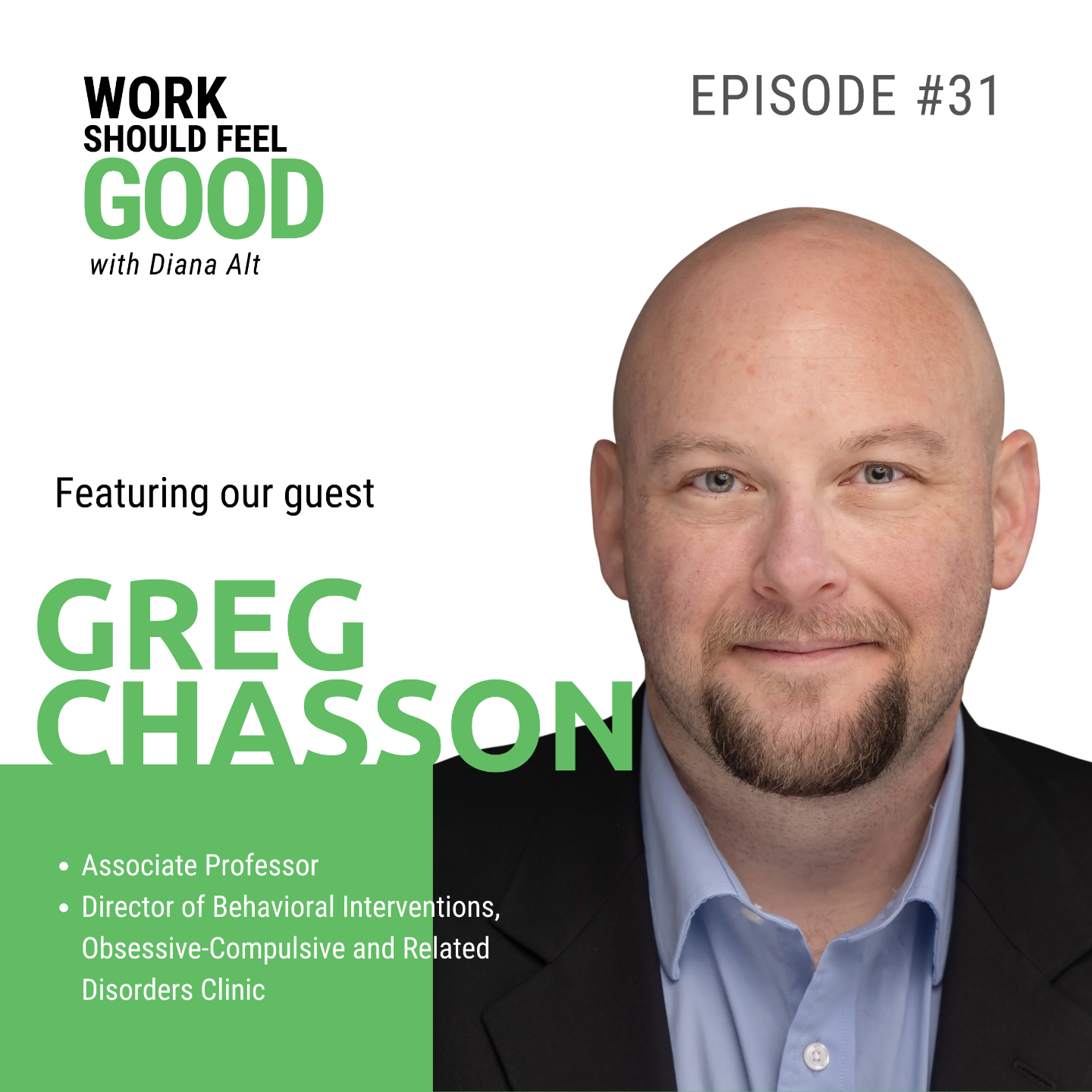
Work Should Feel Good with Diana Alt
Episode 31: Managing Perfectionism at Work with Greg Chasson
Perfectionism shows up at work in more ways than we realize — overdelivering, overpolishing, rewriting the same email ten times, or expecting everyone else to match our standards.
In this episode, Greg Chasson, author and psychology professor, joins Diana Alt to break down the real patterns behind perfectionism at work and why so many high performers fall into the “A-leveling everything” trap. They talk about cognitive rigidity, the pressure to be flawless, the difference between rules and principles, and how to pursue excellence without burning yourself out.
You’ll hear:
- why A-leveling every task leads to overwhelm
- the difference between striving vs. perfectionism
- how other-oriented perfectionism damages teams
- the A/B/C emphasis framework Greg teaches (and why it works)
- practical ways to shift from rigid to flexible thinking
If you’ve ever felt like your inner critic is running the show — or you’re tired of treating every task like it’s life-or-death — this episode will hit home.



Episode 31: Managing Perfectionism at Work with Greg Chasson
Episode Description
Are your high standards helping or hurting you at work? Let's unpack the real cost of perfectionism.
Dr. Greg Chasson joins Diana for an eye-opening conversation on how perfectionism shows up in the workplace and what leaders and individuals can do about it. A licensed clinical psychologist, professor, and expert in OCD and related disorders, Greg breaks down how perfectionism isn’t just about wanting things to be “right”it's often a barrier to progress, innovation, and well-being.
Whether you're a leader, a team member, or just tired of beating yourself up for not being “perfect,” this episode will give you the mindset and practical insight to create a healthier relationship with achievement.
⏳ Timestamps:
04:44 The Seth Godin book blurb story
06:00 Childhood roots of perfectionism
10:13 Compulsive vs. impulsive behavior
12:00 How OCD and perfectionism intersect
15:29 Perfectionism vs. the pursuit of excellence
19:02 Workplace examples of rigid goals
21:46 Cognitive rigidity and burnout
22:58 Strengths and struggles of perfectionists
25:04 Impact on team culture and leadership
30:12 How to overcome perfectionism and reclaim flexibility
💡 Take action
🔥 Subscribe for future episodes → https://www.youtube.com/@dianaalt
📖 Grab my Resume Don’ts Guide → https://www.dianaalt.com/resumedonts
❌ Avoid these common job search mistakes → https://www.jobsearchmistakes.com
🚪 Wondering if it’s time to walk away? → https://www.isittimetowalk.com
💼 Work with me → https://www.dianaalt.com
📢 Connect with Dr. Greg Chasson
🌐 Website → https://www.gregchasson.com
🔗 LinkedIn → https://www.linkedin.com/in/gregchasson
📘 Facebook → https://www.facebook.com/DrChasson/
🐦 X (formerly Twitter) → https://x.com/GregChasson
📸 Instagram → https://www.instagram.com/gregorychasson/
📚 Check out his book Flawed: Why Perfectionism is a Challenge for Management → https://www.amazon.com/Flawed-Why-Perfectionism-Challenge-Management/dp/B0CY3GVD81
📲 Follow me on social media:
LinkedIn → https://www.linkedin.com/in/dianakalt
YouTube → https://www.youtube.com/@dianaalt
Facebook → https://www.facebook.com/dianakalt
TikTok → https://www.tiktok.com/@thedianaalt
Instagram → https://www.instagram.com/thedianaalt
#CareerGrowth #WorkShouldFeelGood #Perfectionism #LeadershipDevelopment #MentalHealthAtWork #OCD #Psychology #PersonalGrowth
Transcript
Diana Alt [00:00:01]:
Hello, hello, hello everyone, and welcome to Work Should Feel Good. The show where your career growth meets your real life. I'm your host, Diana Alt, and Today my guest Dr. Greg Chassen and I are going to discuss the ways perfectionism shows up at work and what individuals and leaders can do about it. Dr. Chasten is a leading expert on treating bad habits and has helped thousands of people overcome impulsive and compulsive behaviors using cutting edge evidence based techniques. He's a licensed clinical psychologist, board certified cognitive behavioral therapist, researcher, professor at University of Chicago, and director of behavioral interventions of the Obsessive Compulsive and Related disorders clinic in UFC's Department of Psychiatry and Behavioral Neuroscience. Which is a lot.
Diana Alt [00:00:50]:
He has a whole lot of jobs, but I don't, I would sometimes I cut that out a little bit, but I'm never going to do it for something as important as what this Guy has done. Dr. Chassen's mission is to bring evidence based behavior change principles to the masses, which is why he wrote what I consider one of the top five books I've read in the last five years or so. It's called Flawed why Perfectionism is a Challenge for Management. So welcome to the show, Greg.
Greg Chasson [00:01:19]:
Thank you so much.
Diana Alt [00:01:20]:
I'm super excited. I'm fangirling a little bit, but that's okay.
Greg Chasson [00:01:23]:
Oh, I, I, yeah, you don't want to give me too big of a head. But I'm so thrilled to be here and I'm excited for the conversation.
Diana Alt [00:01:29]:
Yeah, you know, I want to, I want to hit with something. So we're going to get into like the way perfectionism can cause you to actually not do things in a little bit. But there's a thing that I think if I was writing a book, I wouldn't have had the nerve to do, which is that you did, and that is do the work to get a blurb on the front of the book from Seth Godin.
Greg Chasson [00:01:51]:
Yeah, it was a little bit nervy.
Diana Alt [00:01:54]:
Talk to me about that because I've actually, I have a couple book ideas. I haven't gotten to them yet, but they're evergreen so they can be written anytime. And an author friend of mine, or publisher friend too, asked me who I would want on the front of the book and I said, well, it would be Tim Ferriss, but he doesn't do book blurbs as a policy. And then I said, probably Seth Godin because it was going to be about something with work. But I don't know, like, I don't know if I could do that. So how did that happen for you? How did you get the nerve to do it? How did you make that happen?
Greg Chasson [00:02:29]:
I. I just asked. Sometimes all you got to do is just ask, but I don't. I know that he's very, very particular about what he wants. To endorse his name is very, very meaningful. And he brings a lot of graph, a lot of gravitas to. To. To what he recommends.
Greg Chasson [00:02:44]:
And I just thought maybe this is a topic that would resonate with him. And I sent him an email. He responded fairly quickly and. And was extremely encouraging. I couldn't have asked for a more responsive and nicer response. And, you know, he. He has certain limitations about how we can use his name, so I have to be careful about that. Which I.
Greg Chasson [00:03:04]:
Yeah, which I respect. But I was just so grateful to have his endorsement because, you know, I find him to be brilliant and I really appreciate his support and all it really took was asking, and I don't know that that would work for everyone, but I. I don't know why he was so responsive. And I frankly am not going to delve into that.
Diana Alt [00:03:26]:
You're not going to question that, right?
Greg Chasson [00:03:27]:
I'm pretty happy that he was supportive.
Diana Alt [00:03:29]:
Thank you for the book blurb, sir.
Greg Chasson [00:03:31]:
Thank you.
Diana Alt [00:03:32]:
One of the things I've heard about him is that he's actually very open to being on podcasts, especially if they're a little bit established. One of my friends has actually had him on twice, and the second time was because I told him about the song of significant. The song of significance. I don't know why I can't say that word today, which is another one of those top five books from the last few years for me. So anyway, it was kind of a trip whenever I saw that on the front of your book. So everybody I know, like, I have my show, the whole idea behind it is career growth. That means for your real life. And I have people on that are like you.
Diana Alt [00:04:12]:
They've written books. I have other career services and coach people. And I also have, like, regular people that are just doing the thing. And one of the through lines that everybody has is almost everyone has some sort of early life story that led them into the domain that they're in. I really see this a lot with coaches because, like, in my case, I spent 20 years in tech, but very early in my career was the tech wreck. I got laid off twice in two years. Had to figure out how to, you know, do all the thing. So what's your story that led you into 20 years of researching studying and teaching about perfectionism and OCD and related disorders.
Greg Chasson [00:04:53]:
Yeah, it's a great question. I do get asked that a lot because in our field, we call it me search, or, you know, you research things about yourself or you are what you study, as they say.
Diana Alt [00:05:04]:
Oh, I love that.
Greg Chasson [00:05:05]:
There's a little bit of truth to that. And in this particular case, I do think that perfectionism resonates with me in particular. And so there's both a personal and a professional journey that led me to being interested in perfectionism. The personal journey started when I was really a child. And I remember very vividly getting stuck drawing a picture of Spider man and just sitting there and drawing this. There's a particular geometry to the webbing on his costume. If you can visualize it.
Diana Alt [00:05:37]:
And I'm a Marvel girl. I know what you're talking about.
Greg Chasson [00:05:40]:
There you go. Yes. And I remember getting stuck because I couldn't get it quite right. We call that in the field not just right feelings. And very cleverly named, I might add, not just right Feelings. And so we. I just got stuck and couldn't get it right. And I kept erasing and erasing.
Greg Chasson [00:05:58]:
And by the time I was done with this, I had destroyed my picture. Not only were there rips and tears in the paper, but also this Spider man looked like he had spaghetti arms by the time I was done. And it was. And that was the earliest I can remember how getting so preoccupied with getting something just right and doing it well could actually get in the way of the final product.
Diana Alt [00:06:22]:
That's so interesting. It reminds me of a TED Talk I heard. I watched, I mean, probably close to 10 years ago, and I can't even remember the woman that. The name of the woman that gave the TED Talk. I'll look it up and put it in the show notes for you guys. But the basic. She. She was a founder of like, a, like, Girls who Code or some.
Diana Alt [00:06:45]:
Some kind of organization like that devoted to helping women or young girls learn how to code. And there was a phenomenon she discussed in the TED Talk where basically what she noticed is that they'd go around the room and look at these girls trying to code and compile and do all the stuff, and there wouldn't be much on the screen, and they'd be really frustrated.
Greg Chasson [00:07:07]:
Yeah.
Diana Alt [00:07:07]:
And she'd find out that if she clicked control Z, so undo, undo, undo. They all had written code and rewritten code multiple times, but they could not quite get themselves to compile the code, if I'm not mistaken. I want to say that when they did some observational research, they discovered that girls were more likely to do that than boys. Boys would compile the code. Girls would want to make sure the code looked perfect, like poetry, before they would try to compile the code. Your spaghetti arms kind of reminded me of that.
Greg Chasson [00:07:43]:
Yeah. I mean, I do think that this affects both males, females and, you know, non binary folks. It's pretty, pretty non discriminatory in terms of how it affects people. And. But I. There are probably some prep. I mean, this is a good research question. There are probably pressures on women in the workforce that adds extra stress and triggers perfectionism, perhaps more because they have to, you know, whatever a man does, a woman has to do 125%.
Greg Chasson [00:08:12]:
Right.
Diana Alt [00:08:13]:
Whatever, whatever the percentage, whatever the number is.
Greg Chasson [00:08:15]:
Right. You know, and so that adds pressure. And we know that pressure and stress triggers anxiety. And that's really what's at the core of perfectionism. So I would not be shocked if there was that link there in the workforce.
Diana Alt [00:08:27]:
I would be really interested in that. Like we're going to get into. In a little bit. We're going to get into like the manifestations and types of perfectionism a little bit because y', all, I did read every single word of this book except for I skimmed footnotes and some friends, I'm in a book club about this said, no, you really gotta go back and read the footnotes, especially in part two. They're real funny.
Greg Chasson [00:08:47]:
So the footnotes are. That's where the personality went.
Diana Alt [00:08:51]:
Yeah, yeah, there's plenty of personality in the book, especially after the more research focused stuff. But I would be really interested to find out, like for the different manifestations of perfectionism, are there any gender, class, race, like any of those kinds of demographic trends that show up. So let me, let me talk a little bit before we dig deeper into perfectionism. I want to talk a little bit about compulsive versus impulsive behaviors. Because the layperson, I think, well, we just like, I've worked really hard to stop doing this, but so many people will be like, I want the towels folded in third. So I have ocd. They'll just use it colloquially when they don't actually have OCD and most people don't have an understanding of what really are impulsive and compulsive behaviors. So you.
Diana Alt [00:09:45]:
Can you talk briefly about that and what the difference between the two is?
Greg Chasson [00:09:49]:
Yeah, happy to. It's a very difficult thing to differentiate. People often colloquially say that they have OCD or that I'm so ocd and I can't even explain to you how much that irritates people that actually have real ocd. And it is something that I think the International OCD foundation, for example, is trying to educate people about, because it can be very difficult for people to hear that. But compulsive behavior versus impulsive behavior is not perfectly well understood. And you get slightly different answers depending on which professional you talk to. But from my perspective, compulsive behaviors tend not to be associated with a reward. So if you are folding a towel in thirds and you're finding that in order to not feel anxious or upset about it not being folded, you fold it.
Greg Chasson [00:10:42]:
Like you're feeling compelled to go fold it because you want that relief. And there's no pleasure associated with it, just the relief. That tends to be more of a compulsive behavior. Now, impulsive behavior tends to be associated with both relief and pleasure. So if you're folding the towel to get relief, but it also just gives you that satisfaction and pleasure, it has a little bit of impulsivity associated with it. Impulsivity also tends to be less thought out and a little bit quicker to act, whereas compulsive tends to be a little bit.
Diana Alt [00:11:12]:
So that's why when people think of ocd, like the routines aspect that shows up sometimes in ocd. Okay. The pattern side of it. Well, thank you for talking about that because, like, there's. I wanna. Now I want to dig into. Because this is mostly about perfectionism, this episode. Can you talk about the relationship? Take us from this impulsive, compulsive thing you've been studying and get us into perfectionism.
Greg Chasson [00:11:40]:
Yeah. And you'll see. You'll see perfectionism correlate with impulsivity and compulsivity. But by and large, it is mostly a compulsivity issue where people feel they need to engage in relieving behaviors because every fiber of their body is telling them to fix something or to do something a certain way. So in general, I tend to find that compulsivity is what characterizes perfectionism more so than impulsivity.
Diana Alt [00:12:05]:
Okay.
Greg Chasson [00:12:06]:
Wanting to know sort of what the big picture overlap is between something like OCD and perfectionism, which is a common question, I get Obsessive Compulsive disorder and perfectionism are not the same thing. If you think about a Venn diagram, you think about a Venn diagram with two circles and they're overlapping. Some people with perfectionism have ocd, and some people with OCD have perfectionism, you tend to see a lot more people with perfectionism have OCD than in the general population. So there's a higher risk of ocd, but there are people with perfectionism that don't have OCD as well. And you know, the idea that I got into this because I'm an expert in ocd, it makes sense because a lot of people who treat OCD also will treat perfectionism because the treatments are very similar.
Diana Alt [00:12:50]:
Here's a weird question. OCD is in the dsm, right?
Greg Chasson [00:12:54]:
Yes.
Diana Alt [00:12:55]:
Is perfectionism in the dsm?
Greg Chasson [00:12:57]:
Perfectionism is in the DSM as a symptom of what's called obsessive compulsive personality. It is not necessarily associated with other disorders, but it is a component of a personality disorder that tends to be about needing things to be just right. Perfect.
Diana Alt [00:13:14]:
Here I am learning a whole new personality disorder.
Greg Chasson [00:13:17]:
Yeah, I don't like the term personality disorder. And so I often will talk about perfectionism as a substitute name for that. In fact, the book that you, that, that you're talking about Flawed is mostly about ocpd, Obsessive Compulsive personality.
Diana Alt [00:13:34]:
Oh, yeah, you just tricked us a little.
Greg Chasson [00:13:37]:
Yeah, because I don't like that name. And I think it turns.
Diana Alt [00:13:39]:
I think there's something like when we get told that our personality shows there's shame associated with personality disorders.
Greg Chasson [00:13:46]:
Exactly.
Diana Alt [00:13:47]:
And really, like that's, that's a whole ball of wax that we don't have time for.
Greg Chasson [00:13:53]:
I also think that that personality type is largely defined by perfectionism. Not entirely. Largely.
Diana Alt [00:14:00]:
Right. So it's like, do we really need to call it that?
Greg Chasson [00:14:04]:
Exactly. Exactly. Exactly.
Diana Alt [00:14:05]:
Okay, so now what I want to do. You spent a lot of time in the beginning of the book talking about perfectionism versus the pursuit of excellence. Yes. And I, I think one of the things that I've honestly had eyes open, I just finished this book maybe two weeks ago. I started reading it two weeks before that. And in that 30, and we're, this is, we're recording this and early November I'm publishing this, like, I think in December is when I have it on the calendar. So just in this 60, you know, 60 day period, 30 day period, I've had my eyes opened to some things, behaviors in myself and behaviors in other people. But it takes like I, I wrestled with that first part of that book.
Diana Alt [00:14:53]:
Like I don't usually reread chapters and things like that, but I found myself doing that because I really wanted to understand it. Can you give the, the, the podcast link? Not the whole answer me and podcast. Give me the podcast version as opposed to the part one of the book version of the difference between perfectionism and the pursuit of excellence, please.
Greg Chasson [00:15:14]:
Yeah, absolutely. In fact, that's at the core of the first part and really helps define what perfectionism is.
Diana Alt [00:15:20]:
I think it's critical because so many people lie to themselves that they have a quality orientation or they just want things to be done well when really they're tilting all the way over into perfectionism. I know for a fact that I've done that.
Greg Chasson [00:15:35]:
Yeah, very common. Very common. So the primary difference between perfectionism and pursuing excellence comes down to two main ingredients. Honestly, one of them is pursuing excessive goals, pursuing things that are just infeasible, completely not realistic. And to be honest with you, that ingredient is common, but it's not necessary. Meaning you can have perfectionistic tendencies in other ways, even if your goals are somewhat reasonable. But we do tend to see a lot of really way beyond the pale sort of goals that are just excessive and way too.
Diana Alt [00:16:09]:
What would be an example of that?
Greg Chasson [00:16:12]:
You know, someone is. You know, someone is. Is. Is a sales leader and needs to go and make a certain number of sales. They have a sales target and a hurricane comes through and they can't, you know, or. Or something to that effect. And their sales goals are way too excessive given the context around them. Right, got it.
Greg Chasson [00:16:36]:
Or they even maybe created goals that were excessive in the first place. And whereas people might say that that's actually common, you know, Kobe Bryant might. Might have had a goal that was way beyond what anyone would ever dream for him, and that. That helped motivate him, and there's some truth to that. But when you combine it with the second ingredient, that's where it becomes toxic. And the second ingredient is cognitive rigidity. Oh, it's inflexible. You cannot.
Greg Chasson [00:17:04]:
You cannot pivot. You cannot change. You get stuck pursuing the same goals and not being able to say to yourself, okay, things have got to change given the new context. So when a hurricane comes through your goal, maybe it was even not that excessive to begin with, but now there's no way any human could potentially meet that goal without.
Diana Alt [00:17:25]:
You know, I think the sales quota thing is there or the sales target thing is a really interesting one because I spent years in technology organizations sometimes working, you know, adjacent to partnering with sales on certain things. I wasn't in sales myself, but I saw this show up around the pandemic, and it happened in two different ways. So one way it showed up was companies who did have the hurricane calm, their business dropped off like there was nothing. Come their Pipeline dried up, etc. And so they were still trying to meet that 2020 goal that somebody set at the, you know, Q4, whatever executive leadership meeting. The other way I saw it show up and this was. And arguably more painful for a lot of people is that I knew people that worked in a couple of sectors where the business dramatically increased in 2020.
Greg Chasson [00:18:20]:
Yeah.
Diana Alt [00:18:21]:
And then in 2021, they set a goal because they always want 8% more than they got last year. And it's like, well, we went up by 35% because of the pandemic. And now you're telling me you want me to add 8% on top of that when we're not pandemic anymore.
Greg Chasson [00:18:37]:
Yeah.
Diana Alt [00:18:38]:
What. What in the world. And those shareholders expect it. No, no, no, they don't.
Greg Chasson [00:18:44]:
That's a rigid process. Right. That's the form and they're not.
Diana Alt [00:18:49]:
So it can be institutionally, if you have enough leaders that are operating in that way. And it can be individually, right?
Greg Chasson [00:18:56]:
Absolutely. That's why I'll go talk to organizations. I, you know, I'll be brought in to give a talk or work with teams because this is from the culture down, can really be a problem and can impact everyone down the path. That's working for you and can really cause turnover, inefficiencies, lack of morale, just all sorts of problems.
Diana Alt [00:19:19]:
Definitely work not feeling good, for sure.
Greg Chasson [00:19:22]:
But this is different than the pursuit of excellence in that pursuit of excellence is a good thing. It gives you something to strive for and it's motivating and, and energizing. And it really involves having goals that are attainable, well defined. But the most important component is that there's flexibility there. If you realize that that goal is not going to be achieved, you don't beat yourself up and consider yourself a failure. You are able to understand the context that went into that outcome. And maybe you adjust, maybe you don't, but you also accept the A instead of the fact that you.
Diana Alt [00:19:57]:
To get the A. I love that. And like, one of the ways I think about that a lot is with weight loss because people say I want to lose £50 in six months or whatever. Which there's all kinds of problem with that goal medically. But let's say that's your goal. And then you hit six months and you've lost 39 pounds. Yeah. Like that's 39 pounds.
Diana Alt [00:20:19]:
You're not. That's five gallons of milk you're not carrying around.
Greg Chasson [00:20:22]:
Right.
Diana Alt [00:20:23]:
There's people that can't see that as successful.
Greg Chasson [00:20:25]:
Oh, yeah. I call perfectionism the irony disease, because of that. That's a good example where what happens after they get upset that they didn't lose 50 but instead lost 39? They engage in this all or non thinking like they're a failure and that this doesn't work. And what happens? They end up yo yoing and gaining 50 pounds back.
Diana Alt [00:20:43]:
Now they're 10 pounds more than I started.
Greg Chasson [00:20:45]:
Exactly. Now their net weight is more than where it started. And there's the irony of perfectionism.
Diana Alt [00:20:49]:
Yeah. So what are some others? So we talked about cognitive rigidity. We talked about how many people infeasible goals is something. What are some of the other symptoms of perfectionism that people might be on the lookout for in themselves or in others?
Greg Chasson [00:21:05]:
Yeah, there's a lot of features that you might identify with or in yourself or others. There's.
Diana Alt [00:21:10]:
Yeah. And I love that you said features. Number one, because I spent years in tech, but also because not all of these are bugs.
Greg Chasson [00:21:19]:
No, not at all.
Diana Alt [00:21:20]:
Like they're, they're use them wrong. So talk to us about some features.
Greg Chasson [00:21:25]:
Some of these are good. Right. Like that's one of the big misconceptions that if you have perfectionism, it's all bad. It's not all bad. It's much more nuanced, much more complicated. Perfectionism comes with some really good qualities. The. Here's the trick though, and I'll go through some of those good qualities in a moment.
Greg Chasson [00:21:40]:
But here's the thing. You don't need to, you don't need to give up those good qualities when you're not wanting. Wanting to be perfectionistic anymore. You can retain all that good stuff and not be perfectionistic at the same time, which is really important to remember that you're not sacrificing all the good qualities. Yeah. And so some of the good qualities, I mean, by far the research shows the biggest, by far the biggest correlate of perfectionism is conscientiousness, thoughtfulness. And I gotta tell you, if there's anybody that I want in my life, whether it's a worker, a spouse, a friend, that's a, that's a trait. Yeah.
Greg Chasson [00:22:16]:
Give that to me all day, every day. Right. Like that is extremely well correlated with positivity and success and strong friendships and strong family bonds and good work and outcomes and people who are really good work ethic. I mean, that is an amazingly tremendously positive trait.
Diana Alt [00:22:34]:
Yeah. And one of the, one of the things I talk about with my clients whenever that comes up is like, I love that you care, but I need you to care about yourself more than you care about what's happening at the office.
Greg Chasson [00:22:48]:
Absolutely.
Diana Alt [00:22:50]:
Because you're gonna kill yourself.
Greg Chasson [00:22:52]:
Yeah.
Diana Alt [00:22:53]:
Burn yourself out.
Greg Chasson [00:22:54]:
It's the whole. Put the oxygen mask on yourself before you put it on your child when the plane's going down.
Diana Alt [00:23:00]:
So conscientiousness.
Greg Chasson [00:23:02]:
Yeah.
Diana Alt [00:23:02]:
What are a couple of others?
Greg Chasson [00:23:04]:
Loyalty. People tend to be fairly loyal when they struggle with perfectionism because they have this often it's a secondary. It's a secondary feature of the sort of rigid moral code that they sometimes. But that also makes them honest. So loyal and honest. And so you have these features that can get in the way, like this rigid moral code that we'll talk about at some point, I hope today. But on the other side of that, you have people who end up being loyal and honest.
Diana Alt [00:23:32]:
Right.
Greg Chasson [00:23:35]:
And also this one's obvious. But they're going to double down on everything and they're going to be your hardest worker in the room. The most industrious people in the room. They're not going to be your efficient people, but they will be your hardest working.
Diana Alt [00:23:46]:
But you also. One interesting thing about that, I have worked with many software engineers in my career and there's a subset of them that view software engineering as a craft. And so it's very interesting because if you take someone that views it as a craft and they go get a job at a place that views it as a factory, that's going to be misery for everyone. But if they are able to find somewhere that treats software as a craft, brilliance, magic, yeah, great things can happen. Innovation, tight code, like all the things. These are also the people that are just. It's like they find their skin crawling over the notion of vibe coding. But, you know, it's like there's so many different ways to do things.
Diana Alt [00:24:34]:
And in my business, I have a. I have a model that I call the four cornerstones of an aligned career. And briefly, they're right work, right leader, right environment, and right culture. And to me, like, everyone's like, what's the difference? Culture is values in action. Environment is all the stuff that makes your work in your life work together. So people, when they come to me and they're like, well, I don't think I should be a software engineer anymore. I have to dig in. Like, do you have an environment problem?
Greg Chasson [00:25:01]:
Yeah.
Diana Alt [00:25:02]:
Where you're a craftsman that's in a factory or are you really, truly sick of the work? It's really interesting to pick through. So let's go there. On the whole cognitive rigidity, though, because you, I want to make sure that we do not miss that because it to me is arguably the most debilitating feature. This is the one that's mostly. This is the one that's mostly bugged to me.
Greg Chasson [00:25:27]:
Yes.
Diana Alt [00:25:29]:
So talk a little bit more about that.
Greg Chasson [00:25:31]:
Yeah, I think it is the most debilitating feature and it can be very challenging to work with and it has a trickle down effect on everyone below you and all the people around you. Actually not even just below you, but everyone. And you know, it can really create a hazardous and toxic work environment for the people around you in families, within relationships. This is not just about work, but it can extend way beyond that. See it in children and I get a lot of people that want to talk to me about their kids that struggle with perfectionism, you know, because it, it, this doesn't just affect adults and it tends to develop early in life and becomes a real problem. And so the rigidity is, I agree with you at the core of a lot of this and requires a lot of careful approaches to address. And basically what the approaches are, you do a lot of work around having them face the things that are anxiety provoking for them by doing things that are a little bit less rigid. And you do it in a stepwise way, in a very slow and methodical systematic way.
Greg Chasson [00:26:34]:
And you have them do things like what we call my field, exposure based therapy, where you might have them engage in making mistakes on purpose, which, which blows people's minds. Right. You're going to have me make mistakes on purpose. And I don't mean like leave a sponge in a patient as a surgeon kind of on this day, I mean, let's send an email where you sign off your name as Gerg instead of Greg, right?
Diana Alt [00:26:59]:
Oh yeah, that's right.
Greg Chasson [00:27:00]:
Or you forget a period or God forbid you forget to attach the attachment to the email.
Diana Alt [00:27:09]:
Right. Or you send Outlook tells you.
Greg Chasson [00:27:12]:
What's that?
Diana Alt [00:27:13]:
Especially because Outlook tells you.
Greg Chasson [00:27:16]:
Yeah, it does.
Diana Alt [00:27:16]:
Then you're going to attach something.
Greg Chasson [00:27:18]:
Right. You mean that unless you're going so fast that you don't even pay attention to what it's.
Diana Alt [00:27:22]:
There's that too.
Greg Chasson [00:27:23]:
Yeah. So there these things that you can do in a systematic way and you grow and build a callus to these kinds of mistakes. And what happens is that you end up learning that worries the catastrophes that you thought might happen that don't actually happen. You worry, you start to learn that you can handle the anxiety around having things not perfect and you learn to be more flexible over time.
Diana Alt [00:27:48]:
And can I Tell you, like how. I wouldn't say that I'm deliberately misspelling things, but I type really fast so I accidentally misspell plenty. But there's like a shift that I've seen in myself and a lot of it. I. I've been on this journey for a while because honestly, studying agile, like being a practitioner of agile software development, which if you don't know anything about, go learn it. We can geek out about it, but there's a lot of principles related to continuous improvement, or kaizen as the Japanese call it. And so before I started doing this, working on perfectionism, when I didn't even know I was doing it.
Greg Chasson [00:28:29]:
Yeah.
Diana Alt [00:28:30]:
I would have something like the, the email you can't get quite right.
Greg Chasson [00:28:34]:
Yeah.
Diana Alt [00:28:35]:
That maybe isn't super urgent. And I would say it and close it and never send the email. And now I'll look at it and I still say it, but I send the email because I'm like, what is the worst? That's what's worse going to happen out of that.
Greg Chasson [00:28:49]:
I can, I can't think of a better segue into the emphasis framework. Can I go into that?
Diana Alt [00:28:54]:
Do you know that is my single most famous favorite thing that I learned from you?
Greg Chasson [00:28:58]:
Oh, well, that's.
Diana Alt [00:28:59]:
Please. I'm trying to explain it based on what I learned in the book. So I'm gonna zip it and let you explain it and then I'll tell you how I've been applying it or like ask questions. Yeah.
Greg Chasson [00:29:10]:
The emphasis framework really is a way of thinking about how to prioritize and what happens when perfectionism takes hold and causes problems. So I think of it as having three different ways of approaching an activity based on your effort. One is emphasis A, the other emphasis B, and then there's emphasis C. Emphasis A is to do something with everything you've got. 110%, really. You lean in very heavily to it.
Diana Alt [00:29:33]:
And is this a quality orientation, a time orientation? Like, how do you think about that?
Greg Chasson [00:29:40]:
It's the inclusive or. Yes, both. It's really both.
Diana Alt [00:29:44]:
Really?
Greg Chasson [00:29:44]:
And.
Diana Alt [00:29:45]:
Or.
Greg Chasson [00:29:45]:
Yeah, and. Or. And then there's emphasis B, which is to just get her done. Just get it done. Doesn't need to be beautiful, but doesn't need to be garbage. Just got to get it done. Then there's emphasis C, which is not to do it at all. There honestly is a time and place for all three of these and figuring out which one to use really comes down to your values and what's important to you.
Greg Chasson [00:30:10]:
But also you got to weigh in what's Required versus what's not required. Required.
Diana Alt [00:30:14]:
Right.
Greg Chasson [00:30:15]:
And so what are your values? And that should be your compass for figuring out how to allocate your effort and your energy and your time and all your skill. There's a time and place for all three of these. I'm actually not judgy when it comes to people using any of those three. Right. So if you're planning your wedding or you're planning you wanting to take the SAT to go to college, and those are really important for you. Just connect with your values wholeheartedly, then maybe you emphasis A those things. Maybe that's what's where you want to devote your attention and invest your resources. There's a time and place for emphasis C.
Greg Chasson [00:30:51]:
I do it all the time. I never answer the question.
Diana Alt [00:30:54]:
If we are not doing emphasis C, there's a problem. If we're not doing emphasis C on the regular, there's a problem. And I like thinking about, like, I want you to get to be, but I like thinking about that both in personal terms and at home. Like, I live alone. Know what doesn't get done every day? The damn dishes.
Greg Chasson [00:31:13]:
100%. Right.
Diana Alt [00:31:14]:
There's no point in it.
Greg Chasson [00:31:17]:
I don't live alone. And you know what doesn't get done every night?
Diana Alt [00:31:19]:
The dishes. I got you. There's a lot of. But there's a lot of things that people do. They have to do. And I'm like, do you?
Greg Chasson [00:31:29]:
Yeah.
Diana Alt [00:31:29]:
Do you? Even if you're doing it as a B level, like, did that need to happen at all?
Greg Chasson [00:31:34]:
And then a lot of that's driven by this. This need to do everything. And we'll get into this pattern. But. And of what happens in perfectionism. But emphasis C is a totally legitimate strategy. A good chunk of the time. I never open my spam mail.
Greg Chasson [00:31:48]:
I never answer the customer service satisfaction survey at the end of my call with Verizon. I never do any of these things.
Diana Alt [00:31:55]:
Why do they. Why are they asking the question, your Verizon, you're terrible. I don't need to. I don't need to fill that out.
Greg Chasson [00:32:00]:
I should apologize if Verizon is a sponsor of your podcast.
Diana Alt [00:32:03]:
They are not a sponsor of my podcast.
Greg Chasson [00:32:05]:
Yeah. But the bottom line is, is that those are tasks that don't deserve my attention based on my value system.
Diana Alt [00:32:12]:
Right.
Greg Chasson [00:32:13]:
Right now, to be honest with you, most things in life deserve emphasis B. That's what's needed. Right? Just get it done. These are the things that you don't want to ignore or you can't ignore them. Right.
Diana Alt [00:32:25]:
So tell me, tell me in your life, like we talked about the sea, like the Verizon stuff. Can you tell me one or two things in your, like maybe one work and one personal example?
Greg Chasson [00:32:38]:
Yeah.
Diana Alt [00:32:39]:
You use emphasis A on versus emphasis B. Oh, definitely.
Greg Chasson [00:32:45]:
So for emphasis A, for example, I might, I just went up for, put my materials in for a promotion here at the University of Chicago to go up a rank from associate to full professor. That application, I leaned in heavily to that. Right. Emphasis A. This was really important for me. I, you know, I felt like this was my time to do this. I wanted to sort of get that next step in my career and so I put in all the effort and energy into that and really took the time on it. Whereas, you know, if I needed to put together some expense reports based on some of my travel for a conference, I don't really need to, to give that a 110%.
Greg Chasson [00:33:28]:
I might have some errors. And what's the worst that happens?
Diana Alt [00:33:31]:
My executive back and say, hey, you forgot your receipt for the chilies.
Greg Chasson [00:33:36]:
Exactly. Now where somebody might freak out about that because they're saying, oh, these people see that I'm not taking this seriously. They're getting annoyed. I know I can do better than this. I'm so ashamed. But I'm thinking that just wasn't worth my time. And sure, some of the time I might make a mistake, but most of the time I'm able to just do what needs to get done.
Diana Alt [00:33:55]:
Yeah.
Greg Chasson [00:33:56]:
So if I need to send a ton of email, I get so many emails per day. And the thing that people often tell me is that I'm very responsive and quick with my emails and that's because I don't have SSA them. Now if there's a really important email, I will. But the people with perfectionism often will do that with every email that comes.
Diana Alt [00:34:14]:
You know what's interesting for me is I worked in organizations for a long time that had very quick turnaround time expectations for email emails which were based in nothing. I wasn't in customer service, I was in product management working on multi month long projects. But there was just some people that really expected, oh, you got to respond within 24 hours. Like, I have 432 emails.
Greg Chasson [00:34:38]:
Yeah.
Diana Alt [00:34:39]:
And I'm doing the work of three people. Like that's not going to happen. But where I emphasis aid at different times in my career was working late just to try to meet that crazy external expectation put on.
Greg Chasson [00:34:53]:
Right.
Diana Alt [00:34:54]:
And so one, so I, I switched it around.
Greg Chasson [00:34:58]:
Yeah.
Diana Alt [00:34:59]:
And now my inbox Is kind of like, I honestly. Okay, this is. This is probably going to annoy some clients if they listen. Like, I. I sometimes look at something and I'm like, I could answer that, but I'm focused on this thing over here, so I'm not going to do it. And there's also. I've had some people in the past, none of these are current clients, but they got super needy and they expected immediate response from me. And I would deliberately delay my send for like two hours on that email because I'm like, I need to train you.
Diana Alt [00:35:38]:
I need to train you that, yeah, I'll respond in my own time. But, like, you don't need to know that I did that immediately because I don't need you thinking. Thinking I'm gonna do what?
Greg Chasson [00:35:46]:
I mean, yeah, you got to set that boundary right. Exactly.
Diana Alt [00:35:49]:
Yeah. Oh, boundaries.
Greg Chasson [00:35:51]:
That's a whole.
Diana Alt [00:35:52]:
That's a whole other thing, isn't it?
Greg Chasson [00:35:54]:
Yeah.
Diana Alt [00:35:54]:
A, B and C. Can I. Let me tell you a little bit about how.
Greg Chasson [00:35:57]:
Well, let me quickly, real quickly tell you what the. The problem with perfectionism, just in a nutshell, is that people try, with perfectionism, try to emphasis A everything away from anything. And what happens is that it creates an impossibility of getting things done, and it pushes things off to emphasis circumstances, but not because of your values, but because of your perfectionism.
Diana Alt [00:36:22]:
So, okay, that has some diagram overlap with the adhd.
Greg Chasson [00:36:27]:
Yes.
Diana Alt [00:36:28]:
Because that inability to prioritize. And I don't have adhd, but I've had several clients that do. And I started recently following a couple of people that really work in this space, including a career coach that's specializes in it. And so when I had that aha of oh, they can't prioritize, so it turns into a C. What is the difference, if there is any, do you know between how it shows up for people for ADHD and how it shows up for perfectionism? I could use that information. Yeah.
Greg Chasson [00:37:03]:
I mean, it's. It's not. There are going to be people that have both, by the way. So this is not a super clean. Okay.
Diana Alt [00:37:08]:
Yeah.
Greg Chasson [00:37:09]:
But I would imagine, just based on that framework, that perfect perfectionism is an A to C problem where things that are really, truly important to them are being pushed off to a C because they're not getting to it and they're trying to do way too much.
Diana Alt [00:37:21]:
And then when you wrap up the fact that we all have multiple things, proclivities, because, like, you could have a combination of. I'm trying to emphasis A everything, but I Also have this fear of rejection, which is really what, like when, when I had five things and two of them end up in C because I didn't have time.
Greg Chasson [00:37:41]:
Right.
Diana Alt [00:37:41]:
The thing that I'm afraid of being rejected to might be most likely to end up in C, right?
Greg Chasson [00:37:46]:
Yeah. Because it's fear of failure and being rejected and rejection sensitivity is all wrapped up in this. ADHD though, to me is not somebody that's overemphasizing A. They are, they just, they have, they have a hard time putting them into the bins in the first place. Not only they might know what they value, but they're having a hard time taking the moment from an executive functioning standpoint to know distinction.
Diana Alt [00:38:10]:
That's a really good distinction.
Greg Chasson [00:38:12]:
Right. They know might, they might even be able to tell you with some time and focus where things should go, but they have a hard time implementing it because their, their executive functioning is, is problematic. They can't allocate their effort in a healthy way because they're just disjointed and lacking focus. And it's not an A to C problem. It's really a C problem because they can't settle on a single activity or they over focus on another activity because they overvalue it and they lose track of time or they don't understand the impact it's going to have downstream on the other activities. Whereas someone with perfectionism, they'll almost always know that they're putting too much time into something.
Diana Alt [00:38:55]:
That's a really good distinction. Thank you for, thank you for untangling that for me. So real quick, I want to tell you how I, I, I have said that this book was immediately actionable for me. And the top thing that was immediately actionable was actually the emphasis framework, which is why I love it so much. I don't like having to say emphasis. That's a lot of syllables. But I actually had, right before I started reading that part of the book, I had promised myself that for the first time in a few years I was going to try to build a business plan. And I have a small business, I'm a solopreneur and I had number one.
Diana Alt [00:39:37]:
There's two reasons I hadn't done it. I hadn't really done it. One is I never done it. So I didn't really know how to do it. So I'm good at a lot of aspects of business, but planning for a whole year was not one of them because it's just my iterations are smaller than that. The other thing is I had medical stuff Going on that I had surgery earlier this year to, you know, improve on it. I wouldn't say it's all resolved that I'm doing better than I was. So I'm like, look, that excuse is removed or reduced.
Diana Alt [00:40:10]:
So we're going to do this. And I fed some of the information to Chat GPT about the emphasis framework, which it kind of understood because it sort of knows about your book, but kind of not really. Yeah, but I put some information in there and then I said, I need help building a business plan and I need it to be an emphasis B exercise.
Greg Chasson [00:40:32]:
Oh.
Diana Alt [00:40:33]:
And I've done it with other stuff too. And I will now, like, I have had occasions where I would, like, I was working on a resume yesterday, which is an emphasis A activity, but I can try to go to A plus plus with that, which can get paralyzed. Yeah, well, some of it's a little bit of like, I don't love doing resumes, but when I get in the flow for a really good client, I dig it. And I'm working with a guy that's a product manager, so that's what I used to do. Yeah, we can nail this. But I actually had it say, like, you don't need to do that again. Which is unusual because Chat GPT will refine and refine and refine until the end of time if you let it. But I basically, it was like, duh, I think this is really good.
Diana Alt [00:41:21]:
Like, you can stop on that, like, work experience section or whatever I was doing. And I've applied it in other areas too. So I will now try to feed it. And I want to get it to where it regularly asks me, like, which level is this?
Greg Chasson [00:41:38]:
I am. So that just, it makes me so excited and happy to hear that. I mean, that's why I write this, why I wrote the book. It's not. The book is written to help people. And the reason I wrote it in the first place is because I had a bunch of trainees, psychologists and who are becoming trained to be licensed, and when I was helping them with their patients with perfectionism, and I used this framework, not just the emphasis framework, but the entire book, all the stuff in there, they said, greg, you gotta write this stuff down. It's really good. And I said, yeah, maybe I should.
Diana Alt [00:42:12]:
Do you have a whole course on it?
Greg Chasson [00:42:15]:
No, no, no, I. No. So I do a lot of. I do a lot of in the clinic training. And so, yeah, training. Hands on. You know, saying hands on when you do therapy is always a little bit awkward, but yeah, it is Hands on, hands on therapy training without the hands on part. And, and so a lot of it is sort of in the, in the trenches and so it's less like seminar classwork.
Diana Alt [00:42:40]:
Got it.
Greg Chasson [00:42:41]:
Yeah. A little spoiler alert. There are things in the works that will make this a little bit more accessible for people.
Diana Alt [00:42:48]:
Yeah, the spoiler alert is great and like, more to come from you and some of the people you're collaborating with. But I, I'm like, just shut up and take my money because I'll figure out. I, I think it's really critical. Like my client base is. There's a lot of people I work with, they're leaders in STEM fields, like mostly in some sort of tech product shenanigans. And there's people I work with where literally if they get it wrong, people can die.
Greg Chasson [00:43:17]:
Yeah.
Diana Alt [00:43:18]:
So it's not necessarily surgeons. Like we said, we don't want the surgeon to put the sp. Leave the sponge inside of a human. That wouldn't be a bad deal. But they, you know, they work on healthcare software. If you don't have that right, somebody's getting the wrong meds in the hospital or like there's just a million ways planes fall out of the sky and they can't, whatever.
Greg Chasson [00:43:39]:
But I do, I work with a lot of surgeons actually.
Diana Alt [00:43:42]:
Do you really?
Greg Chasson [00:43:43]:
High level, interesting, high level of people who come to see me are physicians who are doing high level work that could kill their patient right on the table. And so what do you think about that?
Diana Alt [00:43:51]:
Arguably the most important people that need to understand pursuing excellence instead of perfection.
Greg Chasson [00:43:57]:
Absolutely. Because here's the problem. Here's also another perfect, pun intended, perfect example of the irony of perfectionism. They will become so preoccupied and stuck doing a good job with their surgery that they will get stuck checking and fixing and seeking reassurance and doing so much stuff that their per. That their patient is open on the table way longer than what they need to be, which is extremely dangerous. And so ultimately the. It leads to more danger and risk by them trying to pursue perfection and not being flexible and understanding that, you know, that they just need to finish this thing.
Diana Alt [00:44:36]:
So I had brain surgery, I had a transphenoidal surgery to remove a pituitary tumor. There's an ENT involved in that and the cardiologist involved in that. And I am 100% confident that those two surgeons were excellence focused. And I can tell that because of everything else about how I interacted with them.
Greg Chasson [00:44:57]:
Yeah.
Diana Alt [00:44:59]:
And they're just some of the most respected. Like, perfectionism does not End up having you be the most respected person all the time.
Greg Chasson [00:45:08]:
It's debilitating.
Diana Alt [00:45:09]:
And when you get into like a thing, a thing we talk about a lot whenever we're trying to help leaders grow, which you're doing in your way and I'm doing in my way is what got you here, won't get you there. So if you have this high quality orientation when you're the doer and then you try to turn around and apply that as the manager, that doesn't work. Which you have a really cool case study in your book. Can we talk about other oriented perfectionism?
Greg Chasson [00:45:38]:
Absolutely. And this is what I was referring to earlier when I was talking about how it can impact relationships. Because it really can. Not just in terms of how rigid you are, but how rigid you are with other people. With other people. So there are three forces in perfectionism that are important to mention. One is self oriented perfectionism, where the perfectionism is coming from you, it's derived from your own thoughts and beliefs and it's projected towards yourself. Right.
Greg Chasson [00:46:06]:
I need to be getting an A plus because that's what's important, that's what should happen. Right. And then there's other oriented perfectionism, which is where you then project your standards of perfection on other people. And then of course there's the third one which is a socially prescribed perfectionism, which is where the world at large projects its perfectionistic tendencies on you. Like the COVID of, if you know of fashion model magazines and these kinds of things. Right. And so the other oriented perfectionism however, is extremely, extremely, extremely toxic, Damaging and toxic.
Diana Alt [00:46:43]:
And I've been that person.
Greg Chasson [00:46:45]:
Yeah.
Diana Alt [00:46:46]:
Earlier in my career I was raised by teacher, like professor, junior college professors. Both of my parents were. My dad was in engineering, my mom was in English. Like we would argue about grammar at the dinner table and talk about laws of thermodynamics. It was beautiful. But they were really into duty. Like they were these kind of pillars of the community kind of people. And I'm a little bit of a contrarian, which when you're like a little blonde haired 7 year old contrarian in the 80s, like that is not an easy way to go through life.
Diana Alt [00:47:20]:
But I ended up seeing other oriented. But in like that good, your parents care about ua. And then I turned it into self. And then I saw the modeling of like this is standards. So I know that there's times in my life I've been absolutely insufferable.
Greg Chasson [00:47:37]:
Yeah. I mean that's a common pattern described. Right. Where you sort of internalize it, it becomes your own self oriented and then you start to then project it outwards. And people do not like to stick around when they're, when the people around them because it comes across as extremely self righteous and sanctimonious. So what happens is that people with perfectionism as we as I was alluding to earlier, become really rigid around morals. Right. And being a moral and good person.
Greg Chasson [00:48:07]:
And while that's not necessarily a bad thing by itself, when it becomes rigid and then when it's projected on other people it becomes a real problem because then you're going around policing people.
Diana Alt [00:48:19]:
Yeah, I've seen. Yeah, that's, that's so important. And what's really interesting too is I'm going to talk about politics without talking about policy for a second because we're seeing this in the US manifest in a lot of different ways. So one way we saw this manifest is people that are very upset about things happening in Palestine, in Gaza, to the point that the only reason that they didn't vote for a presidential candidate last year that normally they would have preferred is because they thought that that person was not strong enough on Gaza. And it's like that person doesn't have anything to do with foreign policy. A candidate had nothing to do with foreign policy. Why are like. But that's just a common to me a combination of other oriented and that sort of world oriented thing that you were talking about.
Diana Alt [00:49:13]:
Like yeah, we expect our leaders to be perfect.
Greg Chasson [00:49:17]:
Yeah. And how you look at it really like that those people to some people can feel and seem principled whereas other people it can feel very narrow.
Diana Alt [00:49:26]:
Yeah. It's like oh, you're principled. But then other people are like there's a thing that we do when voting called harm reduction.
Greg Chasson [00:49:33]:
Yeah.
Diana Alt [00:49:34]:
And so I feel like I've just started having these thoughts prick up as I watch news coverage or see articles or things like that which I probably should spend less time looking at but it's hard to avoid. Can we before I forget because I think this is like one of the most important things left talk about rules versus principles getting mixed up.
Greg Chasson [00:50:06]:
Yeah. This is a classic example of rigidity where people with perfectionism have a tendency to conflate or confound rules and principles.
Diana Alt [00:50:15]:
And so the way to best difference between the two.
Greg Chasson [00:50:18]:
Yeah. I have a figure in the book and I think it's best to sort of illustrate this that the. It's kind of like a pyramid at the very base and the core of every of a rule at the very bottom. That's Supporting everything is a value. And then directly above that, that's supported by the value is a principle. And then everything above the principle then can be used to create a rule. And so I use the example in the book of you might have a rule of everyone needs to show up to work at 7:00am Right.
Diana Alt [00:50:48]:
Okay.
Greg Chasson [00:50:49]:
The principle underneath that is something a little bit more abstract and vague, but provides you with some structure around.
Diana Alt [00:50:59]:
7Am.
Greg Chasson [00:50:59]:
7Am and it's something to the effect of we be to work on time. We expect people to be at work on time. Right. But punctuality is the value.
Diana Alt [00:51:10]:
Value. Got it.
Greg Chasson [00:51:12]:
So as you move down towards the core of the pyramid, it becomes more and more abstract, less and less concrete. And ultimately at the very top you have the rule of being to work at 7am that's concrete. It's achievable. It's very well defined. You know, whether you've met it or not. If you showed up at 701, you have not met the rule.
Diana Alt [00:51:33]:
Right. Underneath you met the principle.
Greg Chasson [00:51:36]:
But maybe, but you have. You can't really meet a principle or a rule.
Diana Alt [00:51:41]:
Meet is the wrong word. It's in the spirit, in the spirit of.
Greg Chasson [00:51:45]:
Yeah. And in the book I talk about it as showing fidelity towards a value and a principle. And because you can never really meet being punctual, you either show fidelity towards it or you don't. And over time you could kind of give yourself a grade. But you never really meet punctuality or being to work on time. Like there are times.
Diana Alt [00:52:02]:
There's also the thing too. Like different people define it different ways. I had a lot of friends that were in art ROTC in college.
Greg Chasson [00:52:08]:
Yeah.
Diana Alt [00:52:08]:
And they were always told five minutes early is late. Yeah, five minutes early is on time. On time is late. So you can think that you're operating well. But then there's this weird unwritten rule as well that's on top of it that complicates everything.
Greg Chasson [00:52:25]:
Yeah, exactly. People are working with different goal posts and it's very difficult.
Diana Alt [00:52:30]:
Yeah, I've, I've had a really, there's a lot of interesting conversation around this. So one of my core values is generosity. And I just went through a little bit of a rabbit trail conversation with what I'm pretty sure was a quick, baity, like rage baity kind of person posting on TikTok that I. It was a woman who is a career coach and she wrote that it's unethical to be a career coach in 2025 because there aren't any jobs so setting aside the fact that that's false. Yeah, you know, I looked at it and I'm. I'm thinking about that because her concern is that there's a lot of shoddy coaches that don't even know anything anyway, and they're charging people a zillion dollars and there's not even any jobs. And like, I can see that through line except for the part where people like, they came to me. But in my case, I believe in generosity.
Diana Alt [00:53:26]:
And. But it's very easy for me to go too far with that. So that's a perfectionism side. But I've decided that for me, generosity is a value, A principle is information should be available for free. Yeah, information should be available for free. So that drives my content strategy. I'm not going to put everything behind the payroll wall or even an email wall. There's going to be stuff like this.
Diana Alt [00:53:52]:
And then the rule is I will set goals for myself to. There's another principle called be generous when I can. So if I happen to have time, because I don't have a lot of appointments and somebody says I need help, but I don't have any money, like, maybe I just do a free call that week that's in line with my principles. But there's no rule that says I have to do five free calls a month.
Greg Chasson [00:54:17]:
No, but if you're perfectionistic, sometimes you get stuck on that stuff, right? You choose, you treat. So there are really two ways that this can get perfectionists into trouble. They treat rules. They hyper focus on rules. They get so focused on rules that sometimes it actually gets in the way of the principle on which it was based. And I use a really stupid example for this that I didn't include in the book, but maybe it will be my next book. Oh, is.
Diana Alt [00:54:42]:
Go for it. Let's hear it. Is heard it here first, kids.
Greg Chasson [00:54:45]:
You. You're. You're at the community pool and there's. And you look over, you're. And there's a kid drowning. And you're like, that's scary. I. What are we gonna do? And you look around and you see the other parents are stuck on their phones.
Greg Chasson [00:54:59]:
They don't see anything. And you look over, you see the lifeguards. They're all flirting with each other. They're not seeing anything, right? And you're like, okay, well, so you start running towards the kid.
Diana Alt [00:55:07]:
I can't run at the pool.
Greg Chasson [00:55:09]:
You run, you run to the pool and the. And you look down and you're like, okay, I can save this kid. But you decide not to. You let the kid drown. And afterwards people come up to you and they're like, why did you do that?
Diana Alt [00:55:21]:
I did not think that was going there.
Greg Chasson [00:55:22]:
I know that's a little bit, it's a little bit sensational for a reason. Because it's so crazy what I'm about to tell you. The person looks and this is obviously a fake story. So he looks up and he says, well, because I, I ate within 30 minutes.
Diana Alt [00:55:36]:
Oh my God.
Greg Chasson [00:55:38]:
And I'm not allowed.
Diana Alt [00:55:39]:
I had a different rule. I ate with them.
Greg Chasson [00:55:41]:
Yeah, don't run near the pool. But this one guy's like, I ate a burrito. I can't go save this kid. And so the idea is what is the rule?
Diana Alt [00:55:48]:
The rule is I need seven minutes, then I can save.
Greg Chasson [00:55:51]:
Exactly. The kid can hold his breath for seven minutes. So the rule is don't go in the pool within 30 minutes of eating. By the way, if you want to know the rule is that you might cramp up. The reason for that is because you might cramp up and drown.
Diana Alt [00:56:02]:
Drown.
Greg Chasson [00:56:03]:
The problem is that I looked this up after I thought about this analogy and that Red Cross has totally debunked that. So. So that rule is total.
Diana Alt [00:56:12]:
It's bullshit. Isn't that really great when you just psyched your like you've totally screwed yourself over A rule that is isn't even a rule.
Greg Chasson [00:56:21]:
But what is that rule originally based on? It was a principle of we want to make sure people are safe at the pool because it could be dangerous. Right. And the value on which that's based? Public safety. Right, Something like that. Well, what's the problem? You just let a kid drown. Doesn't that undermine both the principle and the value? So sometimes you can be so hyper focused and rigid with the rules that it costs you and undermines the principles and values on which it was based.
Diana Alt [00:56:46]:
Drastically.
Greg Chasson [00:56:47]:
And that is something I see with perfectionistic folks all the time. They get so rigid about engaging in rules that actually cost them the, you know, the point of that rule in the first place.
Diana Alt [00:56:59]:
That's great.
Greg Chasson [00:57:00]:
The other, the other problem that I see is that people end up treating principles like rules that they have to meet. And so when they don't do something a hundred percent like you show fidelity. But they're treating it like meeting meeting goals. Careful to correct the language that you use.
Diana Alt [00:57:19]:
Because you see this in other oriented perfectionism a lot. Yes, with Taylor Swift.
Greg Chasson [00:57:25]:
How so?
Diana Alt [00:57:26]:
Because people will have this idea that rich people should be generous.
Greg Chasson [00:57:31]:
Yeah.
Diana Alt [00:57:32]:
And it's other Oriented. And I mean, that's fine. I like when rich people are generous, but they'll say she's a billionaire and there's no ethical billionaires, which is a whole other argument. But basically she's trash because she makes all this money.
Greg Chasson [00:57:47]:
Yeah.
Diana Alt [00:57:47]:
And then you'll say, well, but she gives away like every single city she toured in, she gave hundreds of thousands of dollars to charities of that city. She gave millions and millions and millions of bonuses to the people that worked for her on that tour. Like there's all these different examples of generosity and people would be like, but she's a billionaire. It's not enough. I'm like, do you, do I have to give away every penny?
Greg Chasson [00:58:12]:
Right.
Diana Alt [00:58:13]:
To be generous? You can't meet that. And for me, a lot of times generosity has more to do with time than it does with money because I am not a billionaire. So I, that's how I look at it. And if I give you time, that is a lot.
Greg Chasson [00:58:28]:
Yeah, that's a great example. I might borrow that going forward. Go for it to give half of what she gives or doesn't give. In a certain context, people might think that she is not generous.
Diana Alt [00:58:41]:
And that's, there's a, there's. There was news out just in the last week or so that Billie Eilish gave away like $11 million to food charities.
Greg Chasson [00:58:51]:
I saw that.
Diana Alt [00:58:51]:
And when you do it as a percentage of her net worth, it was like 15, like 10, 20% of her whole net worth is what the number I heard. I don't know if that's accurate or not. But then people are like, oh, that's great. And Taylor Swift's giving away money too. And they're like, well, until she gives away 20% of her net worth, she's not as good as Billie Eilish. Right. Like, like probably 50% of her net worth, if not more, is tied up in the value of her masters that she just bought back. Like Homegirl does not have.
Diana Alt [00:59:18]:
Taylor Swift does not have that kind of cash laying around. So it's, it's just such an interesting, especially in the other oriented way. I find other oriented perfectionism really fascinating because as I've worked on trying to reduce perfectionism in my life, I made progress on other oriented perfectionism first and then towards myself.
Greg Chasson [00:59:41]:
And how have you noticed that having a downstream positive impact on your relationships with people?
Diana Alt [00:59:47]:
Yeah, I think so. And I also feel like there's less factors to be stressed about in life because. Well, another thing that I discovered along the way is I started Reading stoicism. And I think that is the thing that got me to where other oriented perfection. That was one of the top things that helped me eliminate other oriented perfectionism. Because a key component of stoicism is to focus on what you can control, which is damn near nothing.
Greg Chasson [01:00:16]:
And that's a huge, huge theme in perfectionism, is a sense of. Yeah, over control. Overestimating how much control you have.
Diana Alt [01:00:24]:
Yes.
Greg Chasson [01:00:25]:
Ultimately I tell people the best use of your control in most situations is to give it up.
Diana Alt [01:00:31]:
Yeah. Well, I think for me, like I had to change it from giving it up and this would work. Just different mental models work differently for people. For me, it wasn't giving it up because nobody likes to give something up. It was acknowledging that I didn't have it in the first place.
Greg Chasson [01:00:47]:
Well, that's a huge part. Right.
Diana Alt [01:00:49]:
Because different ball tracks. I'm not handing somebody something. I'm saying, oh, I just looked in my basket of stuff and turns out control isn't in there.
Greg Chasson [01:01:01]:
The most important lesson about what you can't control, in my opinion, One of the things that was most illuminating to me was that you really can't control other people. You can't at all. You can.
Diana Alt [01:01:13]:
One thing I've been thinking about with some of your models, especially the emphasis model, is I work with a lot of job seekers. It's not my whole business, but it is a significant part of my business, especially when I work in tech and there's been so many layoffs and so many people worried about that. And I also work with people that are in an age bracket. They're kind of like in that part of their career where they're, you know, they're late 30s to early 50s on average, and they're kind of hitting that. Is this all, like, I want something more than just chasing a paycheck. So I have people that need work and I have people that want different work in my tribe. And they don't understand. They're.
Diana Alt [01:01:53]:
They're doing a lot of things where they think they're doing emphasis A on their job search. But the way that they're doing it is what I call busy work masquerading as a job search because it's a bunch of low quality.
Greg Chasson [01:02:06]:
Yeah.
Diana Alt [01:02:07]:
Networking outreaches and things. It's like fewer things done at the A level.
Greg Chasson [01:02:11]:
Yeah.
Diana Alt [01:02:12]:
Have sometimes, not always. But there are certain aspects of searching for a job where if you did fewer things to an A level that you would have better results than if you try to do a bunch of things to a B minus. Level. The whole model is fascinating for that.
Greg Chasson [01:02:29]:
Yeah. So it really is about like that.
Diana Alt [01:02:31]:
That would, that would be a fun thing. I know, I know. Your other collaborator also works in this, the career space, the one that you're working on. It would be very interesting to take that model and apply it to things like career progression, job search, etc. So there's one, there's one question. I. I texted a friend of mine who is also a neuroscience nurse.
Greg Chasson [01:02:53]:
Nerd.
Diana Alt [01:02:54]:
She is a lawyer that gave up her whole law practice, went to Harvard to get a master's in psychology.
Greg Chasson [01:03:01]:
Okay.
Diana Alt [01:03:02]:
And she has coined a whole framework for what she calls holistic resilience. So that's taking care of your, your health and your mindset and, you know, understanding what grit is versus what resilience is. It's very cool. But I messaged her this morning and I said I'm interviewing my perfectionist I told you about. And she wanted to know about quieting the inner critic because something that she talks to people about a lot and has experienced is that that critic. And she says the perfectionists that in her life have a louder inner critic.
Greg Chasson [01:03:38]:
Yeah.
Diana Alt [01:03:38]:
So, you know, would you argue that everything in the book is to calm the inner critic or is there something special that someone can do? Yes.
Greg Chasson [01:03:49]:
So everything in the book can calm the inner critic because behavior will always quiet thoughts in that sense. Meaning you can, you know, if you do exposure therapy, the. The critic won't. I mean, because the inner critic has no leverage over you. It has no limbs. It can't do anything to you. It's just really loud. And he's kind of obnoxious.
Greg Chasson [01:04:07]:
And it's the human.
Diana Alt [01:04:09]:
I mean, let's face it. He's an asshole.
Greg Chasson [01:04:11]:
Yeah.
Diana Alt [01:04:12]:
And an idiot.
Greg Chasson [01:04:13]:
He is an idiot. He's an. And it's most definitely a he. Only a. He could be like that. Right. Like this is a. I don't know.
Diana Alt [01:04:19]:
I've known some women.
Greg Chasson [01:04:19]:
Well, okay, maybe not, but, but, but the idea is that behavior will always win in that case, as long as the behavior is oriented towards your values and doesn't, you know, is anti. Perfectionistic. But there are strategies that you can use at the metacognitive level where you are essentially thinking differently about how you're thinking. And I know that that's a lot.
Diana Alt [01:04:41]:
To wrap your brain around thinking about thinking. I had to stash this as overthinker behind me. Yeah.
Greg Chasson [01:04:47]:
But part of being an overthinker is to catch yourself overthinking, which is a meta process. And part of catching Yourself thinking is catching when you're being a self critic or when you're being a jerk to yourself. And there are strategies like metacognitive strategies. In particular, I like to use what's called cognitive diffusion to help people strip the power away from all those.
Diana Alt [01:05:09]:
So use words that people that didn't get a PhD in psychology are going to understand to explain that.
Greg Chasson [01:05:14]:
Yeah. Cognitive fusion is essentially a way of distancing yourself from your thoughts.
Diana Alt [01:05:20]:
Keeping.
Greg Chasson [01:05:22]:
It's about creating, talking back to them in a way that sees them as just thoughts and not anything more than that. That they don't necessarily reflect reality or fact.
Diana Alt [01:05:34]:
Oh I love that. Because you don't even have to have an argument back. You don't even have to say if it's saying like Seth Goden is not going to email you back like don't, don't bother him, he's busy. You can just say we don't know. That's just a story.
Greg Chasson [01:05:50]:
Yeah.
Diana Alt [01:05:51]:
I lose nothing if I send this email.
Greg Chasson [01:05:54]:
I just say thanks for that opinion. I will. I'll take it. Noted.
Diana Alt [01:06:00]:
Noted.
Greg Chasson [01:06:01]:
But can't control my actions and I'm gonna do this anyway. Right. And you know that this, this and I like to externalize it and give it a name. Jackass works but Fred works whatever you want to call it.
Diana Alt [01:06:14]:
What's your inner critic's name?
Greg Chasson [01:06:16]:
Oh, Jackass is probably the jackass name.
Diana Alt [01:06:19]:
And just named mine. But I have had clients name because mine is quieter than it used to be. Yeah, I may. I made. I do encourage my clients to name theirs. So maybe I should model the behavior and name mine but mine. Yeah.
Greg Chasson [01:06:36]:
The best way is to.
Diana Alt [01:06:37]:
Bitchy girl from high school.
Greg Chasson [01:06:39]:
There you go. The best way to deal with the inner critic is not to engage it in the first place and instead to rise above it. It's not to push it away or to repress it or suppress it. You have to accept that it's there. You can't shut it up necessarily. But you can choose whether you respond to it in a way that gives it power or in a way that does not give it power.
Diana Alt [01:07:01]:
The phrase I'll take that under advisement just came to mind because never in the history of anything has anyone that uttered I'll take that under advisement. Actually taken it under advisement.
Greg Chasson [01:07:12]:
Right. Exactly. Exactly.
Diana Alt [01:07:15]:
That's really good. Well, I have a couple of. I'm. I'm going to put your website for those people that are. What I meant to do this before but we got so involved in talking that I failed I'm going to put your website, Dr. Greg. Your website, Gregchassen.com is up on the screen for people that want to know how to spell it and go and find it. It'll also be in the show notes.
Diana Alt [01:07:38]:
I have kind of a lightning ish round.
Greg Chasson [01:07:41]:
Okay.
Diana Alt [01:07:41]:
Because sometimes we discuss it and then we can close. And so the first one, the first question I have is, what is the worst piece of career advice you've ever received?
Greg Chasson [01:07:50]:
Oh, my goodness.
Diana Alt [01:07:52]:
I usually get. There's so many.
Greg Chasson [01:08:00]:
Wow. Actually, the worst piece of career advice that I've ever received is to value. This is going to be so idiosyncratic. So I'm not even going to go there. I was going to talk about an academic thing. So the worst, it's about valuing tenure. Right. Like the idea that.
Diana Alt [01:08:21]:
Oh, yeah, let's talk about it.
Greg Chasson [01:08:22]:
Because I have a brilliant friend. He's basically a brother who I was struggling at a place and I was. And I didn't necessarily like being there anymore. Right. And you're a career coach, so you understand that. And this, this I said to him, like, but I have tenure. I don't want to move. And he, he said to me, he's like, why do you want tenure at a place that you don't want to stay?
Diana Alt [01:08:45]:
Thank you.
Greg Chasson [01:08:46]:
And that was the best career advice I ever received. But the worst career advice really is more of a compilation of you need, like, tenure is the holy grail.
Diana Alt [01:08:55]:
Yeah.
Greg Chasson [01:08:55]:
And in reality it's not. Because then the second thing my friend said to me, my brother said to me was, do you really think you're the type of person that's not going to be able to, like, that you're going to get fired from a job?
Diana Alt [01:09:06]:
Oh, man.
Greg Chasson [01:09:07]:
And I was like this. No. Like, I've never been that kind of person. Like, I always. I'm like a good employee. Right. And so.
Diana Alt [01:09:15]:
Or that you can't recover if you do.
Greg Chasson [01:09:17]:
Right. And so in some ways, those two pieces of advice which were given to me within 10 seconds of each other kind of flipped my understanding of.
Diana Alt [01:09:26]:
Of the bad advice of.
Greg Chasson [01:09:27]:
The bad advice of 10 years. The Holy grail. And in reality, I do believe that there are things in academia, like traditional academia that are dying. Dinosaur. And I left that type of academia to go into a medical center. And it's a very untraditional move. Gave up tenure. Right.
Greg Chasson [01:09:47]:
And I have never been more satisfied and happier with my decision.
Diana Alt [01:09:51]:
That's really cool. I love that the chasing of tenure is. It's insane to me. But I've always been at will. You know, my. My dad was a teacher who taught, who had a farm. I mean, he and his brother farmed. So you're at the whims of Mother Nature for that.
Greg Chasson [01:10:10]:
Right?
Diana Alt [01:10:11]:
Talk about the whims of the economy and the board of directors. Like, I. I think. I think job security is the biggest fiction that there is. Is.
Greg Chasson [01:10:19]:
Well, that's the other. Tenure is. Is really a bit of a fantasy. Right. Because if they just decide to fold your department or fold it into a new.
Diana Alt [01:10:27]:
You're out of luck. Yeah.
Greg Chasson [01:10:29]:
Right.
Diana Alt [01:10:29]:
Yeah. So what's a personal habit you have that has helped you be successful?
Greg Chasson [01:10:36]:
Creating systems. Little itty bitty systems.
Diana Alt [01:10:39]:
Oh, tell me one of your little favorite tiny systems.
Greg Chasson [01:10:42]:
I mean, they're stupid, right? This, like, make sure that my keys go in the same place this every day, no matter what. Right. Or, you know, or make sure that I stop looking at the news after 8pm Right.
Diana Alt [01:10:55]:
Okay.
Greg Chasson [01:10:55]:
I like these little systems. And this is. I have a. My son struggles with his executive functioning because he has some adhd, but he's brilliant, like a brilliant kid, but he struggles with systems. And I. To the point where all I have to say is that word, and it irritates the heck out of them because you need a system, buddy. You need a system. And of course, if anyone else said it to him, he'd be like, you're right.
Greg Chasson [01:11:15]:
But because it's his dad, he's, like, really angry. Exactly.
Diana Alt [01:11:19]:
Yeah.
Greg Chasson [01:11:20]:
But really, that's what he needs. Like, he's losing his ID badge for school. He loses his house key. I'm just like, dude, you need a system. So to me, it's. I love that systems.
Diana Alt [01:11:28]:
I. I also love it because it's the. It's like. It's habits. But there's also decisions that it helps with, too. And I do. I mentioned Tim Ferriss earlier. He's got one of my favorite podcasts, and he talks about policies, you know, the decision that eliminates a million other decisions.
Diana Alt [01:11:46]:
It's really cool. The last one I have, I stole this from Adam Grant, who's one of my favorite psychologists.
Greg Chasson [01:11:52]:
Yeah.
Diana Alt [01:11:53]:
Is. What is something that you've rethought or changed your mind about recently? Ish.
Greg Chasson [01:11:59]:
Yeah, I've read that book. It's good. I've actually had a good book. Had some connections with Adam. He's a good guy. What have I rethought? God, these lightning rounds are always tough for me.
Diana Alt [01:12:16]:
That's why it's lightning. That's not really lightning.
Greg Chasson [01:12:19]:
It's lightning, but not lightning. What have I rethought is the importance of other people's opinion of you.
Diana Alt [01:12:28]:
You.
Greg Chasson [01:12:30]:
I.
Diana Alt [01:12:31]:
How did you rethink it?
Greg Chasson [01:12:32]:
This is part of my perfectionism growing up was I had to please everybody, and it was unsustainable, and I was miserable. And I realized that that's A, impossible, and B, just a rule. Like, who, what, like what's the principle underlying that? Right, Right. And so when I started giving up that idea that I needed to please everyone, I started doing things that I valued. Of course, not at the expense of other people. Those. You know, that's not what I'm saying. But when I started doing things that I valued rather than what other people valued, I realized that that's where the contentment and satisfaction come.
Diana Alt [01:13:09]:
You could become more interesting as a human, too. I think there's also something really important with that is there's. There's a way to change that mindset or career. Correct. That perception that I think is harmful, and there's one that I think is really good. The harmful one is, you know, I don't. I don't care what anyone else thinks that turns into things at the expense of other people and that kind of stuff. But my favorite way to think about it that I worked on really hard is other people's opinion of me is none of my business.
Greg Chasson [01:13:44]:
Yeah. And you can't control it.
Diana Alt [01:13:46]:
Yeah. You can't control it anyway. You can influence it. And I think there's an important distinction between influence and control so that you don't end up fatalistic, like, why should I try anything because I can't control anything. Well, you know, I can't control the stock market, but I can influence my financial future by saving some money. Right. So.
Greg Chasson [01:14:09]:
But you know what? The best to go back to something I said, you know what? And one of the best ways of getting over that sort of concern about impression and how people perceive you is behavior. Like I said, behavior trumps all. And there is nothing that will tame your concern about other people's opinions more than becoming a therapist, writing a book, going on a podcast, podcasting in general. Because people will not hesitate in this day and age to tell you exactly what they think of you.
Diana Alt [01:14:38]:
Yeah. And then you say, noted. I'll take that under advisement.
Greg Chasson [01:14:43]:
I'll take that under advisement.
Diana Alt [01:14:45]:
Greg, so much. This was. This was the best way I could think of to spend the last. It turned into hour and 15 minutes. We could have. Joe Rogan didn't gone for three hours.
Greg Chasson [01:14:55]:
But yeah, Well, I appreciate.
Diana Alt [01:14:56]:
We won't do that to anyone else. Right. So thank you very much, everybody, and we'll see you next time on Work. Should feel good.