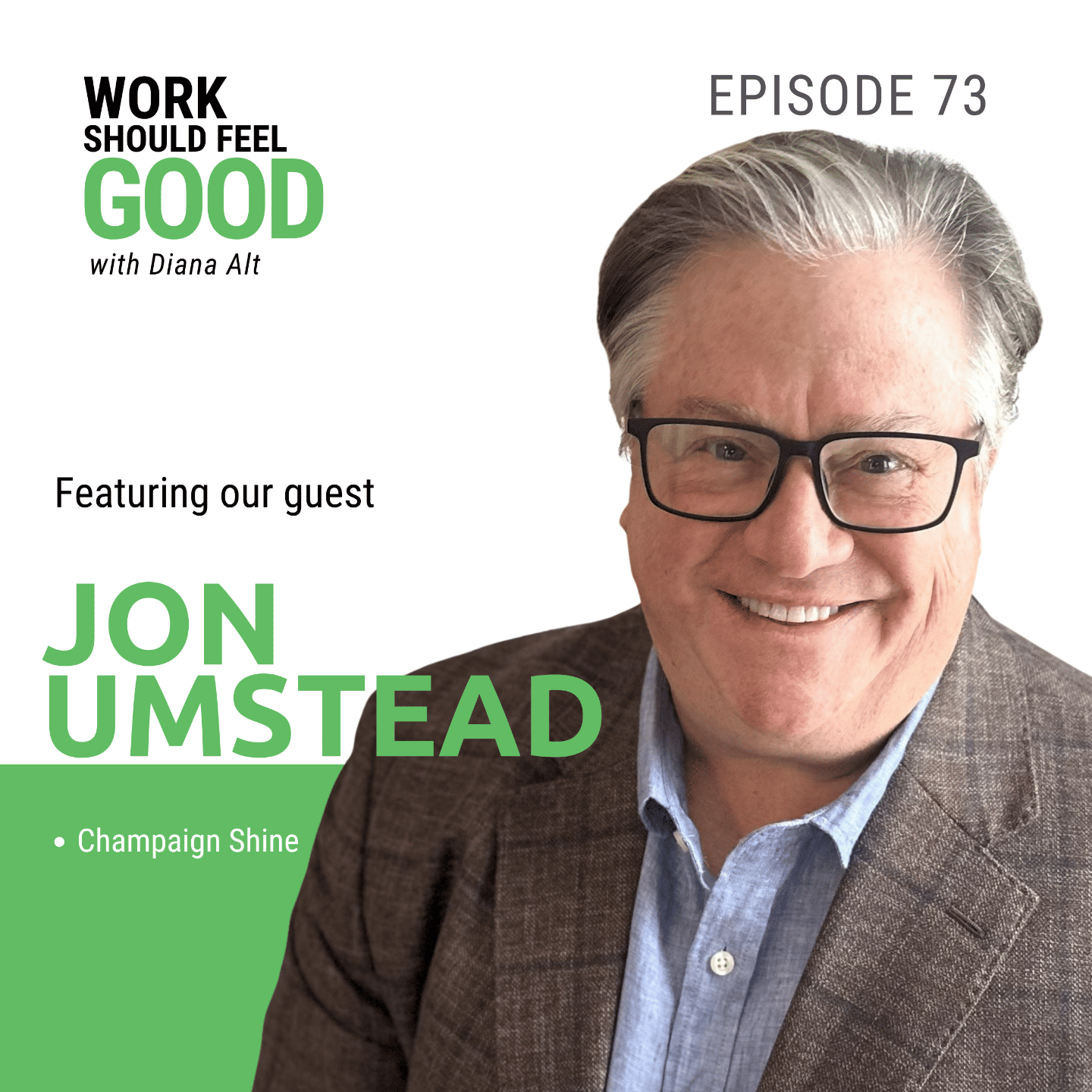
Work Should Feel Good with Diana Alt
Episode 73: Leadership, Change, and Getting Things Done with Jon Umstead
Diana sits down with longtime business leader and author Jon Umstead to explore the surprisingly useful business lessons hidden in the world of moonshiners, bootleggers, and distillers. Drawing on more than 30 years of leadership experience, Jon shares what he’s learned about people, process, change, and execution.
They also talk about nonlinear careers, taking chances before you feel completely ready, leading without getting caught up in titles, and why the best plans have to change when reality does.
You’ll learn:
- Why making the ask can create opportunities you never expected
- How to build a career around your strengths instead of a conventional ladder
- Where leaders create unnecessary complexity through process and planning
- Why caring about people matters at every level of leadership
- What moonshiners and bootleggers can teach businesses about innovation and distribution



Episode 73: Leadership, Change, and Getting Things Done with Jon Umstead
Episode Description
What can leaders and business owners learn from moonshiners? More than you might think.
Jon Umstead has spent more than 30 years leading teams and organizations, from startups to Fortune 500 companies, in roles ranging from COO and CMO to transformation leader. In this episode, Jon and Diana reconnect after working together more than 17 years ago to talk about leadership, navigating change, entrepreneurship, and why getting things done often means keeping things simpler than we make them.
-
Why reaching out and making the ask can create unexpected opportunities
-
Building a career around curiosity, variety, and knowing yourself
-
What leading through organizational change and M&A can teach you
-
Why process for the sake of process creates unnecessary complexity
-
Treating people like people as a foundation for effective leadership
-
Why plans need to change when reality changes
-
Using volunteer and board service to build new skills
-
What moonshiners and bootleggers can teach businesses about distribution and innovation
-
How entrepreneurial thinking can exist inside large organizations
-
Why leadership doesn’t require direct reports
⏳ Timestamps
00:00 Meet Jon Umstead and why making the ask matters
06:09 Against the Grain and Jon’s new book
07:50 From corporate executive to mobile tap business
10:51 Building a career around variety and curiosity
15:03 Lessons from organizational change and M&A
20:51 Why business problems are more alike than we think
23:08 Where leaders create unnecessary complexity
26:31 Why leadership starts with caring about people
28:59 Growing from leading small teams to large organizations
34:05 Building experience through board service
40:44 Business lessons from moonshiners
43:34 What bootleggers can teach us about distribution
49:13 Entrepreneurial thinking without starting a business
50:46 How to spot a genuinely entrepreneurial workplace
54:05 Bringing real-world leadership experience into teaching
55:24 Rethinking what leadership needs to look like
57:39 Where to find Jon and Against the Grain
💡Take Action
🔥 Subscribe for future episodes → https://www.youtube.com/@dianaalt
📖 Grab my Resume Don’ts Guide → https://www.dianaalt.com/resumedonts
❌ Avoid these common job search mistakes → https://www.jobsearchmistakes.com
🚪 Wondering if it’s time to walk away? → https://www.isittimetowalk.com
💼 Work with me → https://www.dianaalt.com
📢 Connect with Jon Umstead
🌐 Website → champaignshine.com
🔗 LinkedIn → https://www.linkedin.com/in/jonumstead/
📲 Follow Jon on Social Media:
Facebook → https://www.facebook.com/champaignshine
Instagram → https://www.instagram.com/champaignshine
X → https://x.com/jonumstead
Against the Grain: Business Lessons From the Still by Jon Umstead → https://www.amazon.com/dp/B0H6G8VMCS
📲 Follow Me On Social Media
LinkedIn → https://www.linkedin.com/in/dianakalt
YouTube → https://www.youtube.com/@dianaalt
Facebook → https://www.facebook.com/dianakalt
TikTok → https://www.tiktok.com/@thedianaalt
Transcript
Diana Alt [00:00:04]:
Hey, Diane Alt here, and this is Work Should Feel Good, the podcast where your career growth meets your real life. Each week I share stories, strategies, and mindset shifts to help you build a work life that works for you on your terms. Hey there everybody, and welcome to Work Should Feel Good, the show where your career, career growth meets your real life. I'm your host, Diana Alt, and today my guest, Jon Umstead, who is a complete blast from my past at a job 17+ years ago. We're gonna talk about what leaders and business owners can learn from moonshiners about building a better business, navigating change, and getting shit done. John has spent more than 30 years leading teams and organizations from startups to Fortune 500 companies in roles from COO to CMO to transformation leader and all kinds of other stuff. He's also the author of the upcoming book Against the Grain: Business Lessons from the Still and the co-owner of Mad River Tap Company with his wife, Carol. Welcome to the show, John.
Jon Umstead [00:01:16]:
Thank you, Diana. Thank you for having me. I really appreciate it.
Diana Alt [00:01:19]:
Thanks for reaching out to me. Um, John is like, there's a, there's a thing that I talk about to people all the time. I do a, I do a fair amount of job search coaching and then of course, like leadership and business coaching. And people are always worried about reaching out to the person they haven't talked to in a long time. And I think since 2009, when I left the employer we had in common, like we've maybe messaged like a couple of times on LinkedIn, if that.
Jon Umstead [00:01:46]:
Yeah.
Diana Alt [00:01:47]:
But you hit me and made an ask. It's like, hey, I got a book coming out. I know you do a show. I do a show. Should we do this thing? What do you feel like people are missing whenever they think they shouldn't do that? Like, what makes your brain go there to the gal that was like 100 layers below you on the food chain 17 years ago to reach out and say, should we do this? Yeah.
Jon Umstead [00:02:11]:
Um, you know, it's funny that you, you asked that particular question because Um, uh, I was talking, I have a relatively new podcast that's in support of the book and how much goes beyond, you know, the launch of the book. I haven't decided yet, you know, and want to get you on there. We had a swing and a miss and we'll get back to it and get that scheduled.
Diana Alt [00:02:31]:
Get it together with your schedule, buddy.
Jon Umstead [00:02:33]:
That's it. I've got to get it together. Oh, I see.
Diana Alt [00:02:36]:
Okay. Sorry, Nick.
Jon Umstead [00:02:38]:
But we talked about kind of that very thing on one of the, uh, One of the first episodes, and it's it's just just going for it. You know, just just take the swing. And you know, the example that he used there was that I had written the book. The manuscript was done. It was in review, and a lot of stories about my dad was coming out in chapter one. And one of the stories was how Buffalo Trace was. you know, his particular favorite bourbon, and we had it at all family events.
Diana Alt [00:03:15]:
I love bourbon.
Jon Umstead [00:03:17]:
Yeah, well, that was his thing. And so I just, you know, as I was kind of re-reviewing, I thought, I wonder if Buffalo Trace would have any interest whatsoever in reviewing the book. And so I reached out to them, and long story short, they came back and gave me a little blurb from their master distiller to put on the COVID front and back covers of the book. And that was just a wild swing moment, right? I just said, I have nothing to lose here. And, um, I think that gets lost with a lot of people is that they think, oh, you know, I shouldn't ask for this, I shouldn't reach out to this person. Why not? You know, the worst that can happen is someone says no, and you're not out anything.
Diana Alt [00:03:58]:
Yeah. Um, I feel like the, the mantra, if you don't ask, the answer is always no.
Jon Umstead [00:04:04]:
That's right.
Diana Alt [00:04:05]:
Is a really good one. And that's not to say, like, don't be obnoxious about it, guys. Like, if you ask the person on the date and they tell you no a couple times, like, let it rest. Go find someone else to ask out. Or you could have, like, an HR problem if you're at work. Like, don't be ridiculous about it. But so many people think that it's positional. There's, like, this positional authority that makes you not able to have a conversation with someone and— No, especially people early in their career.
Diana Alt [00:04:34]:
Like, when you were an SVP in a company, wouldn't you rather— you'd almost rather network with the kid that's 25 years old and bold enough to ask you about your career than the person that's like 48 years old and, you know, probably is gonna ask you for a job. So, which is more interesting?
Jon Umstead [00:04:51]:
Yeah, and, and, um, you know, it's tough because especially in larger organizations, You want to have that relationship with everyone. You want to get to know everyone, but there's not enough time in the day.
Diana Alt [00:05:04]:
Yeah.
Jon Umstead [00:05:05]:
And, but outside of that, I've always operated and believed in, all right, you've got organizational structure for administrative purposes.
Diana Alt [00:05:16]:
Yeah.
Jon Umstead [00:05:16]:
But for doing to, for accomplishing the organization's mission, everyone has to be kind of an equal. You know, we all have to work together. And I don't— titles are there for a reason, but I don't, I don't believe much in them, if that makes sense.
Diana Alt [00:05:36]:
It's like, I'm going to butcher the saying, but like there's a saying about theater that people sometimes say, like, there's no small parts.
Jon Umstead [00:05:43]:
Yeah.
Diana Alt [00:05:44]:
And it's like the person, the person that's 2 minutes on the stage may be one of the most important and pivotal people. The person that's answering the phones has as much importance to a company as the CEO. They don't have to be on the news. They're not going to get fired when you miss a few quarters in a row, but they're just as important. Human dignity goes a long way. So we should try that.
Jon Umstead [00:06:09]:
We're all people.
Diana Alt [00:06:10]:
Yeah, we should try that. Okay. Before we forget, because I promised you before we hit record, say the name of the book. And say where to find it and the date it's releasing. We'll make sure it's all in the show notes and we'll probably talk about it a lot, but let's get that out there for you.
Jon Umstead [00:06:26]:
Yeah, thank you. Thank you for that. The name of the book is Against the Grain: Business Lessons from the Still, and it is available September 15th on Amazon. Kindle is available for preorder, but for whatever reason, Amazon doesn't have a preorder option for paperback or hardback. I'm not doing a hard copy, hardcover. I'm doing just paperback, but they don't— they have the preorder option for Kindle, not anything else. Um, but everything is available for real on September 15th at Amazon.
Diana Alt [00:06:59]:
How exciting.
Jon Umstead [00:07:01]:
Yeah.
Diana Alt [00:07:01]:
Um, I have my favorite. I was telling a friend of mine earlier, like, I have this— I can see it in eyeshot from where I'm sitting in my office. I've got a bookshelf that is probably 3 out of the 4 shelves are books by people I know, or I'm only 1 degree separated from. So. We'll get you on the— we'll get you on the bookshelf before it's all said and done.
Jon Umstead [00:07:21]:
Yes, I owe you. I owe you a copy.
Diana Alt [00:07:24]:
Yeah.
Jon Umstead [00:07:25]:
I promise that.
Diana Alt [00:07:26]:
Yes, I have not read his book. This will be different from the interviews where I've read the books. It's not out yet. Before we go much farther, okay, kind of a wild card. You own a taproom? Like, I didn't realize that until I read your bio when I was prepping for this. Talk about how— because you're like corporate muckety-muck is where you've spent 30 years of your career. What drew you and Carol To doing a taproom?
Jon Umstead [00:07:50]:
Well, it's actually a tap trailer, so it's a mobile bar service.
Diana Alt [00:07:55]:
You have a food truck tap thing?
Jon Umstead [00:07:57]:
Yeah, it's like a, it's like a vintage-style trailer that has— that's customized, and it's got 4 taps on it, so we can serve cold beverages out of 4 different taps. And Take it to weddings, you know, social events, corporate events, what have you. It's kind of a brand new enterprise. And actually, Carol's the boss. So she's, she's the CEO and I am her, her trusty assistant. Yeah, I say the maintenance man usually, but yeah, I'm, I'm the guy that does whatever she tells me to do.
Diana Alt [00:08:38]:
That's an interesting position to be in. So How is that? So does your— what is your wife's professional background before?
Jon Umstead [00:08:47]:
Yeah, so she has been a career-wide, uh, career-long dental hygienist, and, um, she just hit a point where she's like, you know, this physically and mentally is getting to me. I've had it. And she wanted to retire from that. She's too young to retire retire, um, and she's always wanted to have some sort of business of her own. Her, her original thought was she would like to have, um, she called it an Event Lab, which was what the concept was basically, that she would be able to supply everything that anyone would need for an event. Um, and, um, uh, but she ran across this tap trailer on Instagram and just started following the guy that was making them. Uh, there's one guy was hand-making them, and, um, she really liked the concept, and we went down and visited his shop in, in, uh, Virginia, kind of the corner of Virginia and Tennessee. And he was a really— he's a young guy, really, really nice guy, really made quality stuff.
Jon Umstead [00:09:49]:
And what she really liked, especially about him, was that he would instruct you on the business, not just sell you a trailer. So he had all kinds of, you know, business plan, marketing tips, all those sorts of things that kind of came along with it.
Diana Alt [00:10:06]:
Oh, that's— yeah, because even people that have business background, like, it is a whole different ball of wax being a coach or a consultant or whatever the hell it is that you and I do. Yeah. Um, and running an actual tangible place. It's a local business. Um, I love that you are reporting to a retired dental hygienist. I think that is fantastic. It takes a lot. There's not a lot of people.
Diana Alt [00:10:31]:
There's not a lot of people that have been senior executives though in their career that would be able to do that, spouse or not. So, because everybody has these ideas about What it means to be each of these things, dental hygienist or SVP of whatever, CMO, COO.
Jon Umstead [00:10:48]:
Yeah.
Diana Alt [00:10:51]:
How did you— so you've done, you've done a lot of stuff. It was kind of fun to go back and dig into your background to prep for the show because I was like, you really have— some people give you the bio that's really thick and then you go in and you're like, it's a little bit of creative writing. But you really have been in all these different concepts and contexts. And what I'm interested to know is, what did your experience teach you? Like the variety of different experiences that you had, what are some of the things that it taught you that you're bringing to bear now in projects like your book and in your consulting? Because so many people, there's a difference between flood insurance business process outsourcing where you and I met, being an author, working as a CMO and a COO are very different. What are some of the couple of the truths that came out from all those different concepts that they're the same no matter what kind of business you're doing?
Jon Umstead [00:11:55]:
Yeah. Well, one truth that came out is it makes it really hard to write a resume and have your LinkedIn profile as something that kind of makes sense to anybody that might be out searching, you know, for, for someone like you, because it's like, you did what, and then you did what, and then you did what, you know. So putting that into a cohesive story, it's hard. Definitely a challenge. Yeah. And, you know, and I'd heard years ago that, you know, the best way to really go far in your career is to really specialize in an industry or in a product. And that just isn't who I am. You know, I think there's merit to that argument for a lot of people.
Jon Umstead [00:12:44]:
But I think what— getting to your question, the answer to your question, I think what it's really kind of illustrated for me is that you really just have to know yourself, you know? And I know that I am the type where I need kind of that variety. I'm a sponge for learning and experiencing new things. I want to try things. I want to try— I want to challenge myself to see if I can be good at it. Um, and, um, you know, that's just who I am. And I think that's, that's probably the overarching lesson that I have pulled from all of it.
Diana Alt [00:13:19]:
Yeah, I feel like it's very similar for me because like I hit a point in my career where, where I was no longer interested in going up the ladder. I was more interested in like the jungle gym of a career where you're chasing interesting work. For a long time, the answer to the question, what do you want to do in 5 years, has just been, I want to make cool stuff with cool people. And where— wherever that takes me that feels like it has purpose is where I want to go. Not everybody likes that answer.
Jon Umstead [00:13:46]:
Yeah.
Diana Alt [00:13:47]:
I don't want to work for the people that don't understand that answer. So it works out great. For me, I worked in a ton of industries, so I was always in tech. I worked— product manager is how I identify most of my career because I was a business analyst or product manager the most. You know, and now the BA work that I did, everybody is calling product management. We're acknowledging that that's actually what it was.
Jon Umstead [00:14:13]:
Yeah.
Diana Alt [00:14:13]:
There is no more cross-functional mess than product management. So I learned how to take that as my skill set and then apply it in different contexts. You need a data and analytics person? Great. Oh, you need this industry? Great. And I was able to bill myself as strategist and a learner.
Jon Umstead [00:14:34]:
Yeah.
Diana Alt [00:14:35]:
That's going to help you build cool stuff with cool people. It took a long time to figure out that that was the story. So. Yeah.
Jon Umstead [00:14:42]:
Yeah. That's, that's the challenge. But once you, once you've got it, it's a pretty solid story, you know, and it gets you excited.
Diana Alt [00:14:48]:
Yes, it is. And it suddenly makes you interesting instead of sounding like other people. So, when you and I worked together, we worked at a co— we originally worked at a company called Covances. And then later on it was purchased by CSC.
Jon Umstead [00:15:02]:
Yeah.
Diana Alt [00:15:03]:
And so you went through an M&A between a company, it was like, I'd call it middle size. It was like a few thousand people into one of the biggest employers in the company, in the country that was working in our kind of business process and tech outsourcing. What is, what did leading through that type of M&A teach you? That has never been able to leave you since then?
Jon Umstead [00:15:30]:
Yeah, um, I can tell you it was not a fun experience, uh, because I was—
Diana Alt [00:15:37]:
I was like, it was hard.
Jon Umstead [00:15:39]:
Yeah, I, I think I was pretty naive about it, Diana. I, you know, um, with Covances, I was given a lot of autonomy. I actually went through an M&A prior because what the organization—
Diana Alt [00:15:55]:
Was it QBR?
Jon Umstead [00:15:56]:
Is that what it was? PDA. So yeah, the organization that we worked for. Yeah, that was an acquisition and I was part of that acquisition team. And then a year after, um, a year after that acquisition, the previous owners said, you know, we're out, um, and they handpicked me to succeed them. And that's how I got into that role. Uh, and at the time, Covantis Just kind of had this neat little business sitting out in Overland Park, Kansas that, you know, just the CFO literally once told me, just keep sending us money and we'll leave you be. And it was great.
Diana Alt [00:16:32]:
And you were, you were at the time I worked with you, you were SVP of like the, what, BPO business unit or something like that? Is that—
Jon Umstead [00:16:40]:
Yeah, it was a combination. Today we would call it SaaS and BPS.
Diana Alt [00:16:46]:
Right.
Jon Umstead [00:16:47]:
But it was, it was technology and business services.
Diana Alt [00:16:50]:
Okay.
Jon Umstead [00:16:51]:
Yeah. But it was before flood kind of became a big part of it. It was really the main focus was on public sector, public sector programs, state and local government programs, women, women, infants, children programs, WIC. Early Intervention, which is kind of a health benefits sort of program for needy kids, challenged kids. And those— that was the big bulk of the business at the time. And, and then our flood business just ballooned over the course of a few years. And that became half of the organization.
Diana Alt [00:17:33]:
That was where I was— WIC was where I was supposed to start.
Jon Umstead [00:17:37]:
Oh, yeah.
Diana Alt [00:17:38]:
Yeah. So, um, I got hired in to work as like a BA and QA manager in WIC, and then I literally showed up on the first day and they're like, I, we have something to tell you. And I guess like some initiative or like a deal that they thought was in the bag, gonna fund my role, didn't go through. And they're like, we have an equivalent role. Okay, cool. And it was over on Flood.
Jon Umstead [00:18:01]:
Uh-huh.
Diana Alt [00:18:02]:
So I had talked to none of the people. But I was like, okay, it's Monday morning. I don't have the last job, so we're gonna do flood insurance now. And, uh, it was very interesting because I'd never worked with anything that was a government program before. That was actually something I was chasing. I was like, I wanted to do something very different from the software industry I'd been in. But yeah.
Jon Umstead [00:18:24]:
Yeah, I had a similar kind of experience whenever I was—
Diana Alt [00:18:27]:
We're referring to flood insurance, guys.
Jon Umstead [00:18:29]:
So if you're—
Diana Alt [00:18:29]:
Yeah, sorry. Talking about The National Flood Insurance Program, which is basically under FEMA. If you're not in the US, you're not going to know what the hell we're talking about. But, and basically the company that John and I worked for managed business processes for several different insurers that were part of that program, including the one that the government ran directly. So that catches you up right there. Yeah.
Jon Umstead [00:18:58]:
There you go. Good job. Good job. It's been a lot of years and you still nailed it.
Diana Alt [00:19:02]:
Years later, I left in 2009 and I can still do that.
Jon Umstead [00:19:06]:
Uh, I was gonna say though that I, I had a similar experience when I was at Nationwide Insurance. Wasn't flood insurance, but, um, I was in the IT, uh, department. And, um, you know, that's where up until that point I had spent my professional life was in IT. And, um, I wanted to, I wanted to change a little bit. I wanted to grow. And so—
Diana Alt [00:19:26]:
What did you do in IT? Were you a developer?
Jon Umstead [00:19:28]:
Like, what was your Originally, I was a developer, eventually a project manager, division manager. And some of the later things I did at Nationwide was like define project management best practices and roll those out and develop strategic plans for the IT area, that sort of thing. But I wanted to do something a little bit different. So there was a, there was a project manager role within the Office of Claims. So the business office of claims. So it was a project manager, not an IT project, but just claims projects, uh, things to make the claims organization better. And, uh, so interviewed, got the job, and right before I started, the, the person that hired me retired, and this new person came in from the field that had been— she'd been a claims adjuster for her entire life. And, you know, she was like, what's this guy that's got no claims experience doing in my office? You know, kind of thing.
Jon Umstead [00:20:31]:
And it was, it was not a good experience. So that lasted about 6 months.
Diana Alt [00:20:37]:
Did you end up leaving Nationwide or transferring or what happened?
Jon Umstead [00:20:41]:
I transferred within Nationwide, um, but within 3 months of that was when I, when I left and went to work for Covantis, actually.
Diana Alt [00:20:48]:
Got it. Well, they came and got you.
Jon Umstead [00:20:50]:
Yeah.
Diana Alt [00:20:51]:
Oh, how interesting. So, um, Before we move on to like no-nonsense leadership and being against the grain, when you think about all these, because you've been in tech, project management, marketing, entrepreneurship, author, what is the thread that runs through all that that's consistent about who John is as a professional?
Jon Umstead [00:21:11]:
I think not only through each of those kind of roles, but through, through every industry, business is business. We all have the same problems. You know, the details under them might be different, but it's the same everywhere you go and everything you do. And so you learn approaches to how you not just solve problems, but recognize them, you know, anticipate them, and then make sure you're doing what you can to ensure that that problem actually doesn't arise, you know.
Diana Alt [00:21:49]:
Yeah.
Jon Umstead [00:21:49]:
It's all the same.
Diana Alt [00:21:50]:
Oh my gosh. One of my, my friend Brian, who he, he was like an Andersen Consulting or, or yeah, he was an Andersen Consulting guy before it became Accenture.
Jon Umstead [00:22:01]:
Mm-hmm.
Diana Alt [00:22:01]:
And then later on started his own business doing basically sales. He was a Salesforce implementation partner and he did some of the most complicated stuff anybody's done, um, within Salesforce. And he had a very interesting definition of a business. That I just loved. He said a business is a collection of processes designed to make money. So that's it. Like, we're trying to make it like everything is so unique and so special and all this stuff. And especially when people are in nonprofits and all of that, they want to make it about like the purpose.
Diana Alt [00:22:37]:
Like, if you ask about the money, you're somehow not qualified. No, it's just a collection of processes. That are designed to make money, I would argue, and run by people that are designed to make money. But, um, it really helped abstract it out because I'm a process person. So I was a business analyst for so many years and I'm like, oh, a process is a process. The goal is money, either saving it or making it. I get it.
Jon Umstead [00:23:03]:
Yeah, I like that. That's a great definition.
Diana Alt [00:23:06]:
Isn't that a good definition?
Jon Umstead [00:23:07]:
Yeah.
Diana Alt [00:23:08]:
Yeah. Um, So no-nonsense leadership is a thing that came through for me whenever I was like prepping for this. And one of the things I want to know is, where do you see leaders making stuff way more complicated than they need to be? What is, what are some of the top places that you see that? Because the longer I work with people, especially in my coaching practice where I work with usually like senior ICs up through VP level is most of my people that I work with in corporate. We make things really hard. People try to act like if we don't get everything exactly right, there's a problem. Like, it's just messy. And to me, it feels like it doesn't need to be messy. Where do you see people creating mess and complication where it doesn't need to be? And what's your advice to them?
Jon Umstead [00:24:04]:
So while you were talking, I thought of 3 things immediately, and then, and then a 4th. So let me challenge, challenge myself to see if I can rattle them off. So the first one is, we were talking about process. I cannot stand process for the sake of process. I am a process person also, growing up in IT. You just, you just are.
Diana Alt [00:24:25]:
Yeah.
Jon Umstead [00:24:25]:
But when you do process for the sake of process, it's not adding any value. That's a pet peeve. And I think we do that a lot. Another thing we do, you mentioned people. A lot of times leaders forget that it is people, you know, that are the boots on the ground that are making things happen. And you have to treat them accordingly. And when you stop treating people like people, it creates problems. A third would be— I'm missing what the third one was.
Jon Umstead [00:24:55]:
So I'm going to go to the fourth. The fourth, you mentioned plans, you know, Sometimes organizations, leaders get so caught up in the plan, the plan, the plan, the plan, that they forget to be flexible with the plan. Because plans are designed today. And tomorrow, the reality is different. So your plan has to live and breathe. It has to be, you have to adjust with whatever is going on. You can't just stick to the plan. And the thing that, an analogy I like to use is like a football team.
Diana Alt [00:25:24]:
Yeah.
Jon Umstead [00:25:25]:
You know, they've got a plan, right? A game plan. And, uh, they go out and take the field and on the first play of the game, the quarterback gets injured and is out. All right.
Diana Alt [00:25:35]:
Right.
Jon Umstead [00:25:36]:
You can't stick to the same plan. No. Right. You cannot. So if you do, you probably won't win.
Diana Alt [00:25:41]:
Yeah. I love that. It's the whole, um, everybody has a plan until they get punched in the face kind of thing. But another way I like to look at it that I think is even more, when you think about planning, which should be done in shorter cycles, guys. Stop trying to plan for 5 years, plan everything for 5 years.
Jon Umstead [00:25:59]:
Exactly. Amen to that.
Diana Alt [00:26:01]:
All models are wrong. Some models are useful is one of my favorite quotes. Like, just because you can't be planning to the nth degree, just because it'll change, that doesn't mean that the plan is not useful. You have to figure out the right way to do it. So thanks for sharing that because I think More struggle comes because people are trying to be clever.
Jon Umstead [00:26:25]:
Yeah.
Diana Alt [00:26:25]:
Than anything. Uh, I got a rule for leadership for you.
Jon Umstead [00:26:29]:
Oh yeah? In your back pocket.
Diana Alt [00:26:31]:
This will appear in my book, which I just started working on and doesn't even have a title yet. Um, I got this from a mentor of mine. The first rule of leadership is loving people. And if you do not love people, you probably should not be leading them. That's not to say you can't contribute professionally, but if you do not actually love and care about humans, you oughtn't be leading them. What do you think about that?
Jon Umstead [00:26:59]:
I think that's spot on. You know, even in the most dangerous of professions, you know, let's take military, for example, battlefield military commanders. You know, you might have to you know, put that, that suit of armor on and, and, and order people potentially to their death. Uh, but that doesn't mean you don't care about them. You don't, you know, and because if you do, uh, if you don't rather, then you're a monster. And, and at some point the troops are gonna understand and recognize that, right? And they're not going to be willing to, to march into danger.
Diana Alt [00:27:39]:
Yeah.
Jon Umstead [00:27:40]:
Um, because they know that the person that's ordering it Couldn't give a damn about them.
Diana Alt [00:27:44]:
Yeah. I had an interesting experience come up, um, in a company that I worked for where I was managing a team and I had made it into a team because you know how there's groups of people that work together and then you have teams. I had made my team into a team and it was also a team that other people wanted to be on. And then there were peer managers in the same group that had groups of people and they did good work. Like, that's not to say that you know, they're bad or anything like that. They just hadn't captured the synergy of the team and made it just a wonderful place to work.
Jon Umstead [00:28:20]:
Yeah.
Diana Alt [00:28:21]:
And I got a lot of pride off of that. Like, I still have people well over 15 years later that come to me and are like, you're one of the best bosses I ever had. I had one gal reach out and I'm like, I'm sorry, like, you had 15 more years of career. I hope, I hope you got somebody better than me at some point before it's all said and done. But Um, part of that is because I was focused on loving people before I even had that vocabulary so that we could do good work instead of being as productive as possible. And yet we were still more productive. So it's a really good way to think about it.
Jon Umstead [00:28:57]:
Yeah.
Diana Alt [00:28:59]:
Um, what do you think? So you've led little teams of people and you've led big teams of people. And if people listen, a lot of people that listen to my show and are in my orbit are people that are at like manager, director, a handful of people, a few dozen people, but they have aspirations to have the kind of role where they might lead hundreds or thousands of people.
Jon Umstead [00:29:20]:
Yeah.
Diana Alt [00:29:20]:
What do you feel like is some of the most important learning or exposure or skills or mindsets? I don't even know the right word to use for this because I've never led thousands of people. But what if you have aspirations to impact and lead organizations of that many people, what some of the top things people need to understand that are the same? And what are some of the top things that are different that people need to be aware of?
Jon Umstead [00:29:46]:
Yeah, well, piggyback first off of, off of the loving your employees, loving your teammates. Because when you do that, you respect them, you don't abuse them, you don't open yourself up to, you know, unethical behavior. Lawsuits, all of that kind of stuff that goes along with being a bad player. Right.
Diana Alt [00:30:10]:
And, and, um, or depression, anxiety, high turnover. Like it doesn't have to be legal where it's a problem too. Right.
Jon Umstead [00:30:17]:
Yeah. Yeah. So, uh, so that's one. Um, I guess another, uh, would be don't be afraid to stretch. You know, we, we kind of get into our boxes. This is my role. And if I do this role really good, then maybe I'll get that promotion to the next step. Well, stretch beyond.
Jon Umstead [00:30:40]:
Yeah, not how it works. Stretch beyond that. You know, be good at what you're doing. Yes, but take on those challenges even if you feel like you know I'm not qualified to do this. Like I said earlier, take take the swing, take the shot. You know, you know hopefully if you take a shot at something that's kind of outside of your current capabilities and it doesn't work out as well as maybe everyone hoped, hopefully you are. working for someone that understands that. They can be disappointed in the result, but not in the person, especially the person that either voluntarily or is asked to, to stretch themselves when maybe they aren't as prepared as they thought they should have been before they started.
Diana Alt [00:31:25]:
Yeah. And prepared doesn't always mean— like, when I ask— I'm going to give you a spoiler alert, so you're going to have a few minutes. And if you haven't ever listened to the show, I ask towards the end— well, let's just do it right now because then it's— we'll just do it right now.
Jon Umstead [00:31:43]:
All right.
Diana Alt [00:31:43]:
The worst career advice you've ever received. That's a question I ask everybody. That's a guess. So what is your worst career advice you've ever received?
Jon Umstead [00:31:51]:
My worst career advice? I don't know if it qualifies as career advice. It was actually in a meeting with a— with someone that I reported to. that literally told a couple of us that were in the room to stop smiling. There's nothing to smile about. And I didn't know how to respond to that. You know, in my head I'm thinking, are you kidding me with what you just said? You know, it's like if something's not good, you have to be— I guess if there was advice that was coming out of what that person was saying, it would be if there's something not good going on, you better be, you know, angry, depressed, you know, whatever, but anything but smiling, you know? And it's like, I think you should smile through the tough stuff too.
Diana Alt [00:32:47]:
So I asked that. I love that question because I love over the— we'll be at episode 70-something whenever you have this release and over all these interviews, The most common things that have come up are, do what, like, do good work and you'll get promoted or you'll be recognized is by far the most common thing that's come up. So I love, I love when there's a different answer.
Jon Umstead [00:33:11]:
Yeah.
Diana Alt [00:33:12]:
But what a wild thing. The other thing, like, I hear people talk about is emotion at work, because especially women deal with this, like, get the bad rap for being too emotional. But I say there's emotion at work all the time. It's just that the only one that's allowed is either toxic positivity or anger in a lot of organizations. And if we can fix to where we're allowing a broader range of emotions, maybe it'll be a healthier place to work. That's my soapbox on emotion.
Jon Umstead [00:33:42]:
Yeah.
Diana Alt [00:33:43]:
But you were a smiling guy too. Like when you said that, I don't, you know, we didn't work closely together when we were at CSC together. But you were a guy, like your default is smile. You're not a guy that frowns by nature all the time. Some people have that kind of resting expression. That is not you. That's not you at all. Okay.
Diana Alt [00:34:05]:
Business lessons from the— oh, I want to ask about board too, before we get into the book. So you are doing board service. Um, and I have also talked to a lot of people lately that are like, I want to be an advisor. I want to be on boards of directors or boards of advisors.
Jon Umstead [00:34:20]:
Yeah.
Diana Alt [00:34:21]:
And those can be kind of mysterious. They have sort of an aura about them. You are currently on at least one board because you're on, uh, you're on the National Flood Insurance Association board.
Jon Umstead [00:34:32]:
Yeah.
Diana Alt [00:34:34]:
Um, what's— how did board service become part of your career? Like, what role does it take? And what do people that are interested in making that part of their career, especially if they're interested in that, like, in their you know, semi-retirement years or later on after they've done the biggest jobs that they plan to do?
Jon Umstead [00:34:54]:
Yeah, I think there's, boy, there's a whole lot to unpack in that question. So I'll just hit a couple of highlights. But one, one is just that curiosity that we talked about earlier. You know, always wanting to learn. You can go serve on a board and simultaneously be serving yourself because you're learning something. Hopefully you're learning something new. You're not just bringing your own knowledge and experience, but you're getting something back as well. So that's, that's one thing.
Jon Umstead [00:35:23]:
Another, I think you're right about someone that maybe is close to retirement or in retirement, maybe looking to slow down the career life but not ready to get out of the game. Board service is a great way to stay involved. You know, whether it's for, like in my case, it's a, it's a industry association, you know, there's no pay associated with that. But there are also paid board or board advisor roles. I haven't— I've actually never sought any of those out. Maybe it's something I'm worth weighing in on.
Diana Alt [00:35:58]:
Okay, so you're doing primarily voluntary board advising?
Jon Umstead [00:36:01]:
Voluntary. Okay. Yeah.
Diana Alt [00:36:02]:
Great.
Jon Umstead [00:36:03]:
Yeah. But— Yeah, go ahead. But those opportunities are out there, you know, if someone is seeking them.
Diana Alt [00:36:11]:
Um, you know, when you— one of the things that I always wonder about is, um, what kind of— when you— whether it's paid or not, like, that's— go figure out which kind you want to do, guys. But I know a lot of people that have felt like, well, I don't have the expertise. I don't— I wasn't a business executive, whatever. Are, you know, do you feel like that's too much of a liability? Like, if a person is— I've been in leadership, I'm interested in this industry, or I'm interested in growing. Are they SOL if they haven't been an executive leader? Or do you feel like this is accessible to people earlier in their career to get started?
Jon Umstead [00:36:51]:
Yeah, I think there's kind of here in this question, there's a little bit of a difference between what, what should be true and what reality is. Yeah. Yeah.
Diana Alt [00:37:02]:
I deal in reality. So, reality.
Jon Umstead [00:37:06]:
The reality is that you're probably, if you're interested in working with boards, Um, you know, there are, there are certainly non-paid board, uh, boards, board, uh, positions that are out there that you don't have to be, you know, corporate executive or something like that to, to join or be elected to. So seek out things that are interest— interesting to you to get some of that board experience. Perfect example, um, I joined a local board. This was several years ago. It was it was an organization that was that was refurbishing an old abandoned local theater, and so it was just all they really cared about was can you come to the table and help get some things organized? You know, help help get work crews together, that sort of thing. So if you've got energy and time to devote, find anything to get some of that board experience that you can put on your LinkedIn profile or on your resume or whatever. The The reality is, though, some of the more career-like board opportunities and paid opportunities are probably going to need a title, you know, of some sort to come with them, or a network, you know, somebody knows somebody, that sort of thing.
Diana Alt [00:38:30]:
So I love that you unpack that because a lot of people I've had actually have been Isn't it fun to get podcast pitches? Are you at that point yet? Are you getting a lot of pitches? I've had, I had someone reach out to me pitching, talking to people on my show about getting paid board positions, which is not something that I've done. My experience with boards has been mostly kind of domain industry. You know, I helped found the IIBA, the Business Analyst Association in Kansas City years ago. And now I'm like emeritus. I'm just like the old guard, not even a member anymore, but they call me. You want to come to this? But it's really important because that was a context that I was able to build skills that I was not going to have the opportunity to build within my actual job. Because when I was a BA at— this was actually at Covansas in 2007, 2008 when this chapter was formed. I was still more on systems side.
Diana Alt [00:39:29]:
I was interested in people. I knew nothing about marketing.
Jon Umstead [00:39:31]:
Mm-hmm.
Diana Alt [00:39:32]:
And I wanted to get involved in part so I could learn about marketing. So I think I took the role of secretary because It's like what I had, fine, I'll do that. That's good.
Jon Umstead [00:39:43]:
Yeah.
Diana Alt [00:39:43]:
But I wanted to make sure that I took a role I could do in my sleep so I could learn from some of the other roles. And then that served me really well when I went into product management, because it's like, I got a little, I have a little marketing chops, helped grow the organization or helped learn what some of the words mean. So you can use it all kinds of different ways. And when you're in an organization and you feel stuck from a skill building perspective, perspective, volunteer work and boards is such a good way to, such a good way to get there.
Jon Umstead [00:40:11]:
So absolutely. Uh, the one role I would avoid, me, I would avoid at all costs is treasurer. I, you'll never see me running for treasurer position.
Diana Alt [00:40:20]:
I will not be a treasurer. And I'm really picky on what I join in an organization anyway, because I just bring, like, I just, I just bring energy to anything that I do. Yeah. So people keep trying to put me on boards and I'm like, I don't want to be on your board. Like, I'm— my business is my baby right now, so I don't have time to be on your board. But yeah, I'll show up and do things here and there. Okay. Business lessons from The Still.
Jon Umstead [00:40:44]:
Mm-hmm.
Diana Alt [00:40:44]:
Why did you pick The Still? You know, you mentioned the Buffalo Trace was your dad's bourbon, but what— when you were writing the book, did you start with the premise of The Still, or did you start with here are a whole bunch of things that I'm trying to tell the world about, and then the still part clicked for you. How did that come about for you?
Jon Umstead [00:41:06]:
Yeah, it was, um, I, I actually, it was back when I did my first book. I was blogging a lot, you know, kind of in support of that. I was doing independent, uh, consulting, and, uh, so just, you know, all of that content marketing stuff that I had going on at the time. And, um, uh, also at that time, I I developed an interest in moonshine. Uh, I like it. Um, and then ultimately I started making it myself. So, uh, I make, I make moonshine. I guess you could say I'm a moonshiner, right? And, uh, so what—
Diana Alt [00:41:40]:
For those of you just listening, he has all his teeth and he is not wearing overalls right now. Right.
Jon Umstead [00:41:46]:
I don't even own any overalls.
Diana Alt [00:41:48]:
Oh, we should fix that. That would be, that would be good.
Jon Umstead [00:41:50]:
And I can't grow a beard. I could grow this right here is about all I could grow. So a lot of luck. But, um, uh, yeah. And, and so, you know, I was watching a lot of shows and documentaries and things on moonshiners, and it occurred to me that, you know, these— some of these backwoods, uh, people have some pretty good business chops. And I wrote a blog about it, and in the blog I, I said someday I'll write a book about it. And so I finally got around to it. And so I guess the still has always been part of the concept, but it was how can I take moonshining and bootlegging and distilling and extract business lessons from that, um, that can fit any industry.
Jon Umstead [00:42:36]:
And so that's what I tried to do.
Diana Alt [00:42:39]:
Uh, that's— I love that. I, I always wonder when people Because she never— you know, I'm neck deep in a book. If you want to be on my behind-the-scenes list, go to dianaald.com/book, sign up. I send crazy stuff out. And right now, it's mostly about what the hell am I doing? So enjoy. But I find how people got to the book really interesting because, as I had an English teacher tell me once, no one ever knows when the first sentence of a book got written. You know, we think it was the best of times, it was the worst of times, or whatever. No one knows if that was the very last thing the author wrote or the very first thing or something in the middle.
Diana Alt [00:43:19]:
So figuring out like how people are actually thinking about constructing their stories in their book is very interesting to me for purely selfish reasons right now. So what are— okay, let's talk about bootleggers.
Jon Umstead [00:43:33]:
Yeah.
Diana Alt [00:43:34]:
You know, you got a distiller. I have a chemistry degree. I know what a still is. Moonshine is moonshine. It tastes like kerosene to me unless you put fruit in it and then it tastes like fruit-flavored kerosene.
Jon Umstead [00:43:44]:
But you just haven't had good moonshine.
Diana Alt [00:43:46]:
Well, then I have to figure that out. I don't think you can ship that through the US mail. So no, you can't do that. But talk about bootlegging because people use that term a lot. But I don't— I think the average person doesn't actually know what a bootlegger is. So define that and then tell us what specifically bootlegging teaches you about business.
Jon Umstead [00:44:11]:
You can kind of think of bootlegging as, uh, like the, the wholesaler or distributor combination of— so the distiller is the manufacturer, right? They make the moonshine. And then the bootlegger is the one that gets it out to market. And maybe that market is to, you know, another bootlegger Um, but, uh, maybe that, that, uh, market is actually the end customer. But so bootlegger is the, is the person in between who actually has the biggest amount of risk because they're transporting the, the illegal product.
Diana Alt [00:44:46]:
Illegal in the time that we were moonshining the most.
Jon Umstead [00:44:48]:
So it's still, yeah, it's still illegal. Uh, there, there are some states, uh, Missouri one, um, there are some states that you are permitted by state law to make up to so many gallons if you are using it, you know, consuming it yourself. You're not selling it or anything like that. So even in those states where you can legally make some for home consumption, bootlegging is still illegal. Yeah.
Diana Alt [00:45:17]:
So, and I was thinking about Prohibition because when I first remember hearing about— oh yeah, like moonshine, I think At least you and I are not too far apart in age. So when we would hear about moonshine as we were kids, it's always some movie and it's Prohibition era.
Jon Umstead [00:45:32]:
Yeah, right.
Diana Alt [00:45:32]:
That kind of stuff. But yeah, you're right. Regulations now. And if I remember right, bootlegging came from the term— like part of it was like we're literally hiding liquor in our boot. Yeah, that was where it came from. So, okay, so distribution. So when you zoom that out, Basically, people talk about product and distribution, and in the SaaS world in particular, everyone gets obsessed with making their shiny product.
Jon Umstead [00:46:01]:
Yeah.
Diana Alt [00:46:02]:
But they don't know crap about distribution, either from go-to-market or from like the technical distribution. So is that the kind of things that you were sharing about in the book? I just made that up. I don't, I didn't know.
Jon Umstead [00:46:13]:
Yeah, no, it's a great example. And yeah, it's a, it's Exactly one of the things that I talk about in the book is, you know, we think about the manufacturing process, right? And distribution, to your point and mine, is often just, you know, you don't think about it when, especially if you're new to, you know, you started up a new business or have a new product, but it absolutely is part of the production process because that product doesn't exist Right? Unless it's in your customer's hands or on their device.
Diana Alt [00:46:48]:
Yeah, it doesn't matter. It doesn't matter. What are some of the most important things about distribution that we can learn from bootleggers? Well, anybody, you know, distiller, bootlegger, any of the people that you talked about in here.
Jon Umstead [00:47:03]:
So bootleggers had to figure out how they're going to get it from point A to point B, right? So they had to pretty clever about it. So in your own business, uh, don't just accept the norm. Uh, think about how you can, uh, differentiate— you can perhaps differentiate yourself through a distribution channel, right? So don't just be like, okay, everybody takes this product and sends it from here to here this way. Um, and, uh, and there's a great example in the book of a, of a, a rum runner, uh, bootlegger that invented a new way. And, uh, you know, and, um, uh, didn't take too long before everyone started copying him. And then that got the attention of the authorities. But he was the first to do it kind of the way he did it. Um, and, uh, it made him a fortune, uh, in just a little bit of time.
Diana Alt [00:47:55]:
Yeah.
Jon Umstead [00:47:55]:
That's an illegal example, but the same is true in legal business, you know. Find, find a new, a new way to do it. That's going to give you more clarity.
Diana Alt [00:48:05]:
One of the ways I see this being talked about a lot, I don't know if you, because you coach and consult with businesses too. Um, one of the top ways I'm seeing distribution of our, all we have to offer is our time, our knowledge, and our wisdom as consultants, really. That's the heart of what we're at. But the simple act of like making a custom GPT to help someone customize, write a cover letter. Yeah, like a very basic thing. That is an example of distributing the knowledge. And then you of course have to figure out, how am I doing it? Am I selling it and giving them a link? Like, you know, there's other things around that. But, um, so many people in the knowledge businesses don't think about distribution.
Diana Alt [00:48:50]:
Yeah, no, especially if they never worked retail.
Jon Umstead [00:48:54]:
Yep. But everything is a product that has to be distributed.
Diana Alt [00:48:58]:
Yes. Even if it's electrons being distributed from your server to my phone. Very cool. What, what else? What are a couple other ideas from the book you really want people to take away?
Jon Umstead [00:49:13]:
I think the biggest idea I'd really like for people to take away is that, you know, anyone can have entrepreneurial spirit. You don't have to start a business of your own to be an entrepreneur. You can be, you know, you can have entrepreneurial spirit within the confines of a big corporation. It's basically, to me, it's just, I see a better way of doing something, and I'm going to create the method for doing that. And that's a big part of what entrepreneurial spirit is. There's a problem, there's an issue, there's a challenge. I accept it. I'm going to solve it.
Diana Alt [00:49:52]:
Yeah. Let me talk to— there's a peeve I have though, that's in corporations. So have you ever worked at a company or for a boss that wants you to be, I want entrepreneurial, we are entrepreneurial here. And then you find out that nobody in leadership has done so much as run a lemonade stand. Like they don't really know.
Jon Umstead [00:50:13]:
Yeah.
Diana Alt [00:50:14]:
Um, what is the difference between an organization that's talking about an entrepreneurial spirit And it's in a good way that's healthy and useful and one that is not. They're just idiots throwing around terms that sound sexy on the internet. How can we tell? Because this is important too. I work with a lot of people in product management. A ton of people are like PMs, directors of products, like VPs of product. And the many of them have aspirations to be founders later. They want to be somewhere.
Jon Umstead [00:50:45]:
Yeah.
Diana Alt [00:50:46]:
That's truly entrepreneurial. But if I had a dollar for every time someone went into one of those companies and found out, oh, this place is not entrepreneurial at all, what could they ask or look for when they're researching someplace to work that would tell them, is this place actually going to reward entrepreneurial spirit all up and down the food chain, or are they not?
Jon Umstead [00:51:11]:
That's a fantastic question because, you know, the company The, the honest truth is, when you are interviewing with a potential employer, they are trying to sell them as hard as you're trying to sell yourself to them, right?
Diana Alt [00:51:27]:
Yeah.
Jon Umstead [00:51:27]:
So, you're in this mutual sales, sales role. And it's sometimes it's hard to cut through the crap. I hadn't really considered this question before, Diana. It's a good one. I think the first thing that comes to mind, though, is maybe ask for some examples.
Diana Alt [00:51:43]:
Yeah.
Jon Umstead [00:51:44]:
And if they've got none or sputter on the question, then maybe that's a clue.
Diana Alt [00:51:50]:
The sputter on the question is such an under— such an underrated thing because there's a difference between like the sputter and the oh shit or the face where it's like, I cannot believe the candidate had the nerve to ask me this question. There's a difference between that and I need to think about it for a little bit. My advice is whatever you're asking about, ask it neutrally. So for you, simply saying, oh, tell me some examples about how, how your entrepreneurial spirit has benefited internal operations, or, you know, has it been part of a product that you brought to market or things like that? I love to ask questions about culture and about things where you really want to make a hard decision as neutrally as possible. So you're not leading the person.
Jon Umstead [00:52:36]:
Yeah.
Diana Alt [00:52:36]:
And I'm a big believer in that, both sides of the hiring table, because that's how we get the straight dope.
Jon Umstead [00:52:43]:
So that's, that's a, that's great advice. I love it. Actually, I'm going to steal it from you and, well, I'll borrow it from you. You can borrow it. I teach a staffing course every once in a while at Franklin University in Columbus. It's all online, but just started a new class. The semester just started and You know, we often talk about— I try to, I try to, with the students, talk about both sides. It's not just, you know, don't just put on your HR hat, you know, doing this.
Diana Alt [00:53:13]:
Is it HR professionals you're teaching?
Jon Umstead [00:53:15]:
Yeah, yeah, yeah. HR management courses primarily. So, but I love that. Yeah.
Diana Alt [00:53:22]:
Yeah. Well, feel free to steal it. I weirdly have never officially worked in HR. I always have been involved in recruiting in some capacity. Like, I was always the one raising my hand from the time I was like a year out of school. I want to be on the interview team.
Jon Umstead [00:53:39]:
Uh-huh.
Diana Alt [00:53:40]:
And I think it's important to have people, you know, don't interview 17 with 17 different people, but I think it's important to include all levels. And I have a friend that owns a staffing agency, and he's like, you've never worked a day in recruiting, but you understand this better than most of the people that have worked 20 years in it. So it's kind of like a nerd area of mine. What got you into teaching HR management? What made you land on that?
Jon Umstead [00:54:05]:
Um, well, I always wanted to do some, some teaching. I grew up, my mom was a teacher. And, you know, one of our chores when we were kids, which she taught 3rd grade, one of our chores was to help her grade papers, you know, so, so I kind of have that in my background. And That's just something that I always wanted to do when the time was right. And about 8 years ago, the time was right. And, um, I— what I really wanted to do was teach, uh, business courses. Um, but they were kind of full up with, uh, they, they had me do a couple, you know, but where they really needed help was, uh, in the HR department. So close correlation.
Jon Umstead [00:54:43]:
So, you know, it was kind of an easy—
Diana Alt [00:54:45]:
Is it in their MBA program or, uh, like a master's in HR?
Jon Umstead [00:54:49]:
No, it's undergraduate. Undergraduate work that—
Diana Alt [00:54:52]:
oh, very cool. Yeah, nice. Well, John, I'm so glad you came on today. What fun to catch up and nerd out about things we 17 years ago never had a reason to talk about because we were talking about flood insurance. Um, I already asked you my default question, so I'll say, um, I got one other question I love. I'm stealing this from Adam Grant, actually. I love Adam Grant. What is something that you have rethought lately or changed your opinion on?
Jon Umstead [00:55:24]:
That's an easy one, actually, because— Great.
Diana Alt [00:55:26]:
Cool. I gave you a hard one earlier. Yeah.
Jon Umstead [00:55:29]:
I just had this conversation with my wife last night, as a matter of fact. It was just based on a news story that we saw. But I was like, you know, I've been working mostly with small teams or as an individual contributor For the last, I don't know, a lot of years, last, last several years, you know, I haven't run a large organization for 10, 13 years. And I don't think I want to anymore. You know, I—
Diana Alt [00:56:04]:
Either. Like, I never did hundreds. Like, I think the most I ever had was like between 10 and 15, which is too damn many on knowledge work, by the way. Because I was the frontline manager with, I think I had 12 direct reports. That was too many. Um, but people ask me all the time, like, how are you coaching leadership and you don't have a big org? And I'm like, because, because part of work feeling good is that it has to be a business.
Jon Umstead [00:56:28]:
Yeah.
Diana Alt [00:56:28]:
That I can manage, that I can spend time in my zone of genius and I can have a higher impact teaching the people that are in the larger organizations how to lead more effectively than I can for a small business building out. Whatever team I have, like, I just can impact more people.
Jon Umstead [00:56:45]:
So, well, and I would argue that you are a leader, you know, a leader doesn't have to have any direct reports, right?
Diana Alt [00:56:53]:
Oh my God, I spent far more, much more of my corporate career in influence leadership roles. If you think about it, product managers, project managers, business analysts, that's where I spent the bulk of the time in my 20 year corporate career, they almost never have direct reports. They're always managing crazy, you know, multi-stakeholder cross-functional shenanigans. They rarely have direct reports. They have way too much responsibility, not nearly enough authority. That's where I spent most of my time. So it was, to me, it's a hell of a lot harder than managing a team.
Jon Umstead [00:57:32]:
Yeah, I totally agree. Far harder. So harder, you gotta be more creative, more nimble, every, everything.
Diana Alt [00:57:39]:
Yes. Yes. Well, thank you so much. Um, give us your website again real quick and the release date of the book again real quick so we don't forget.
Jon Umstead [00:57:49]:
And then we'll close. So the website is champagneshine.com and Champagne is like, uh, Champaign, Illinois. Uh, C-H-A-M-P-A-I-G-N. Yeah. The book is Against the Grain. It will be out on Amazon September 15th. You can get information about it at my website, blog posts, podcasts, articles.
Diana Alt [00:58:14]:
All things. What's the name of your podcast if people just want to go hunt it on Apple though?
Jon Umstead [00:58:19]:
Also called Against the Grain.
Diana Alt [00:58:20]:
Well, there you go. You just made it super easy. Well, thank you so much, John, for being with us on Work Should Feel Good today. And we'll see you all next time.
Jon Umstead [00:58:29]:
Thank you.
Diana Alt [00:58:31]:
Want some more career goodness between episodes? Head on over to dianaalt.com and smash the big green Let's Connect button to sign up for my newsletter. Let's make work feel good together. And that's it for this episode of Work Should Feel Good. If something made you laugh, think, cry, or just want to yell, yes! At your phone? Send it to a friend, hit follow, hit subscribe, do all the things. And even better, leave a review if you've got a sec. I'm not gonna tell you to give it 5 stars. You get to decide if I earned them. Work should feel good.
Diana Alt [00:59:07]:
Let's make that your reality. Work should feel good. Let's make that your reality.