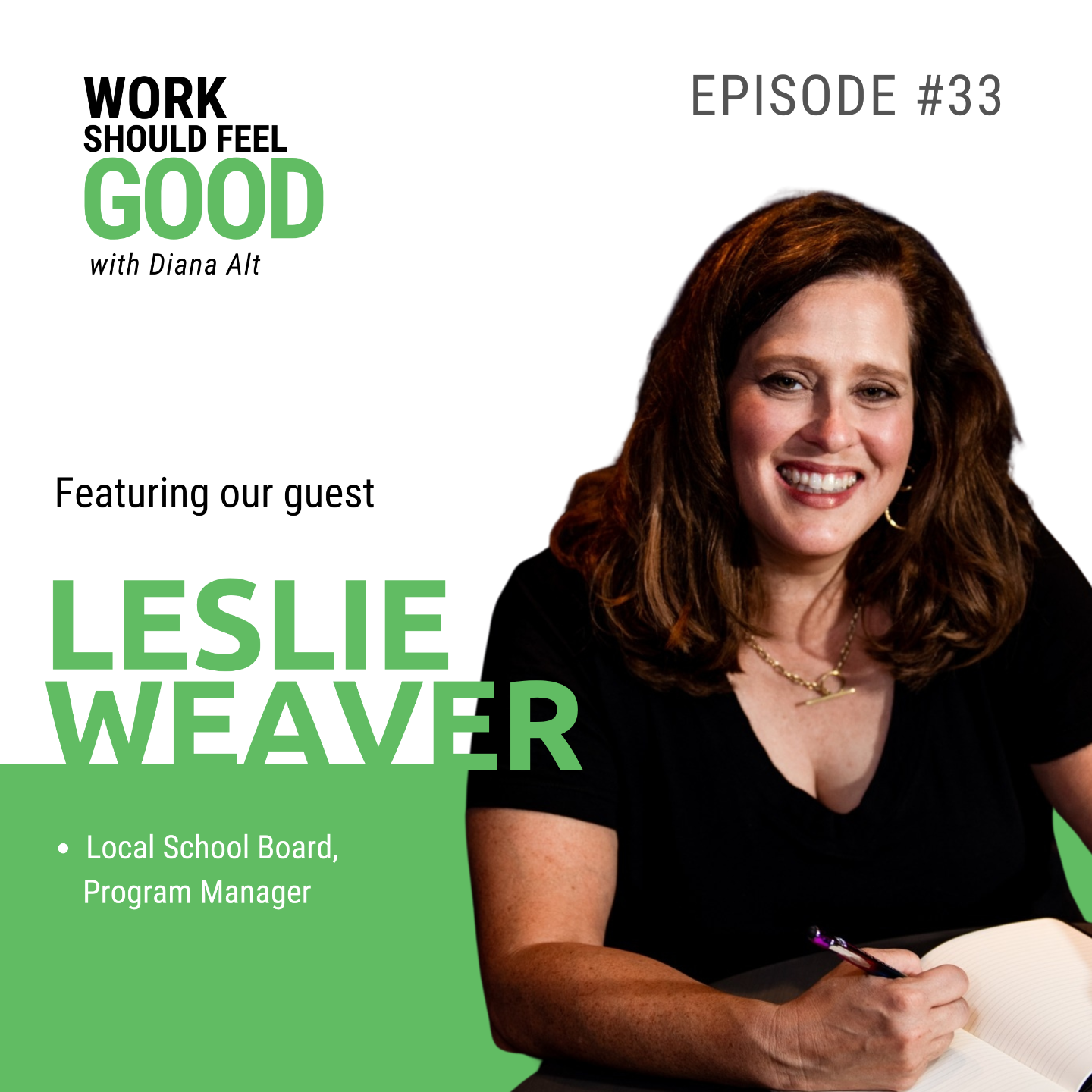
Work Should Feel Good with Diana Alt
Episode 33: Achieve More By Eliminating Time Confetti with Leslie Weaver
Leadership isn’t about titles—it’s about influence.
In this episode, Leslie Weaver joins Diana Alt to unpack a grounded approach to leadership: start by leading yourself, then scale what works to your team. They dig into how to turn vague goals into meaningful action, use reflection without self-blame, and stop scattering your focus with “time confetti.”
You’ll walk away with:
- A simple, repeatable goal-setting rhythm (annual → quarterly → monthly → weekly)
- The “good / great / grand” method for measuring success
- Tools for naming barriers early and planning your responses
- Practical ways to celebrate wins and recover from setbacks
If you’re ready to make leadership feel effective and human, this episode is for you.



Episode 33: Achieve More By Eliminating Time Confetti with Leslie Weaver
Episode Description
What does it take to lead 500+ people, grow a thriving program, and still prioritize personal growth? Leslie Weaver has the answers and she’s sharing her powerful, practical insights with us today.
In this inspiring conversation, Leslie Weaver, Program Manager of before and after school programs for one of Tennessee’s top school districts, shares how she leads with purpose, models growth from the top down, and creates a culture of care and excellence.
We talk about her journey from coaching gymnastics and working in retail, to thriving in education leadership. Leslie reveals how she helps her team feel seen, heard, and supported, even in high-turnover environments. You’ll hear how she builds leaders from the inside out, the tools that reignited her spark during burnout, and why "leading yourself well" is the foundation for everything else.
Expect honest stories, real leadership wisdom, and practical strategies, plus how Leslie tackles “time confetti” and keeps her people aligned, inspired, and growing.
⏳ Timestamps:
01:14 Leading 500+ staff and navigating public education systems
03:53 When Leslie first noticed her leadership tendencies
06:13 Career journey: From retail to Girl Scouts to education
09:14 Building more than just child care creating enrichment
10:35 Engaging parents, growing programs, and earning trust
13:20 Reducing turnover and building a mission-driven culture
15:36 Why leading yourself is the foundation for leadership
17:06 Recovering from burnout and the power of modeling behavior
21:27 Goal-setting, reflection, and building intentional habits
23:17 How Leslie stays inspired and focused on growth
💡 Take action
🔥 Subscribe for future episodes → https://www.youtube.com/@dianaalt
📖 Grab my Resume Don’ts Guide → https://www.dianaalt.com/resumedonts
❌ Avoid these common job search mistakes → https://www.jobsearchmistakes.com
🚪 Wondering if it’s time to walk away? → https://www.isittimetowalk.com
💼 Work with me → https://www.dianaalt.com
📢 Connect with Leslie Weaver
🔗 LinkedIn → http://www.linkedin.com/in/lesliepweaver
📲 Follow me on social media:
LinkedIn → https://www.linkedin.com/in/dianakalt
YouTube → https://www.youtube.com/@dianaalt
Facebook → https://www.facebook.com/dianakalt
TikTok → https://www.tiktok.com/@thedianaalt
Instagram → https://www.instagram.com/thedianaalt
#CareerGrowth #WorkShouldFeelGood #LeadershipDevelopment #BurnoutRecovery #WomenInLeadership #LeadYourselfFirst #ChildCareLeadership #CliftonStrengths
Transcript
Diana Alt [00:00:02]:
Hey there everybody, and welcome to Work Should Feel good. The show where your career growth meets your real life. I'm your host Diana Alt and today my guest Leslie Weaver and I are going to talk about the leadership and goal tactics. Leadership and goal setting tactics she uses to make great things happen every day at work and to develop leaders. Leslie is passionate about growing leaders from the inside out, helping them recognize their influence and, and lead with purpose and confidence. She currently serves as the program manager of before and after school programs for one of the top performing largest school systems in the state of Tennessee and is responsible for a team of 500 plus employees to create life shaping experiences for thousands of students each day. Welcome to the party.
Leslie Weaver [00:00:49]:
Thanks. Excited to be here.
Diana Alt [00:00:51]:
500 is a lot of people. Like that's the kind of thing. That's the kind of thing. When I, when I first started hearing about you from your husband Terry, who was on the show earlier this year, I heard him talking about Leslie leads five or six hundred people. And I was like, who is this certified badass? And what does this even look like? So can you tell a little bit about this large organization that you're leading?
Leslie Weaver [00:01:20]:
Sure. So I work for a school district. It's in an affluent area of Nashville, Tennessee and our department oversees elementary students. So we are mainly elementary students. And those 500 employees that I oversee are all different levels. Everything from high school students to teachers that choose to work in our program, to teaching assistants. So and I have all different levels of education. So everything from a high school student up to people with PhD.
Leslie Weaver [00:01:53]:
So it's quite a interesting group to get to lead with different levels of education. Desire to learn, honestly.
Diana Alt [00:02:02]:
Yeah.
Leslie Weaver [00:02:02]:
And so it's definitely a unique place to be. And just meeting all those needs is, is a challenge, but it's a challenge I'm up for.
Diana Alt [00:02:09]:
Yeah, well, you're up for almost every challenge I've seen thrown at you. So one of the things I actually find the most interesting about the work that you do is that diversity of people that are involved because you have how many schools are you working with? And then you have district level stuff.
Leslie Weaver [00:02:26]:
Sure. So I have 29 schools that I oversee different programs and then we're licensed through our Tennessee Department of Education as a child care program in a public education setting. So that adds a whole different level of falling spirit. School board policies and then our Tennessee Department of Education policies as well.
Diana Alt [00:02:45]:
Oh my gosh, lots of stuff. So that, I mean it's as, it's as complex of an organization as any large tech company or any Fortune 500 in so many ways, as far as I'm concerned, especially for a company that is mostly US based, like when you get into global stuff and some of the large companies that it's different, but just the people that you serve, which is the kids, but really the parents, because they're paying and all of the different levels of people. So I want to go back a little bit. Well, I want to go back a lot first. When did you first remember, like organizing and leading people, even if it was only. I mean, you could have been a kid for all I'm concerned. But this seems so core to who you are. I'm wondering when it first showed up.
Leslie Weaver [00:03:31]:
You know, I think back to probably middle school because I was an athlete growing up and I went to a lot of summer camps where we did a lot of coaching. And so I was a gymnast. And so I was in an organization where they wanted to grow you as a person, as a leader, not just in the sport, to take your influence and help younger children. So in a middle school setting, they wanted us to teach preschoolers. And so they took us away to this camp. Camp. And I remember being at that camp and we would have weird activities we'd have to do as a group. And I remember in those settings, like, I'd be like, well, why don't we try it this way? Why don't we try it this way? And so it kind of started there, I would say.
Leslie Weaver [00:04:12]:
And then definitely in college, I had a lot of people, a lot of amazing, just mentors in different organizations and professors that just were like, you have a lot of potential. Let's. Let's harness this. Let me give you opportunities to learn and grow. And so it kind of just developed from that over the years where people were just like, I. I want to give you this opportunity. And then I saw it as a way to just grow myself. And then over time I was like, why can't I grow other people? And so that's where I am now.
Diana Alt [00:04:39]:
Cool. That actually reminds me of stuff because sometimes people ask me questions like that. A lot of times people ask like, when did you start coaching? I'm like, I'm not aware of a point in my life where I ever wasn't. Probably was annoying people with it when I was younger and I didn't really know what it was. But when I was in. Was it middle? I think it was high school. Like freshman sophomore year, I took dance and I wasn't a great dancer, but, like, it was fun and I did it And I actually taught like four year old classes at the studio that I was at because they were so cute and it was such an interesting experience. And there's a lot of ways in which wrangling a 4 year olds is easier than wrangling adults, but 100%.
Diana Alt [00:05:25]:
100% for sure. So you have worked through a lot of different industries as well. And I'm curious, can you talk to us about how you went from the middle school gymnast that is kind of leading people, give us like the quick Cliffs Notes to how you went from that drive to grow as a kid into where you're at now, leading 500 people?
Leslie Weaver [00:05:48]:
Sure. So I, I would say a lot of this just leadership growth, development all started in college. And so I went to an all girls college. It was actually a public university. And so it is now a co ed university because it is a public institution. But in going to a woman's college, it was Texas Women's University in Denton, Texas, they were very much focused on not just educating women, but teaching them how to be able to speak publicly, confidently. And I hated absolutely every minute of it. I hated having to present in a group or as an individual, every single class.
Leslie Weaver [00:06:31]:
You had to do something. Today I am forever grateful that I was forced to do that because it's, I'm not as scared to do it and I see a lot of my younger people who are scared to do it, but I'm forever grateful for that. And so I did, you know, my college was a key piece of that. I worked at summer camps. I still continue to coach. I was in a lot of organizations where I was given a platform to lead. And then after college I did the nonprofit world. I did some ministry stuff.
Leslie Weaver [00:07:03]:
I just did nonprofit. And then I did retail for a while. For a long while, around 9 11, I did retail just to be able to pay the bills for a little bit because I was trying to figure out what I wanted to do next. And then I was sitting in a store one day as a manager, successful as a manager, and was like, why am I doing this? I have a college degree. This is not my passion. I don't love customer service. Why am I doing this? And so then I just saw a local job ad for girl Scouts in the area. And so I applied for the job and I got the job, which was exactly what I loved.
Leslie Weaver [00:07:39]:
I love inspiring women and young girls to grow in their leadership skills, to be confident in their leadership skills. And so I did that for six years. Loved it. And then kind of tapped out of There and was like, well, what's next for me? I was actually working on my master's degree in organizational leadership because I had connections through Girl Scouts with my local school board. That's how I got the job where I am now, because I had those connections and relationships. And. And so I was not. I didn't feel capable when I took the job I'm in now.
Leslie Weaver [00:08:11]:
Luckily, at the time it was 10 schools, and we've grown into every elementary school we oversee the program for. Okay, so my master's degree, I got it through Liberty University. It was foundational to be able to grow into the job I'm in now because it's definitely evolved and changed from 10 schools to 29 schools from, you know, barely 100 staff, barely less than a million dollars a year in revenue. And so that degree shaped me to help lead it and to structure a program I'm proud of, where we don't just offer child care. That's a part of what we do, but we're really enriching students and our staff. And so that's where I'm able to take those passions from long ago, my education and growing into what I am today. Because, yes, we do child care, but we're so much more than that child. Just this week I had a new employee.
Leslie Weaver [00:09:01]:
She's probably been here maybe five weeks. She. I just really engaged with her for the first time, like on a one, on one level this week, doing a training. And she said, I am going to retire with this organization.
Diana Alt [00:09:13]:
Wow.
Leslie Weaver [00:09:14]:
Sold my mission and vision have been accomplished and embraced. Like, she caught the vision of what we're trying to do. And she's like, you grow your people. You care about us. And I'm like, if you could see that in five weeks, it's not just me, it's my whole team. Let's be. And so to me, that's why I do what I do, because she got it and she's here to learn and grow. And if she's learning and growing and cares about herself and the work she does, it's going to reflect with the kiddos that we serve.
Diana Alt [00:09:43]:
Other than. So other than the devotion that you have to making sure that every single one of these 500 plus people has an opportunity to develop their self and their leadership. What are some of the things that differentiate the experience for the parents and the kids that are in these programs? Because, you know, surely that trickles down from 500 people to all these people you're serving?
Leslie Weaver [00:10:11]:
I think it's just they. The parents feel the kids and the parents, they feel valued and they seem, they feel seen and they feel heard. Heard. I think you know that from somebody just doing a job to somebody that truly cares about you as a person, it's just, I mean, we're a self funded program. All of our revenue is based on parent income. So if we don't keep parents happy and kids happy and wanting to be in our program, we don't have budget program. Right. So I think just for me, when I walk in a school, the attitude I see of my staff and how they treat a parent and student.
Diana Alt [00:10:50]:
So yeah, I've had the privilege to be hanging out at your house in the greater Nashville area during times when you had like, we're opening enrollment for next semester and we're doing all of that. And you've, you've become so in demand. You know, you scaled to three times as many schools, but you scaled even more than that in terms of the people served. What do you attribute that, that huge growth to within your district?
Leslie Weaver [00:11:24]:
I think it's being clear in our expectations of what I expect my employees, it's being clear in the services that they provide. And it's just if my people don't enjoy their job, I care enough about them. I will help you go find a job somewhere else that meets the needs of what you're looking for. Because I want people passionate for what, what I do. And I think the passion for us caring for kids is what grows our program. That we care enough and that we listen to our parents. That's the other thing we do. Parent feedback, parent service.
Leslie Weaver [00:11:56]:
We do it with staff too. And you know, child care is a huge turnover industry. It's one of the, yes, highest turnover in the whole nation. That in education, you know.
Diana Alt [00:12:05]:
Yeah.
Leslie Weaver [00:12:06]:
And what we see in our program a lot is a lot of people, they resign, they leave. I have a lot of returning employees. So I call it their, their best first and third job. And so they come back, they do and they're like, I made a mistake, I want my job back. And sometimes we're like, great, come on back. And sometimes we're like, has anything changed since last time you worked for me?
Diana Alt [00:12:28]:
Right.
Leslie Weaver [00:12:29]:
Yeah, so. But I think, you know, that's a lot of it.
Diana Alt [00:12:34]:
So yeah, I want to go quickly back before I get into some of the nitty gritty of how you think about leadership. I want to go back to this drive that you said approximately 437 times in 12 minutes to grow personally. Where do you feel like that came from?
Leslie Weaver [00:12:55]:
You Know, I'll attribute a lot of that to my dad. He was a military pilot and then a helicopter pilot after that. He always encouraged us to be looking towards some. Something that. And gymnastics, I will say gymnastics was a big part of it, too, because I have always been a very competitive, driven person. It's just, I think it was growing up in sports because I wanted to be successful in what I did. I knew early on in gymnastics, in order to. To get where I wanted to go, I had to put the work in.
Leslie Weaver [00:13:29]:
And so for me, it just. I think it developed in the gym because I. I mean, that competitive piece, I wanted to be at the top. I wanted to win out. Yeah. And I mean, even if I wasn't in the gym, conditioning, working out, I could also visualize being on the podium, getting the medal, getting the, you know, trophy. Oh, my gosh, I had so many trophies, ribbons. That for me was a big thing.
Leslie Weaver [00:13:56]:
And when I stopped doing it, that was a hard piece because I had to figure out, how do I. How do I still fulfill that need in my life? Because it is a need. And so. And over the years, I've had to also learn what's a realistic level of being able to achieve and what's too much. And especially having an autoimmune disease. Over the last 10 years, I've had to go, you can't achieve it all. So what is truly important and what do you prioritize as important versus trying to accomplish all of it?
Diana Alt [00:14:23]:
I love. Like, I have an autoimmune thing, too. And one of the wildest parts about having conditions like that is that if you can pull your head out of your butt, it makes you focus. Like, the gift of being forced to focus is really valuable. And I honestly don't think I appreciated it until this year when I went, oh, crap, I have to have surgery to address some of the stuff I have going on. So I love that. Okay, so your leadership philosophy, as I've heard you talk about it, and as the longer, fancier bio that you sent me said is around leading yourself kind of as the first level, can you talk a little bit about how you view your. So many people equate leadership with power and of controlling and orchestrating other people, and you look at it different.
Diana Alt [00:15:22]:
So talk to us about that.
Leslie Weaver [00:15:24]:
Absolutely. And I think it starts with, a lot of people don't understand leadership. They confuse management and leadership, and leadership is very different than management. When I think of leadership, I think of influence. And for me, when somebody says, I remember when you said, this to me, and it made an impact, and it has stuck with me. That's leadership in my world, having that impact and influence. And so I've learned over the years that if I don't lead myself well, and I'm not proud of the way I conduct myself, I'm not going to see it reflected in my people, because my actions reflect my people. And if.
Leslie Weaver [00:16:01]:
I mean, there's been seasons. I mean, I worked in education in Covid. It was hard. It was. I mean, there were days where, oh, my gosh, I. I didn't want to sit in Zoom for 12 hours, and I sure did, and was drained and exhausted. And there was a season after that where I was burnt out. And I don't.
Leslie Weaver [00:16:18]:
If anybody in education told you they weren't burned out in that season, they are lying, right? But I had to come out of that burnout and figure out. I mean, I saw it in my people when I had a bad attitude, when I was grumpy, cynical at times, I saw it in my people. And so I had to step back and go, you're the reason that's happening. Because of my attitude, my attitudes are contagious. And so I've learned that I've got to find my spark, my passion, and. And share it with my people and then model for them. I mean, I'm a huge proponent of modeling leadership with my people, my actions, my words, my tone, because that's what reflects in my people if I'm not careful. And so if I'm not leading myself well, I can't expect my team to.
Leslie Weaver [00:17:03]:
To lead well and to serve those families and those students well. And that's the core of what we do, is we want our kiddos that we serve to. Want to come to our program, to enjoy being there. And we're positive role models that. That help them grow life skills and just friendships. I think a lot of what we do is teaching kids social skills because it's missing. And so they've got to be passionate and willing to do that. And I think it just starts with understanding the impact of what we do.
Diana Alt [00:17:29]:
I think that, you know, one of the. I've been thinking a lot about the impact thing, because over the last few years, there's been a lot of conversation about, especially when dealing with marginalized communities, people that are in more powerful positions, either socio. Socioeconomically, gender, race, like, whatever that is, that kind of makes you a little higher on the totem pole. They want to focus only on intent. And realistically, when you are specifically in a marginalized community or earlier in your career, you're lower on the power structure for any reason. It's actually impact that matters. Like it doesn't really matter if you didn't intend to make racist comments in front of a class of students. It matters that the little black and brown children feel like their teacher hates them, even if it's all accidental and there's no intention.
Diana Alt [00:18:26]:
That's a very extreme example. But I think it's such an important distinction that the impact matters.
Leslie Weaver [00:18:33]:
And I think also when you make a mistake, how do you own up to it and what do you do about it? And that's my thing for my people is we're all going to make mistakes. You know, we, we say it jokingly. Did everybody, you know, at the end of the day, did everybody make it home with the right person and were they safe? That's all I care about. And so that's really the barometer that we're on. If you made a mistake other than those things, let's talk about, own up to it, talk about it. And then what actions are you going to take so you don't repeat it? That's all I care about.
Diana Alt [00:19:02]:
Yeah. And you know, I spent a lot of time, you know, it's totally a different thing, but it's when I was in the IT field still. We had. There was always some sort of incident response thing. So that could have been like the payroll system was down, the website was messed up. Like those kinds of things that people think more of data and systems. But we would go through the whole thing of what went wrong and what is root cause analysis and what is remediation. And sometimes the remediation is not a new step in the process, especially if a mistake only happened one time.
Diana Alt [00:19:37]:
Sometimes it is making sure that people understand that it's okay you made a mistake once, but you don't get to make that mistake two and three and four times. And if they know that you're okay with it, you'll help them if they have questions that will prevent more than any process that you now put on 500 people because one person made a.
Leslie Weaver [00:20:00]:
Mistake, some of that too. It requires the notion that it's okay to reflect after.
Diana Alt [00:20:07]:
Yes.
Leslie Weaver [00:20:08]:
And so we just did that in a staff meeting on Tuesday. We had our first full day of care over fall break. So we took time as teams to reflect what went well, what didn't go well, what was my role and what didn't go well, what was the team's role, how do we improve it? So I Think if you establish that reflection selection piece and then the action piece of how to change it, that's key too, because I think a lot of people don't. They just would rather blame and focus on the blame than the solutions to.
Diana Alt [00:20:34]:
Fix it or if they're not doing that. What I see even more often is people just don't take the time to do it because we are too busy. We're too busy to rehash. Well, it's like, well, are you too busy to make the same mistake for the next five days that you have full day care or whatever that situation is? So what do you consider the top couple of components of leading yourself so that you can grow to lead others?
Leslie Weaver [00:21:02]:
I think for me, knowing the direction that you want to go and you want to take your team, and so having goals, having an intentional plan to grow, like if you're stagnant, your team's to. To be stagnant. So having an intentional growth plan, whether that's reading, engaging in conferences, events, having mentors, a mentoring relationship, I think a lot of it is your attitude towards the work you do in growth in general. So to me, goal setting is a key piece. I know everybody doesn't feel that way, and I think we get so, so caught up in goals, and people are turned off by goals. But if we dove into goals a little more, we do a lot of things that are goal driven that we don't realize.
Diana Alt [00:21:50]:
Yeah.
Leslie Weaver [00:21:51]:
So we're gonna get there. Yeah. And I think a lot of leading yourself is just understanding being stagnant is not progress, and it's not going to move you forward to where you want to go.
Diana Alt [00:22:04]:
I used to have a leader that I worked for for years, that worked at a company with them for about five years. He was a CIO at one of my first couple of jobs out of college. And for whatever reason, he decided he took a shine to me and we had a mentoring relationship for a while. But what he said to me and sometimes would say to others was, if you're not growing, you're dying, or if you're not growing, you're going backwards because everybody else is growing. So tell me a little bit about a couple of the things that I'm interested to know, a couple things that you personally have done to grow. And then when you think a couple layers down on your food chain, people that don't have the same experience and scope of leadership, how does that compare with how you're encouraging those people to grow?
Leslie Weaver [00:22:53]:
And I'm going to actually kind of put this back on you. So you and I met during COVID and all these things because I was just trying to figure out, you know, education is a hard place to be. Be. Yes. And I was trying to figure out what's next, how do I want to grow, how do I, how do I get some passion back for what I do. And you kind of helped me lean into this idea of the learning and development field. And so I really leaned into that and explored it. And so I joined the national organization, I joined the local organization.
Leslie Weaver [00:23:21]:
And that has really been a game changer for me.
Diana Alt [00:23:24]:
It's a big deal.
Leslie Weaver [00:23:25]:
Oh, absolutely.
Diana Alt [00:23:26]:
And for the, for those of you that are wondering, it's the associate, it's atd, the association for Talent Development that you're talking about, right?
Leslie Weaver [00:23:34]:
Yes, it is. And so that just kind of gave me a spark again because those were people that are learning nerds that get it and get what I, I love, I love sitting in those meetings and going, oh my gosh, I'm not. That's my people, you know, they get it too. And so surrounding yourself with people that are like minded, that are going to challenge you maybe a little further ahead of you, and then there could be people behind you that you can invest in is just finding that group of people to really challenge and grow you. And then I've also, I'm always looking at books, learning opportunities, like I choose to lean into things. One of the things I'm hoping to do. John Maxwell is a big mentor that I look up to and so his teachings, his books, I have never seen him in person as much. Really read his.
Leslie Weaver [00:24:25]:
Nope, never. So trying to go. He's in the air a couple hours from here in December and it's a very reasonable ticket price. And that's my goal for the end of the year, is to see him in person because I mean, he's getting older and you know, who knows?
Diana Alt [00:24:38]:
I know you might not have very many opportunities to see him in person, but he, he's done a great job of creating an organization that's going to carry that forth. But there's somehow nothing quite like seeing the, the one that you consider the biggest mentor. So that's exciting.
Leslie Weaver [00:24:54]:
I mean, and that's actually in my goal structure. One of the things I do is I have a plan every month. How am I going to continue to grow as a person and in my leadership skills and professional skills. And so I'm very intentional to make sure that I'm focusing on growing myself so my team members grow.
Diana Alt [00:25:12]:
Well, let's go there because one of the things, one of the things I love about you is that you can take something that can be really freaking squishy because people love to talk about I want to grow. And you, I mean, you and I have worked together on CliftonStrengths. I don't remember all of your like top 5 or 10, but I do remember that your top domain was execution, the get. The get shit done domain. And you have a talent for making things very concrete. Like every single time I see you speak at the thing, which is the event that Leslie's wife hosts every year, we're recording this on Halloween actually of 2025, and in a couple of weeks we're going to be together at that event. But every time you get up on the stage, you bring like the simplest, most concrete frameworks and so talk to us about your framework for goal setting for the year. What.
Diana Alt [00:26:10]:
How do you go through that process? I want to poke at that a lot.
Leslie Weaver [00:26:13]:
Sure. So I will tell you. I've just. I just kind of. It just made sense to me and I guess for me things have to make sense for me to actually execute them and make them happen. And so same.
Diana Alt [00:26:27]:
I have to resolve them in my brain.
Leslie Weaver [00:26:29]:
Yeah, it just has to like flow. And so I. It wasn't until not too long ago that I realized I had a framework of what I do and how I do it. And then I, as I've gotten out there, I realized, oh, other people do this too. And so you know what I do. And I will tell you peop. You have to figure out when it comes to goal setting, you've got to figure out what works for you. And a lot of people get caught up.
Leslie Weaver [00:26:51]:
I'm not a goal person. You probably are if you look at some other things you do. But what I do is I always set aside time every year and sometimes it looks different and I'm actually in a place where I'm kind of rethink it. A year at a time is almost getting to be too much for me.
Diana Alt [00:27:06]:
It's a lot.
Leslie Weaver [00:27:07]:
My brain's just getting overwhelmed by it and the idea of it. I like having a general idea, but really focusing in like a quarter or a month is kind of. That's not as overwhelming for me. But what I always do is right about now, I start thinking about really Thanksgiving. I guess I'll start thinking about what has this year been like. And so I flip through and this will sound silly, but I start with reflection. I literally go through my planner. I go through My photos in my phone, and I just start making notes of the year.
Leslie Weaver [00:27:38]:
Because I don't know about you, but January was a long time ago. And I'm like, oh, oh, yeah, I forgot that happened. You know, I forgot I did this.
Diana Alt [00:27:44]:
August was a long time ago.
Leslie Weaver [00:27:46]:
Right. I feel that. So I just start making notes and jogging my memory of the year, what happened this year. And so I just kind of start making that list. I also start being curious. I'm a big word of the year person. And so I start just being curious of what I'm seeing, hearing what, like just kind of sparks an interest. I mean, I literally just keep notes on my phone of words that I hear that I'm like.
Leslie Weaver [00:28:07]:
I kind of like that. That's kind of.
Diana Alt [00:28:09]:
What's your word for 20, 25?
Leslie Weaver [00:28:11]:
Monumental. Because I had a big birthday with a zero on the end. And so it was a monumental year.
Diana Alt [00:28:17]:
Leslie is not 30, but 0 on the end. I had that same one last year. So, yeah, that's a great word.
Leslie Weaver [00:28:26]:
Yeah, it was. And so it's. It's been. It's been a good year. So. So I kind of start with that, and then I go through and digest that a little bit more. And I do this over weeks. I don't do it over a day.
Leslie Weaver [00:28:38]:
That, to me, is overwhelming. I need to. I'm a processor. I need time to sit, digest, process, and then come up with a plan. So I start that list and then I start thinking through, well, what were my wins? What were my highs for the year? What were my challenges? Tension points even. What did I grow through? Because I think a lot of times we just focus on the negative and we forget, well, what. What do we accomplish through that situation? What was the outcome? How did I grow through that situation? So I think it's important to. To focus on those things as well.
Leslie Weaver [00:29:07]:
And then something I do, I take all of that information and something I do, I usually do it the week between Christmas and New Year's. I create an accomplishment board because I think it is so important to celebrate the year. And I think we forget to do that.
Diana Alt [00:29:20]:
Okay, I want to stop for one second. There's two questions I have. Number one, I would love to hear an example about this grow through thing because we are wired for, like, new negative things are negative. So can you give an example of something that was maybe difficult or not, what you expected that you grew through so others can see?
Leslie Weaver [00:29:45]:
Sure. And I'm going to do on a personal level. And so we talked about this. Autoimmune thing. And so, oh gosh, maybe nine years ago, growing through a diagnosis that was life changing, changing, I had to grieve my old self and what I had projected for my future and rewrite what was realistic. And that took time to learn my new boundaries, my new normal. And it wasn't a bad thing. It just made me set new boundaries.
Leslie Weaver [00:30:18]:
And I, I've learned the value of that, of how to prioritize like we talked about, how to prioritize tasks, task and what's important to me. I've learned how to delegate things. I do not grocery shop, I do not go in stores. Mail order is my favorite thing. And grocery pickup or grocery delivery, I don't need to waste my time and energy on going to the store and also exposing myself to other people's germs when we hit flu season, that's not worth my time. So it really, as much as that isn't something I love living with an autoimmune disease, it is something I've learned, learned to manage and to prioritize what's important to me. And even through, you know, losing loved ones. I lost a parent about 10 years ago and now I help provide care for the surviving parent.
Leslie Weaver [00:31:05]:
Even this week alone, I've had to deal with some health issues with my mom and helping her with that. And it's just made me go, okay, she's my priority to help her figure out what's next in the next day stage of life. And so if, and she's walking through some things that I walked through with my diagnosis, like she had to have one of the tests that I've had done and I'm like, oh, I can help you with that. Who would have thought my 83, 84 year old mom, I'm teaching her, here's what you can expect when you go through this procedure next week. And so I've also learned that a lot of times what I've been through, I can use that to help other people. And generosity is one of my core values.
Diana Alt [00:31:43]:
I like to be, yeah, generosity is awesome. Yeah.
Leslie Weaver [00:31:47]:
And so I try to view each situation even if it's not in the moment. How do I grow this? And I've had lots of employees go through health issues and I've been able to say, let me help you with this, let me walk you through. Or even it can be something as silly as how to manage our insurance company, because that is hard sometimes, or how do you advocate for yourself, how do you advocate with the insurance company that this is the necessary thing that you need to cover. And so I think seeing the positive that can come from it and how you can help other people, that's what drives me through it.
Diana Alt [00:32:17]:
Yeah, I love that. And I also like when I think about that stuff. You sometimes need a little distance for that to work. But if you can wrangle your insurance company to cover expensive crap that they don't want to cover, you can also go to work and advocate for. To the school board for something that your team of 500 needs to service the thousands of kids. Like, those things are transferable skills, which is great, but the. The generosity value you and I both share that, if anything, it's hard to not give too much. So, so, so basically you've done all this reflection.
Diana Alt [00:32:54]:
You've thought about this. Are there certain domains that you think about every single year with goals, or do you kind of just pick your top five or how do you think about that when you're working at that annual goal level? Sure.
Leslie Weaver [00:33:07]:
So I kind of have some core areas. Generally, they're within the same thing. So, like, for me, one of my core ones is finances. And that may just be the stage of life I'm in as I'm thinking ahead and what things I want to make sure I've had in order. And after losing, you know, my father, I learned a lot about finances, and I've learned so much. And so that's kind of become a core thing just in the stage of life that I'm in and how I want to be remembered. Legacy. You know, one of my things I focus on is growth.
Leslie Weaver [00:33:38]:
Wellness is another one. And wellness can be so many things, including your personal health, your like. For me, strength training is a big thing. Weight loss was something I worked on. And so wellness is so many things. And rest. Rest is a big one that I put under my wellness and mental health and wellness and taking time away. I'm very passionate about taking time off.
Leslie Weaver [00:34:03]:
I schedule time off at least once a quarter just to have that Being in a. I mean, this job is stressful at times, uses a lot of responsibility.
Diana Alt [00:34:12]:
Yeah.
Leslie Weaver [00:34:13]:
And so I have to have that time. I'm counting the days. As much as I love the work I do and my people, I am counting the days to get to go to the conference. And then after the conference, we take time for vacation, which is really nice. And actually we're taking a whole month off later this year. And so.
Diana Alt [00:34:28]:
Wow.
Leslie Weaver [00:34:29]:
Yeah, we're taking two weeks in December and two weeks in January. And so.
Diana Alt [00:34:33]:
Oh, my gosh. Have you ever done that?
Leslie Weaver [00:34:35]:
No, I'm not gonna know what to do. So I'm excited because I need us. I need that time just to reset.
Diana Alt [00:34:41]:
Oh, we're gonna nerd out when we get together in a couple weeks. We'll help you figure that out. I just did a lot of nothing for two months. And I didn't, I wasn't in a physical space where I could, you know, do a lot of fun things, but I did a few and I changed how I thought about things. So if you looked at my calendar right now, my calendar looks very similar to before I had surgery in August, but I feel differently about it and I'm making some changes myself. Like, I've decided in 2026 I want to work on Fridays as little as possible.
Leslie Weaver [00:35:18]:
Nice.
Diana Alt [00:35:19]:
So, which it's always, it's always felt like, oh, I'm solopreneur and I'm busy and blah, blah, blah, blah, blah. Like, I can't possibly do a four day week. But I'm like, well, I'm never having a weekend. So for me, like, I'm never, I'm not having a weekend because I do all that adulting on the weekend and I'm like, this has got to stop. So. So you have this, these domains and you go through and look at them. One of the biggest challenges I've seen that I have personally when I try to do this, which is nowhere near as organized as your process, is that I. It's really tempting to pick too many goals.
Leslie Weaver [00:35:55]:
Absolutely.
Diana Alt [00:35:55]:
So how do you prioritize them?
Leslie Weaver [00:35:57]:
Yeah. So I will tell you, this year is a great example. I made a list of 25 things I wanted to accomplish in 2025. Yeah, no, that was too much. And so as I've gone through the year, I just, I was thinking, well, I could just each quarter focus on a couple. No. And it was okay. And I've.
Leslie Weaver [00:36:16]:
As I set goals, I think it's important. Less is more in my world and you can even elaborate within goals. And so one thing that I've done is what are levels of success when I set a goal, what is good, I'm okay with what is great and what is grand, that I would be like, oh my gosh, over the moon, accomplished.
Diana Alt [00:36:34]:
Oh, I love that.
Leslie Weaver [00:36:35]:
But it's okay to have levels within a goal to go. And even if I get to the good part, do I want to get to the next level? That's great. That's up to me to decide. Or am I okay? Which is. And honestly, that's, that's probably really hard for me, because you were talking about strengths, finders, achievers, my number one. So I'm always. But I've got to stop and go but for my personal health and rest, do I have to keep going? Is it that important to me? And so I think having those levels of success is okay and being okay with just accomplishing and making progress in one area. And so I think it goes back to that reflection of what progress am I making and what does it look like.
Leslie Weaver [00:37:13]:
I think it's important to define what success looks like with your goals too. And so I think a lot of times we just. I want to lose weight. Cool, that's great. But what, what, what would make you happy, what would make you in a healthy place and what would make you just outrageously excited about that? And so I think just defining those is really important.
Diana Alt [00:37:35]:
Yeah, I'm a big fan. Like my years doing software development, agile software development have me conditioned to the concept of definition of done. Another way to look at that is like what needs to be true for me to consider that this was a success. Like there's a lot of ways to ask that question. Something I've done in the past with goals. I'm curious if you look at it this way. A lot of people when they think about goals, they only think about projects like I'm gonna run the marathon or I'm going to make $50,000 in my side business or whatever like that. But I think that there's such a thing as habit goals that are just as valuable.
Diana Alt [00:38:15]:
Do you do a mix of both or do you lean more towards one than the other?
Leslie Weaver [00:38:19]:
I do. And so like that's kind of where I'm leaning towards boards in next year. I know one of the things I've got to do. I've lost a lot of strength just health wise and so I've got to rebuild my strength. And so to me it's a habit, a regular habit of enforcing it. And I'm a huge person on habit stacking and like that's key to me in figuring out what's important and then how do I develop those habits? I'm a huge, my neurologist, when I first got diagnosed they did an education, patient education event and they said save your brain for the things that are important. Take pictures, use notes, create habits. Save your brain to remember the things you want to remember and the things that are important to you.
Leslie Weaver [00:39:05]:
It was one of the most impactful things I ever heard. And so to me that's what habits do. Habits take the thinking out of things you save your brain for what's truly important and what matters matters to you.
Diana Alt [00:39:16]:
Yeah. This is, it's so interesting because there's so many ways for that to show up. I'm a checklist person.
Leslie Weaver [00:39:22]:
Oh. Yep.
Diana Alt [00:39:23]:
And I like, I print a lot of them. So I have like kind of things that I want to make sure I do every morning or I have like a weekly review thing and it's a freaking checklist because if it's Friday and I'm tired because I just worked for 10 hour days, which is what this week happened to look like. And then I recorded a podcast like the brain is fried. If I have to not make decisions about what I'm doing, it's really helpful. So when you think. So do you do a process every month or like week, month, year? Like, how do you break your goals down and then review and make sure that you're on track? What's your process?
Leslie Weaver [00:40:03]:
I do. So I do my annual goals and then I'm a quarterly person. And so each quarter I'll break down what, what within my quarter, four, I think this year I have four areas that I focused on and then I have little things I'm trying to accomplish within that quarter. And then so I do that every quarter. I do it every month as well. And so each month I won't. I might have five goals, let's say, but I'm going to focus on three this month. That's it.
Leslie Weaver [00:40:27]:
And I do it for work and I do it for personal. And so I have core things I'm working on. And you know, some months it might just be one that I want to focus on. Like this month, month. I'm not in the office very month or November, I'm planning ahead here. So November, like I'm in the office next week and then I'm in the office Monday, Tuesday and Wednesday of Thanksgiving week. That's it in November. And so my goal for November is not going to be a lot for work.
Leslie Weaver [00:40:51]:
On a personal level, I'm focusing on some other things. So I. And then each week I go break it down even more into my task of what in a lot of my task lists, I'm trying to align what's important and what has to get done with my goals. And so that way I am. I'm strategic in what I'm trying to accomplish and how I'm going to accomplish it. And I want to back up just a second and also say, I think a key thing in this whole process is naming barriers that are going to keep you from getting to your goals. And this is something I've learned recently. And then having a plan for when you hit those barriers to know what am I going to do when that happens? And at least when you have a plan, you're more likely to overcome it and be, be at least making progress.
Leslie Weaver [00:41:34]:
If not successful, you're at least still making progress towards that goal and you're addressing it. So I think it's also important to name those potential pitfalls or roadblocks that are going to keep you from.
Diana Alt [00:41:44]:
I love that they call it like what the word impediment comes up a lot with a lot of the people that I work with, because that's specifically a thing in Scrum, which is one of the agile development methods. And so I've carried that forward, forward, that kind of thinking forward. So those. And when you think about barriers like that can be everything from we didn't make as much money as we thought, so we can't do this thing to, you know, my mom got sick and I wasn't able to spend time on it all the way through. Like, my head trash is getting in the way. So it doesn't just have to be an external thing. Honestly, the internal things are sometimes the best to focus on. So what do you do when you get to the end of the month and you're like, well, shit, I didn't get that done.
Diana Alt [00:42:37]:
A lot of people let that stop them with progress for the quarter of the month, how do you deal with that?
Leslie Weaver [00:42:46]:
So I think there's a couple things. I think it starts with you evaluate. Is this still important to me? If it is, we're going to put it on the next month and then we're going to break it down. I think a lot of times it's too big and we get overwhelmed by it. It just stops us in our tracks. So do we need to break it down smaller and define what the next step I need to take to get there and kind of schedule that or add it to your calendar or plan to get there. So I think that's some of it. And then I think one of the things I've learned recently is when we set these goals because there's, I mean, you're not always going to be motivated.
Leslie Weaver [00:43:21]:
That's just the nature of what we do. But what does motivate me is if I want to accomplish this goal, what is at stake if I don't accomplish the goal? Like, what am I going to miss out on? And is it that important to me to motivate me to take the steps to get there. So sometimes we have to backtrack and go, why was this important to me? And what's going to happen if I don't get there? And is it going to matter to me enough that it's going to motivate me to do it?
Diana Alt [00:43:48]:
That's a great set of questions. Thanks for those. How do you use your goals and all the breaking down that you do to help keep you from letting shiny shit get in the way? Because one of the things I've been working on a lot is I have a framework in my business that centers around four components. Bankability, visibility, connection and ease. Because everything that I really need to do in my business somehow relates to one of those and I'm getting better at eliminating. So when I have something on my list, when someone asks me to do something, I look not just at business plan goals, but does it fit in one of these three lanes? Because if it does not, then I eliminate it. How does that kind of thinking show up for you? Sure.
Leslie Weaver [00:44:40]:
So I can tell you my reward system is part of that.
Diana Alt [00:44:45]:
Oh, say more about the rewards. Let's go there.
Leslie Weaver [00:44:49]:
So I'm going to tell you like. So, like at work right now, I am passionate about improving our onboarding process and making our first impression with a new hire. Amazing. And just utilizing some instructional design and some resources sources we've never used. That's really getting me excited right now. But I won't let myself get to that until I get these tasks done that I've got to get down here and reach these. So that's my. And that's kind of an intrinsic reward I'm setting for myself that if I can get this done, I can do that.
Leslie Weaver [00:45:20]:
And even for the thing my talk coming up, I've kind of been. I don't know why it I have all these ideas here, but getting it on paper and into a presentable way, I've just got to stop procrastinating and get it on paper. And so the shiny new is okay. And I use that as my reward to get through what I need to do. So I don't allow myself to do it now. I've got to work towards it by accomplishing these things. I've started doing that and that's a motivating factor for me. I'll get the junk done.
Leslie Weaver [00:45:51]:
I don't always want to do or that's holding me back because I get to do what I want to do. If I get these things.
Diana Alt [00:45:58]:
Are there some other. Because that I love that. Like, the project that's your favorite doesn't need to be done as soon or as high overall priority as the project that's not your favorite, but necessary. Do you use any other kinds of rewards? Like, you know, are you a person that's like, I hit this thing, so I'm gonna go do the spa day or buy a new book or do you have a mix of them?
Leslie Weaver [00:46:22]:
I do, and I have that. For my personal ones, I have that. And so. So, you know, with losing, I've lost £50 over the last two years. And so, you know, just getting started, I rewarded myself for even taking the steps to lose weight. I bought myself a cute purse, and then when I got to my goal weight, which I did, and I got there early, I bought myself some jewelry. And so that was my reward, and it was something tangible that I had to visualize that I was successful in this to keep me going and to maintain it. And so I'm huge on that.
Diana Alt [00:46:54]:
And.
Leslie Weaver [00:46:54]:
But I also make sure that my rewards are something I want. And huge spa day. Absolutely. I had to laugh. So every time I have to go to a medical appointment. And this was my mom's doing. Growing up, I had some injuries when I was a gymnast, and so one of them, I had to do physical therapy every day. I got to go to school late every day because I had to go to physical therapy every day to relearn how to walk.
Leslie Weaver [00:47:14]:
And so my mom always rewarded me. Probably not the best reward, but we would have chocolate milk and a donut before I went to school after having gone through physical therapy. And so nowadays, every time I go to the doctor. So I recently had an MRI and had a neurology appointment. And so I bought myself a cute pair of shoes. And my husband laughs. He's like, why do you do that? Your mom should have to pay for that, right? So my mom had to go to the doctor recently. So I'm like, well, we're gonna go for a reward afterwards.
Leslie Weaver [00:47:41]:
So it's kind of funny how it's all full circle. And so rewards have always been.
Diana Alt [00:47:45]:
I love that I have a friend that's a. She's a brilliant keynote speaker. Her name's Ken Becking. And she had breast cancer very young at 32 years old or something like that. Like, her son was tiny, the whole nine. And she goes and gets either shoes or a purse for mammograms. She's like, you get a mammogram, you get. You're gonna get new accessories.
Diana Alt [00:48:11]:
So talk to us a little bit about time confetti. So, yeah, I think it's so d. It's. It's such a annoying thing. First, define what time confetti is.
Leslie Weaver [00:48:26]:
Sure. So I'm gonna use an. Adapt an analogy for you. So when I think of time confetti, if you've ever paid attention to New Year's Eve in New York City, so not too long ago, they actually started throwing confidence confetti off the buildings and out windows. And so that's what I think of when I think of time confetti. I think of New York City, all this confetti falling on people. They just look up and it looks amazing, but that confetti lands on the ground. So when those people are trying to get the confetti, they're told to try to.
Leslie Weaver [00:48:55]:
They actually hand throw it, in case you don't know. There's hundreds of volunteers.
Diana Alt [00:48:58]:
They, oh, wow.
Leslie Weaver [00:48:59]:
The tops of these buildings. Their goal is to get it across to the other building. Well, that never happens. It lands just wherever it goes. And so time confetti is when we don't have a purpose behind our time or an intention, we get. That's when we get to the end of the day and go, what did I accomplish? I talked to a lot of people. I. I just not sure what I actually accomplished today.
Leslie Weaver [00:49:23]:
I think we've all had those days. And so, yeah, I think when I think of time confetti, time can be overwhelming if you don't direct it to where it goes. And, and I think that's what goes back to having goals or intentions, whatever you want to call them. And so, But I think goals can also be like time confetti for our neurodivergent people. They goals just are too much. And goals are hard if you don't put the time in. It can be hard, it can be overwhelming. And so we've got to just have a plan of how we're doing this, because I don't know if you know this either, but.
Leslie Weaver [00:49:56]:
But they started recently, the last several years, the confetti pieces in New York City, they allow people to write their aspirations or their dreams for the year. And so you might get a piece of confetti with somebody's intentions for the year.
Diana Alt [00:50:10]:
Oh, wow.
Leslie Weaver [00:50:11]:
Isn't that amazing?
Diana Alt [00:50:12]:
I've always thought. I just had a conversation with my friend this morning because I'm going to New York in a week, and we were talking about how we're excited to go because November, they'll probably have some Christmas stuff up and, and how we never, ever, ever want to be there for time for New Year's Eve, though. And now I'm kind of like, well, maybe I do, because this is pretty neat. It would be fun to catch somebody's dream in my hand.
Leslie Weaver [00:50:34]:
I'll tell you, I've been in New York City on New Year's Eve, and I didn't go. We went to a show instead. But. But the funny part is, the next day, the city's completely different. And so. And if you study what happens on New Year's Eve, you know, there's the bells, the whistles, everything's amazing. And then the next day, there's a whole crew of people. As soon as people, like, leave, they come clean up the city.
Leslie Weaver [00:51:00]:
And when we were there the next day, which was the best deal, we got a amazing suite in New York City in Times Square the next day for a pennies fraction is what I will say, because nobody was in the city, but. But what was left? They're, like, walking the streets. There was no trash. Like, the cleanup effort was amazing. And so I was shocked that, you know, there was a plan to make it happen. They cleaned all that. I mean, you're still gonna have pieces of confetti falling, but it. I think that goes back to that time.
Leslie Weaver [00:51:30]:
Confetti. Some people, it's just overwhelming. And some people, they just sit there and look at it and go, that's overwhelming. That's amazing. I don't know what to do. It's kind of the deer in headlights thing. And so I think.
Diana Alt [00:51:42]:
I think a lot about. There's a couple different people. God, I can't even remember what book I saw this in. I've heard it talked about a couple of times, though. One of the things that is overwhelming for people, particularly in corporate environments or like, your environment where there's a lot of people and potentially a lot of meetings, is they feel like they don't have any time to work. Work. And one of the interesting distinctions that helped me a lot is understanding the difference between what the model called manager time versus maker time. So maker time is for deep work, and you usually need at least 90 minutes to kind of get in the flow and then get back out of the flow.
Diana Alt [00:52:23]:
And usually between 90 minutes and two hours, you need a break anyway. So you can do more in that two hours than you could in two days that have meetings sprinkled all over. So manager time is the stuff that you can do in, like, anywhere from one minute to half hour. So you can do it between the meeting that ends at 11 and the meeting, the lunch meeting, that starts at 11:30. And ever since seeing that, I've organized my calendar very differently. And I started learning about this, but when I was still in corporate, so I had a little bit, it was harder whenever other people needed my time to pull this off, but I decided that I was going to block some maker time blocks on my work calendar. And then like if a vice president or something asked me, you know, can you do this because it's the only time in a week I can meet, then I would do it, but I would move the time block. So if I had to give up my Tuesday, I'm going to move it to Thursday so that I still get that time during the week.
Diana Alt [00:53:28]:
And then I love also what you said. So many people get overwhelmed by the size of their goals. So the process of taking the big goal and turning it into the quarterly or monthly goals and then turning it into the small weekly tasks is great because then when you have 20 minutes in between meetings, you can go and look and see. Can I do something? But I gotta tell you, you know what else is really powerful? Letting some days have confetti.
Leslie Weaver [00:53:54]:
Absolutely.
Diana Alt [00:53:54]:
Like I've decided. And this, this is usually when I look at the. A lot of times when I have a day like that, the objective is connection. So I consider in my model doing a podcast interview with my friend that has something to add to the people that follow me is both visibility and connection. And so a day where I have two podcast interviews and then I just kind of like text a lot of people and nothing else gets done feels on one level like time confetti. But because I was doing stuff sometimes ad hoc towards one of my principles, it's still productive. So there's ways to not have to feel like every second of every day is booked and still not not be falling prey to too many days of I don't know what the hell I did.
Leslie Weaver [00:54:48]:
So I'm gonna say too, this is the system that works for me and the way my brain works. And I think everybody has to figure out what works for them and what, what's going to help them move forward. And so I've learned in managing employees, some people, they don't grasp goals, they don't understand it. But when I introduced the idea of having a vision board, that made it come alive, vision board was a goal and a goal setting tool for them, and that was all they needed. For some people, a word of the year, just an intention for the year. That's what they need. Last year I had my core people that I oversee directly. I had them each.
Leslie Weaver [00:55:25]:
I reframed the idea of a goal into a passion project or one or two passion projects. So what is something you're passionate about, you could bring into our program and add value. Value and then let them run loose with it. And so for me, that was just a different way to reframe it. It's all goal setting. If you want to be honest, it is. But you've just got to figure out what makes you tick, what's important to you, and how do you get there? Like what? Because like for my husband, goal, he's a bhag guy.
Diana Alt [00:55:54]:
He's like an intentions and be. Is he listening to you?
Leslie Weaver [00:55:57]:
I'm not sure.
Diana Alt [00:55:59]:
Oh, I thought I heard him.
Leslie Weaver [00:56:01]:
But he may be. But like, this is too form for him and too overwhelming. It's that time confetti.
Diana Alt [00:56:06]:
It's.
Leslie Weaver [00:56:07]:
It's too probably restricting for him. But for me, goal setting is freedom because it gives me direction and it, it helps me get to where I want to go. So I think it's important that you find what's meaningful for you to move you forward. Whatever you want to call it, it doesn't matter. It's that you're making.
Diana Alt [00:56:25]:
I think that there's a lot of people that are incredibly dogmatic about the idea of a small smart goal and it just drives me crazy because sometimes the intention is more powerful than the smart goal that you over defined and you're going to be overwhelmed by. So I really, I really like how you put that. Well, I'm gonna go into a couple of questions that I've been asking everybody on the show and then I'm gonna pop. I meant to put it up earlier, but be in the show notes too. Leslie. I'll just do it right now before I forget again. Leslie loves to connect with people, especially if they want to nerd out about goal setting and leadership development. I've put her LinkedIn kind of username.
Diana Alt [00:57:11]:
You put that after LinkedIn, LinkedIn.com in/and then you do Leslie P. Weaver. But yeah, connect with her there. She's a good follow.
Leslie Weaver [00:57:23]:
What? Do some goal things in December just to kind of get people thinking.
Diana Alt [00:57:27]:
Yeah, helping help inspire the masses with your goal stuff. So my first question for you is, what is the worst piece of career advice you've ever received?
Leslie Weaver [00:57:38]:
The worst piece of career advice I've ever received. You've got to make everybody happy all the time.
Diana Alt [00:57:47]:
No one tells men that. Nobody tells men that. So I love that one. What about. I mean, we just talked about one of them, probably. But what is a personal habit other than the goal setting that we just beat to death that helps you to be successful?
Leslie Weaver [00:58:06]:
I think for me, it's having those planned vacations. And so we're part of the Disney Vacation Club, and so we have a rule in our house. We don't leave vacation without a vacation on the books, so we have something to look forward to next. Sometimes it happens, sometimes we have to move it. But at least our. We've got to make time for rest and restoration, and so that's fun with them. We don't leave vacation without another one on the books. And it doesn't have to be something big and grand.
Diana Alt [00:58:34]:
Nice. I love that. And then what is something that you've rethought or. Or changed your mind about recently?
Leslie Weaver [00:58:40]:
That's great.
Diana Alt [00:58:41]:
So I stole that from Adam Grant.
Leslie Weaver [00:58:44]:
But I did a whole thing on the Blue Angels and this idea of excellence. And so I. Excellence has always been something that I've been taught has. You have to always be striving towards excellence. And I'm even doing a thing with my staff on the Blue Angels, but I've redefined what excellence means.
Diana Alt [00:59:00]:
Ooh. Say what was it before?
Leslie Weaver [00:59:03]:
Yeah.
Diana Alt [00:59:04]:
And tell us how you've rethought it.
Leslie Weaver [00:59:06]:
So I think I had a. My view of excellence is I had to always be my best on my A game and top of the game. Whereas I think excellence is just giving my best to myself and my team and those around me every day. It doesn't have to be grand every day. I can strive for excellence, but I get to define excellence. Other people don't define excellence for me.
Diana Alt [00:59:30]:
I. I love that. And one of the pictures that comes to mind for me is like, there's. It's hard to just think about the graphic, but basically, verbally, if you wake up feeling 100% and you give 100% that day, you've given your best. And if you wake up feeling 40%, but you give 35 or that 35 or 40%, you still did your best that day.
Leslie Weaver [00:59:54]:
Absolutely.
Diana Alt [00:59:55]:
And I have a tendency to, like a lot of time. There's been a lot of context, especially when I'm in, like, the right environment where my 80% is better than somebody else's 120%. So the bar is already high. But then I feel like I need my a hundred percent every single day, and that's a recipe for burnout. So thanks for sharing that. So you mentioned is what else are you working on? You said something about there's going to. Are you doing content for your goal setting stuff? Are you going to do a workshop? Like, what you doing?
Leslie Weaver [01:00:25]:
You know, that's.
Diana Alt [01:00:26]:
Are you figuring it out? Okay.
Leslie Weaver [01:00:28]:
Trying to figure that out. I would love to do some stuff for six weeks leading up to the new year. Just challenging people to think about goal setting and what they want for the next year. And I'm also a huge person. I don't believe that the new year starts January 1st. That is the worst year of my life. Like the day. That's the day my dad died.
Leslie Weaver [01:00:46]:
So I don't start anything new on January 1st. Yeah, it's just a day. And so. So I actually, like, usually take a week to lead into the year to figure out the year and figure out what I want it to look like.
Diana Alt [01:00:57]:
So I like that too.
Leslie Weaver [01:00:59]:
Yep.
Diana Alt [01:01:00]:
I think going back to work on January 2nd sucks. So I don't do it anymore.
Leslie Weaver [01:01:04]:
I'll be on vacation this year until March.
Diana Alt [01:01:06]:
Yeah, you'll be back. Like, your year might start February 1st this year, so. Well, thank you very much for coming in. If you are interested in following Leslie's stuff about goal setting, I'm sure at least some of it is going to land on LinkedIn. It might already be there by the time this is published because we're planning to do that in the middle of December. So keep your eyes peeled for wisdom from her. So thank you very much and everybody have a great day.
Leslie Weaver [01:01:37]:
Thank you.