Work Should Feel Good with Diana Alt
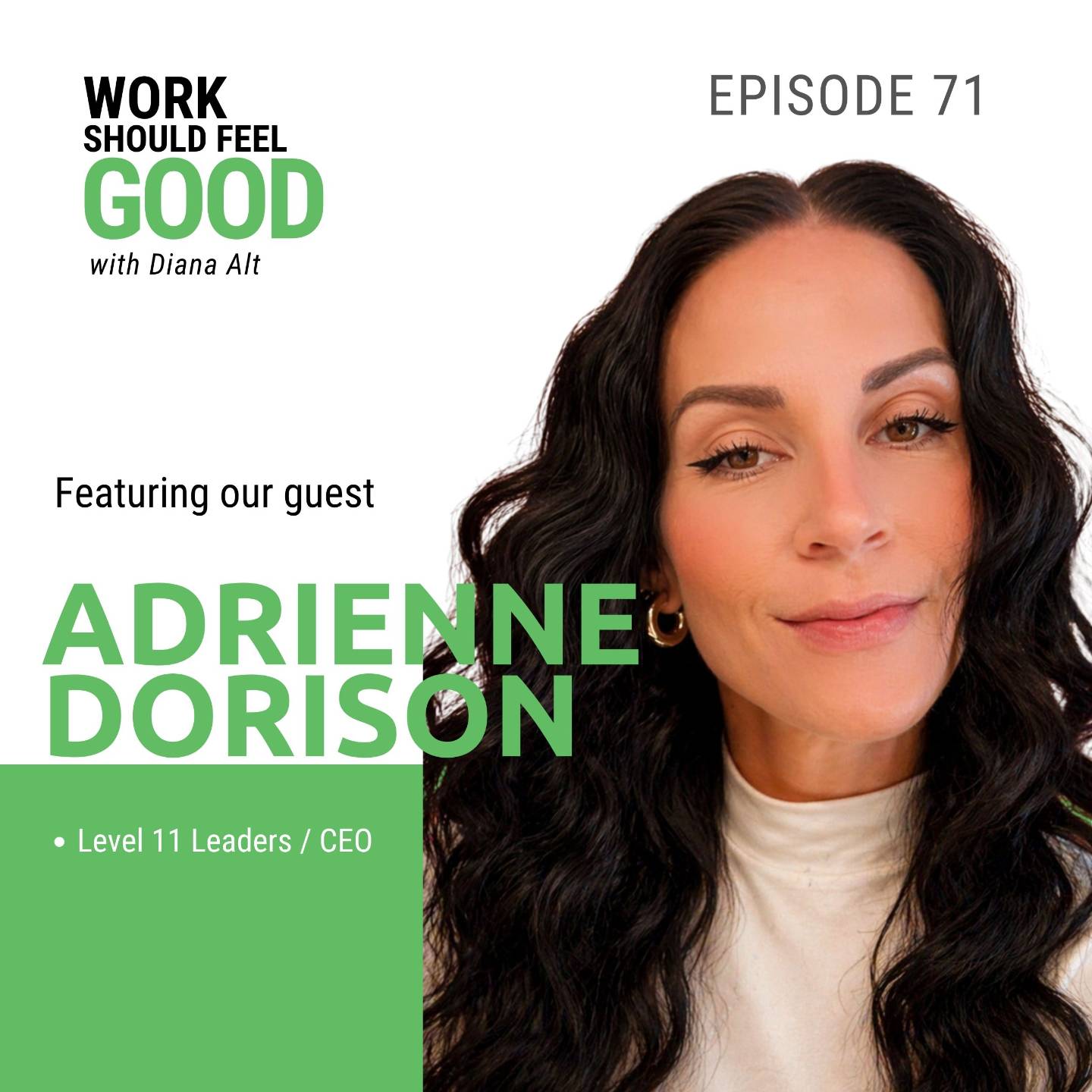
Episode 71: How to Stop Being the Bottleneck at Work with Adrienne Dorison
What happens when being the person everyone relies on turns you into the bottleneck? Diana sits down with Adrienne Dorison, founder and CEO of Level 11 Leaders, to talk about building teams and businesses that can operate without depending on one person for every answer and decision.
Adrienne explains why real delegation requires transferring decision-making, not just tasks, and how leaders can build autonomy by teaching people how to think. They also explore owner dependency, business risk, and what these principles look like whether you’re an entrepreneur or leading inside a larger organization.
You’ll learn:
- How answering every question can turn you into the bottleneck
- Why vision and values can serve as decision-making guardrails
- How to teach judgment without expecting people to think exactly like you
- Why delegating a task isn’t enough if you still own every decision
- How Adrienne’s IPO framework helps clarify information, permissions, and outcomes



Episode 71: How to Stop Being the Bottleneck at Work with Adrienne Dorison
Episode Description
What happens when you become the person everyone depends on to keep things moving? Diana sits down with Adrienne Dorison, founder and CEO of Level 11 Leaders, to talk about building teams and businesses that don’t rely on one person for every answer, decision, or task.
They dig into teaching people how to think instead of simply telling them what to do, distributing decision-making, delegating outcomes instead of tasks, and reducing owner dependency. Whether you own a business or lead inside someone else’s organization, Adrienne shares practical ways to build more autonomy without sacrificing results.
-
Teaching people how to think instead of giving them every answer
-
Building better judgment and decision-making
-
Using vision, values, and guiding principles as guardrails
-
Reducing owner and leader dependency Delegating outcomes, not just tasks
-
Adrienne’s IPO delegation framework
⏳ Timestamps
00:00 Building work that doesn’t depend on one person
01:25 Adrienne’s unconventional career path
13:20 Lessons from life as a safari guide
21:21 Teaching people how to think
28:10 Developing judgment and critical thinking
31:12 Decision-making through vision and values
44:51 Removing owner dependency
54:51 Building the business you actually want
01:05:00 Delegating without becoming the bottleneck
01:08:07 The IPO delegation framework
01:16:46 Where to connect with Adrienne
💡Take Action
🔥 Subscribe for future episodes → https://www.youtube.com/@dianaalt
📖 Grab my Resume Don’ts Guide → https://www.dianaalt.com/resumedonts
❌ Avoid these common job search mistakes → https://www.jobsearchmistakes.com
🚪 Wondering if it’s time to walk away? → https://www.isittimetowalk.com
💼 Work with me → https://www.dianaalt.com
📢 Connect with Adrienne Dorison
🌐 Level 11 Leaders → https://level11leaders.com
📲 Follow Adrienne on Social Media:
🔗 LinkedIn → https://www.linkedin.com/in/adriennedorison
Facebook → https://www.facebook.com/adrienne.dorison
Instagram → https://instagram.com/adriennedorison
Threads → https://www.threads.com/@adriennedorison
📲 Follow Me On Social Media
LinkedIn → https://www.linkedin.com/in/dianakalt
YouTube → https://www.youtube.com/@dianaalt
Facebook → https://www.facebook.com/dianakalt
TikTok → https://www.tiktok.com/@thedianaalt
Transcript
Diana Alt [00:00:04]:
Hey, Diana Alt here, and this is Work Should Feel Good, the podcast where your career growth meets your real life. Each week I share stories, strategies, and mindset shifts to help you build a work life that works for you on your terms. Hey there, everybody, and welcome to Work Should Feel Good, the show where your career growth meets your real life. I'm your host, Diana Ault, and today my guest, Jim Morris, and I are going to talk about why genuine human connection matters more than ever in the age of AI and how equal opportunity curiosity might just be one of the most valuable skills you can build. Jim is a keynote speaker, author of Connect or Die: How to Survive AI, and CEO of Human Touch Publishing. His work is centered on something increasingly important in this tech-driven world, helping people build the human connection with curiosity, integrity, and intentionality. So welcome to the show, Jim. Thank you for having me.
Jim Morris [00:01:08]:
It's wonderful.
Diana Alt [00:01:09]:
I'm really glad to have you here. I love when people say yes when I don't know them very well, but I've kind of admired what they're about. You have a good vibe. And I want to kick this off with, You just released your book. Was it 7/7? Was it in July? Did you release it on 7/7 or did I dream that? Okay, cool. That's a good date. Um, you shortly after were in Times Square with like a picture of your book on a building. What was that like? Because that just seems— that seems like crazy talk.
Diana Alt [00:01:47]:
Like, how could that actually happen for a person? You think that's Legit famous, famous people. What was that process like to decide to go for that? How did you make that happen? Like, tell me all the things about that.
Jim Morris [00:02:01]:
I'll happily share all the things, and it relates back to a lot of the stuff that I talk about. So this is a great question.
Diana Alt [00:02:07]:
Excellent.
Jim Morris [00:02:09]:
I had a gentleman when I was doing a consulting deal with an organization, and he had was one of their clients, and we had just built a relationship and a connection. And, um, that gentleman had reached out to me. Um, he had gotten injured and was terminated from his job, his role with a, with a company. And he had reached out to me and he said, hey, Jim, called me, he said, hey, Jim, um, you know, I know we haven't known each other for a while. I just lost my job. And the first person I wanted to call was you. You know, you've given me advice, you've been kind to me. You know, what should I do? Like, I literally just lost my job.
Jim Morris [00:02:56]:
And, and I spent some time with him on the phone. And one of the things that I recommended, you know, was look at this as an opportunity to potentially do something that may align more with you. Yeah.
Diana Alt [00:03:11]:
Amen.
Jim Morris [00:03:12]:
You know, something that could, could make you more money, right? Like, take this opportunity. I know it's hard. I know this is a dark time. I know that what I'm saying is going to be really hard to listen and curate and actually do. Um, but, you know, in that moment, I really just wanted to inspire him and motivate him to look at it in a different way. Because I know how hard it is when you go from a paycheck to no paycheck.
Diana Alt [00:03:45]:
Yeah.
Jim Morris [00:03:45]:
And you still have living expenses. You still have things you want to do. You still have a lifestyle that you've been living consistently over, you know, the last X amount of years you've been employed and was getting that check. So ultimately I said, why don't you come into my office every single day? Come here. You know, we can— good energy. We can joke. You know, let's sit down, let's think about some opportunities. Who do I know? Who does my business partner know? Just get out of the atmosphere of you're going to wake up at home and you don't have a job, you know, and you're going to be in this mental loop of, I got to figure this out.
Jim Morris [00:04:23]:
I got to be— I'm stressed out. All that to be said, I make some introductions. My business partner makes some introductions. He starts applying, going on interviews and just helping him through that process of how to prepare. And he lands a job, and that job is more money and more aligned with what he wanted to do. So all that to say, that's not the gentleman who connected me to be on the billboard in Times Square. Because of that relationship, he said, hey, Jim, I know someone who will be a great guest on your podcast, and I think, you know, you guys are going to really align. You know, he's in New York City.
Jim Morris [00:05:06]:
You know, you grew up in Massachusetts, you know, lived in Boston, went to UMass Boston, and, um, just get on a call with him. So we got on a call and I had him on the podcast. And one of the things that he had said to me after the podcast was over was, wow, Jim, like, I really enjoyed this, man. This was different. You didn't ask me all these predetermined questions. You didn't make me fill out all these like, you know, an hour of forms and—
Diana Alt [00:05:33]:
Oh God.
Jim Morris [00:05:33]:
I just really enjoyed talking to you. And, you know, thank you for doing that. Thank you for putting me on the podcast. And, you know, he had also mentioned that one of the things that he enjoyed was giving people and companies the opportunity to be on billboards. He owns an out-of-home company. And, you know, I followed up with him and I said, hey, what would this cost? And he had said, hey, you know, you put me on your podcast. I really enjoyed connecting with you. You know, you asked deep questions.
Jim Morris [00:06:08]:
You asked about my family. We talked about business. I didn't feel like I had to perform. You're a great interviewer, man. I would love to put you on a billboard for free.
Diana Alt [00:06:20]:
Stop.
Jim Morris [00:06:21]:
And I love what your book's about, and I support that. So for me, it was a very, um, Interesting experience because, you know, I had this opportunity. I wrote a book on human connection and how, you know, if you do it with compassion, if you connect with people, if you're not just all about what you can get and you can give, right? And it just kind of came full circle in the book process.
Diana Alt [00:06:48]:
Yeah. Isn't that wild?
Jim Morris [00:06:50]:
It was absolutely wild. You know, like, I love that. And standing there in that moment in Times Square, looking at the billboard and looking at all the buildings in the background and people, you know, hitting the QR code on their phones.
Diana Alt [00:07:09]:
Wow.
Jim Morris [00:07:09]:
And it was just, it was something that I'll always remember. And funny enough, you know, in a previous career of mine, I wanted to put myself on a billboard and market, and something just didn't feel right. I was like, maybe this isn't the business to put myself on a billboard for. So it was very personal for me, and I didn't expect it. I had no intention to do that. I really just was, you know, super grateful. And it was one of those dreams that I've always wanted to be on a billboard, but for the right reasons. And even with some of the conferences that I do, I was like, well, I don't wanna put the conference.
Jim Morris [00:07:59]:
I wanna put like an inspiring, powerful message. Like maybe it's, you know, go to the website and if you're, you wanna come to the conference, great.
Diana Alt [00:08:08]:
Do you know what just came up for me when you said that? So do you ever listen to the Tim Ferriss Show?
Jim Morris [00:08:13]:
Yes, I haven't in a while though, but yes.
Diana Alt [00:08:15]:
It's one of my favorite podcasts and it's common for— he doesn't do it as much as he used to, but for a long time he always asked people that he was interviewing, if you had one message that you could put on a billboard for the whole world, for a billion people to see, don't worry about language, just what would that message be? And I like, from what I've learned of you since I met you a couple months ago, Connect or Die probably is pretty Close to what you would put on that billboard if Tim Ferriss asked you, am I right?
Jim Morris [00:08:49]:
You are. And now you've got my brain going. I'm like, hmm.
Diana Alt [00:08:56]:
Huh.
Jim Morris [00:08:56]:
You know what I just did, actually? I just ordered some t-shirts that say encouragement is free.
Diana Alt [00:09:02]:
Can I have one?
Jim Morris [00:09:04]:
Yes. I want one. Yes.
Diana Alt [00:09:05]:
Yeah, I need that.
Jim Morris [00:09:07]:
So maybe it's encouragement is free, #ConnectOrDie. That might be the billboard right there. That's good.
Diana Alt [00:09:12]:
I love that. I love that. Very cool. So what is really interesting to me too, so it's funny how the— I want to get it like dig deeper into this, but like I am leveling up my guests on the podcast. Like I have a lot of different kinds of people. I have people like you that did 20 podcasts this month because you're launching a book. And I have people that I'm their very first podcast, like a couple of people that I interviewed in the last few weeks myself. And when I reached out to you and said, I want you to be on my show.
Diana Alt [00:09:48]:
And you said, yes, that was real close to when I had seen a picture of you on Times Square billboard. And I thought to myself, what the hell is this guy doing getting on my little podcast when he's on a billboard on Times Square? What's your response to that? Because me feeling like that about my podcast, there's an equivalent of that, that are, that people are out there, whether they're thinking about you or whether they're thinking about somebody else that they have appreciation for. So when someone's brain is folding in that particular knot, why would they want to talk to me? Why would they want to be on my show? Like, why did you want to be on my show? How should I think about that question?
Jim Morris [00:10:34]:
I think that, you know, I'm going to go back to that quote of you know, you can't hit a home run without swinging the bat, right?
Diana Alt [00:10:44]:
Yeah.
Jim Morris [00:10:44]:
And, you know, I think in my life personally, I've had the same emotions, right? Where I'm like, oh, I'm gonna reach out to this person. And in some cases, people have been, you know, very mean about invites to my podcast or to speak on my stages, and they've been very um, you know, not in a, in a great place or how they communicated. And, and so I've experienced both ends, right? I've experienced— I heard someone on Mel Robbins' podcast, reached out to her, she came on my podcast, she ended up speaking at one of my conferences, and she's in my book, and we've become great friends. And then I've also had someone tell me, you know, It's hot out there. Take that podcast and shove it up your ass. I hope you stay hydrated.
Diana Alt [00:11:37]:
Wow.
Jim Morris [00:11:37]:
So I've had, I've had it on both spectrums. And one of the things that I always relate back to is you've got to swing the bat and you never know what, what could happen. The best opportunities only come if you put yourself in the right position. And at the end of the day, someone might, might not respond the way you want, but there's so many other opportunities and there's so many people that will. And I think when you're around people who like to serve, that have been in the same place you've been at starting a podcast or just getting it out there or growing your audience, and if you can communicate that and build the relationship through the messaging that's real, that's not, you know, an AI script, and just be vulnerable, people will help you in those moments, right? That woman, that was the first conference I ever threw.
Diana Alt [00:12:38]:
That's really— I love that you brought that up because I've become a lot more comfortable with asking than I was a few years ago, which is why I've got some of the people that are in my sights and why I told, I told you before we started that One of my things is I want to have Seth Godin on the show, but I weirdly have every confidence that I can get Seth Godin on the show because he's been on shows of other people that I know. And I know that he's interested in the kind of stuff that I talk about, but so many people are just afraid to ask. And it's not going to kill you if someone tells you no, even if they tell you no in a really mean way. So what, uh, I want to talk a little bit about your origin story before we dig farther into the book. Everyone loves a good superhero origin story, I think. And yours is really interesting. Like, it didn't have it on my bingo card when I started reading it, because when we were at The Thing, Terry Weaver's event in Nashville in June of this year, you talked about it some. But reading it is more visceral to me because I'm such a book person.
Diana Alt [00:13:42]:
Tell us about how you started and what was it in that origin story that made you realize that human connection is the key that you had to master?
Jim Morris [00:13:54]:
So, you know, I grew up in a very, you know, normal situation. Both my parents were still married. We, you know, had a pool and they both worked and, you know, things were great. And at the age of 14, I found out that they were addicted to OxyContin. And it wasn't something where my parents just decided to do OxyContin one day, right?
Diana Alt [00:14:19]:
They didn't wake up and be like, oxy seems like it. Yeah. No one does.
Jim Morris [00:14:24]:
My dad fell off a telephone pole at work and broke his knee and was prescribed to OxyContin. And, you know, my mom had part of her lung removed, um, and was prescribed to OxyContin. And, you know, at that time, the opioid pandemic, or whatever you want to call it, um, you know, it wasn't researched. It was early on. So people didn't know the effect of giving someone prescribed drugs and then, you know, saying, hey, you're all done, your prescription is over. So my parents were highly addicted, you know, from age 14 to 18. We moved 7 times. I went, you know, to 2 different schools, and I really lost connection with my parents, you know.
Jim Morris [00:15:11]:
And I remember the exact point where I felt really lonely I felt very victim mindset, like, why me? Why is this happening? This isn't happening to anybody else. And in that moment, it was when my dad had come to me and said, hey, our insurance will only cover one of us to go to rehab. Your mom's gonna go to rehab, and I need you to give me $500 or I'm gonna take my life. I need to buy oxys. I'm freaking out. And at that point, it kind of all sunk in and I just felt really lonely. I felt that in that moment I had to be the parent rather than getting the love, getting the support from them. And one of the things that is really important to me when I share this story is that my parents, the whole entire time of their addiction, were telling me to be a good person, teaching me to love on others.
Jim Morris [00:16:08]:
Um, you know, teaching me integrity, honesty, but the part that I struggled with is that they weren't necessarily honest or holding integrity because they had this addiction. Right. And they were keeping it from me while telling me to not, not do drugs, not drink, not do all these things. So, you know, at that moment, it was really tough for me. And, um, you know, I had gotten a baseball scholarship. I was about $5,000 short to play baseball in college, and my parents had said, hey, you know, you're not gonna—
Diana Alt [00:16:44]:
We can't do it.
Jim Morris [00:16:45]:
College, we can't come up with the money. Um, and I had gone down to the local community college, and this was about 3 weeks after the semester started, and I basically was honest and real and vulnerable and kept telling the enrollment woman the truth. Like, if I don't go to college, if I can't get in, I'm never gonna go. I'm never gonna continue education. I'm just gonna continue going down a path that's like my parents. And, you know, shout out to that woman because after going down there a couple of days, she made the exception and she let me in. And at that point I thought, oh, everything's gonna be fine. I'm gonna get financial aid and my parents make enough money and, you know, all these things.
Jim Morris [00:17:36]:
And because it was so much less than the other college, I thought it would be fine and it wasn't. My parents didn't have the money, couldn't do it. So at that point I started selling drugs and I sold a lot. of marijuana, and I paid for college cash. Um, and that was something that was really hard for me because I didn't want to do that.
Diana Alt [00:18:03]:
Yeah.
Jim Morris [00:18:03]:
And I didn't want to be a drug dealer, and I didn't want to, um, you know, continue to support people's habits or, you know, really put them in a situation where I was feeding them that substance. And, um, it was really hard for me. There was a lot of dissonance. I, um, I remember, you know, my, my hands were so sweaty that they would literally drip sweat.
Diana Alt [00:18:30]:
Like, you know, that's so wild to think about. And the, the other thing that's coming up for me is like, okay, I'm 51. You're like, did you just— you, you're 40 or close to 40, something like that.
Jim Morris [00:18:42]:
36.
Diana Alt [00:18:43]:
36. Okay, great. I could bear it. I could, I could biologically be your mother, but not socially. Anyway, when we think about the era that you were in, like now, almost 20 years later, everybody understands, or many people, many more people understand addiction as an actual disorder, illness, etc., instead of as this choice. That people make to be addicted. So, um, the combination of being that young and then living in a society that thought that addiction was a moral failing, not a medical condition, I can only imagine that had— they had to have killed. That had to have just been so difficult.
Diana Alt [00:19:29]:
So cognitive dissonance would already be hard now. 10x it because of youth and the way society viewed addiction, and it's a little— It's really wild. So, man.
Jim Morris [00:19:42]:
Yeah, I think there was a lot of weight to carry through that process. And, um, you know, navigating some of those pivotal points in my life where, um, you know, in the, in the drug game, um, building a relationship with a serial murderer and being protected by them and using those connection skills for my own personal use to navigate through a hard time and, and have open conversation, but also for, you know, real-life protection, um, was pivotal. Getting into college was pivotal with that relationship I built with the enrollment woman. So that's when it really started to hit me of how important it is to, you know, engage with people and be real and be honest and authentic and vulnerable. And, you know, when I look back and I did a timeline of my life, that kept popping up. the opportunities came from relationships. Navigating the dark times came from relationships. Um, where I felt the, the most success and, you know, celebrating the biggest wins in my life came with people around me that were confidants, that I trusted, that loved me.
Jim Morris [00:20:53]:
Um, and as I kind of did that timeline, I realized how important it was. And I started going to events and I started meeting people who Just didn't really understand it. It was very transactional. It was very, what can you do for me? Okay, you've done the thing. Now see you never type of approach.
Diana Alt [00:21:11]:
Yeah. And that's, that's one of the reasons I wanted to have you on the show. There's a few. One is I just, I, I watched you do this. You know, it was really interesting because I've read like 2/3 of the book, which is more— it's called Connect or Die, guys. If you're watching the video, it's this. It has Jim's picture on the front in his trademark hats that he likes to wear. Um, we'll put a link to it in the show notes.
Diana Alt [00:21:38]:
But when I was reading the book, it was, you know, I started reading it right after I bought it, you know, 6 weeks or something after you and I met at the thing. And I watched you do the things. I was reading some of the techniques you teach and also just your overall aura at that event. And I'm like, oh, this guy practices what he preaches. And there's, uh, it's always interesting to look around the room. And see who is really connecting that way and who is cosplaying connection, because that is such a real thing among people. But I— that's part of the reason why I wanted you on, because a lot of my people, many people in my audience, the majority are employees. They're not business owners like you and I.
Diana Alt [00:22:23]:
They are people building corporate careers of some sort. Some of them might be looking for a job right now, others trying to go up the food chain. on the org chart, whatever. But a common thing that I hear from everybody that seems drawn to me is, I don't want to be transactional. I don't want to be inauthentic. I don't know how to network or connect with people without doing that, those types of things. And I'm like, this guy's got it. And you don't talk about it as a formula.
Diana Alt [00:22:52]:
You don't talk about it as a, this is the script to do all the things. You talk about it as, Walking into a room with one thing on your mind. Do you want me to say it or do you want to say it? What's the thing on your mind? What do you need? I was going to say, you walk in the room, what do you need? How can I help people, people in this room? And if that is your paradigm, every single thing shifts about how you interact with people. So if you take nothing, this is Diane. Jim may want you to learn something else. But if you take nothing else away from me from this episode, it is that walking into the room with your first bias being, how can I help somebody else, will change your life.
Jim Morris [00:23:37]:
Period.
Diana Alt [00:23:37]:
Full stop. End of story.
Jim Morris [00:23:39]:
Okay.
Diana Alt [00:23:39]:
We can stop. We're done with the podcast now. No, we're not really done with the podcast.
Jim Morris [00:23:45]:
I would agree with that, Diana. And I think, you know, not only do you separate yourself from the pack, But you start to build your own wolf pack. And as we know, you know, wolves, they live in a pack, they eat in a pack, they protect themselves in a pack. And when you can start to harvest that in a corporation, in a department, in a team, cross-departmental, you know, I remember it—
Diana Alt [00:24:12]:
Cross-industry.
Jim Morris [00:24:14]:
Cross-industry.
Diana Alt [00:24:15]:
Because what if you have to walk out the door of that company? Yes.
Jim Morris [00:24:20]:
And I remember in my corporate career, you know, I— we had people from accounting, we had people from HR, we had operations, we had the IT manager, we had interdepartmental transportation, and we would all get together and we would build this, you know, experience. We'd go to this place in Boston that was right down the street in after hours, and we'd hang out and we'd eat and we'd drink and And it was so great to hear the different perspective. And when you needed something in the workplace, when you had to figure out, hey, this new guy came in, what's your experience? You know, we don't really know a lot about this person. Or, hey, you know, I need help. This doesn't make sense, Jim. And you're in operations and I'm in accounting and you pick up the phone and you ask them, hey, is there anything I can help you? And I remember helping people in accounting with other asset managers and directors' portfolio because they didn't have a relationship with them.
Diana Alt [00:25:23]:
Yeah.
Jim Morris [00:25:23]:
And when they went to them to ask questions, they were kind of jerks and they had an ego and were arrogant. So I was able to help that person. Now, I couldn't do the accounting, but I could say, hey, this is what this line item probably is. Put it on this chart of accounts because I use the same company in my department. And this is what they provide. So when they put out those financial reports, the chart of accounts were perfect and the budgets lined up with the actuals. And, and that's just a small example, but that allowed me when someone said, hey, Jim, you know, your expense report is due tomorrow, make sure it's on time because the CFO is going to send out this really, you know, blastful, nasty email if you don't get it on time. And I know that you were traveling and you were in Florida this week.
Diana Alt [00:26:12]:
Yeah.
Jim Morris [00:26:12]:
So I just want to give you a heads up to get it on time. And I'm like, and that's a text message, right?
Diana Alt [00:26:17]:
And right.
Jim Morris [00:26:18]:
So like, not only did it help them, but they also had my back as well to ensure that we could both rise up and continue doing what we do and have a great performance in the organization.
Diana Alt [00:26:29]:
It's the WD-40 of life, honestly. And, you know, there's a, there's a lot of conversation about this. Largely because of this whole return to office and like going from 5 days a week at home to 5 days in the office or 3 days or 2 days or whatever the heck that's going to be. I think what, what a lot of people fundamentally do not understand is that, yes, the collisions that happen in the hallways, at the water coolers, at the coffee pot, they can add value. But if you're not oriented To helping people. If the people that you've forced back in the building aren't oriented towards each other, then all you're going to get is a bunch of mad people that are not helping each other any more than you thought they were going to. So, I would much rather have people on an all-remote team that never saw each other in person, but woke up every day thinking, how can I help my colleagues? How can I help my clients? than people that are in the office for collaboration, which is—
Jim Morris [00:27:34]:
Totally.
Diana Alt [00:27:35]:
The least understood thing in corporate America, in my opinion. So, so you wrote, you had this crazy history. You figured out over time that it's human connections that are making it work. And then you set out this task where you decided to write this book and try to help teach it as a, as a habit. And a skill. And I love that you did it that way because so many people hide behind, I'm introverted, or I don't know how, or I'm not that kind of person, or I'm on the autism spectrum, or, or, or like they have all these things that they feel are barriers to human connection. And your view isn't that it's innate that we connect. I mean, it is from a social animal perspective, but You don't take the, the tack that if you weren't born with it, you can't have it.
Diana Alt [00:28:27]:
You take the tack that you can learn these skills and you can make habits of applying them, right? Correct.
Jim Morris [00:28:35]:
Yes.
Diana Alt [00:28:36]:
What, what made you believe that? Is it because you didn't operate that way before? Or like, how did you come to realize, oh yeah, this is what's going on, this can be taught?
Jim Morris [00:28:49]:
Well, you know, a lot of the early days in my career and growing up, I didn't have like natural charisma, right? And, you know, I wouldn't say I was introverted, but I would engage, but I wouldn't really be the center of attention, or I wouldn't really have this slick, smooth approach or say the thing that everybody belly laughed and like rolled over Um, those things to me aren't charisma.
Diana Alt [00:29:21]:
They're performative nonsense, but that's just me. So, but you didn't have that thing that people at least called charisma and how most people think about charisma.
Jim Morris [00:29:34]:
And when I, when I started to try that, right, I remember I got the suit, the really nice suit, because I wanted to be all, you know, slick. And I had the, the brand new dress shoes on and, and, and I went to the networking events to get new business and I went to the corporate company happy hours. And I, and I, you know, okay, I'm dressed to impress. I'm gonna do what I see other people doing. And, you know, I, I bought drinks for people, and I, and I tried to do all these things to build relationships. And, you know, I woke up the next day with a hangover. I woke up the next day with some money on the company card that I had to explain. I woke up with some— a lot of money on my personal card.
Jim Morris [00:30:16]:
I bought this other, you know, I bought the suit, right? Those are personal expenses that Yeah. And I got nothing from it because I was performing. I was putting on an act. And so then I said, okay, well, let me just really think about the things that, you know, why do I like certain people? Why do I jive with certain people? What are they actually saying and doing rather than just having this natural, cool, hip sleekness to them? And that's when I really started to look through of like, okay, This person's super successful in the company, but I don't really want to hang out with them. I don't really want to go for a beer with them, but I'm doing it anyway. Well, this person's super successful in the company and like, I hope they invite me to lunch every single day because I just want to be around them.
Diana Alt [00:31:04]:
Yeah.
Jim Morris [00:31:04]:
And then I started to go, well, why is that? Right? And it came down to, you know, and back then when I was in corporate, It was like LinkedIn had just kind of popped and came out, and, and that person's LinkedIn profile was the same way that they acted in person. They, um, weren't this super duper polished, straight edge, like in the box, like everything was great.
Diana Alt [00:31:33]:
They didn't match what they said, didn't match who you experienced them, and probably didn't match who they actually were on the inside.
Jim Morris [00:31:42]:
Correct. And they weren't performing, like you said, that performative word. And I think that's really important. And they— at that time, who I was outside of work and who I was inside of work were completely different, completely different. And I was trying to attract people to this mask, this actor, this thing that I wasn't.
Diana Alt [00:32:08]:
Yeah.
Jim Morris [00:32:08]:
And I just sat down one day and I remember exactly where I was. I was in Seaport in Boston, Massachusetts, and I was looking into the harbor and I'm sitting there and I'm going, you know, what's the worst that can happen if I just be myself? If I just talk the way I talk, if I'm just honest, if I'm just vulnerable, if I start opening up, if I just be me, then am I going to get fired? And I was like, well, what if I do get fired? Like, what's it matter? Like, yeah, this whole, like, spending money to be something I'm not and trying to put on an act again, it felt just not congruent to my soul, to my heart, to who I wanted to be, to who I wanted to show up as. And, and I remember going in and, you know, someone had asked me, hey, you know, they asked me, hey, can you help me with some of the marketing stuff? You know, you put together some cool stuff for your portfolio. And I looked at them and I said, I'm the worst person to ask to help you with marketing. I have no idea what I'm doing. But what I can tell you is, Emily, if you spend time with her and she goes to break at like 1:30 every day, go in there, sit down with her, talk to her. She's always like on her phone. Head down.
Jim Morris [00:33:30]:
I said, I'll do that a couple days a week. I built a relationship with her, and now she comes to me and she's like, hey, is there anything else I can help you with this week in marketing? I said, if you just do that. And, you know, that was the first time that I wasn't like, yeah, I know how to do marketing. Yeah, I can help you.
Diana Alt [00:33:50]:
Oh my gosh. So it's such a mark. It's just such a mark of security. When people say, I don't know, like, I am of the opinion that, that one of the most valuable words that anybody, especially entrepreneurs, can say is no. But another one is, I don't know. And the fear of saying, I don't know, is so strong. Like, people feel shame if they don't know. And you shouldn't— like, you should feel shame if you're not willing to learn, not if you don't already know.
Diana Alt [00:34:29]:
Like, it's not always your circus nor your monkeys. So, uh, but yeah, I love that you were like, God, it reminds me of a story. So my dad— I went to college at the same place my dad was teaching, and it was funny because this was his retirement gig. He taught at a community college for umpteen years. And then got a lecturer position at a local university where a lot of his students had transferred. And when I was graduating, um, one of my sorority sisters, her fiancé was in my dad's class. And it was that class you have to pass the last semester or you're just in trouble. And he struggled with it.
Diana Alt [00:35:09]:
And he came to me at the beginning of the semester and said, hey, Diana, what do I pass your dad's class? This is something I'm weak at. I have a really big load. I'm going to have to be interviewing all semester. What do I do? And I say? I said, never miss class unless it's because you're really sick or you're on a plant trip, which is what we called engineering, like onsite visits, and go to his office hours at least once a week. That's what you have to do. And I'll be darned if at the end of the semester my dad wasn't looking at like, where is the pass/not pass cut line for his grades and put my friend's fiancé right above the cut line. Because he showed up. He built a relationship with my dad.
Diana Alt [00:35:51]:
And it was a big joke because he kept telling my dad, it was like a cert— it was like an electrical circuits type electrical engineering class. And my friend kept saying, I don't have to, I'm never going to use this. I'm never going to use this. I'm an engineering management major. The guy ended up working in an electroplating factory.
Jim Morris [00:36:10]:
Let's go.
Diana Alt [00:36:12]:
Yeah. So that was a really funny story that both of them would tell, but like he passed that class. Because he showed that he respected my dad and he worked and he tried and he turned in all his homework, even if it wasn't a good grade and like the whole 9 yards. And that wasn't about kowtowing to my dad was like the most accessible professor I've ever seen in my life. So human connection, one of the things. So I go to a lot of— I love a good conference. I'm a learner. I'm a nerd.
Diana Alt [00:36:44]:
Like if I could go to, if I lived in Nashville, I would be at events all the time. And I'm an introvert because there's so many cool ones going on. But one thing I was thinking about in June at the thing was how 2 years ago or so, like 18 months to 2 years ago, when you were in any conference where AI came up, it was as a tool. It was as the shiny toy. It was as the productivity and efficiency tool. And then now when you go to an event, It's about, okay, yes, AI can do all those things. Please don't forget your humanity and also knowing when to use your human judgment in the whole thing. Have you seen that same evolution? Have you, like, am I crazy for having noticed that, or have you also watched that evolution in conversation about AI?
Jim Morris [00:37:29]:
Well, I've watched it and I agree with you. And I think, you know, what comes to mind when you bring this up is the fact that A couple of years ago, AI was being used as a tool by the early adopters, people who jumped on it early, that a lot of marketers, right? Because they were putting in a lot of the tools they were using and consolidation and all that, right? So I remember that it was a tool, but there was a certain subset of people that were really pro-AI, really diving into it, really learning it.
Diana Alt [00:38:06]:
Yeah.
Jim Morris [00:38:06]:
And they believed in it. They believed it. They believed that it was the next best thing and it was never going away.
Diana Alt [00:38:12]:
At the time, everybody was either like early adopter, this is the best thing ever. And they were also putting all that pressure of like, this week the new model came out and this week and this week and you're behind and you'll never catch up if you don't keep track of every single model. And then you have the people that are like, this is Skynet and no middle. And I'm the middle. Like, I'm not usually an early adopter of technology. So that's what I observed. And now it's a little different. So.
Jim Morris [00:38:41]:
Well, yeah. And I think now that a majority of people are using it daily, it's now when you Google something, an AI response comes up, like it's now adopted, right? So now I think the next phase of this is somewhat of a rebound to say, well, now we're starting— it's gotten so consistent and everybody's stuff looks the same, everybody is, is talking the same way. Like, now it's kind of rebounding back to like, well, if you use your brain, you're gonna stick out, opposed to using AI to stick out.
Diana Alt [00:39:17]:
Yeah.
Jim Morris [00:39:17]:
So I think that's the struggle. And the struggle that I've always had with it is, you know, if I used AI and something sounded really good and it really made me feel really smart, there was always something in me that was like, man, if I say this or if I do this, I'm kind of writing a check that I can't cash, right? Like, if someone questions me on it or if someone wants to go deeper, I don't have the depth in it.
Diana Alt [00:39:44]:
Yeah.
Jim Morris [00:39:44]:
So for me, it's— I've always kind of had that resistance around kind of integrity. If I'm going to say that I know this and I don't really know it, That doesn't really feel good internally. So I'm either going to really study it and I'm going to dive deeper and deeper and deeper, or I'm just not going to use it or say those things.
Diana Alt [00:40:04]:
Or I'm going to do it like, there's another thing that I think is underrated, and that is admit the degree to which you know it and don't know it. Admit it. Be like, I've been learning about this. I was searching. I did deep research on this subject area and perplexity and learned this and read 2 articles, and I don't know it deeply yet, but This is cool. I think that is so underrated. It's like everybody has— thinks they have to be an expert of every— in everything, which is just another version of being afraid to say, I don't know about something.
Jim Morris [00:40:39]:
So— I would agree. I would agree. And I think that comes down to self-connection, right? And I think that comes down— I talk about this in the chapter, loving yourself, right? Like, do you love yourself enough to just be honest with people, to not wear a mask, to say things like, I don't know, to admit that you're using AI or admit that you just got into this work and you're new. When I think about speaking, I remember literally every green room that I was in that first year, going to every single speaker before my speech and asking for advice, telling them I'm a rookie. And then after my speech, going back into the green room and being like, hey, what should I do different? What sucked? What wasn't great? Like, is there anything you did like? And I would position it as the rookie because I was the rookie. I was not the keynote speaker. I wasn't even probably getting paid. I was probably the only person in that green room that didn't get a check that day.
Diana Alt [00:41:43]:
Right.
Jim Morris [00:41:44]:
In some cases, I even paid for my own travel, my own hotel.
Diana Alt [00:41:47]:
Yeah.
Jim Morris [00:41:48]:
And I was so honest about that. And some of the best relationships were built in that green room because I didn't come in with an ego and I loved myself enough to just be real and be like, hey, I'm, I'm the new guy. I have no idea what I'm doing. I'm trying really hard. But like, you've been doing this for 10 years. You— I know what your fee is. I looked it up. I overheard the host say, you're the keynote.
Jim Morris [00:42:11]:
We spent 90% of the budget on you. So like, I'm sitting there going, pour it in on me. Like, and even to this day, I will ask people, like, in the green room or after the event. And I'm thinking about a certain person that I asked at the event we met at. And I was like, what did you think? Was that what you wanted? Do you think people received it well? And especially the host, right? Because the host is going to give you the, like, very important information around, did that line up with what they expected? Did that line up with what you positioned? You know, and those conversations are the conversations that will allow you to come back to the event.
Diana Alt [00:42:52]:
Yes.
Jim Morris [00:42:53]:
Right.
Diana Alt [00:42:53]:
And I mean, speaking as the person that worked with Terry, the event host, to organize that, not everybody gets invited back. And what's very interesting is How much more often the reason is that they were difficult to work with than anything they did or didn't do on stage. It's not worth it. Yeah, there— I mean, there's people that I've— I've been in Terry's community for like 6 or 7 years, and I'm in his mastermind. Most of us go to the event, and always within a couple of weeks after the event, he'll ask all of us like, what do you all think? How did that Hit for you? What did you hear? You know, is so-and-so a person we need to have back? Is there anybody that didn't drive? And it is more often when people are like, I don't know, like we might need a break from Susie Q. You know, we don't need her. Because there's some people that are like on the stage, on his stage very often, and other people that are one and done, and some people in between. And it is almost never about their skill as a speaker.
Diana Alt [00:44:04]:
It's about sometimes did they deliver what they said they were going to deliver? That's a real thing. And then how did they treat people in the room? How did they treat people in the lead-up and aftermath for the room?
Jim Morris [00:44:17]:
Yep.
Diana Alt [00:44:18]:
So again, with the human connection, how can I help you? So the wildest thing, the thing that we talked about, a couple of my friends that were at the event and I talked about is We can almost tell who is cosplaying success and who is actually successful on their own term by how they move through the room and how they act with people. Because people that are there and they feel successful, even though we all want to grow our businesses and all that, you know, we have all these aspirations that that's why we started our business. You can tell the people That at the same time are insecure in themselves, but also want to place themselves somehow higher on a pecking order. It's utterly transparent. And I have a hard time describing why. Like, sometimes there's a specific interaction where you're like, oh, you literally act like, you know, you're literally— we're like, I don't want to be on your podcast because you don't have a— you're not Joe Rogan's downloads or whatever. But then other people, you can just kind of feel it. What do you— can you— you wrote a whole book that I've read only most of.
Diana Alt [00:45:33]:
What do you think that is? Because this is the thing that people are concerned about when genuine people that like other humans, they want to have high integrity, go to try to network or begin connecting with others. They want to make sure they're not doing that thing. that feels gross. So what is that thing that feels gross? Like, what are they avoiding, I guess, is my question.
Jim Morris [00:46:01]:
I think, well, there's 2 things that come to mind. The first one is when you're engaging with someone or, you know, you're seeing them even from a distance, there's an energy transfer that's happening and you can kind of feel what they're radiating. And if someone isn't leading with compassion, And like really wants to serve, you kind of— you're watching the body, you're watching kind of the phrases, the vernacular they're using. It just feels off, right? Like we have— we know what danger is, right? Like we are humans. We've been around a long time.
Diana Alt [00:46:38]:
That limbic system.
Jim Morris [00:46:40]:
There's something happening between us. And I talk a lot about mirror neurons. that are occurring. That's biology, it's science, right? Um, so like, if that's not happening for some reason, then your mind, your body, the amygdala, like, it's kind of off. It's kind of in that fright, right? Rather—
Diana Alt [00:47:01]:
Yeah.
Jim Morris [00:47:01]:
Or that fear. Um, and I think that that naturally happens. You know, you know when someone's radiating negative energy. You know when someone doesn't want to talk to you. You know when someone doesn't want to even be in the room.
Diana Alt [00:47:16]:
Yeah.
Jim Morris [00:47:16]:
And when you can feel that, you might not be able to name it, you might not be able to put your finger on it, but you definitely know.
Diana Alt [00:47:25]:
Okay.
Jim Morris [00:47:26]:
And I think for me, trusting that feeling, trusting that there's something off, right? And in some scenarios, someone could have got really bad news right before they came into the event. Someone could have just lost the biggest deal while they're sitting in the seat. Someone could have a scheduling conflict and got a message like, see you tomorrow, and they're in Nashville and they're supposed to be in LA for an 8:00 AM, right? So we don't know what's behind the scenes, but we know something's off and something's wrong.
Diana Alt [00:47:59]:
Yeah.
Jim Morris [00:47:59]:
And it's really up to us to say, do I want to investigate? Do I want to ask you if you're all right? Um, or do I want to just move through? And in a lot of cases, at an event specifically, there's enough people that are giving off good mirror neurons.
Diana Alt [00:48:16]:
Yeah.
Jim Morris [00:48:17]:
And good energy. So you're going to make that decision to say, oh, don't really want to talk to that person, but those 3 people are right here. Let me go talk to them. And even though that person may not even know that it's happening, unfortunately, they're losing in that situation. They're going to lose every single time. One of the things I think that's really, really important is, you know, to really try to center yourself when you're going into a big room, whether you're dealing with stuff, you know, that just happened before, or you've got stuff coming up.
Diana Alt [00:48:49]:
I want to interject for just a second. Big room is— can be— it doesn't have to just be big number of people, guys. It could be big stakes. So walking into the final interview for your dream job can be just as big of a room when you're only in there with one person as getting up on a stage in front of 5,000 people and then trying to deal with the aftermath after you get off the stage. So sorry to interrupt, but I think that's important for people to know. Totally.
Jim Morris [00:49:24]:
And, and, and one of— and even when I say stage, You know, that could be you asking for more budget to your one boss.
Diana Alt [00:49:32]:
Mm-hmm.
Jim Morris [00:49:33]:
That could be you presenting on entering a new market, um, to, to your VP and the CEO. That could be— there's so many scenarios that are relatable. So it could be you going into a work event and being like, hey, I really wanna connect with people and I really wanna meet people. You could be starting a new job, you could be transferring departments, right? There's a million scenarios. But I think really understanding who's showing up today. And one of the things that really has come to my mind over and over, and I've heard some people talk about it in a different way, is taking it like— think about it like this. You have an orange, okay? It's a big orange. You know that it's an orange.
Jim Morris [00:50:16]:
When that orange gets squeezed, you know that orange juice is going to come out.
Diana Alt [00:50:21]:
Right.
Jim Morris [00:50:21]:
My question to you is, when you're being squeezed, what comes out of you?
Diana Alt [00:50:28]:
Yeah, and a lot of people leak— some people leak fear, some people leak adaptability. I don't know what else to say. Some people leak disdain for other people or stress. That's a really interesting way to look at it.
Jim Morris [00:50:45]:
Negative energy.
Diana Alt [00:50:47]:
Negative energy.
Jim Morris [00:50:48]:
Negative energy. And if you can feel that, you don't, you don't really want to be a part of that, unfortunately. And, um, it doesn't feel good. And that's the thing that I keep coming back to when you're asking, like, how do you know? Most of the time you don't know the reason or the underlying effect, but what's, what's, what you do know is the behavior doesn't seem correct. The behavior doesn't seem right.
Diana Alt [00:51:14]:
Yeah.
Jim Morris [00:51:14]:
Well, what's that layer you need to peel back? And in most cases, you're not going to ask the question. You're not going to peel it back. You're just going to say, eh, not a big fan of Johnny or Jennifer.
Diana Alt [00:51:25]:
Not a big fan of Rajesh. So I'll say that, let me, let me see if I can kind of put this together for people that may be listening that are less inclined to this working the room thing than you and I are. So if you're feeling weird about somebody, Especially if it's somebody that you're supposed to like, because we all have people that we're supposed to like or supposed to respect. I'm hearing from Jim, listen to what your body is doing a little bit, which some people think sounds a little bit woo, but it's a real thing. Try to get a little bit out of your head before you go back in your head and decide what to do. If you don't want to be the gross person, That feels incongruous, then walking in the room with, how can I help somebody, eliminates a huge part of that. And then the thing I would add is get reps. Because even when you walk in a room, again, any room like we just described, when you walk in a room with that perspective of, I want to help, if you haven't done this very often, if you're new to it, It might feel awkward for a while.
Diana Alt [00:52:38]:
And awkward is not necessarily gonna set off the amygdala in the people you're talking to the same way that a true threat would, but it might feel a little bit off. You just have to do it. You have to do it. I wanna talk about one of my favorite things that I literally read this morning out of the book before we get to the point where we're gonna close. I could talk to you literally all day. We're not gonna do that. It is send later, which is an— I just found that feature on my phone like maybe 8 months ago. Talk about the principle of send later and how it can help with human connection for people.
Jim Morris [00:53:24]:
So there's 2 ways to look at it. And what Diana is referencing is on your phone, if you go to text message someone, You know, you're in your text messages and there's a little plus sign and you can scroll down to the Send Later feature. And what that does is it schedules a text message to go out and you can choose the time, you can choose the day, and you can write the message and hit send. And it doesn't send immediately. It sends on the schedule in which you put it to it. Now, the first thing I want to talk about is using this feature when you meet someone or connect with someone. And when everything is fresh in your mind, in your brain, you just had a really good conversation. You leave that connection and you can schedule a follow-up.
Jim Morris [00:54:13]:
Mm-hmm. And you can say, hey, Diana, I really enjoyed meeting you. It was so great. You know, you cracked this joke. I'm still laughing. You're super funny. You're super kind. And I would love to, you know, maybe meet once a week.
Jim Morris [00:54:27]:
And there's a cool burrito spot down the street from the office. Right, like blah blah blah blah blah, right?
Diana Alt [00:54:31]:
Whatever.
Jim Morris [00:54:32]:
What you're doing is you're taking the energy of that interaction and you're placing it down the street or down the road for a later time, and that can go out in a couple days. We're busy, we're distracted, you know, there's a million things going on in our life, right? Whether it's a boyfriend, girlfriend, a spouse, kids, work, projects, you know, all the things. Right? TV, internet, all these things, your cell phone, Instagram, all of it. So by doing it right in the moment, you're capturing that energy and you can transfer it for a later time. That's one way to do it. The other way to do it is whenever you think about someone or you have a really good thought, rather than letting that escape you, capturing it and sending it in the appropriate time for someone to best receive that information. And I'll give you an example. I have a friend who I know that he just had a baby and his wife wakes up and she does the breastfeeding thing and then she gives him the baby around 2:00 AM.
Jim Morris [00:55:38]:
Well, I'm sending him funny memes that hit his cell phone at like 2:30 AM because I want to give him something to laugh at. He's probably like a zombie. He's probably like, I really want to get to sleep. I have to work in the morning. So I use it in that way to build a relationship, to show up for someone knowing that I'm an early riser. There's no way I'm up at 2:00 AM to send that in real time.
Diana Alt [00:56:03]:
Yeah.
Jim Morris [00:56:03]:
The other way to use it as well is I had a boss a while ago and he would send emails at 4:30 in the morning. He would do all his catch-up and you'd wake up to a bunch of emails, which would be stressful, right? He was the VP of the company. So much so that in the break room, people would talk trash about this. They'd be like, you know, this guy, he's blowing my phone up and all of a ping, ping, ping, and he's waking me up at 4:30. And then I put it on vibrate and it's next to my head. And then I just had to silence my emails. But now I'm missing my emails. And why does he send that? Like, he's the only person up at 4:30 doing this, this blah blah blah blah blah.
Jim Morris [00:56:41]:
And it was like four or five people talking about this. So now they were they were. distancing themselves from an executive because of this one thing. And by sending out those emails or scheduling them, which you can do, but also in a world where we text message, where we reply to text messages, where that's a direct line of communication, you can send those later. You can, you can have that thought at 4:30 in the morning. But knowing that that employee starts at 9, you can have that text message land at 9:30. Give them 30 minutes to settle into their work, right?
Diana Alt [00:57:15]:
Yeah.
Jim Morris [00:57:16]:
When you're thinking about someone at 11:00 before bed or a project or a question about work, you can send that for 9:00 AM the next day, 10:00 AM the next day.
Diana Alt [00:57:26]:
Yeah.
Jim Morris [00:57:27]:
And there's a reason why people pop into your head. There's a reason why ideas or creative opportunities come up typically before bed. It's when you're relaxed, right? It's when your mind can begin to create. And by capturing that, I do believe it's advantageous, but sending it in real time and waking someone up or sending it when they're not going to be able to receive it and actually read it and respond to it isn't beneficial to you. And most importantly, it's not beneficial to them. Sending stuff on the weekends. Yeah, the weekend's a big one, right? Like, my boss used to blow me up on the weekends. I'm like, dude, I'm already working like 70 hours.
Jim Morris [00:58:08]:
I'm just trying to relax and I wouldn't answer it. Well, then I would forget about it on Monday or Tuesday. Right. So like, if you have a thought on a Saturday and it's a really good one, send it from Monday at 10:00 AM when they're being paid to answer that message. Yeah.
Diana Alt [00:58:24]:
There's two— there's a couple other ways that I use it that help me a lot whenever there's a communication that I feel nervous about in any way. So for me, it's very closely related to what you talk about. But in addition to thinking, when might this be better for the person to receive, it's also about relinquishing control a little bit. Like, I'm a, I'm a big fan of the Stoics, love the old dead Roman guys. But the whole notion of ceding control, paying attention to what you actually can control, what you actually can influence. When you think about things like sales follow-ups or networking outreach or things like that, the most important thing most people need to do, especially if they're not used to putting that in the rhythm of their life, is take care of the outreach part, their part of it, and then kind of release the outcome. I found it's really a lot easier for me to do that if I send like a sales proposal that I'm nervous about or a sales follow-up that I'm nervous about And I send it right away, then I'm like, oh, well, they didn't reply in 15 minutes. They must not be— no, I sent it for like 2 hours later.
Diana Alt [00:59:40]:
It's still in the business day. It's fine. But I've moved on to other things. And so I don't think about it again until I either hear back or until whatever my next follow-up that's in my process is. You can do the same thing with networking outreach and decide, okay, well, I'm going to email or I'm going to text my old boss that I want to see if there's a job at their company or I want to catch up for lunch, but I feel a little weird because I'm not used to this outreach. Just send it for an hour later even. And you'll go on to watch your Netflix show or whatever. You're not thinking about it until you get it back and you're like, oh, oh yeah, he wants to have lunch next Thursday with Jim at the burrito place down the street.
Diana Alt [01:00:23]:
So anyway, that's one of my favorite things to do. I want to, I want to wrap up. Here with— first off, other than Connect or Die, go buy the book, go buy the book. And if you're an author, there's this other one that Jim gave me while I was at his office called 7 Figure Author. I haven't cracked this one yet because I was reading the other one. Um, other than please go buy the book and follow me on the socials in the show notes, is there anything else you'd like, uh, other people to consider? to keep— stay in touch with you or learn more about what you're doing?
Jim Morris [01:00:59]:
Yeah, check out realjimmorris.com. You know, I talk a lot about connection to drive effectiveness, efficiency, and growth in organizations and companies. So I'm always looking to pour into your team or really get people together to build out culture and belonging and all that stuff. So from workshops to one-on-ones with small executive teams to, you know, getting everybody together to go through interactive exercises. Also too, you know, I help people write, edit, publish their book to build authority in their space. So, you know, we didn't even get there today, which is why— I know.
Diana Alt [01:01:43]:
We had a good time on the other stuff.
Jim Morris [01:01:45]:
So So, you know, if you're in a corporate role and you've got 30 years of experience and, you know, you may be looking for a change, having a book out and leveraging that through different interview processes gives them a really good way to see inside of your knowledge and your expertise and your skills. That's not a resume, right? So imagine going—
Diana Alt [01:02:09]:
And your humanity. And your humanity. If you do it right.
Jim Morris [01:02:14]:
Yeah. The real side of you and who you truly are and those real experiences you've navigated. But think about it this way. Imagine, you know, you put out a resume and you also send your book to the office and someone goes, oh, HR director goes, oh, Jim Morris. Oh, I saw his name on an application. And instead of just forwarding your resume, they're dropping that book off on the hiring manager's desk as well. That is going to put you in a completely different category.
Diana Alt [01:02:49]:
Yeah, that's true.
Jim Morris [01:02:51]:
So I think using that as a tool, and especially before you make a change or a jump, is a great way to leverage a book as well. So building that authority in whatever way, shape, or form that you wish to utilize the book as a resource, I believe that If you put the book in 50 to 100 people's hands that, um, are the right people, it's much more powerful than selling 20,000 copies to random people on the internet. Um, and we help people build that out in that process.
Diana Alt [01:03:23]:
Yeah, I'm looking forward to it. I just announced last week that I'm doing my first book. I'm working with a ghostwriter, not one of Jim's ghostwriters. I had another one. But Jim and I have talked along the way about this, and I'm looking forward to it because I just, I feel like there are so many people when you, when you're talking about things on especially LinkedIn, but when you're using mostly social media to share your expertise, there's just not room for nuance. And it's like in a LinkedIn post, a lot of times you can get either the humanity or like the concrete expertise shown. It's sometimes hard to show both. So.
Diana Alt [01:04:00]:
I'm pretty excited about that. My last question before we go, Jim, is what is the worst career advice you've ever received? I ask everybody this.
Jim Morris [01:04:10]:
The worst career advice I've ever received.
Diana Alt [01:04:11]:
Worst career advice you've ever received.
Jim Morris [01:04:14]:
These numbers are incorrect, but no one will know.
Diana Alt [01:04:17]:
Oh, that's the first time I've heard that one. And I love it. So thank you for sharing that one. And also, please don't ever do that to anyone. Ever, if you're listening to the show. That stuff can get you thrown in jail depending on what the numbers are. So anyway, thank you so much, Jim, for coming. It was great to connect with you again, and I hope you enjoy the next 20 podcasts too, because I know you're on that circuit right now.
Diana Alt [01:04:48]:
All right, everybody have a great day, and we'll see you next time. Want some more career goodness between episodes? Head on over to dianaalt.com and smash the big green Let's Connect button to sign up for my newsletter. Let's make work feel good together. And that's it for this episode of Work Should Feel Good. If something made you laugh, think, cry, or just want to yell yes at your phone, send it to a friend, hit follow, hit subscribe, do all the things. And even better, leave a review if you've got a sec. I'm not gonna tell you to give it 5 stars. You get to decide if I earned them.
Diana Alt [01:05:26]:
Work should feel good. Let's make that your reality.