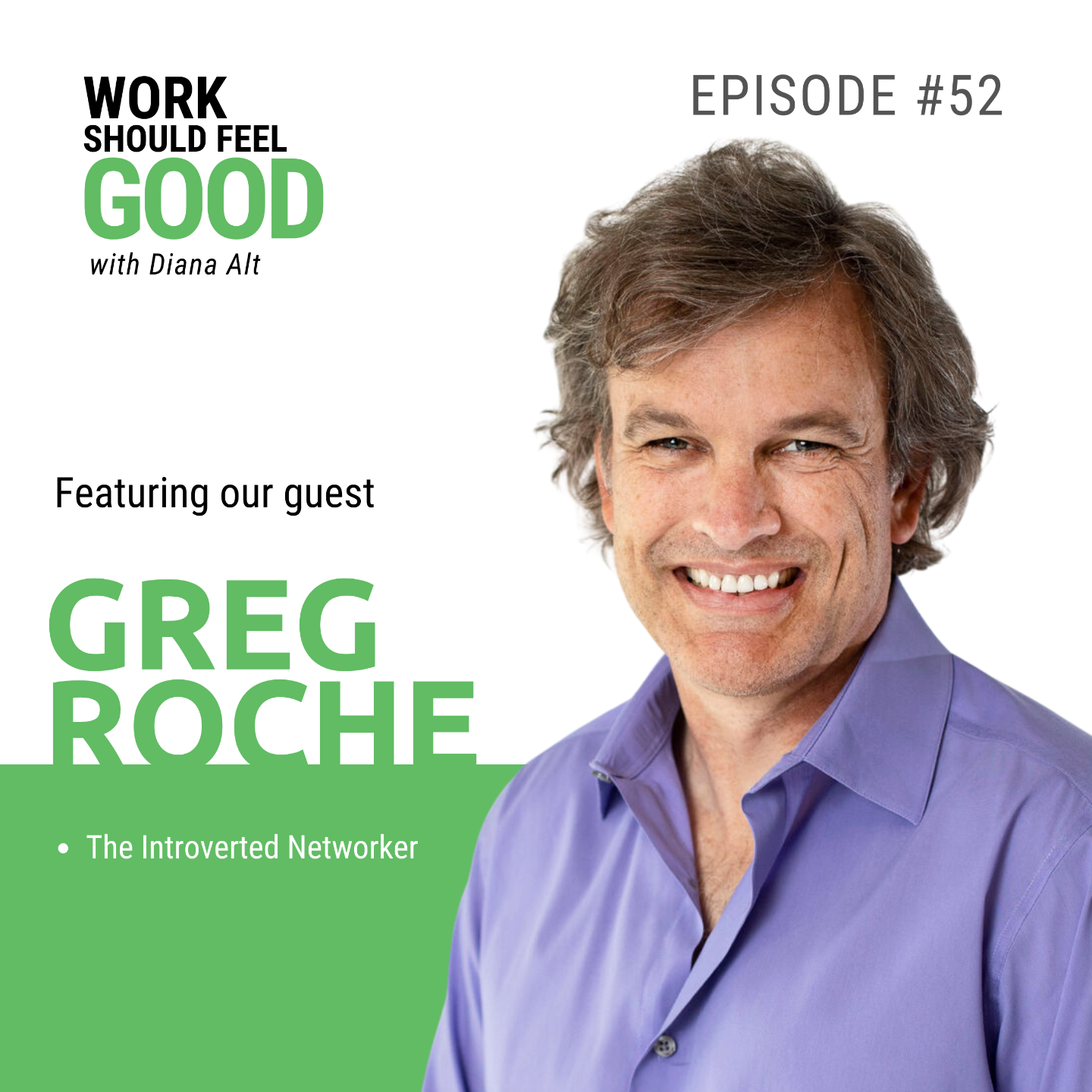
Work Should Feel Good with Diana Alt
Episode 52: Networking for Introverts with Greg Roche
Diana sits down with Greg Roche, author of The Fast and Easy Guide to Networking for Introverts, to talk about building real connections without feeling fake. Greg shares how getting laid off made him rethink what networking really is, and how he built a system that works even for introverts.
They dive into the myth of being “shy,” how to ask better questions, and why reconnecting with people you already know is the most underrated job search strategy out there. Whether you're in a job search or just want to feel less awkward when reaching out, this episode will give you a fresh perspective.
You’ll learn:
- How to reconnect with dormant contacts without it feeling weird
- Why vague requests for help don’t get results
- What to say in your outreach to make people remember you
- How to build a system so networking becomes easy (and sustainable)



Episode 52: Networking for Introverts with Greg Roche
Episode Description
Networking doesn’t have to mean awkward events or forced small talk. In this episode, Diana sits down with Greg Roche to break down a practical, low-pressure approach to building meaningful professional relationships especially for introverts.
-
Rethinking what “networking” actually means
-
Why traditional networking advice doesn’t work for introverts
-
How Greg built his approach after being laid off
-
Using “dormant ties” to restart your network
-
Why being “easy to help” matters more than being impressive
-
The power of specificity in asking for help
-
How to describe what you do so people remember and refer you
-
Why adjacent connections matter more than direct ones
-
Simple outreach strategies that actually get responses
⏳ Timestamps
01:03 Meet Greg Roche and his background
03:16 Getting laid off and realizing the importance of networking
04:56 Rethinking networking for introverts
07:00 Early career experiences and hidden networking
12:05 Introversion, energy, and communication style
14:09 Learning to lead conversations through better questions
18:07 What networking is (and isn’t)
23:21 Why imagination matters in job search networking
26:29 How to make it easy for people to help you
29:10 Why vague asks don’t work
32:14 Building and using a target company list
35:14 Giving people the words to describe you (the “memory dart”)
38:59 Dormant ties: where to start networking
43:08 How to reach out and restart conversations
48:28 What to say in your first message
Resources Mentioned
- The Fast and Easy Guide to Networking for Introverts by Greg Roche → https://www.amazon.com/Fast-Easy-Guide-Networking-Introverts/dp/B08MTZ8T85
- Greg’s Substack: The Introverted Networker → https://gregroche.substack.com
- Adam Grant's Give and Take → https://adamgrant.net/book/give-and-take/
💡 Take Action
🔥 Subscribe for future episodes → https://www.youtube.com/@dianaalt
📖 Grab my Resume Don’ts Guide → https://www.dianaalt.com/resumedonts
❌ Avoid these common job search mistakes → https://www.jobsearchmistakes.com
🚪 Wondering if it’s time to walk away? → https://www.isittimetowalk.com
💼 Work with me → https://www.dianaalt.com
📢 Connect with Greg Roche
🌐 Website → https://gregroche.com
📬 Substack → https://gregroche.substack.com
🔗 LinkedIn → https://www.linkedin.com/in/gregroche
📲 Follow Me
LinkedIn → https://www.linkedin.com/in/dianakalt
YouTube → https://www.youtube.com/@dianaalt
Facebook → https://www.facebook.com/dianakalt
TikTok → https://www.tiktok.com/@thedianaalt
Transcript
Diana Alt [00:00:01]:
Hey there, everybody, and welcome to Work Should Feel Good, the show where your career growth meets your real life. I'm your host, Diana Alts, and today my guest, my guest Greg Roche, and I are going to talk about how to be an effective networker when you freaking hate networking, especially if you're an introvert. Greg, who is known as the introverted networker, teaches professionals how to build meaningful relationships without awkward events or awkward small talk. For over a decade, he's coached individuals and led workshops that help people grow their networks through simple, repeatable steps. Greg is the author of The Fast and Easy Guide to Networking for Introverts, which you can find on Amazon, and has a weekly Substack called The Introverted Networker, which is followed by thousands and honestly one of the best looking Substacks I've seen. So welcome to the show. Greg, I'm so excited to have you.
Greg Roche [00:00:55]:
I'm excited to be on, Diana.
Diana Alt [00:00:57]:
Yeah.
Greg Roche [00:00:57]:
We've kind of followed each other for a while, so I feel like we've.
Diana Alt [00:01:00]:
Quietly circled each other as people doing this. And I've been really excited. First off, isn't it funny how in the age of mostly like when a lot of us network only online, but you can go years without knowing how to say someone's name?
Greg Roche [00:01:20]:
Yeah, yeah, yeah. It happens a lot. It happens a lot.
Diana Alt [00:01:25]:
I do. And guys, whenever I do invite a podcast guest on, I send them a Google form. That's an intake and it has, you know, bio and all this stuff. And at the bottom it says, what's something that I should know? And Greg said, it's Rocher, like Ferrero Rocher, which I'm an addict of. And my whole— for 6 years I've been calling you Greg Roach in my head.
Greg Roche [00:01:47]:
So that's okay.
Diana Alt [00:01:49]:
Thanks for straightening me out.
Greg Roche [00:01:51]:
No, it happens all the time.
Diana Alt [00:01:53]:
It's why I put it in the form. It can become a conversation point though. Yeah. So here we are. How did you like— I like to, to basically go straight into how people got where they are in their career because I think the journey is so important. So what led you to becoming the Introverted Networker?
Greg Roche [00:02:15]:
I got laid off. I mean, that's the short answer. Uh, 2012, I went to lunch one day and came back to my office, and my boss was sitting in my office, and she said, I'm eliminating your position. And I'd worked there for 9 years. I had started— I'd worked up, got promoted, really felt like as long as you were doing a really good job at work and kept getting high ratings you were safe, you weren't going to get laid off. And I never really liked networking, so I didn't do it. I just don't like going to events. I'll go to conferences, but more for the speakers or the content, not really to meet people, because the idea of a big huge room of people that I don't know is not my favorite thing to do.
Greg Roche [00:03:05]:
Not, not it for me. So I didn't do it. And when she said, I'm eliminating your position, and I thought, now I've got to go find a job. And I hadn't applied to a job in years. You know, I knew you got your resume together. And yeah, you know, this was the mid-2000s. So obviously there was online job postings and stuff like that. But I hadn't really done a lot of that since the early 2000s.
Greg Roche [00:03:32]:
I, um, realized I needed to grow my network. I needed to learn how to do this. And so I started finding a way that worked for me because again, I didn't want to go to all these events and do that, but people said you gotta go network. So I just started working through people I already knew, people who I'd worked with in the past, people who had maybe worked at the same company I had worked at, but had left maybe a few years before. I really just started reaching out to those people and having one-on-one conversations. And as I went through that, I found they were really good conversations. It wasn't as awkward or transactional as I thought it was going to be. And I really kind of found a way that worked for me.
Greg Roche [00:04:14]:
And as I did that, I made connections and I got to the place where I actually got my next job. And there was multiple sort of networking touchpoints to get me there. But when that happened, I told myself, I'm never going to be under-networked again.
Diana Alt [00:04:30]:
I think that's such a powerful statement. I'm never gonna be undernetworked again. And I, I would love to go back a little bit before this. Mm-hmm. Because we're definitely gonna talk about these techniques. Most of the people that I work with are, they're pretty analytical. Like typically they're leaders in tech or otherwise drawn to me because I'm into nuance systems and strategy alongside with building relationships with people. So we're gonna get there, but I wanna, talk a little bit about what you thought networking was and how you got jobs before, because you got laid off in 2012.
Diana Alt [00:05:05]:
You'd been there for 9 years earlier in your career before that. What, what did getting a job look like for you? Did it look like, did you use your network and not realize you were doing it? Were you applying like HR departments, or what was it?
Greg Roche [00:05:25]:
Well, okay, so I started my career straight off of, uh, campus recruiting. So my very first job, I got hired by Andersen Consulting, which is now Accenture, and they did campus recruiting.
Diana Alt [00:05:38]:
So yes, interviews with Andersen Consulting.
Greg Roche [00:05:41]:
So yes, so, so yes, you, you applied sort of, but you were going through the campus process and you did interviews that were on campus. And, and so I got my first job that way. Okay. Um, I didn't know it at the time. I did actually use my network, and I had— I didn't know it until I really reflected back on all I know about networking now, that there were upperclassmen I knew who worked at Andersen at the time, and we knew each other and we talked to each other when I was going through the process, and they gave me tips and strategies on how to approach the interview. But what I kind of realized later is those people were also volunteering to be in campus recruiting. And when it came to, hey, who gets to move forward, you know, you don't really realize this, but those people are in the room. Yes.
Greg Roche [00:06:34]:
People look around and go, well, what do you know this person? What do you think? I think they're good. We should hire, we should move them forward. Right. And so it wasn't sort of the typical thing you think of, of like, hey, can you introduce me? Or, hey, can you refer me? But by knowing those people. It was people I knew who, who, you know, had, had worked with me in student organizations and other things like that. And they said, yeah, let's move this person forward.
Diana Alt [00:06:59]:
So, you know, what's wild is I have almost the same story, only it wasn't Accenture or Andersen. AC was at the time still for me too. So I knew I was interested in consulting and I had watched people and I watched the people at AC get the most burnout out of my friends. So I was not as in interested them. Which was funny.
Greg Roche [00:07:23]:
Okay.
Diana Alt [00:07:23]:
But E&Y, Arthur Andersen, and then CSC, which had a private consulting division that was kind of like what y'all were doing at AC, they interviewed on campus. And one of my sorority sisters started like 6 months or a year before at CSC before I did. And I had people at E&Y too. And so it was the same thing. I was just talking to my pledge sister Casey about what's happening at CSC and figuring out the difference between like her experience working there and then the people that were working at E&Y that got so accounting focused, like they felt overlooked. And it was really interesting and I know that mattered. So didn't know I was doing either, but I knew it mattered.
Greg Roche [00:08:11]:
I would say, you know, I went from there and The funny thing was, so, so I had— I took this year off. I'll say off. I wasn't off. I was working on a cruise ship. And that was a funny story because.
Diana Alt [00:08:27]:
What did you do on a cruise ship?
Greg Roche [00:08:30]:
Uh, I call— I was a what was called an entertainment host. I worked for the cruise director, so it's cruise staff. So I called bingo, hosted karaoke, hosted trivia, played fun. You know, shuffleboard with the guests. That was funny because I really applied the really old-fashioned way, which was paper resume and cover letters in envelopes mailed to the HR departments, 'cause that was how you did it. Again, 1999, not a lot of job stuff online yet. And so it was like a mail merge of like addresses and labels and cover letters and stuff that I did. Um, that I learned how to do while I was working in Andersen Consulting.
Greg Roche [00:09:14]:
So I was able to, you know, use my tech skills to, to kind of, you know, I think we were.
Diana Alt [00:09:20]:
Close in age, but like, I, I was looking at your more recent stuff and then I got distracted by your amazing Substack this morning when I was researching for this. We graduated from high school the same year.
Greg Roche [00:09:31]:
Okay.
Diana Alt [00:09:32]:
And from college the same year, so it's no wonder But you have a BA in English, which actually explains a whole lot about what I observe of you because you have critical thinking and language skills that sometimes aren't as valued in the people that have STEM degrees like I do. So you just got another extra gold star. But so have you always— like when you were younger, did you have the word introvert about yourself? How did you think of yourself in terms of how you interacted with others?
Greg Roche [00:10:05]:
I, I didn't. I, I would have just called myself shy as a kid growing up. Uh, I had friends, but I mean, when you're a kid growing up, you go to school and the people around you, they become your friends, right? Right. You get— you don't really get to choose your friends. I mean, you, you do, but I mean, the pool of people you're in is decided by where you live.
Diana Alt [00:10:26]:
Yeah.
Greg Roche [00:10:27]:
And so, you know, I, I grew up in a fairly small town in southern Colorado, one high school. You know, grew up there my whole life. My parents had lived there most of their lives, so I knew a lot of people. So there wasn't this— I never was that kid who moved to a new school. I never had to say— I never got forced into like, how do you meet new people? You just went to school and you met people, right? Um, then I went to college and I went to school out of state. So you went to A&M?
Diana Alt [00:10:56]:
Like big?
Greg Roche [00:10:56]:
Yeah, yeah, yeah.
Diana Alt [00:10:58]:
Not little Commerce?
Greg Roche [00:10:59]:
No, like there were more people at A&M than in my county that I grew up in.
Diana Alt [00:11:05]:
Yeah.
Greg Roche [00:11:07]:
And that was a challenge for me. But I found ways through joining student organizations to get to know people. That was kind of how I dealt with it then. But I always kind of considered myself more quiet, more on the side that would more listen and observe in the conversation as opposed to kind of dominating it. And I, I would watch people though, in college who I considered good networkers because they could walk up to anybody and just start talking to them. Like, just walk up. There were people who would walk around class the first day of class and introduce themselves to every single person in class, just shake their hands. And I thought, you're like, whoa, that's a lot, you know? And yeah, I wasn't— I mean, I wasn't like, ooh, don't talk to me.
Greg Roche [00:11:51]:
But at the same time, I was like, man, I don't, I don't know if I have the energy to do that. So I didn't really think of it like I was an introvert until probably a lot later, you know, you get farther in life and you take Myers-Briggs and you come across this other stuff and then you're like, oh, okay, I kind of identify more with that approach.
Diana Alt [00:12:10]:
I thought for a long time, I thought I was an extrovert and I still get people that are like, what do you mean you're an introvert? And it's because especially when we were younger, when people use the term extrovert, they meant friendly. Or they use the term social butterfly, got used a lot. And so, you know, people argue all the time, what is introvert extrovert? Are they mutually exclusive? Whatever you hear. And I'm an extroverted introvert and vice versa. But for me, the energy management theory of it has always been huge for me and my whole life. I've always been somebody that was like, I'm at zero or 100 miles an hour. I didn't have a middle. And I was the kid my mom never had to worry about putting me to bed because I would basically go hard all day at whatever I'm doing.
Diana Alt [00:13:02]:
And then I would crash out at 8:00 and there wasn't even a conversation when I was a little kid. So I feel that a lot because I'm not shy and I know a hell of a lot of introverts that are not shy. Yeah. Do you still ever attach the term shy to yourself or because— No, I.
Greg Roche [00:13:21]:
Wouldn'T say so now. I mean, I think Obviously, I've, you know, grown through the years and I wouldn't call myself shy. I just have a different approach to social interaction. Yeah, I think it's more— I've learned that I, I really want to listen more and, and really speak less. And I've always kind of been like that, even at work. I had, I had feedback over my career of, you know, really need to talk more in meetings. You really need to speak up. You really need to say more.
Greg Roche [00:13:50]:
You know, we want to hear from you. And I, for a while, I kind of struggled with, with that in, in terms of— and, and, you know, my response was, I'm listening. And they're like, yeah, but sometimes when you're listening, it feels like you're not really engaged in the conversation. So whatever was going on on my face— aloof was the word that came up. You look aloof, like you don't want to be there. And I was like, well, I'm listening and I'm processing what's happening. They're like, but you got to give some sort of signals, like, to let people know you're in there. And so my approach, my, my solution to that was ask better questions.
Greg Roche [00:14:26]:
And that strategy really worked for me because there were questions that were on my mind, but instead of keeping them in, I just kind of started to ask them. And they weren't sort of challenging or combative questions, they were clarifying questions. So I would try to ask more clarifying questions like, okay, I just want to make sure I understand this. You're saying this, this, then this. Is that correct? Am I understanding that correctly? Which gave people this— I was engaged in thinking about it.
Diana Alt [00:14:50]:
Yeah.
Greg Roche [00:14:51]:
But it also— what I learned is it gave me control of the conversation. I could steer the conversation the way I kind of wanted it to go by my questions. And so I was actually able to sort of take, not take over, but sort of manage meetings and discussions better through my career by learning how to ask better questions that, that took it the direction I wanted it to go.
Diana Alt [00:15:14]:
There's, there's such power in that because there's this interesting fine line between asking questions to discover and guide and asking questions to steer your agenda or toward your pre— all your preconceived notion. It really is an art form to figure out how to ask questions.
Greg Roche [00:15:34]:
Yeah.
Diana Alt [00:15:34]:
What did you feel before you got laid off in 2012? What did networking mean to you just in terms of like the activities? Like what? Because I think this is one of the things that people struggle with. Because they have a preconceived notion of what constitutes networking and it's stuff they don't like. So then they don't want to do anything. I'm curious what your brain told you networking was before.
Greg Roche [00:16:03]:
Yeah, I had the same probably preconceived notion that most people who struggle with it still have. Remember when I was talking about that, those people in school who would walk around and meet everybody and shake everybody's hands the first day of class. I was thinking that's networking. So networking is walking into a room full of strangers you don't know and just starting to shake hands, which it's not, but at the time that's what I was thinking. Or you go into some big room and there's a bunch of people standing around with name tags and, you know, you're hanging out, you find some groups of people you try to get into, and, and you're trying to have conversations, right, which is people you don't know make small talk. Not something I really like to do. I mean, I can, I can make it happen. It's just not a really good use of my time.
Greg Roche [00:16:51]:
Yeah, because I'm probably not going to get to the place where I'm feeling like, hey, I made a real connection with you. So that was what I thought it was, and which is why I avoided it as much as I could. And I, I tell a story whenever I do. I do a lot of presentations to either executive in transition groups or job search groups or sometimes even college students or different professional groups about my approach to networking. And I start with a story about being on a shotgun range in eastern Colorado. I got invited to a sporting clays networking event by one of the vendors that I had worked with when I worked at that company where I got laid off. So this was right after I got laid off.
Diana Alt [00:17:40]:
Well, and you're not saying no when you know you're under-networked. You're going to go to any weird thing at that point.
Greg Roche [00:17:47]:
Exactly. And people said, you, you need to network, you lost your job, it's time to go network. And this vendor said, hey, you know, because, because I contacted the vendors and said, hey, I'm leaving the organization, here's going to be your point of contact, which is a great strategy, by the way, if people get or get laid off. Make sure you tap into those vendor networks because they know who has openness. Um, and so I, I just told him, I was like, hey, this happened. He's like, you know what, we're having this networking event, it's a sporting clay thing. I don't know if you've ever done that before, but there will be people there from Denver, you should check it out. And I said yes.
Greg Roche [00:18:25]:
And I had, you know, I went, but I spent 3 hours shooting clay pigeons, which I was not really good at, hadn't done a lot in my life, and just felt like— it felt so weird. Like, it was, it was, yeah, it was, what are we all doing here? What do we have in common? Why am I talking to you? Why are you talking to me? And it was kind of there that I thought, I am not going to go through this job search doing things like this, because it was a very— right when I got laid off, it was like the day— it was, it was, I think, literally my last day working. And I, I was like, I'm not doing it this way. It was sort of that moment when I said, I'm going to do something different. I don't know what different is, but I'm going to figure it out. But this is not what I'm going to do for the next several months to find a job. And that's when I just started thinking, okay, who do I know? Like, who could I just talk to? Who could I go talk to for advice? Who might have some ideas? And I just looked at people who I liked working with, who I thought highly of or respected, and I just tried to find them and figure out where they were and say, hey, you know, I, I would love to get back in touch. Um, it's been a long time, I know, but just want to have a conversation, kind of catch up and see what you're doing, and, you know, really just kind of reconnect.
Greg Roche [00:19:45]:
And, and a lot of people said yes. A lot of people were willing, and, and It was no secret. They knew I had been laid off or I was looking for a job. I didn't try to hide that, but I also didn't go in and say, hey, I'm on a job search, I really could use your help. I said, let's have a conversation and just kind of catch up and reconnect.
Diana Alt [00:20:03]:
I think that's so important. There's always one of the things I deal with a lot with you. I have so many people that I work with that they're this interesting combination of very direct, like they would rather chew broken glass than engage in small talk. And also really analytical. So they overthink all of it. And then the end result is like what you just said is really simple for you and for now, me, like sit down and brainstorm, you know, go through your own resume. Who are 10 people I liked at ACME, 10 people at XYZ, 10 people at this, who was in my PMI chapter and who are some buddies from college that I'd like to get back? And you can get a list of 100 pretty quick. If you're willing to think about that.
Diana Alt [00:20:51]:
But so much of what people are trying to do, they're— they want to have an agenda and a purpose for every single conversation that is often centered on the wrong thing. Like, when you're looking for a job, people just, in my opinion, don't have enough imagination. A lot of times they're like, well, I'm a product manager, so I'm gonna go meet I want to network with VPs of product or, or other product managers, and they can't see outside that. I always say, go talk to your hairdresser, because your hairdresser might cut the hair of somebody that hires product managers, or cut the hair of the person that's married to the person that hires product managers.
Greg Roche [00:21:35]:
So yeah, that, that point about imagination, I think, is is really, you know, that's on target because people just go, well, this is what I want, I'm going to go talk to that person, not understanding that that's not how relationships and how this really work. It's not how the world works. And I'll often talk to even business owners and people who are trying to grow businesses, and if I'm talking to those people, we're focusing on not networking necessarily with your target customer, but the other people who interact with your target customer. Yeah, those are the people you want to connect with. Those are people you want to network with because those people are going to hear their— your target customers say, I really need somebody to do this, and it's the thing you do. And they go, oh, I know a guy, his name is Greg, you should talk to— I got it. Everybody wants to say, I got a guy, right? You know?
Diana Alt [00:22:30]:
Yeah.
Greg Roche [00:22:31]:
And so, uh, That's what you want to focus on. Same thing in a job search though, right? To your point, you don't want to just target VP product managers. Who else is around a VP of product manager, right? Or, or who else could possibly know somebody like that? And focus on how do I get connected with those people, or even just other people at those organizations where those people work.
Diana Alt [00:22:54]:
Yeah.
Greg Roche [00:22:55]:
And so you don't have to go— I, I know some people like, well, why waste your time? Go directly there. It's like Cause sometimes like the frontal assault is not the best way to like storm the castle.
Diana Alt [00:23:07]:
People need to learn how to come from the side. And that, which sounds like something you kind of had a talent for, like that active listening stuff that you did where you got called aloof. There's no right number of questions to ask in meetings. I'm convinced, by the way, you got told too many, too little. I got told too much. Sometimes. But in all seriousness, the sideways— the sideways approach can be so much better than just full on. Um, I, I used— I got laid off in 2012 as well, and I went to Right Management.
Diana Alt [00:23:44]:
Like, we had outsourcing from them, and I'm like, I know how to find a job, I know how to write a resume, like, I'm good on this. But I just went because they had a thing every week or every other week that was a networking group And I just wanted to go meet other people. And it was interesting because there was people from that had just gotten laid off of companies I never wanted to work for that were trying to get hired also at companies I never wanted to work for. But one of those people connected me with my next job. Yeah. And he and I just sat down and shot the breeze at Panera one day about our background. And the next thing I know, he's introducing me to the VP of client services. At a database marketing agency, which is not something I had background in.
Greg Roche [00:24:25]:
So, right, yeah, you didn't even know it was out there, probably.
Diana Alt [00:24:29]:
I didn't know it existed, but I had worked in software development my whole time, and I had background in CRM, and they were hella interested in that. So yeah, that's where imagination is a thing. So let me ask this, so some people are do lack the imagination of who to talk to. So can we dig a little bit deeper into that? You said, you know, talk to people that are adjacent to the full frontal, like calling the VP of product management. What are some of the ways that you guide people to help brainstorm who that list of contacts they're going to approach over the next few weeks or months should be?
Greg Roche [00:25:12]:
It's a little bit of a balance between being really specific and, and too specific, I guess.
Diana Alt [00:25:23]:
Yes.
Greg Roche [00:25:23]:
Yeah. So, so I tell people you always want to get as specific as possible because it helps people think of the— think of who they know. And for job seekers, you know, my big go-to here is the target company list, that list of companies you're interested in. Now, I always try to specify interested in. It doesn't mean this is the only list of companies you'll work for. It doesn't mean that you can't possibly apply somewhere else. It's not designed to just be, I'm only, I'm only setting up alerts for these companies, right? So, so I have to try to kind of tell people what it's useful for so they understand how many people, how many companies should be on the list and what they're going to do with it. When you're talking to somebody and it's a great conversation, you're sitting with the guy at Panera shooting the breeze and he goes, well, tell me how I can help you.
Greg Roche [00:26:30]:
And most people want to help, especially if you're having one of these conversations.
Diana Alt [00:26:33]:
And you're in the situation most people can't answer.
Greg Roche [00:26:36]:
Well, so, well, because they can't get specific enough. And so if you think of yourself and somebody says, and you say to somebody, how can I help you? And in the past this has happened to me because a lot of my career ended up in HR and people knew that. And so we'd have conversations and they'd say, well, here's my resume, can you hand it to somebody in recruiting? And I'm like, sure. I mean, I'll I'm do you any good. not in recruiting, but What position is this for? Do you have any idea? Like, is it open? Did you apply for it? Like, do you know anything about the recruiter? No. Okay, now I got to go find the recruiter. I got to, you know, walk down to recruiting, talk to the recruiters and say like, hey, here's this position for this person. I'm not sure.
Greg Roche [00:27:23]:
I think they're interested in this, but I don't really know. And if that's the case, it might have sat on my desk for a few weeks before I got a chance to go down there. And then I give it to the recruiter and they put it on the pile. With everything else. And yeah, so when I think of that and somebody goes, here's my resume, I go, this is going to be really hard to help you. And when you're hard to help, sometimes you don't get helped. But on the other hand, if somebody.
Diana Alt [00:27:50]:
Handed me a list— hang on, say that again for the kids in the back about being hard to help.
Greg Roche [00:27:57]:
If you're hard to help, you're not going to get help.
Diana Alt [00:28:01]:
Bam. That's so important. So I think it's underrated.
Greg Roche [00:28:07]:
I just— well, yeah. And I don't think people really think about what they ask other people to do for them very often. And they don't. And so I'm all about everything in networking being about— I call it golden rule networking. You can call it whatever you want, but it's whatever you're asking somebody else to do. Think, would I be okay being asked to do this? So, so if you say, you know, hand— here's my resume, can you hand it to somebody? If that person turned around, like, here's my resume, go hand it to somebody, would you be like, ugh, I don't want to have to go do that? So same thing, if you're going to send a LinkedIn request or a message to somebody and you think, I wouldn't want to get this message, then don't send it. Write the message you'd want to get. You know, write the one that would be— yes, would connect with you.
Greg Roche [00:28:58]:
And, and, you know, that's a general guideline. It's not 100%, but it's a good rule of thumb to— if, if your networking is not working, think about what am I asking of people? What am I saying to people? And is that something I would like to hear? But going back to— it's so important.
Diana Alt [00:29:15]:
Because the thing that I just want to shake people and say sometimes is stop being so damn lazy about— and, and that feels like on one level, like I don't say that out loud to very many people because that feels really hard, especially when I'm talking about people that are in a job search and they unequivocally feel like, but I'm doing all the things. But if you're doing a whole bunch of all the wrong things, that is not effective. So the message of what, what DM would you want to get and how can I make myself easy to help is to me very freeing because you can just sit down and say, what would I want if a friend of a friend DM'd me? What would make that compelling? Oh, saying find me a job? No. Saying Greg said you could find me a job. No. Saying Greg said that you might know someone at Acme I could talk to and learn more about Acme because I'm looking for a fintech SaaS product management job and I want to learn more. That is a message that I would want to get.
Greg Roche [00:30:34]:
So yeah, and you would respond and you're like, here's— maybe I can help you. Let's talk. Let's find out more. See what we can do. I think if I go back to thinking about what makes somebody— if somebody comes to me and they say, here's, here's, you know, I'm looking for this job, I happen to be looking for it in Denver, you're from Denver, I know kind of what you did, here's a list of companies I'm interested in. Well, what I'm going to do is I'm going to look at that list and I'm going to immediately start thinking, who do I know that works at any of those places? And there's a good chance that I might know somebody, and I can say, you know what, I know somebody that works at this company. Let me send an email and I can introduce you, and you guys can take it from there. Okay, I've, I've helped.
Greg Roche [00:31:20]:
It was really easy to help. I've done it. And now this person's gotten introduced to somebody that's closer to one of their targets.
Diana Alt [00:31:27]:
Yeah.
Greg Roche [00:31:27]:
I might also look at that list and say, you know, I don't really know anybody at one of these, but I see these 5 companies are kind of in the same industry. Have you ever thought about this other company, the 6th company that's not on your list? Because I do know somebody there. Okay, great. Sounds good. So again, that's why I go back to your target company list. It's not laminated. It's— yeah, it changes.
Diana Alt [00:31:48]:
I used to have a document that I called a networking brief, and this was one I actually learned how to do it in that right management. It was like the one other thing I learned besides just meeting the people that were in the group. And I had like the executive summary from my resume, just a list of roles and titles. So not any details, but like the last few jobs from my resume with no details. And then I had some target companies, um, kind of like a profile of what kind of place I want to work because I knew some of them might be smaller. And then roles that I was interested in. And I had all these like business analysis. I've always worked in these jobs that are like one leg in tech and one leg in people and process and tons of transferable skills.
Diana Alt [00:32:36]:
So I would explain it in terms of work like this. And then when I sat down and talked to people, it was, oh, well, I like working on this problem and that problem. And I would discover new job titles and new companies, which was really how I should do a YouTube video on that because it is underrated to think in those terms. And yeah, the target company thing is interesting too, because we know most people are now doing— so many people are doing nationwide job searches now.
Greg Roche [00:33:05]:
Yeah.
Diana Alt [00:33:06]:
And so I encourage a lot of my clients to think about both what's that dream company list. I don't care if it has 5 people or 50,000 people to have those names of companies, but I think the profile of what you're looking for is really important.
Greg Roche [00:33:21]:
Yeah. And, you know, even if you're saying something like, here's my list of target roles, anything you can give people and, and, you know, go back to your, your CRM, your database days, right? You're trying to give them an idea of like which index to start at to find the data, right?
Diana Alt [00:33:38]:
You gotta give them something.
Greg Roche [00:33:39]:
Where do I start in the mass of information that's in my brain to start looking through that mental database to go, these are the people I can connect you with? Because yeah, if, if I come in and, you know, people, when I, when I tell people to do this and they're like, I'm explaining the target company list and I say, okay, who should I know? Who should you— who could you introduce me to?
Diana Alt [00:34:02]:
Who should I know?
Greg Roche [00:34:04]:
Well, it is, but when it's that broad and you get asked that question, you go, I don't know.
Diana Alt [00:34:11]:
Oh, you know, you're right. Because when I would ask, who should I know? It was like half or two-thirds of the way through a conversation where we already started. So yeah, you definitely don't want to start with, who should I know?
Greg Roche [00:34:23]:
Great.
Diana Alt [00:34:23]:
Thank you for clarifying that.
Greg Roche [00:34:25]:
And it's just, it's just, again, the list, whether it's titles, whether it's companies, Even if it's certain people, you're like, now I can drill in and go, here's who you should know. Here's— I've narrowed in this, that my, my scope, my vision in my brain, I've narrowed the focus to this group of people. And now these are the people I can introduce you to.
Diana Alt [00:34:48]:
Yeah. But when you just laser in on something that is in this vein or that helps make this— so while I was wandering around on your Substack, I found the most brilliant article on— you use the term manifesting. And so you talked about using the language when you're trying to get people to think of you, to refer you, say your name, to talk differently. And the example you gave was that you shouldn't say, I help with medical billing. That's one of the things you had in the article.
Greg Roche [00:35:22]:
Yeah.
Diana Alt [00:35:23]:
So, and that's where people start. I'm in product management. I am a, I'm a total rewards compensation expert. I'm this. And I, it drives me to distraction because I've always been in the roles where like project manager can make $55,000 a year or $355,000 a year and everything in between. I've worked in a lot of those domains. So why is saying I help with medical billing not optimal? And what, what should people say instead and why?
Greg Roche [00:35:56]:
For— from a networking standpoint, nobody walks around and says, hey, do you know anybody that helps with medical billing? So the example was, I was teaching my networking approach to a group of franchise owners who had bought a home-based franchise medical billing business. And so the CEO of this company followed my newsletter, saw me on Substack, really liked my approach. And he said, most of my franchise owners have never run a business before. They want to work from home, so they're not outgoing, not great at sales development, and they know they need to network, and they, they belong to the Chamber of Commerce, and they do stuff, but when they go out, they just don't know how to do it.
Diana Alt [00:36:47]:
Yeah.
Greg Roche [00:36:47]:
And so what we were talking about was I was saying their ideal customer is a physician that runs their own practice. So a physician runs their own practice, let's call it a primary care practice, has their own office, and that person got into medicine to see patients, not to fill out insurance forms and do billing.
Diana Alt [00:37:09]:
Preach. Yes.
Greg Roche [00:37:10]:
And Some of them hire staff to do that, but the medical billing franchise, what they want to do is go to that physician and, hey, look, I can take that problem off your plate. I'll do it for you. You don't have to do it. You know, of course you're going to pay me to do it, but it will take all that burden off of you and you don't have to worry about it. But a physician doesn't walk around the world and say, I need somebody to help me with my medical billing. A physician says something like, I love being in medicine, but the part that I hate the most is filling out the insurance forms, or I hate the billing the most. That's the one thing that ruins running a practice for me. And so what I was telling them is, you want to tell everybody you network with that if you ever hear a physician or somebody in the medical field, say, I would— this would be the perfect job if I didn't have to do medical billing, or I love everything about my job except for I have to fill out these insurance forms.
Greg Roche [00:38:17]:
Say those words to the people you're networking with, and they will carry those around in their head. And then when they do meet a physician and the physician says those words, they connect those words to you, and they connect that person to you.
Diana Alt [00:38:33]:
Yep.
Greg Roche [00:38:33]:
But if you just say, I do medical billing, that's forgettable. Yeah, that's not going to stick in their head. I think that's really going to remember that.
Diana Alt [00:38:40]:
That's really good. There's a guy that was at this event— I went to a conference last week, and there's a guy there that, um, calls that level of clarity a memory dart. So he helps people develop a memory dart that people will— exactly. And he, like, His little title he always puts in conferences, and I think it's probably on his LinkedIn, is King of Clarity. And I'm like, I'm going to forget that Steve is the King of Clarity anytime soon. I love that you bring this up because like one of the ways I help people with this, so because I work with people all the time that are in these roles that have brought such breadth to them, especially once they get outside the four walls of the company that they're already at. I like to work them through their superpowers in addition to whatever their scope was. And so whenever I'm able to take somebody and they're like, yeah, I'm a project manager, and one of my specialties is getting people that don't want to talk to each other to work and get a project done, that hits different.
Diana Alt [00:39:44]:
Like, oh, this is our guy. I will take your red project and turn it green with a smile. Great. Like, that, that is something.
Greg Roche [00:39:52]:
So, and And the person who's hiring isn't just like, I need a project manager. I mean, that's what they're going to say, but what they really say— they.
Diana Alt [00:39:59]:
Say, but they never mean only that.
Greg Roche [00:40:03]:
Yeah, they mean I've got a bunch of red projects. I just want somebody to come turn those green with as little hassle and chaos as possible. That's what I want. That's the problem. So you need to describe the problem you solve in the words of the person who needs it solved. Right.
Diana Alt [00:40:20]:
Yes.
Greg Roche [00:40:20]:
Whoever has that problem that you solve, you want to describe it in their words. Because to your point of the memory dart, that's what that creates. And then people will remember you versus the 5 other people who said, I'm a project manager.
Diana Alt [00:40:34]:
Yeah.
Greg Roche [00:40:34]:
Helps you stand out from everybody else who has the same title that's going for those jobs that you're going for.
Diana Alt [00:40:41]:
It's— I talk to it, and this is fundamentally what branding is, and a lot of which is interesting. There's a lot of people that are out there looking for a job, especially if they haven't hit like director and VP level where you must have a personal brand. And sometimes you work at a place where the marketing department will help you with that. You give it— I refer to it as giving people the words to say about you when you're not in the room. And a lot of what you're doing in networking is doing that because that's where, to me, that's where you go from, okay, well, I talked to Greg, but now I'm talking to Greg's friend Jane. And Jane's going to introduce me to Pablo, and Pablo is where I get my next client. That daisy chain, that 6 degrees of Kevin Bacon goes a lot easier if you're able to give people the words to say about you. So thanks for going through that.
Diana Alt [00:41:30]:
I— my jaw dropped at how so good that particular article was on your Substack. I want to talk a little bit about dormant ties, and then also I think you're pro— I saw this on Substack too, connection loop process, whatever your system is, because my people, they like systems. Anybody listening to this wants to get efficiency through a system. And to me, that's freeing because if you have a method to the madness, then the organic weird curiosity that happens in conversation, you don't feel weighed down by.
Greg Roche [00:42:08]:
So yeah, dormant ties, dormant ties, dormant ties are the start of the connection loop. And when I talk to people, a lot of times they'll say things like, I know I should be networking, but I don't know where to start. I hear that all the time. In fact, when people, when people subscribe to my newsletter, I ask them, what's your biggest challenge? And one of those is, I don't know where to start. And so people will respond. And then I'll say, you know, I'll say respond with a letter that indicates what your biggest challenge is. So sometimes it's, I don't have time, or it feels awkward, but a lot of times it's, I don't know where to start. And that's understandable.
Greg Roche [00:42:44]:
I tell people, start with who you already know, and that's your dormant ties. Your dormant ties are people you've worked with or have been in your life at one point in time. You know who those people are, they know who you are, but you don't talk to them on a regular basis. So probably not your immediate family, people really close to you. You see your friends. I'm talking about people who You could send them an email, LinkedIn message, a text, and they would recognize your name and be like, oh, it's been a long time since we talked. That concept is— and it was in Adam Grant's book Give and Take. That's the first place I came across it.
Greg Roche [00:43:20]:
And then I looked into the study that MIT did that was behind, you know, the research that Adam had done for his book. But it was was a— it an experiment where they took executives who were in their executive MBA program and asked them to reach out to what they called their dormant ties, what I just described, people these executives had worked with but had lost touch with. They basically said, go through your contact list for your career and send messages out to these people and just say, hey, it's a while since we spoke. I was thinking of you the other day, uh, wanted to get back in touch and see how you were. And they ended up getting twice as many responses from those people as they thought. They thought they'd get like 3 or 4 out of 10. They usually— they got about 7 or 8. And then they turned those responses into conversations that the executives came back and said, those were really productive conversations because these people had gone out and had different life experiences and different work experiences and came back with insights that these executives weren't getting from their trusted circle of peers that were close to them on a day-to-day basis.
Greg Roche [00:44:25]:
So I always say that because that's a good way to, again, start to have I would say low-risk conversations with people who already know your name, trust you to a certain extent, know who you are, um, could potentially be working in places that are interesting to you because they've probably left where you were working and gone on to other, other places. They work other places. And so that's, that's where I tell people to start. Now, a lot of times people will say, well, they're already in my network, that doesn't really help me grow my network. And I say, I understand that. That's why you're going to take more steps than just reaching out.
Diana Alt [00:45:02]:
You're not stopping there.
Greg Roche [00:45:04]:
I says we're going to start. That's not we're going to finish. And so back to what we— you said the word earlier, proximity, right? The people who have been close to us in our lives, either organizationally or geographically, but have now moved on. That's where we want to start. And so once you do that, and that's kind of the first step. So that's the first thing I would tell people, start making that list.— and you kind of mentioned that too— you can make a list of a lot of those people, whether you go through your resume and just think of the people, or if you go through LinkedIn and go through your experience section and start looking for people who have the same past companies as you do. And you start to see, am I first-degree connected? Oh, I forgot about that person. A lot of times you realize you forgot more people than you know when you start going through your LinkedIn.
Diana Alt [00:45:48]:
Yeah, and it's— but it's not the kind of forgotten Often it's not the kind of forgotten where it's like they're gonna not know you from Adam, right? Whenever you— yeah, send them a message, it's just, I haven't thought of that guy in 5 years since we did the Salesforce conversion or whatever.
Greg Roche [00:46:06]:
Yep. So, and so, you know, a lot of times, um, you can start the list that way. Once you start doing that, you know, I have people move on to the next step, which is to get back in touch online. So let's use online and the, the technology we have to make first connection, but we're really trying to move to some sort of voice-to-voice conversation.
Diana Alt [00:46:26]:
So can I tell you my hot take on online?
Greg Roche [00:46:30]:
Sure.
Diana Alt [00:46:30]:
I tell my people when they're doing this that they should use— like, LinkedIn is actually the last place I would have them. So if you have a text because you were close enough to have that person's phone number, text first.
Greg Roche [00:46:45]:
Sure.
Diana Alt [00:46:46]:
Email second.
Greg Roche [00:46:47]:
Yep.
Diana Alt [00:46:48]:
Facebook or Instagram third.
Greg Roche [00:46:51]:
Interesting.
Diana Alt [00:46:52]:
Okay, because it's disarming.
Greg Roche [00:46:55]:
Okay.
Diana Alt [00:46:55]:
And you know, that partly depends on are they active on the platform. Sure. The person hasn't posted on Facebook in 3 years, then no. And then LinkedIn, because people check LinkedIn less often.
Greg Roche [00:47:06]:
Yep, that's true.
Diana Alt [00:47:07]:
And there's garbage in it, so it's less. So I, I suggest that, um, and You know, you don't— it doesn't always have to be a LinkedIn DM. It's really the message that I'm trying to send them.
Greg Roche [00:47:22]:
So yeah, I would agree with that. I mean, I think if you can't do it— huh, if you can't do it through text or email, if you've got that, yeah, go with that. Because again, it's, it's going to be more direct. Um, you know, again, I think probably the Instagram and Facebook if they're active, because They're, like you said, they're not going to expect it. And so it's going to, it's going to pop in there and catch their attention. And yeah, last but not least, if you can't do it any other way, look for LinkedIn. But some way to send the initial message. And the initial message isn't your life story or your whole story of your layoff or your job search.
Greg Roche [00:48:00]:
It's, hey, I thought of you the other day. I realized we hadn't talked in a while. Would love to catch up.
Diana Alt [00:48:05]:
It literally can be that simple.
Greg Roche [00:48:07]:
It should be that simple. Yeah, it should be that simple.
Diana Alt [00:48:11]:
It should be. And I'll sometimes suggest to people, I sometimes will suggest one other sentence to add, and that is like when, when I talk about network, I'm always talking about can we make sure that we're giving value? And then some people feel like I don't have any, you know, this guy is now a senior vice president, whatever, 3 layers above where I would be. I say appreciation is value. So simply adding something like, you know, I really recall how good it was to work with you on X project or X team back in the day. Was thinking about you. Can we connect? That one thing that says I appreciate you in the middle of it works really well for me. And it's sometimes it's the unlock for people to make them be like, oh, okay, I can do this. I'm not just asking random for things.
Diana Alt [00:49:04]:
So.
Greg Roche [00:49:05]:
Yeah, and I, I typically then say, and, and I go to that value sort of step after you've gotten back in touch with them and they say, yeah, I would love to talk, and you set up a video call or face-to-face call if you're in the same geography and it's not too hard to get together, or just a phone call. I mean, a phone call works too, you know, just having a phone call with somebody, and it doesn't have to be an hour. You're like, let's just take 15 minutes and, and talk. Um, now a lot of times 15 minutes turns into 20 or 30, you know, but you don't have to make it a big huge thing because you're trying to make it as easy as possible again for this person to say, yes, I would love to talk to you, that'd be great, let's, let's chat. And go into that with the idea that you're coming into this curious about the other person. You're focused on asking them questions, right, back to the better questions. You're focused on listening to understand, not to respond, but listening to understand them and understand what they're working on and what's important to them. And through all that, what I then say to try to do is in that whole process, think about then where you can add value, right? What can you do in that moment to give advice? I mean, this Hannah Morgan advice— introductions, recommendations, air.
Greg Roche [00:50:25]:
Give air in this situation so that they go, wow, we got— we had— you reached out, we had this conversation, I'm the one walking away with something of value. That's great. Because once you've done that, you move to the fourth step, which I call be easy to help. And it's called be easy to help, but it's probably the hardest step, which is what we talked about, is when they say, this has been a great conversation, Greg. I mean, I really appreciate all the stuff you've done and everything you've told me. How can I help you? That's what you're looking for right now. The invitation is there. You're not pitching, you're not saying, here's what I need from you.
Greg Roche [00:51:00]:
They're saying to you, how can I help you? And that's when you've got to be really specific and really clear on what it is that they could do so it's so easy to help you they can't possibly say no. And, and they, they go, yeah, sure, I'll introduce you to that person. Great, no problem. They introduce you, they feel amazing. Right, they walked out this conversation where you listen to them, you help them, they helped you, they feel great about this. Hopefully you're getting introduced to somebody new. Now you're at the top of the loop, right? Now you're back to, I've got this person on my list, I'm now going to reach out to them, DM them, introduce them, reply to the ID, reply to the.
Diana Alt [00:51:36]:
Email.
Greg Roche [00:51:36]:
Yeah, we're going to have this conversation, and you just keep going through this loop, you know. And if you run— if it doesn't— if it stops, if it doesn't work out, you go to the next dormant tie. And you just can kind of keep doing this. I like to say on your schedule, you do it as much or as little as you want in your space, meaning you can do it online, you can do it in person, you can do it, you know, on the phone, however you want to do it in your own style. If it's more one-on-one or if you want to do this, you know, long meetings, short meetings, however you want to do it, it's really the idea is you have control over your network.
Diana Alt [00:52:13]:
I think that's the most important thing. When I hear people objecting to networking, The main things that they object to are other than I don't know where to start, because we all, you can have all kinds of, there's so many ways that shows up, but it often is, um, I feel like it takes too much time. Well, you can send texts to 3.
Greg Roche [00:52:35]:
People in 5 minutes.
Diana Alt [00:52:38]:
5 minutes.
Greg Roche [00:52:39]:
Yeah.
Diana Alt [00:52:39]:
And that can be your cue that you're trying to work through this week. You know, like you could start Monday morning with 3 texts on your lunch hour. And if you do that for 4 Mondays in a row, someone's going to have lunch with you at some point.
Greg Roche [00:52:53]:
Yeah. Or just talk to you on the phone.
Diana Alt [00:52:56]:
Or talk on the phone or whatever it is that you need to do. So the other thing is just style of networking, because what you're talking about respects the idea that some people like to go out and have a long martini lunch and some people just want to have a 15-minute phone conversation. Something I often say is never underestimate the power of a good meme in reconnecting. Because if you worked with someone a few years ago and you know that they like Star Wars and there's a funny Star Wars meme you see and you send that to them and say, hey, haven't talked in a long it's time, just one more thing that is like, not only do they— right, they remember me and they remember something that I like. And to me, that's really good.
Greg Roche [00:53:42]:
And so, and who doesn't like to hear the words This made me think of you. Or who doesn't like to be thought of? Yeah, you know, I mean, everybody wants to hear— I mean, you know, in a professional manner, right? I mean, I think, you know, obviously we're talking about very, you know, professional behavior here and things like that. But you just say, hey, you know, this, this made me think of you. And, you know, we're assuming this is going to be aligned with their interests and it's going to make sense. It's not going to be something that they're going to be like, Why'd you send this to me? But all that stuff aside, people are going to go, that's great. I mean, that, that's awesome. And, and I have some people will sometimes say, I haven't talked to this person in 10 years, why are they going to respond? And I go back to this and say, well, let me ask you this: if they sent you a note and said that they thought of you and they know it's been 10 years but that you crossed their mind, they'd love to catch up, would you say yes? And they like, yeah, that would be great, I would love to catch up with them. Like don't you think they're going to think the same thing?
Diana Alt [00:54:40]:
Right.
Greg Roche [00:54:41]:
So, so don't, don't hesitate. You know, again, put the shoe on the other foot. Think about how you'd feel about it. And most likely that's going to be the way that, that they're going to feel about it.
Diana Alt [00:54:51]:
I feel like I'm, I'm, I am a big nerd for Stoicism. And basically that has been my compass to figure out what I can and can't control and kind of release the need to control things. And so for me, I often talk about you need to take the action and then you need to release the mental need to control the result. And I remind people worrying is that no one's going to call you back is a form of trying to control the result kind of in a cosmic sense. Yeah, we are almost out of time before I go to the, to the— I don't, I don't know how we spent 55 minutes. You're so interesting to talk to. But I told you before we hit record that I had put up a question on my Facebook that said, hey, I'm interviewing an expert on networking for introverts today. What do y'all want me to ask him? And I got a few different things.
Diana Alt [00:55:52]:
I'm going to pick one that came up the most, though, and that is, how do I rethink small talk? They're really like, these people do not want to do the small talk and it's stopping them from embracing networking. So, um, it feels surface level. They're— they feel like, I want to get to something deeper. What, what kind of advice do you have for people that are in that mode?
Greg Roche [00:56:23]:
It's gonna sound very, I would say, Ted Lasso-ish, but approach it with curiosity. Be curious about the other person. So what are you curious to know about them? And ask them those questions. And again, back to this idea of asking questions so that you don't have to be the one that makes the small talk. You're, you're controlling the conversation. But I would say don't just think about questions like, well, how have you been? What's new? That's not getting— you know, what's something that's been going on at work the last month that you're really excited about? What, what's something that's coming up in the next 30 days that really has you, you know, hopping out of bed in the morning? What kind of cool vacations do you have planned for the rest of the year? You know, things like that, that, you know, you can go online and find any number of resources on great questions to ask.
Diana Alt [00:57:22]:
So really, one of the other things is that What a lot of people dismiss as small talk is because a lot of people do this terribly. I mean, let's be real. What is the top question anybody asks of a new person? And if they're especially Americans, but a lot of Western culture people, is what do you do? Yeah, but there is a little skill called rapport building, which usually there's a little bit of surface, but it doesn't have to be. And the curiosity that you're talking about. Falls under rapport building. So it doesn't have to be about the weather. It doesn't have to be about which halftime show did you watch at the Super Bowl. It doesn't have to be that.
Diana Alt [00:58:04]:
It can just be what's got you jazzed right now. So that's really good.
Greg Roche [00:58:09]:
Yeah.
Diana Alt [00:58:09]:
Well, thank you for that. I got a couple of questions that I ask pretty much everybody, and then we'll wrap. The first thing is, what is the worst piece of career advice you've ever received? Hmm, man.
Greg Roche [00:58:30]:
Oh, geez. I would say I'm just trying to think of all the bad bosses that I ever had that told me things.
Diana Alt [00:58:42]:
There's so much better, man.
Greg Roche [00:58:44]:
You stumped me on this. I would say, you know, maybe not. Oh, I know. Okay, I would say the worst piece of career advice I ever got was, we're gonna like advance or get far in your career if you don't go get an MBA or a master's in something.
Diana Alt [00:59:02]:
Oh, that's such an expensive mistake that someone will make.
Greg Roche [00:59:06]:
And, and I remember thinking at the time, like, I don't really want to— don't think anything I want to really do requires that. And it was just like, no, no, that's like what you do. That's, that's how you like make more money. And I think in some fields that might be the case, but I think you really have to think about what's the ROI on it. Um, not just like if you just.
Diana Alt [00:59:28]:
Want a master's, like go get it fine. But I think that especially me being in product management, it's not as much this way anymore, but 20 years ago you had to have an MBA at a lot of companies to even be considered. Yeah, product management at all. And so that piece of advice has hung on like way, way, way much longer than it should have. So what's a personal habit other than networking? Because we know that's going to be on the list. What is a personal habit other than networking that has helped you be successful, Greg?
Greg Roche [01:00:09]:
I would say It's gonna sound sort of meta, really learning how habits are developed. Um, so the whole, uh, I'm, you know, BJ Fogg, Tiny Habits, you know, did a lot of work with that, really understanding if I wanted something to be part of who I am, how to form the habit and do it in a way that would make it stick. And so I've done that. I would say in areas where I've done that are in what I eat, and I'm not like crazy, you know, strict about that, but some of my, my habits around eating, some of my, my habits around fitness, um, things like that have really, I would say, helped me be a healthier person. Um, and then also I would say in terms of being productive, just being really consistent about my— what I do in the morning. And I don't have some crazy morning routine.
Diana Alt [01:01:06]:
You're not like a 4 AM guy?
Greg Roche [01:01:07]:
No, I, I mean, I wake up— I wake up between like 5 and 5:30. I mean, but I'm not like journaling and meditating and like, you know, you're.
Diana Alt [01:01:16]:
Not trying to compete with the other.
Greg Roche [01:01:18]:
Bros. No, but, but I do have sort of a normal sequence of things I do in the morning, which I feel help me get productive for the day and, and help me get started. It's sort of a startup sequence, like.
Diana Alt [01:01:32]:
You'Re thinking about that a lot because I was dealing with health issues where I was just like barely hanging on by my fingernails. And some things that felt really good have completely fallen off. So the inertia of that is real.
Greg Roche [01:01:46]:
Yeah.
Diana Alt [01:01:46]:
It's also reminding when you said about food, I worked with a guy 20+ years ago that had decided he was mad as hell, not going to take it anymore and wanted to lose some weight. And he just made a rule that he wasn't eating anything white anymore. And this was like before paleo and keto, you know, like before that was cool. So he didn't eat white bread anymore. He didn't eat pasta. He didn't eat mayo. He didn't eat ranch, which I'm from the Midwest, like that's, that's like saying we're not doing oxygen anymore. Um, but he, I mean, he dropped, he was young too, so he dropped like 25 pounds over a few months because The only law he made was I'm not eating anything white.
Greg Roche [01:02:26]:
I, I think there's nothing wrong with that. I think when you make those kind of rules, you have to be willing to do them for the rest of your life. Yeah. And so you have to be willing to— whatever rule you're going to put in place, you have to think, could I do this forever? Because yeah, if you stop— I haven't.
Diana Alt [01:02:41]:
Talked to him in a very long time, so who knows, maybe he's still not eating white food. But that was wild. And then the last thing I wanted to ask before we go is, what is something you've changed your mind about recently? This is my Adam Grant ceiling question because he asked. I think.
Greg Roche [01:03:06]:
Man, these are— you should send these out in advance because I'm sitting here.
Diana Alt [01:03:10]:
No fun in that. I can edit out the pause.
Greg Roche [01:03:13]:
Sitting there stumped. Um, okay, good. As long as you can edit out the pause.
Diana Alt [01:03:17]:
I can edit out some pauses.
Greg Roche [01:03:21]:
I think, uh.
Diana Alt [01:03:27]:
I made you nervous. Wow.
Greg Roche [01:03:29]:
No, I know, I just— it's, it's just I'm trying to think of like— there's nothing like I would say major, but maybe the thing I've changed my mind about lately, and it's, it's maybe been over a course of, of a couple years, is I was always really, um, focused on, okay, do I— am I making enough money? Have I saved enough money? Do I have enough to live? And I was always super, um, I don't want to say frugal, but I track my expenses. I make sure, okay, like everything looks good.
Diana Alt [01:04:03]:
You're responsible.
Greg Roche [01:04:05]:
Yeah. And I feel like recently I've relaxed more about that. And not that I'm like going on big like spending sprees, but like where I used to be really sort of tight on, oh, I don't want to spend the money on that, to now like, you know what, why not? Because it's, it's going to make you happier. It's better. You know, it's, it's not the, the, the difference between like buying something that's really, uh, I don't say high-end but better in terms of a product, um, and the low end is probably not that much difference. It's not really going to impact you that much. And you're probably gonna be happier in the long term.
Diana Alt [01:04:44]:
Yeah.
Greg Roche [01:04:45]:
With the better product versus, you know, just trying to be super frugal and get the cheapest thing.
Diana Alt [01:04:50]:
Well, that's also like not even getting into the fact that like, especially with stuff like shoes, cheap shoes do not last.
Greg Roche [01:04:59]:
Yeah, yeah.
Diana Alt [01:05:00]:
Shoes that cost 25% more can last for years. So that's not even taking— so I—.
Greg Roche [01:05:05]:
So it's probably more— I've, I've kind of gotten to this point where like it's okay to to pay for quality and, and, and not just try to like be saving money all the time. And, and some of that may be because as I, as I get older, uh, I start to think about, well, you know, yes, I still feel like I got a lot of years, but not gonna be here forever. So what is saving all this when I'm 80?
Diana Alt [01:05:32]:
Like, yeah, probably not.
Greg Roche [01:05:34]:
Exactly, exactly.
Diana Alt [01:05:36]:
For sharing that, um, I know we said people can connect with you with The Introverted Networker. I'm going to make sure that that is in the show notes. Anything else you want to share before we close?
Greg Roche [01:05:49]:
No, I just love the conversation and always love your, your content on LinkedIn. I think we always see each other all the time out there in the virtual, in the wild space, in the wild. Yeah, right. The internet. And so you know, glad we got to connect and had a great conversation. So thanks for having me on the show.
Diana Alt [01:06:08]:
All right, thank you very much. Um, that's it for today.