Work Should Feel Good with Diana Alt
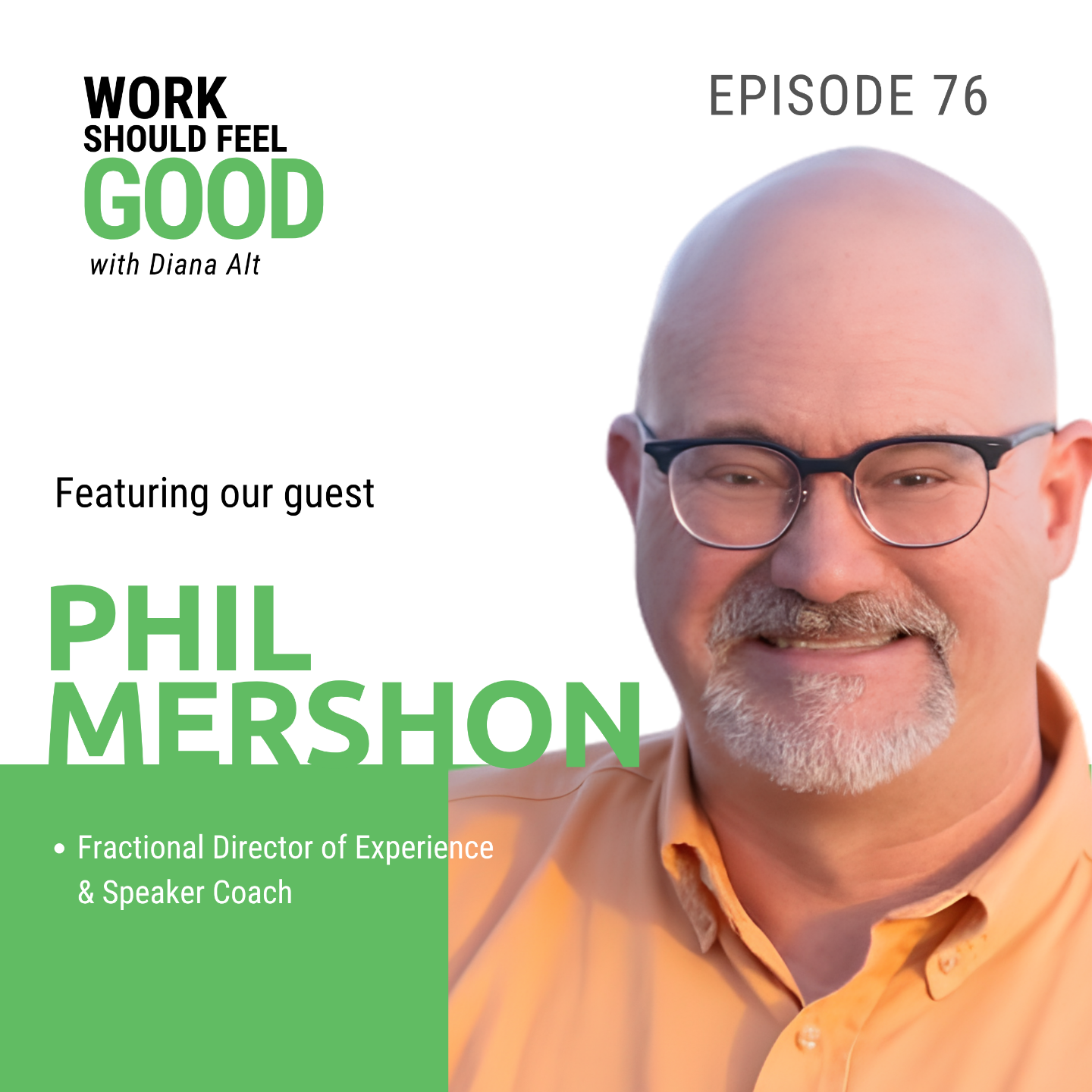
Episode 76: How to Create Unforgettable Experiences at Work with Phil Mershon
What separates an experience people simply attend from one they remember? Diana sits down with event strategist, speaker coach, musician, and author Phil Mershon to explore how memorable experiences are intentionally created.
Phil shares lessons from decades of designing events, along with practical ideas for creating belonging, making strong first impressions, supporting volunteers and speakers, and paying attention to the moments between the moments. He and Diana also explore Phil’s unconventional career journey and what it teaches us about work that actually fits who we are.
You’ll learn:
- How personalization can turn an ordinary interaction into a memorable experience
- Why first impressions, transitions, and endings deserve intentional design
- How to create belonging for newcomers without forgetting returning attendees
- What event organizers can do to create better experiences for volunteers and speakers
- Why good career advice requires understanding more than someone’s obvious skills



Episode 76: How to Create Unforgettable Experiences at Work with Phil Mershon
Episode Description
In this episode of Work Should Feel Good, Diana Alt sits down with Phil Mershon, speaker coach, musician, event strategist, and author of Unforgettable, to explore how intentional experiences can transform events, workplaces, and everyday interactions.
Phil shares lessons from his unconventional career journey and years of creating memorable events, including Social Media Marketing World. They discuss why first impressions matter, how to make people feel welcome and valued, and what event organizers, leaders, volunteers, and speakers can do to create experiences that leave a lasting impression.
Key Topics or Themes
-
How personalization, creativity, and multiple senses make experiences memorable
-
Phil's career journey from technology and ministry to music, education, and event strategy
-
Why customer experience begins long before an event starts
-
Creating belonging and connection for first-time and returning attendees
-
Designing memorable moments through anticipation, surprise, and thoughtful endings
-
Why the experiences between scheduled activities matter
-
Making volunteers feel appreciated, supported, and valued
-
How event organizers can create better experiences for speakers
-
Why clear communication and preparation make speakers easier to work with
-
Helping audiences remember meaningful ideas rather than overwhelming them with information
⏳ Timestamps
00:00 Intro and meet Phil Mershon
01:21 Creating personalized experiences through musical improvisation
07:06 How music and improv develop adaptability
09:22 Phil's unconventional career journey
13:06 Building a career through relationships and unexpected opportunities
17:01 Lessons from creating Social Media Marketing World
20:17 Designing experiences for new and returning attendees
25:52 Why first impressions begin before an event
29:25 Creating memorable moments and meaningful endings
33:40 The importance of experiences between scheduled activities
36:24 Making volunteers feel valued and appreciated
40:48 Creating a better experience for event speakers
45:02 Helping audiences remember your message
47:32 How speakers can become easier to work with
💡Take Action
🔥 Subscribe for future episodes → https://www.youtube.com/@dianaalt
📖 Grab my Resume Don’ts Guide → https://www.dianaalt.com/resumedonts
❌ Avoid these common job search mistakes → https://www.jobsearchmistakes.com
🚪 Wondering if it’s time to walk away? → https://www.isittimetowalk.com
💼 Work with me → https://www.dianaalt.com
📢 Connect with Phil Mershon
🌐 Phil Mershon → www.philmershon.com
🔗 LinkedIn → Phil Mershon on LinkedIn
📲 Follow Phil on Social Media:
Facebook → https://www.facebook.com/phil.mershon
Instagram → https://www.instagram.com/phil_mershon/
📖 Unforgettable: The Art and Science of Creating Memorable Experiences →
https://indiepubs.com/products/unforgettable-9781636981017
📲 Follow Me On Social Media
LinkedIn → https://www.linkedin.com/in/dianakalt
YouTube → https://www.youtube.com/@dianaalt
Facebook → https://www.facebook.com/dianakalt
TikTok → https://www.tiktok.com/@thedianaalt
Transcript
Diana Alt [00:00:04]:
Hey, Diane Alt here, and this is Work Should Feel Good, the podcast where your career growth meets your real life. Each week I share stories, strategies, and mindset shifts to help you build a work life that works for you on your terms. Hey there, everybody, and welcome to Work Should Feel Good, the show where your career growth meets your real life. I'm your host, Diana Alt, and today my guest, Phil Mershon, and I are going to talk about what makes some experiences unforgettable and how you can apply those ideas to your work, your leadership, and your everyday interactions. Phil has spent decades helping people create experiences that people don't just attend, they actually remember for a long time to come. He's a speaker coach, a musician, which I have seen a tiny bit of in person, event strategist, and the author of Unforgettable, a book about the art and science of creating those memorable experiences. Phil, welcome to Workship Hill Run. I'm so glad to have you.
Phil Mershon [00:01:07]:
Glad to be here, Dana. It's been a lot of— long time since we've been together. It has been a long time.
Diana Alt [00:01:11]:
We met, what, almost 2 years ago at Terry Weaver's thing event in Orlando. I had heard your name for a long time though. You're like a little bit
Diana Alt [00:01:21]:
famous among all this set of people that likes to create events. And so one of the things that I remember from when I met you is you spoke on stage. You're a musician, which we'll talk a little bit more about in a minute, but you actually were making personalized songs for people. You were asking for, you know, tell me 3 words about you, and you didn't even know a lot of the people you were doing this for and creating a little like 60 to 90 second song on the spot. How did you get into doing that and what's going through your head whenever you make up those songs for people on the spot?
Phil Mershon [00:01:58]:
So my training is partially as a jazz saxophonist. I'm never going to be the best jazz saxophonist in the world because I haven't put in the thousands and thousands of hours that, you know, whoever your favorite is— Charlie Parker, John Coltrane, someone modern— I can't be that because I don't have the time and I've got too many interests. But what I can do is respond in the moment to a situation. And that, that's the kind of song I like to write. That's the experiences that I try to create, is something in the moment that is going to be unforgettable. It may not be something you ever share again, but I've done it dozens of times for people, sometimes as a birthday wish, sometimes because I've been in a conversation and just feel like responding to it. Um, that is the only conference I think I've ever been to where I did it with multiple people during the conference where I said, hey, can I just create a moment for you? Um, I wish I did it more.
Diana Alt [00:02:56]:
Oh, why not? You should try it sometime. Um, I thought it was very interesting, and especially when I know that so much of what you have been doing professionally is trying to create things that are memorable. When I was prepping for this interview, um, I, I was like, hmm, What is the wild card? I always like to try to throw something out that isn't just on like whatever bio you sent in, because otherwise someone can just Google Phil Marchand podcast and listen to any number of them. But that was the thing that I remembered the most about you, is that you were off by where the photo background was and you were doing that for people. And I think the— one of the things I'm most passionate about right now is that adaptability is the top skill that anyone needs to develop. So you're just kind of doing it in real time for all this. It was very cool.
Phil Mershon [00:03:50]:
Yeah, and actually I forgot where it started. So I was playing a bunch of jazz gigs and I was playing at a wine bar and I had this idea, what would it be like to have everyone in the audience drink the same wine but then I play a response? And there was one time I did this. I do it always, not all, Always, but almost always at the end of a keynote speech.
Diana Alt [00:04:12]:
Okay.
Phil Mershon [00:04:12]:
I will play a response to the talk, but based on the audience's words that they give me. And many times I'll do that on a podcast. StreamYard doesn't like it when I do that.
Diana Alt [00:04:22]:
Yeah.
Phil Mershon [00:04:23]:
And I don't have my saxophone here, but maybe after the fact I could record you something. But a guy said, I love wine, but I've never heard wine. And you just helped me hear this wine. And I was like, that's what I'm trying to do. I'm trying to bring multiple senses together in a way that you're never going to forget that moment in time. And so, but it started at a bar, you know, and I was playing there and I thought, well, what if they gave me a glass of wine? Yeah, I was trying to get a free glass of wine, but there was a bigger objective of let's create an experience for people that they weren't expecting when they came here. They expected maybe some background music and to have a drink or some food, but now I've brought them into it. Now it's personalized.
Phil Mershon [00:05:10]:
And so that's really a lot of it is I'm trying to create a personal—
Diana Alt [00:05:15]:
What's going through your mind when you do that? Like when you were— I don't know how well you remember the wine example. I love this example though. What was going through your mind when you were creating that?
Phil Mershon [00:05:26]:
Well, in that particular situation, I figured out this guy's a sommelier, so I asked him to tell me some of what he was tasting.
Diana Alt [00:05:35]:
Okay.
Phil Mershon [00:05:36]:
Um, I got a little bit of the background on where the wine came from. Um, some of that just inspired words, and I responded back verbally some of what I was hearing. And then I allowed those word pictures to guide the sound. Um, sometimes I don't have that. Sometimes it's just the flavors, and I'm not a sommelier. I can't taste all the tones and notes and Whatever. But I can have a reaction. And so I do have a reaction in the moment, just like if you were to give me 3 words from this interview, those words are going to mean something, especially in the context of this conversation.
Phil Mershon [00:06:14]:
And so I'm trying to play the emotions that are evoked. And a lot of times when I just play for somebody because of a special occasion, it feels very personal because, again, I'm responding to who they are. And it's surprising to me how often people will say, I heard that in what you played.
Diana Alt [00:06:34]:
Oh, how cool.
Phil Mershon [00:06:35]:
And I'm like surprised because, you know, I'm trying to convey it and sometimes I'm— I feel like I'm more successful than others. Sometimes I'm limited by my technique, like I can't play everything that I hear because I don't practice hours a day. But yeah, it's— I love it when that reaction happens, when they smile, when they want to share it, when You know, they get, you know, a tear in their eye, or it just makes their day, or they talk about how memorable it was. That's— that gives me great satisfaction.
Diana Alt [00:07:06]:
I won't forget the experience anytime soon. I did— I found it on my phone. Like, thank God nothing happened. Thank God it was recorded on my phone. And for me, what was so interesting is it was less about, like, did I feel like Phil captured me, and more about I just think the whole idea was so cool. And I am a per— I'm like quite analytical. I read a lot. I live in my brain more than I live in my body and my emotions.
Diana Alt [00:07:37]:
And so whenever anybody can— whenever people have the ability to step outside that, it's always fascinating to me. So I actually went to an improv class this week for the I've only gone like 2 or 3 times. There's an improv company and they, they have drop-in classes downtown. Like, that is too far away for me to go regularly, but I was able to make it work. And I'm just— I'm not very good because I want to think ahead so much. So that's why I went and did it. I think it's good for anybody. Well, I think anybody can benefit from anything with music or improv at this point because it trains adaptability.
Diana Alt [00:08:18]:
So, 100% agree with that.
Phil Mershon [00:08:21]:
Yeah.
Diana Alt [00:08:21]:
Have you done improv yourself?
Phil Mershon [00:08:24]:
I've done some improv games, but I've never gone to like one of those workshops. Well, actually, no, I've been to a conference where they had an improv guy come in and do a workshop with us. I have another friend who is a Hollywood comedian, and she did that with us at a group. So, but I've never gone through a class.
Diana Alt [00:08:43]:
I haven't done a full— this is like a drop-in class, so we mostly were doing games and short scenes. But
Phil Mershon [00:08:49]:
yeah,
Diana Alt [00:08:49]:
um, I'm trying to figure out how to shoehorn actually doing like— they do like 6 or 8 week classes. I would love to. Um, so shout out to the KC Improv if you are in the Kansas City area. I highly suggest you check them out, even if it's just for a drop-in class every once in a while. So, okay, so career journey, you started Uh, you started in like music and ministry and now you're this person who is doing— no, you didn't start in music. Okay. This is— I did a bad job researching then. I'll just shut up.
Diana Alt [00:09:22]:
Where did you start?
Phil Mershon [00:09:23]:
It's not all online. I,
Diana Alt [00:09:25]:
you
Phil Mershon [00:09:25]:
know, when you've got a resume as long as I have, there's things that you leave out.
Diana Alt [00:09:31]:
Well, I highly support that as a person that helps people curate their resumes and all of that stuff when I coach job search. Yes. So I knew of you early on doing music work and ministry work. What's the actual OG? What are you willing to share with us about?
Phil Mershon [00:09:50]:
Yeah, so my first undergrad's in economics, so I had professors say, Phil, you should go into IT because you're very analytical and logical, which is true, which apparently there's a high correlation with music and logic. So, my first job was programming computers for Boeing military airlines or airplanes here in Wichita where I live. And after less than a year when they were starting— there were rumors of layoffs, I started asking myself, well, what would I do if I got laid off? And I wasn't enjoying it because I didn't like being in front of a computer 95%, 98% of the day. Yeah. That wasn't really me. And I was good at it. Like, I was in the top in my class, you know, got rewards, but I definitely was acknowledged for great work that I was doing, but I just didn't enjoy it. And so, I went to my pastor and just wanted to have a conversation and say, please take this away from me.
Phil Mershon [00:10:52]:
I think I want to come work for the church, but I know that's a crazy idea. What should I go do if I get laid off?
Diana Alt [00:10:59]:
Yeah.
Phil Mershon [00:10:59]:
Well, instead, he reaches in his desk and he pulls out a piece of paper and he gives it to me and says, read this. And I read it and I thought, he wrote this for me. And we both looked at it with that kind of sense of maybe this was meant to be, like this conversation was a turning point. So that was a— that led to an internship, which led to 4 years working with a nonprofit ministry in Colorado. Which then led to grad school in biblical counseling where I met my wife and decided to make a pivot. Went to work for Koch Industries doing corporate training primarily. Did that for 3 years. Then when they laid me off due to market changes, I went and got a music degree.
Phil Mershon [00:11:44]:
Then I was in music ministry from, you know, basically '99 until 2016, either part-time or full-time. Um, but started working with Social Media Examiner in 2010, and that became full-time within a couple years. And so did that—
Diana Alt [00:11:59]:
You're always the guy, you've had layers on layers in your career over time. And like, I, I spent 20 years in tech too. Like, I'm a little younger, I'm a little younger than you, but I came out of engineering. I went to Missouri S&T, formerly University of Missouri-Rolla. Got a chemistry degree, got a master's degree in engineering management, went into IT consulting a couple years before the tech wreck. And so I did various roles in tech for 20 years until I decided I don't want to do that anymore. And I've been coaching since then. And so I work largely with the same kind of people I used to work with, but I'm not arguing about bugs and project plans anymore, which is nice.
Diana Alt [00:12:41]:
So, um, how cool. What was, uh, and so, and now do you, so you worked for Social Media Examiner. Talk a little bit about how you wander, kind of worked your way into Social Media Examiner. And many of the people might not know that organization. So if you can give a little bit about what that is and how you got over in there and what your role was.
Phil Mershon [00:13:06]:
Sure. So Social Media Examiner is an online, um, resource, educational resource for small business marketers and owners. Started in social media marketing, that was the bread and butter for a long time, but we've now moved into AI. I say we, but I'm no longer an employee. I was an employee from 2010 until just this, this year. And now I've moved full-time into working with, as a faculty member at WSU Tech and consulting. But how I got into it is in 2007, I moved to San Diego to be part of a church. By then, I had a Master of Divinity and was a pastor.
Phil Mershon [00:13:48]:
They brought me out, but they couldn't bring me on full-time. So I had to find another job, which was business manager. Wow. So using my economics background for a small startup school, which I love startups, like that's in my blood of starting things. And so while there, Mike Stelzner, who founded Social Media Examiner, was my volunteer marketing director. And over, you know, when I got laid off from that school, when all the market downturns were happening, and, you know, you know, it happened in 2008, San Diego very hard.
Diana Alt [00:14:20]:
It was a mess.
Phil Mershon [00:14:20]:
Yeah, he, he invited me to do some part-time work for him, just some, you know, contract work. And I was glad to do it while I looked for a full-time job. Well, I didn't find a full-time job, but the work with him grew to so much by the end of 2010 that I really didn't need another job. And it just kept on growing until he eventually incorporated and hired me as an employee. So, it was relationships. Yeah. And it wasn't because I had these amazing skills in social media. It wasn't because he thought I was an events guy, although looking back on it, Of course I am.
Phil Mershon [00:14:57]:
Like, I've had this revelation this week. The business of churches— well, one primary business of churches is events.
Diana Alt [00:15:05]:
An event every single weekend.
Phil Mershon [00:15:06]:
Yeah, they're in the event business. And one of the pastors that I'm reading said that. It's like, oh, no wonder that was such a part of my formation and how I approached doing other business.
Diana Alt [00:15:19]:
You get a ton of reps at it because, like,
Phil Mershon [00:15:21]:
every
Diana Alt [00:15:21]:
week, especially if you're in a larger church that has You know, 2, 3 services a weekend, you're doing 156 events. You have repeatable processes. You have people that are not afraid to tell you if they don't like something.
Phil Mershon [00:15:37]:
That's for sure.
Diana Alt [00:15:38]:
And then you layer on the special stuff too, like what's the Christmas pageant or this, that, or the other. It's very interesting. I always grew up in small churches. Um, so That, which I feel like the smaller the church, the more people will tell you if they don't like what's going on. So it's very interesting. It's a very interesting space to be in because it's such a mix of personal and that it's your professional tied into personal and everybody coming in would say they're coming in for personal reasons. It's a very interesting soup.
Phil Mershon [00:16:12]:
I've had some very interesting confrontations. From people, and especially small startup churches who have very strong opinions about things like technology and whatnot. And so you develop a thick skin. Mm-hmm. But it is— you're producing an event, you know, you sometimes you get into autopilot, and event people do the same thing. You just start following the checklist instead of thinking about what's different about this event and how can we make this fresh and memorable. Which is a lot of why I decided to write a book, because I train people for the conference that we run, and I wanted to figure out why do people say this event's different from all the other events they go to.
Diana Alt [00:16:52]:
I'm just gonna ask you, like, again, and this will be a good segue, I think, because, um, because Social Media Marketing World, that's the name of the conference, right?
Phil Mershon [00:17:01]:
Correct.
Diana Alt [00:17:01]:
Um, I feel like there's a lot of conferences that sound a little the same, but I know tons of people that have gone to that one. And have said the same thing, but especially when you think about early on when you were working with Michael in that organization, what are some of the things that you did early that you feel like really made a mark and were different and that you're proud of?
Phil Mershon [00:17:28]:
I would say the first year, most of us didn't know a thing about what we were doing.
Diana Alt [00:17:33]:
Excellent. That's a great place to start. I
Phil Mershon [00:17:35]:
love it. Yeah. I like, I've been doing events for a very long time. By that point even. But doing a 1,000-person event is very different. When you're doing a one-time event, you're showing up at a hotel and you're transforming that hotel into another world, so to speak. I didn't even know what that meant. Like, if you'd have used those words to me, I'm like, okay, sure, we're just gonna put on an event with 5 different rooms and speakers.
Phil Mershon [00:18:01]:
And but one of the things we learned very early And I would say even the first year was customer experience is paramount.
Diana Alt [00:18:09]:
Yeah.
Phil Mershon [00:18:09]:
And so, we had training the very first year even for the staff and volunteers about how we create customer experience. And I would say in the first couple of years, we really started to fine-tune what that meant. And I'm responsible for a lot of that training that happened the first decade that has grown over time. So, I think that's one thing, and then getting volunteers involved, we call it volunteer army. Year 2, we realized our staff is too small. Like, our full-time staff was too small to run the event by ourselves. We needed volunteers. And we saw that there were people who said, hey, I'd love to come, but I can't afford the full price.
Phil Mershon [00:18:49]:
Do you have any options? And we offered that. Yeah.
Diana Alt [00:18:52]:
And,
Phil Mershon [00:18:53]:
you know, for the most part, that turned out to be a good thing. We learned some things about, you know, you have to vet the volunteers and make sure their motives are right and that they're actually going to show up and do what they said they were going to do. We got held— left holding the basket in a couple situations where someone decided their job was more important, which of course it was, but they didn't communicate with us in advance that, hey, I might get called into something and I can't do— and I had somebody in a stage manager role for our main stage who just didn't show up. It's like, uh, oh my gosh, you know, that we're not going to have that happen again. So we, we ended up hiring someone to do that because we wanted someone who we knew was going to be there and we could rely on them. So, I think the customer service, thinking through that customer journey is something that we learned over time. But community was a big thing too, like building community before, during, and after. And I think we had an advantage because people were in social media and they wanted to connect in person.
Phil Mershon [00:19:55]:
They were online. They were already connected online, but we found over time that half the people never go into any of the social media things that we have online. They just show up. And then 60% can be new people. So you're having to constantly create a new community and people who are part of it love it. There's people who've been all 13 years.
Diana Alt [00:20:17]:
Don't you have to think about it a little like, okay, I'm not a huge Disney person, but I hang out with a lot of people that are, like Terry. And the thing that I actually find the customer experience side and business side, I will read Disney books all day. I don't necessarily want to spend tons of time in the park or whatever. But when they talk about we're not designing a show or a ride or whatever for the person coming the first time, we have to design it for the person coming the 50th time. Did, did you have that mindset as well when you're putting on events like Social Media Marketing World because you have such a mix of new and old?
Phil Mershon [00:20:57]:
I'm definitely thinking about both. Audiences. We don't have a 50th time, but it's definitely— you're thinking about the repeat and the first person. I probably emphasize the new person more just because you want to get that barrier down as quickly as possible. But you acknowledge, like, you're creating lots of opportunities for those who are returning to create experiences with you and to lead others. Like, we Created a program called Welcome Ambassadors, who— that's for people coming with a ticket who have great hospitality gifts. And we just say, hey, come and help others feel the same welcome that you felt, and welcome them into the community, introduce them to a couple of people. Um, you know, we'll give you a, a free lunch.
Phil Mershon [00:21:46]:
It's not a big deal.
Diana Alt [00:21:48]:
But it's what people will do for a free lunch.
Phil Mershon [00:21:51]:
Well, and it's because they remember that feeling. They know what it felt like to be overwhelmed when they first arrived and what it felt like to have someone take interest in them and quickly feel like that they belonged. And so if you do that, and I think Disney definitely thinks about the experience, you walk in the gate, the first thing you see is the castle. Yeah. They're building anticipation. They're creating those surprise and delight moments with Goofy or Mickey or whoever they've got there. Different ways of finding out what you like and creating that experience because Johnny's birthday is now or whatever. They're looking for those and they're using technology to make those experiences.
Phil Mershon [00:22:30]:
And so, we do it without technology for the most part, but trying to create a very human experience that is beyond the normal. Every event has many of the same elements. One of the things I talk about in the book is there's 4 basic ingredients in a loaf of bread, um, you know, water, yeast, flour, and salt. And but the way you put them together can create very different kinds of loaves depending on the oven, depending on the skill. That's true with events. Like, events have pretty much the same elements in them. You have speakers, you have networking, you have a registration desk, you've got a venue that you're going to, etc. But the way you put those together creates very different experiences, and some of them feel bland and some of them are memorable.
Diana Alt [00:23:20]:
And so I have a really funny— I have an interesting— number one, like, not every conference has speakers. Like, talk to Vince about that.
Phil Mershon [00:23:29]:
That's true.
Diana Alt [00:23:29]:
His event is one of the best events I've ever been to. It's just magic. It's the entire conference's margins. But I had a really interesting experience a couple of years ago. It might have been the same year that you and I met, where I was going to Florida for the thing. And then I had a new client that I was working with who actually was speaking at a conference also in Orlando that same week. And I had a day off, which was the exact day he was speaking. There was another gentleman that was coming to the thing with me was interested in L&D, which is what the other conference was about.
Diana Alt [00:24:10]:
So I brought him along. So we have this guy that is kind of new to going to conferences that gets to go to 2 things, and they couldn't be more different because the L&D conference was a wonderful event. But there's a lot of death by PowerPoint and people with too small of words on the slides, and it just feels like a traditional, more corporate thing. And then you walk into Terry's event and there's like this saxophone guy and like books being read and like Legos everywhere and stuff like that. And both amazing events, not too different in number of people. I think the L&D one was a little bit larger, but it wasn't like it was hundreds and hundreds of people. And it was kind of funny to watch my friend Andy, it was his name, just whip. It was almost like whiplash between the two things.
Diana Alt [00:24:56]:
So pretty cool. What do you feel? So you met, you mentioned, you know, customer experience is everything. What do you think are the top hallmarks that are the most important for people to get right whenever they think about the customer or the— I'm gonna talk specifically about attendee because I think there's also experience for volunteers and things like that. But when you think about attendees, What do you think are the couple of most important things that people need to get right? And then also, maybe what's one of the most interesting surprises that you've either put on yourself or seen at an event that was just like that extra cherry on top for attendees?
Phil Mershon [00:25:45]:
Well, let me start with the first one and see if I can get the second one going in the back of
Diana Alt [00:25:51]:
my brain.
Phil Mershon [00:25:52]:
Yeah. So there's a lot of things, but first impressions obviously are huge. And I think one of the things many events forget about is that starts at the moment that they buy their ticket.
Diana Alt [00:26:07]:
Yeah.
Phil Mershon [00:26:07]:
So there's a sense of anticipation that develops when you buy your ticket that most events say thank you and they send a receipt and then you don't hear from them again until 2 days before, and you get this long email with 1,000 pieces of information that overwhelms you. They send you into a mobile app that's just not obvious.
Diana Alt [00:26:32]:
Mobile app.
Phil Mershon [00:26:33]:
So you show up feeling disoriented, and even then, like, you're just a number. So I think the first impression from when you sign up, but even if you don't get that part right, Make sure you prepare people in the last week or 2. Like, if I sign up 9 weeks in or 9 months in advance, I'm not actually caring.
Diana Alt [00:26:54]:
I don't remember anything. I just need to know, like, what the day is and when do I have to fly in.
Phil Mershon [00:27:00]:
Make me at least feel good about the decision I made.
Diana Alt [00:27:03]:
Yeah.
Phil Mershon [00:27:03]:
And then I'm not expecting to hear from you until, you know, a month before or something like that. We actually start 2 months before, just slowly helping you prepare. But, you know, do that. So number one, make them prepared before they show up. Even if you miss some of them, which you will, because some people don't read their emails until they feel like they have to, like it goes into a folder or they start ignoring it if there's too many of them. Then when they step on ground, and that could be when they check into a hotel, if you've got official hotels, or, you know, in the case of The Thing, everything's in the hotel. Let them feel welcome from the moment they arrive. Are there signs? Like, many events miss the opportunity of making people feel like, hey, you're in the right place.
Phil Mershon [00:27:53]:
We're so glad you're here. Yeah. Make it easy to find where you're supposed to check in. One of the biggest drop-offs is after registration, you get your badge, you know, then you try to figure out, what do I do now? It can be the most awkward moment I've found, especially at larger events. Like, there's no one around to tell you what to do. You're trying to figure it out. And I'm an introvert. You may or may not know that.
Phil Mershon [00:28:19]:
And so that is a very awkward moment for me if I don't already know people. Now, if I know people there—
Diana Alt [00:28:24]:
And the larger the event, the more likely it is you'll get lost.
Phil Mershon [00:28:29]:
Yeah. If I've done my work right as an event planner and helped people connect before they come and they already have plans to meet somebody, That barrier of awkwardness and fear drops. Having people there that their job is to help people feel welcome in that moment. You know, I did an analysis on a symphony a couple of years ago, and the difference of the personnel, the volunteers who were there greeting, was profound. If somebody had a smile and made you feel glad that you were there, it got you excited. If somebody had a, you know, a sad face or they just handed you the program and You know, were like, looked like they wanted to be somewhere else, or worse, they're on their phone. So, first impressions are one of the biggest things for me. The next one is paying attention to when are those key moments that you want people to remember.
Phil Mershon [00:29:25]:
So, there's usually some high points, and usually they're first things or it's the end of the event. So, it could be your first keynote. It could be the first time that everybody's together for a networking event. First things matter a lot, and you want to notice where are people all together with heightened experience. With that, you're looking at the energy flow, like the customer journey within the event. Where are people going? When is their energy likely to lag? And you can look at circadian rhythms.
Diana Alt [00:29:57]:
Yeah.
Phil Mershon [00:29:57]:
Yeah, you can know that after lunch, people are probably going to want a nap. Or at least they're going to be lower. Well, how do you counteract that? How do you bring a surprise in that moment, something that's going to help them? The other moment that I think— I am guilty of this too, because it's one of those things that gets left to the end, and it's the end of the conference. Like, one of the other awkward moments is when people get to the end and it's like, OK, we're done.
Diana Alt [00:30:27]:
I think we got a lot we can learn from Jesse Cole.
Phil Mershon [00:30:31]:
Jesse's great at that.
Diana Alt [00:30:33]:
So for those of you who aren't familiar with who Jesse Cole is, he is— he and his wife founded the Savannah Bananas. And I've had the opportunity— have you gone to a Bananas game yet?
Phil Mershon [00:30:43]:
I have. I've interviewed him. He endorsed my book.
Diana Alt [00:30:47]:
Okay. He
Phil Mershon [00:30:49]:
learned from us.
Diana Alt [00:30:49]:
Okay. Well, I feel silly because I forgot that he endorsed your book, but I've gone— I've just gone to the game twice, and I've gotten to talk— I got to talk to Emily pretty extensively the second time I went to a game. But after the game is over, there's a whole experience outside the stadium where their band is playing and they're getting people to basically sing songs and hang out and get autographs and get pictures with whoever the mascot is. And then at the very end, there's a very clear closure ritual that I'm not going to give away because I want people to experience it for themselves. But, you know, it's time to go home at the end of that. And it's maybe, I don't know, like half hour, 40 minutes. It's not a long, long time. It's long enough that it feels really good.
Diana Alt [00:31:39]:
It doesn't feel rushed, but it doesn't feel like you're there forever. And, you know, more, more of how could we do our version of that could be really beneficial for a lot of events. So.
Phil Mershon [00:31:50]:
Yeah, he's— so I've learned from him for sure, and he's learned from me, but I've probably learned more from him. He's really good. Moment you sign up, they're sending an email to you with a video. Hey, we're excited. They used to do personalized phone calls in the early days, but now they have to send a video that's more standardized. From that moment, they're sending you playlists. They're telling you what to do at parking. Before the gates ever open, they've got a line and the band and players are working the line.
Phil Mershon [00:32:20]:
There's a DJ out there. I've been to 3 games, 2 in Savannah and 1 in Kansas City. And so there's this whole pre-show. They welcome you in and they know the show starts as soon as you walk in.
Diana Alt [00:32:33]:
Yes.
Phil Mershon [00:32:33]:
So they've got stuff happening the game before the game, you might call it that. So they've choreographed every moment. And like you said, all the way up to the closing song, they've got different songs through the event. So they're very much paying attention to that flow. It's why it's entertainment as opposed to baseball. Um, but they're— they want that fan experience to be something that people remember.
Diana Alt [00:32:58]:
Yeah, that's why they're sold out. And you— and what's so interesting about this is you don't have to do— I mean, clearly when you have 70,000 people that are in some like D1 SEC football stadium for the Savannah— for a banana ball game, like you're gonna There's a lot going on there. But if you have an event with 50 people, you can still create your version of that, which I think is very cool. So what is, what is one of the coolest things you've seen at like not a Bananas game, but maybe— I
Phil Mershon [00:33:29]:
was gonna say, that's the best is a Bananas game.
Diana Alt [00:33:33]:
Yeah. We're not all throwing Bananas games or getting to go to Bananas games though. So. You
Phil Mershon [00:33:40]:
know, I think They did this at Inbound one year when Hamilton first came out. They had a trio come and they did a song from Hamilton at the beginning of the event because that was their— that was cool. But even cooler, because they're in Boston, they brought some students and professors from Berkeley. Oh, cool. And they had a string ensemble out in the lobby as people were moving from one event to to the other. So they thought about the experience between the experiences. And that's, you know, I think that's an important thing is what are we doing in the seams? I call it the brick and mortar. Um, the bricks are the, the, you know, the scheduled things, but the mortar is what's happening in between.
Phil Mershon [00:34:23]:
Are you thinking about how it's all connected into one story? Many times it's not. Many times, like, okay, the session's over, now it's dead time. What am I doing in the dead time? You know, and I don't know, it can feel awkward. Now my energy sags, now I've got to build it back up. But you've got little, little things going on there that could be a surprise and delight. We, uh, we brought a show choir in this past year. Oh, wow. A friend of mine and her partner lead one of the top, uh, show choirs in the country, teen show choirs, but they are award-winning.
Phil Mershon [00:34:54]:
And she said, hey, could we bring them to your show? It was too late to work them into the main stage, um, so I said, well, what about them being in the lobby? And we worked it out and it was so good the first time they did it that we said, we want you to do it after the keynote too because people missed it and we need to see you. Yeah. And so, we literally had hundreds of people before their next session go out and watch this 7-minute little presentation. It was just like a nice little moment that nobody expected and it brightened the day. So I think
Diana Alt [00:35:28]:
I love that, especially as a former show choir kid. I would have gotten a kick out of doing that when I was in high school. One of my favorite things that I've seen, which Vince actually does at the uncon— I can't remember. Have you gone to the unconference?
Phil Mershon [00:35:41]:
I was supposed to go this last year, but something came up. I couldn't.
Diana Alt [00:35:45]:
Yeah, well, he does mystery dinners. Yeah. So he will— which I've— I love the idea. I'd never been to an event that did one, but basically the first year was a little clumsier, but he got it. The second year it was more organized. And basically there was just this table that had envelopes, and the color of your envelope was your group of people so you could easily find them. And they had asked people like, what cuisine do you like? Or do you have any allergies? Or like, what limitations do you have? And then assigned people to groups, made reservations, and you just met in the hotel lobby. Here's your 7 best friends now for dinner tonight, whether you'd talked to them before or not.
Diana Alt [00:36:24]:
It's just a really nice way to do it because I like that because of the randomness, but also it's very easy when you're new to an event and don't know a lot of people too. There are people who do slip through the cracks and don't have anybody to have lunch or dinner with. So I love that too. Now let's talk a little bit about next. I want to hit like, is there what else on top of that should we keep in mind for volunteers that are assisting us with the event, especially ones that are mostly like a day-of volunteer? They're not necessarily— necessarily, you know, fully embedded for a long period of time with an event team.
Phil Mershon [00:37:01]:
Yeah, and that's most of the volunteers that I've worked with is they show up, you know, we give them half a day of training before they start. We ask them to spend an hour or 2 before they ever show up just reviewing some materials so they understand what their job is. Some of them need to spend more time than that because it may be a more complicated job. Again, do you start with appreciation? Do you make them feel really welcome and glad? Is it clear and easy for them to engage in their role? Have you picked the right role for them? That can be the worst thing in the world is to be a volunteer, but you're being asked to be frontward-facing and you really don't want to see people. So, knowing that stuff, but I think valuing them and what they have come for. So get to know why, why are they volunteering in the first place? Some people just love volunteering. Some people want to be close to the staff. We found there's some people that have a motivation that they want to be with the speakers for their own reason.
Phil Mershon [00:38:03]:
And, you know, that ends up being a bad fit because they end up doing things that are off-brand for us. Um, but yeah, making them feel appreciated and giving them opportunity for growth themselves, like they've given their time In our case, they're paying for their travel. We give them a free ticket and we feed them, but they've got to get there and put themselves in the hotel. And so, and that's true for most events in terms of volunteers. If you have paid staff and you have volunteers, paid staff you treat differently. So, make sure that the investment that they're making has been worth it. Yeah. Otherwise, they're not going to come back.
Phil Mershon [00:38:42]:
Otherwise, they're not going to tell their friends. Hey, you should volunteer for this event. It's different than any event that I've ever been to. They actually reward you and acknowledge your talent, your abilities. We have people— we had a guy who owns a $10 million business. He's consulted many 8-figure businesses. And for 7 or 8 years, he came and he was just a greeter. I love that.
Phil Mershon [00:39:08]:
And nobody knew who he was. And he loved it because he didn't want to be known. He just loved being able to come in and be with people. And he was introducing famous people like Guy Kawasaki, who had no idea who this guy was, and he didn't care. Like, you know, he watched to see what people's true colors were, you know, because some speakers would treat them like dirt. And if they had known who he was, they might not have done that. But,
Diana Alt [00:39:32]:
you
Phil Mershon [00:39:33]:
know, he liked that experience. So, some people like to do that. They want to be anonymous. We have a guy from Suriname who comes every year and he says— and he runs the largest digital marketing agency in Suriname, but he comes to the event and says, I want to just work. I don't want responsibility. This is like my vacation to be able to come and just make something happen that I don't have to own at the end of the day. Nobody's reporting to me. I'm not having to feed somebody.
Phil Mershon [00:40:04]:
So you got those kind of people and then you got people who've come because they actually want to learn this stuff, but they can't afford to be there. And then you got students who have a different reason that they're volunteering. So I think when it comes to volunteers, you need to know why are they there? What are they hoping to get out of it? How do you care for them as humans? What are their expectations? Like being clear, hey, you know, we would— we'd like you to work 20 hours in exchange for the ticket that we're giving you. So be clear about that. And then Keep it to that. If you need them to do more, ask them before you do it.
Diana Alt [00:40:39]:
Yes.
Phil Mershon [00:40:39]:
Um, because they need to choose, you know, some people will, some people won't, and you've gotta be okay with whatever they choose.
Diana Alt [00:40:48]:
There are a lot of people that have been very burned by volunteering and, you know, I tend to prefer smaller events. Like I hear so much very good about some events like Social Media Marketing World that have people in the thousands and I'm like, ugh, I like people in the dozens. But, um, there's so much, so many people that you might tap into because they like to volunteer, but they've been burned because they were told 20 hours and they weren't— it became 40. Or they said, all I really want is to make sure I can see this speaker and go to this session, and then it's not respected. It's wild stuff. So what about, uh, speakers? So I want to first talk about what do you do for the speakers to make their experience great. And then I want to talk about the reverse in a little bit, but let's first talk about what you're doing to make it a compelling story, a compelling event for speakers to come to and make their experience great.
Phil Mershon [00:41:48]:
Yeah, you want to make it easy as possible, you know, clear communication. They understand what's needed, what's expected of them. I like to say white glove. So, you want to go above and beyond in answering their questions quickly, clearly, working with them. Some people are going to ask dozens of questions and send you lots of emails. Others, you'll never hear from. Yeah. We'll talk about those in a minute.
Phil Mershon [00:42:15]:
Those are a different kind of challenge. But I think clear communication, above and beyond type of service, like if you can get to know who they are and personalize it. A 50-person event, you can do that way better than a 2,000 or 10,000-person event, but they're all people. And so you right-size the team, make sure whoever's responsible has the capacity and is good at that kind of thing. They need to be both detail-oriented because there's a lot of details with speaking, but they also need to have great, you know, communication and human skills. Um, I think If you're paying them, it does look somewhat different than if they're volunteering their time. Um, but
Diana Alt [00:42:56]:
yes,
Phil Mershon [00:42:57]:
but in either case, they are bringing something valuable to the event. So help them understand the value that they're bringing and how you appreciate the value that they're bringing to the event and how that fits in. And, you know, if you've got professional MCs, which I've over time grown to, and we can talk about that if if you want to, you know, understand the resources that are available to you. One of the things we started doing in recent years is offering them coaching because some people are younger in their career as a speaker. Other people just want to make sure they nail it for this specific audience. And it could just be as simple as a 30-minute call to make sure they know who the audience is, because that's, you know, you know, as a speaker, sometimes if you don't understand the audience and you give the wrong talk, It could bomb, right? Not in the good way. It won't be the bomb. It'll bomb.
Phil Mershon [00:43:50]:
And so we try to like—
Diana Alt [00:43:52]:
what's really interesting too, I love that you offer the speaker coaching aspect because something that I've been in the rooms where it gets talked about, and I did this even before I started helping Terry with some of the cat herding is what I I call— I dub myself the speaker concierge. That's the vibe, not the administrative assistant, but like trying to do a white glove, um, to the degree that we can. But what was really interesting is talking about people that had been on the stage over time because I'm in his mastermind and who may have gotten the biggest claps and applause. But we can't remember a single relevant thing that they taught. You know, because sometimes it's like great and you're emotional and hyped up in the moment and you want both. You want the audience to love, to love your speakers and you want people to remember something that they can grab onto because that benefits the event and the speaker. So I love that you offer coaching because I'm sure it helps a lot with that. So.
Diana Alt [00:45:01]:
Very good.
Phil Mershon [00:45:02]:
Yeah, I think a lot of us as speakers, and I've done it, you know, we try to say everything that we know, and if you try to say everything, you say nothing. So helping people to realize what is the core of their message, how do you pace it in a way that it will be memorable. You know, when you've been to an event where you're— people hear 15 sessions, um, how does your session land with them? They're not going to remember your 3 main points. Hopefully they remember one.
Diana Alt [00:45:29]:
One.
Phil Mershon [00:45:30]:
Yeah. And that's what I encourage people with, is find one thing. And if I give 5 and you pick one of them, awesome. I can't predict which one you're going to land on, but hopefully you walk away with one and I've done something that gives you a mental hanger that's going to be able to stick with you when you leave the event. And certainly the emotion that you've tried to create helps with that. The more senses that you involve, even if you can't get them tasting, you can talk about something that gets all those things going. So, yeah, I think it's important. If it's a professional speaker, I don't necessarily assume I need to work on that, but you'd be surprised that not all speakers who are professionals are effective in that way.
Phil Mershon [00:46:19]:
They may look great, sound great on stage, but it may not be memorable.
Diana Alt [00:46:22]:
They also may be— it may be the first time they're doing a talk. So they could have something in their back pocket they've done 25 times, but for whatever reason, yours is the first time they're doing a newer keynote to that audience. So everybody's growing in that. Okay, let's flip. So I speak some, like, I, you know, I don't make it the major part of my business. And for a few years, my health limited how much I could speak, but I'm doing a little more now. But I did have a mentor of mine, Kim, a few years ago that said— she's— she is a keynote for 20 years, wonderful speaker. She heard me speak at a conference that we met at in a breakout session, and she and I hit it off.
Diana Alt [00:47:05]:
And she said, you're a really good speaker. If you want to pursue this, though, I got to tell you, the most important thing is for you to be easy to work with. Not a doormat, but easy to work with. So for people that want to be the speaker that provides the amazing experience to the event staff that actually selected them, what are the top things they should do?
Phil Mershon [00:47:32]:
Again, be responsive to any email or communication that comes your way. That is one of the best things that you can do if they've asked you for something. Get it to them on time or let them know what to expect if something has changed. You know, some speakers' sessions have to change even up to the last minute because what they're talking about, if it's AI or social media, things are changing daily. They may need to change it, but stay in communication. So communication is number one. Be a student of the event and understand ways that you can come support it. So, you want to be that ally for the event planner.
Phil Mershon [00:48:13]:
It's not just the company president, although you want that. In our case, Mike Stilzer might have asked you, but you're not working with Mike prior to the event.
Diana Alt [00:48:22]:
Right. You're working with the speaker leader. Yeah.
Phil Mershon [00:48:24]:
Yeah. Whoever's the speaker leader, the team, you're working with them. So, get to know them. How can you be their best friend and ally? Do your research if you can. I know some people are speaking 50 times a year. A little harder, but AI can help you, your assistant can help you. Try to get to know who they are. And then, yeah, be very easy to work with when you're on site.
Phil Mershon [00:48:49]:
Don't be resistant. Don't be overly demanding. Try to be clear on what you need ahead of time. I don't love when people give me a rider where it expels out 1,000 things that they need. But something that says, hey, these are the things that I need, makes it a lot easier for the AV team to say, make sure they have what you need when you get there. It's terrible to have an expectation that they're going to have something for you, and then you get there and it all of a sudden throws you off because they didn't have this.
Diana Alt [00:49:22]:
Yeah,
Phil Mershon [00:49:22]:
I'm in a different studio, right?
Diana Alt [00:49:24]:
Yeah. One of the things that I worked with Terry and Ryan on was Like I have it, you know, we invite the people and they confirm and then we have like the full intake that's like, okay, this is, you know, what's your bio, what's your headshot, like all that kind of stuff. Tell us what your go and do is because we usually know, but we want to make sure that we're planning the session blocks right. And then we say this is exactly the equipment we have.
Phil Mershon [00:49:50]:
Mm-hmm.
Diana Alt [00:49:50]:
Standard. If you need something else, tell us and we'll let you know. if we can accommodate, because we'd had some— we didn't do that before and then had some really interesting things to try to figure out on the fly. So I love that suggestion. Yeah, but trying to be easy, my philosophy as a speaker has always been that I try to be as simple as possible. So I deliberately, like every deck I have, if I'm using PowerPoint, I have a version that has You know, whatever animations, and I don't mean like fancy, but even just like bullet points bringing up one at a time instead of all the whole page. I have one with no animations and one with animations just because you never know what the heck is going to happen. And that way we can switch it out.
Diana Alt [00:50:36]:
It's little things like that. Another thing I would add for speakers having sat in the seat now is, to your point, like Michael Stelzner might have invited you. But there's another person likely that you're going to do the logistics with. Don't treat that person like they're less than, you know, my dad raised me that if you want to get into the CEO's office, being mean to the executive assistant is not the way to do it. So have an understanding because I had a couple of people that treated me very poorly in the event that I just helped Terry with in June.
Phil Mershon [00:51:15]:
Hmm.
Diana Alt [00:51:15]:
And I don't know that they'll be back anytime soon. Um, including, you know, it's like, well, I just figured I'd coordinate with Terry. I'm like, Terry literally sent you an email that said, don't do that. So, um, but it was really difficult. But you can't, you don't, you don't ever know. But from a very pragmatic perspective, you don't know where the power structure sits. You know, you might think that the CEO or the event host or whatever you want to call them, you might want to think all the power sits there, but they listen to their team. If they're going to be running good events.
Diana Alt [00:51:48]:
So, um, yeah, that's kind of, kind of my take on it.
Phil Mershon [00:51:53]:
Yeah, if you've got special things that you do, um, in addition to communicating what those are in advance, sometimes you just need to bring your own equipment. So if you've got a certain kind of clicker that you need,
Diana Alt [00:52:06]:
that's a really
Phil Mershon [00:52:07]:
great— most of the professional speakers I know travel with their own because they don't want to assume And that's probably the big word, don't assume. Don't assume. And where it's gotten me on both sides of the table is when I know the person pretty well, then you start making assumptions that they are— of course they know that I need this, or they've assumed, of course, you know, Phil knows that I need this. Then all of a sudden you're a day before and realize, oh, you need that? We don't have the capability of doing that. So how are we, you know, now we're in a pickle because you told me last minute and, you know, the AV team's in a different city. They don't have access to all their equipment. They're not gonna go out and buy what you needed. So if you can bring it with you because, you know, this is, I always need this kind of dongle.
Phil Mershon [00:52:57]:
I know I need this. You know, some speakers travel with their own headset because they know it's designed for them. Um, whatever. If you've learned you need something, if you're new as a speaker, you don't know those things, and that's fine. Just be okay with what they have at that point. But if you can anticipate and communicate in advance, um, it will help you a ton. There's one more thing I want to say.
Diana Alt [00:53:23]:
Go ahead, please.
Phil Mershon [00:53:24]:
If you can stay for the entire event,
Diana Alt [00:53:28]:
yes,
Phil Mershon [00:53:28]:
don't drop in, do your talk, and leave. Like, there are places if your name's Malcolm Gladwell, if you're a president of the United States, then you're different. Fine. We understand you don't want the crowds mobbing you, but if you're like us going to an event, be there as long as you can. I always say at least a day. Invest a day in the event. If you can, come as early and as late as you can. I understand that's not always possible, but you want to invest.
Phil Mershon [00:54:00]:
That makes the event better. For the event planner, because you are one of the attractions. You're one of the reasons that they signed up and paid their money to come. And if they don't get to talk to you, they feel like they got cheated. It wasn't just for your 45 minutes.
Diana Alt [00:54:13]:
And especially trying to stay after, because a lot of people don't even, you know, they might have read a paragraph about you in a program, but they don't really know they wanna talk to you most of the time until they see you on the stage. So if you have to err between, you know, if you, if you are a 10 AM speaker and you fly in and you don't get there till 10 o'clock the night before, you're not at the prior day of the conference. Like, don't leave, don't leave till 6 o'clock that night. Leave the next morning if you can. I love that perspective as well, because there's been speakers that I was like, I wanted to talk to and they had to run out and it happens. But
Phil Mershon [00:54:54]:
yeah,
Diana Alt [00:54:54]:
when I'm attending, I, I like to engage with people. I want to talk to them and I want to talk to them about what they talked about. So I love that suggestion. So before, um, we close, we could have talked for like 3 hours. I have really enjoyed this. Um, especially I'm speaking at an event on Wednesday and I also am in the middle of planning my very first, very small event. Maybe we can riff on that for a couple of minutes after we're done. But I would love to know, you know, most the people, most of them listening to this, to this show, to this podcast, they will probably have gone to at least one conference in the last year or so.
Diana Alt [00:55:35]:
Some of them will be on stage, whether it's a live or in-person or virtual stage. But they're not planning conferences, most of them. They're going to listen to your podcast, not my podcast, if they're event planners. What are a couple of things you think people can just take into their professional life that create a better experience of working with the individual? What are the top couple things? Is it communication? Is it something else?
Phil Mershon [00:56:05]:
When you say working with the individual, I mean, just
Diana Alt [00:56:08]:
as if you— if I'm just a human Diana that doesn't do events and I want to create a better experience of working with me day to day, even if I sit in a cube farm as a project manager, what are some of the things I can learn from the experience, the customer, the client experience or customer experience things that you're an expert in that I can just make being around me a better experience?
Phil Mershon [00:56:34]:
That's a really great question. I think communication for sure, like letting people know when you're available, being clear what you're looking for. If you're running a meeting, you know, respect people to have an agenda and keep it moving on time. Don't let it be meandering and making people feel like, you know, they didn't accomplish anything or it was a waste. I think that is a way that you respect people for sure.
Diana Alt [00:57:05]:
That's a really good angle. That's how I should have asked the question. Like, hey, we all— we might not be going to events, but we schedule meetings all the time in our Life. So you're saying be clear, have an agenda, respect the time, be caring to the people that are there, but you don't have to be a doormat. One of the, one of the things that I think gets really mistaken sometimes is flexible, adaptable, work with the people. Sometimes people think, oh, I have to do whatever they want. No, you have to be clear about what is needed for the goal. So.
Diana Alt [00:57:41]:
Thank you so much for that.
Phil Mershon [00:57:42]:
Yeah. And have you thought about who's in the room? Just like at an event, if you're putting on a meeting, do you know the people who are coming? I've been in meetings where there was a vice president at Koch Industries, which is a large— he's a very successful guy. He was going to be in the room. You design the meeting a different way if you know who's in the room. I made a proposal when I was out there not understanding the power of the people that were going to be there.
Diana Alt [00:58:09]:
That's tough.
Phil Mershon [00:58:10]:
And within the first 3 to 5 minutes, I realized I had completely missed the audience. And I was going through the motions after that because they'd already decided my idea was terrible. And no one had advised me, but I could have done my research to say, who's going to be here and what do they care about? So I think that's the same thing you do at an event. You try to do it at scale. So now you've got groups of people that you're trying to Address their needs as opposed to individuals.
Diana Alt [00:58:39]:
Yeah, it can apply when you have 5 people on a 45-minute Zoom call to talk about the project status. One thing I would add is specifically if you're trying to create a good experience for meetings at work, uh, like small meetings, not, you know, the sales kickoff or whatever, is tell people what decisions need to get made. In advance, because that'll help prime their brain. We're not necessarily trying to make decisions the same way at a social media conference or, you know, leadership conference. But I love that. Okay. I have a question that I ask everybody. And you've had a wild enough career, I feel like your answer may be really good.
Diana Alt [00:59:23]:
So what is the worst piece of career advice you've ever received?
Phil Mershon [00:59:29]:
Go into IT.
Diana Alt [00:59:32]:
Why was it bad? Why was that bad advice for you?
Phil Mershon [00:59:36]:
Well, so it was 2 professors in college, and they didn't say IT, they said computer programming, who knew I was— they knew part of me, they didn't know the whole me. So they said, Phil, you're really logical, you're quiet. They didn't know when I was quiet and when I Actually came to life.
Diana Alt [00:59:56]:
Yeah.
Phil Mershon [00:59:57]:
And so, they didn't know the full me. So, it wasn't necessarily terrible advice, but it was incomplete. So, if you're going to offer career advice to someone, get to know who the person is.
Diana Alt [01:00:09]:
Yeah.
Phil Mershon [01:00:10]:
You're never going to get to know somebody fully, but it was like 10 years later that an outplacement consultant said, Phil, you've been in the wrong field for the last 10 years. How did you ever survive? You're the most creative person that I've ever had in my office. What in the world were you doing? I was like, really? That's who I am? And I had
Diana Alt [01:00:31]:
no idea. I think a really interesting thing, like something I've said to people a lot lately is don't let people who don't know you tell you who you are.
Phil Mershon [01:00:40]:
Yeah.
Diana Alt [01:00:41]:
Like they can give insight to you because they might see a glimmer, but they can't— you don't let other people tell you who you are. So, this was wonderful, Phil. Thank you so much. It was a long time coming. We've scheduled this a couple of times and life has intervened, but I appreciate your perspective on this. And I hope I get to actually see you in person again sometime really soon. All right, everybody, that is it for this time. We'll see you next time on Work Should Feel Good.
Diana Alt [01:01:09]:
Want some more career goodness between episodes? Head on over to dianaalt.com and smash the big green Let's Connect button to sign up for my newsletter. Let's make work feel good together. Hey, Diana Alld here, and this is Work Should Feel Good, the podcast where your career growth meets your real life. Each week I share stories, strategies, and mindset shifts to help you build a work life that works for you on your terms.