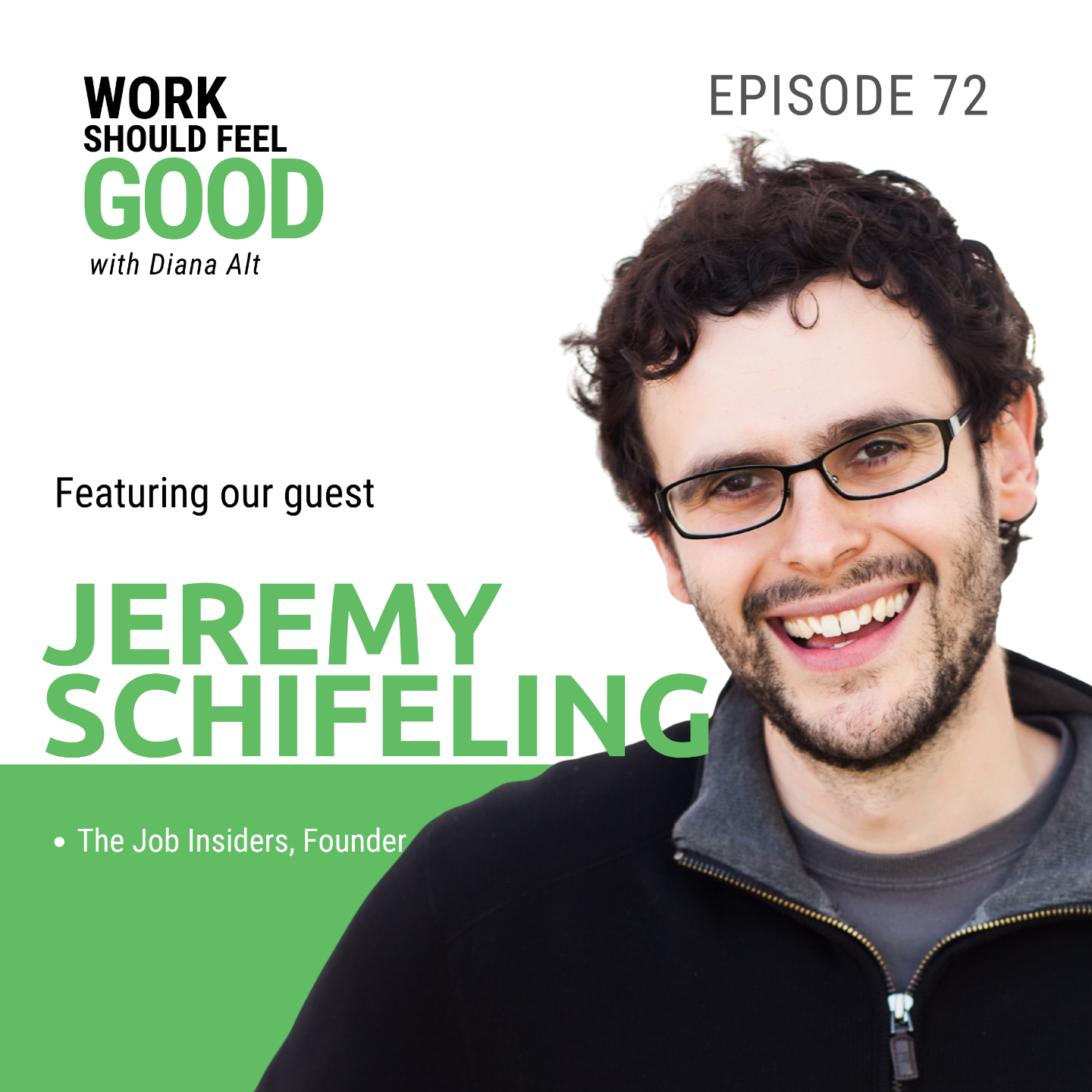
Work Should Feel Good with Diana Alt
Episode 72: How to AI-Proof Your Job Search and Career with Jeremy Schifeling
AI has changed how people apply for jobs, how employers evaluate candidates, and even which skills are scarce. But Jeremy Schifeling argues that the best response isn’t to use more AI to blast out more applications, it’s to understand the humans on the other side of the hiring process.
Diana and Jeremy dig into referrals, resumes, career pivots, human skills, and what it means to build an “unbreakable” career when nobody can predict exactly what the labor market will value next.
You’ll learn:
- Why empathy may be one of the most valuable skills in an AI-driven workplace
- What a strong referral actually means—and why not all referrals are equal
- How to make your resume easier for recruiters and hiring managers to trust
- Why using AI to mass-produce applications can work against you
- How to think about future-proofing your career when valuable skills keep changing



Episode 72: How to AI-Proof Your Job Search and Career with Jeremy Schifeling
Episode Description
AI is changing how companies hire, but trying to beat AI with more AI isn’t the answer. Diana talks with Jeremy Schifeling, founder of The Job Insiders and author of Unbreakable, about the human skills that matter most, how to build trust in your job search, and how to use AI without losing what makes you valuable.
- Why human skills matter more in the age of AI
- How referrals build trust in a job search
- Creating a high-trust resume
- What job seekers get wrong about AI
- How recruiters, sourcers, and hiring managers evaluate candidates
- Using AI to strengthen your career instead of automating your job search
⏳ Timestamps
00:00 Intro and meet Jeremy Schifeling
07:11 From education to marketing and tech
16:37 The skills becoming more valuable because of AI
22:56 Empathy and human connection as career advantages
27:35 Why referrals and trust matter
33:33 How to AI-proof your job search
36:13 Building a high-trust resume
40:19 What job seekers get wrong about AI
43:31 How hiring actually works behind the scenes
46:49 Why LinkedIn matters in recruiting
55:35 Using AI to explore your career
57:00 Staying relevant as AI changes work
01:02:00 Jeremy’s book and closing advice
💡Take Action
🔥 Subscribe for future episodes → https://www.youtube.com/@dianaalt
📖 Grab my Resume Don’ts Guide → https://www.dianaalt.com/resumedonts
❌ Avoid these common job search mistakes → https://www.jobsearchmistakes.com
🚪 Wondering if it’s time to walk away? → https://www.isittimetowalk.com
💼 Work with me → https://www.dianaalt.com
📢 Connect with Jeremy Schifeling
🌐 The Job Insiders → https://www.thejobinsiders.com/
🔗 LinkedIn → https://www.linkedin.com/in/schifeling/
Unbreakable: How to AI-Proof Your Job Search, Career, and Future → https://www.thejobinsiders.com/unbreakable
NY Fed employment data→ https://www.newyorkfed.org/research/college-labor-market#--:explore:outcomes-by-major
Free LinkedIn Profile Makeover→ https://www.thejobinsiders.com/profile
AI + LinkedIn Training for Career Leaders → https://www.thejobinsiders.com/linkedin-for-colleges
📲 Follow Me On Social Media
LinkedIn → https://www.linkedin.com/in/dianakalt
YouTube → https://www.youtube.com/@dianaalt
Facebook → https://www.facebook.com/dianakalt
TikTok → https://www.tiktok.com/@thedianaalt
Transcript
Diana Alt [00:00:04]:
Hey, Diane Alt here, and this is Work Should Feel Good, the podcast where your career growth meets your real life. Each week I share stories, strategies, and mindset shifts to help you build a work life that works for you on your terms. Hey there, everybody, and welcome to Work Should Feel Good, the show where your career growth meets your real life. I'm your host, Diana Alt, and today my guest Jeremy Schifeling and I are going to talk about what it actually takes to build a job search and a career that can survive the AI revolution. Before we jump in, if you enjoy this kind of talk, take 30 seconds and leave a rating or a review wherever you listen so people can discover my show. I'd appreciate that. Jeremy has spent his career helping people learn, get hired, and build better careers, with stops ranging from teaching kindergarten to leadership roles at LinkedIn and Khan Academy. He is the founder of The Job Insiders and the author of Unbreakable: How to AI-Proof Your Job Search, Career, and Future.
Diana Alt [00:01:12]:
Jeremy, welcome to the party. How are you today?
Jeremy Schifeling [00:01:15]:
I'm doing really well. How are you, Diana?
Diana Alt [00:01:17]:
I'm good. I have to say, I, one of the things when I was prepping for this, this Jeremy's one of the rare people that like I didn't actually know before. He just pitched me in the email and he pitched me well. So here we are. But I was really drawn to the fact that you started your career as a kindergarten teacher. And I love, like, the world does not have enough male kindergarten teachers. So I want to know, what is your most vivid memory from Being in kindergarten, not teaching it, but like being a kindergartner? What do you remember?
Jeremy Schifeling [00:01:53]:
Yeah, so here's the funny thing. I think you'll probably agree with this, Diana. When we were in kindergarten, kindergarten was so fun. I remember spending like an entire year just learning the letters, one, you know, letter of the week. I remember for C, we brought in like a cotton candy machine. And then fast forward like 20 years, and when I was a teacher, It was all about test prep and getting our kids ready for literacy and numeracy. So this is why I'm not a kindergarten teacher today.
Diana Alt [00:02:22]:
My toxic trait in kindergarten is that I lost my recess.
Jeremy Schifeling [00:02:26]:
Oh, no.
Diana Alt [00:02:27]:
The time I walked in reading. So I was like, 1980 is literally when I went to kindergarten, and I walked in knowing how to read already at like a first grade, second grade.
Jeremy Schifeling [00:02:39]:
Wow.
Diana Alt [00:02:40]:
And I just wanted to talk to my friends because I'm like, I don't need this letter people business, whatever we're doing. I do not need that. Can I have a book, please? So, um, but yes, you're right. It was more about fun. And I, I was in the half-day kindergarten age. Were you in the half-day kindergarten?
Jeremy Schifeling [00:02:56]:
Exactly. Yeah.
Diana Alt [00:02:57]:
Yeah.
Jeremy Schifeling [00:02:58]:
Now it feels like ancient history.
Diana Alt [00:03:00]:
Yeah. Were you morning or afternoon kindergarten?
Jeremy Schifeling [00:03:03]:
So I was morning kindergarten, but here's the crazy thing. I actually taught at a half-day kindergarten when I was first starting as like a substitute teacher.
Diana Alt [00:03:12]:
Oh yeah.
Jeremy Schifeling [00:03:13]:
And I realized the afternoon kids have all the fun because the teacher's a little loopy by that point. Okay. That's when all the craziness happens. I don't know if that was your experience.
Diana Alt [00:03:21]:
I was an afternoon kindergarten kid, and I distinctly— when I was little, I used to grocery shop with my dad. Okay. I just like going to the store. You pick out the chips, you pick out the cereal. There's a lot of power in that. But I went to that. We had to leave at like a little after 11. So every darn day I watched The Price is Right and I was really good at it at 5 years old because I went to the store with my dad all the time.
Diana Alt [00:03:48]:
So, wow. So I guess my, maybe my most stark memory of kindergarten is like around kindergarten, not actually in class. Oh, I did. I did refuse to cut. They only had right-handed scissors.
Jeremy Schifeling [00:04:03]:
Oh.
Diana Alt [00:04:03]:
Hands were pointy. So I just decided whatever the 5-year-old version of you haven't given me the tools necessary to be successful, that was going to be me. So I just wouldn't cut.
Jeremy Schifeling [00:04:14]:
Well, here's my Price is Right connection. I became a kindergarten teacher probably because I wanted to be Bob Barker, and I figured the easiest way to have this captive audience was not to become a game show host but to have your own classroom. So, oh my God, I ran my class a little bit like a game show. Yeah.
Diana Alt [00:04:30]:
I have the same birthday as Bob Barker.
Jeremy Schifeling [00:04:33]:
Wow.
Diana Alt [00:04:33]:
December 12th. He's clearly a little older than me. Well, he's gone now. Clearly a little older than me. So that's why I was gonna ask like, what got you into wanting to be a kindergarten teacher? And so it was wanting to have the captive audience. Have you always kind of liked to be a performer or a speaker?
Jeremy Schifeling [00:04:51]:
Yeah, so, you know, it's interesting. Even as an introvert, I did have this idea that teaching could be so much more than like information transmission. That it can be this exciting experience that people get, you know, pumped up about.
Diana Alt [00:05:03]:
Yeah.
Jeremy Schifeling [00:05:03]:
So I tried to bring that into the classroom, but I have to admit I wasn't the best teacher because being a great teacher is not just about entertainment, it's about classroom management, it's about family engagement, all these other things which I wasn't so good at. So yeah, it was definitely one of many failures along my career.
Diana Alt [00:05:20]:
Well, you started— you learned a lot just the fact of having to educate little People that didn't all want to be there. As much as 5-year-olds like to learn, they don't necessarily like to sit at a desk and learn. So, yes. Did you have a lot of teachers in the family?
Jeremy Schifeling [00:05:36]:
You know, I didn't. I was the first one out of multiple generations.
Diana Alt [00:05:40]:
Yeah. Oh, wow. My parents both taught at the community college level. My dad did a little high school too. So I had educators in the family, and I knew enough to know that that was not for me. not being in that system. But I had, I feel like all we do is educate people every day now. So.
Jeremy Schifeling [00:05:57]:
Yes.
Diana Alt [00:05:59]:
What is something that you learned in managing 5-year-olds that applies to the work that you do today as basically like a workplace and job search trainer and coach and all the things?
Jeremy Schifeling [00:06:15]:
Yeah, no, it happens all the time. You know, I'll be giving a speech at some college And a student will come up to me and say, hey, how did you get so good at storytelling? Like, how were you able to do that presentation and make it interesting even though it was about LinkedIn? And I said, it all goes back to kindergarten. Here you are teaching the most boring things in the world, like how to use scissors, and yet you gotta turn it into something that sucks your audience in. So if you can do that, a boardroom, a lecture hall of students, no problem.
Diana Alt [00:06:42]:
Yeah, we learn in stories. It's wired in. to how we operate. So, yes. So you went— I always like to get a little bit of the correct— the path for people because you went from kindergarten to big tech, which most people do not have that combo on their bingo card. And now, and then into the career guy. Let's take the first step. What made you want to go from being the kindergarten teacher to being in the tech world?
Jeremy Schifeling [00:07:11]:
Yeah, so it all comes from that failure that I mentioned, you know, realizing that I was ultimately sucking at this job and it was too important a job to suck at given the consequences for these kids' lives. I was like, what am I actually doing really well at? And even though I wasn't the greatest teacher, I was really enjoying building blogs for the classroom families and creating PowerPoints for back-to-school night and all this stuff. And I realized deep down My superpower was actually able to sort of communicate digitally, use these new tools to really reach people. And that's what led me into marketing, which is what led me into tech. And so really in the midst of that failure were the seeds of what led me to that next stage of my career.
Diana Alt [00:07:53]:
You were, you've been through marketing, you were in product marketing too, right?
Jeremy Schifeling [00:07:58]:
Do I remember that correctly?
Diana Alt [00:07:59]:
That's right.
Jeremy Schifeling [00:07:59]:
That's right.
Diana Alt [00:07:59]:
So I'm a recovering product manager. Um, and I worked a lot with product marketing, like depending on the company that I was in, sometimes I had to do some of that. One company didn't have any product marketing, so that kind of got distributed out. Uh, what do you like best about marketing?
Jeremy Schifeling [00:08:17]:
Yeah, well, I think in some ways it goes right back to teaching kindergarten, which is I like the idea of getting someone to learn about something new, get excited about it, and to try it out. And I think that in a lot of ways, all marketing, all sales is getting someone to actually experience something new, even though as humans, we're creatures of habit and we prefer the status quo.
Diana Alt [00:08:38]:
Yeah.
Jeremy Schifeling [00:08:38]:
And so if we can bring that horse to water and get them to say, hey, this is a tasty drink, that's a win.
Diana Alt [00:08:43]:
It's so interesting because like I came out, so my parents, my dad taught like all the engineering things, pre-engineering basically. And then he like managed all the transfer agreements with the big colleges around in the state. And then my mom taught English, although she could have been an engineer if she would have wanted to. Like, she was smart in every subject that there was to be smart in. For me, I grew up in this world where business was like not cool enough. So, you know, when, when my, my older brother's friends, like some of them started majoring in business, we were like, oh, well, that's not for the people with the brains like you have. You know, it was that kind of thing. So imagine my shock whenever I go into full-time business for myself, um, 18 years later and find out, oh yeah, it is all marketing.
Diana Alt [00:09:33]:
If I would have realized like what business and marketing was, I might have majored in it because I think it is so interesting. And for me, it's about problem solving.
Jeremy Schifeling [00:09:43]:
Yeah.
Diana Alt [00:09:43]:
Which everybody says they like to solve problems, but it's marrying up like, what is a real thing that people need to have solved? and will pay for, 'cause that's the missing thing for me. So when you think about, okay, so you went into, how was that transition? Like, was that hard? Like, how long did it take you to go from education into where you were at companies like LinkedIn or I think Apple and Google, like all those kinds of places? 'Cause that is not a traditional path.
Jeremy Schifeling [00:10:18]:
That's right. And I think I want to be really clear about 2 things. Number one is it took a long time. It wasn't like I walked out of my kindergarten classroom and I was working at Google the next day. First, I worked in nonprofits on the marketing side. You know, I worked at Teach for America. I worked at sort of social ventures. And then ultimately went to grad school for business, like you said, to really sort of rebrand myself.
Diana Alt [00:10:41]:
Yeah.
Jeremy Schifeling [00:10:41]:
But I think the key, and this was sort of a conversation that I had with the Apple recruiter who hired me, was when she saw my resume, she didn't think, oh, here's this random kindergarten teacher, what's he doing here? Because that would've been a natural reaction. She said, oh, that's kind of a strange background, but look at what he's showing me in terms of how he's done these things already. He's understood his audience.
Diana Alt [00:11:04]:
Yeah.
Jeremy Schifeling [00:11:04]:
He's built powerful engagement campaigns, powerful stories. He's moved the needle on the things that matter. If you pull back the essence of what it is to be a product marketer or a product manager, Those are the same key things. And so I think for everyone listening out there, you're gonna say, oh, Jeremy, you were so lucky. And I probably was, but at the same time, I created a little luck for myself by telling a story that positioned myself as an insider, not just an outsider.
Diana Alt [00:11:28]:
Well, there's 2 things to it that are really important for people. Um, cuz we're— it's really interesting cuz I hear a lot of people say like, you can't make a pivot right now. Don't try to make a pivot. Well, the fact is like, we only have one life. Tomorrow's not guaranteed. And if you truly want to make a pivot, yes, it's harder whenever the market is soft. But you, you got to go for it. Like, we have one wild life to live, right? So, but you did not— the fact that you learned how to address and speak to the problems of the job that you were going for is quite possibly like we could almost end the podcast right now because it's literally the most important thing.
Jeremy Schifeling [00:12:11]:
That's right.
Diana Alt [00:12:12]:
If you're not doing that, That, and you're struggling in a search, that's probably one of the reasons why you're struggling in a search. But the other thing is that path, because so many people want to go straight from A to, you know, they want to go from A to Z, or they want to act like it's A to B when it really is A to Z. A to Z. When you started going into the marketing roles, though, after you were a teacher, did you already have your mind on big tech? Was it very purposeful that you spent those several years so that you could be in big tech, or did that evolve over time?
Jeremy Schifeling [00:12:46]:
Yeah, great question. So I would love to say looking back it was all part of my master plan, I had orchestrated it beautifully, but of course not. That's not how lives are led. We live them one experience at a time. Each experience informs the next. So I think after leaving the classroom, I was really trying to find that home, both about things that I cared about, because I still cared about education, but in a way that gave me a chance to use my gifts and my strengths.
Diana Alt [00:13:11]:
Yeah.
Jeremy Schifeling [00:13:11]:
And I think part of going to Apple and Google and all these places was just the chance to discover what's out there. And I remember, you know, Diana, you and I are old enough to remember when job seekers were told, oh, you have to spend at least 5 years at a company because otherwise you'll be a job hopper, when in fact the very nature of job hopping early in my career allowed me to figure out what I like, what I didn't like, and help me fine-tune things at a later stage. So I'm glad I had a chance to try different stuff, even if I failed.
Diana Alt [00:13:39]:
I got laid off twice early, very early in my career. I started, I think I'm a few years older than you, but I started my big girl career in 1999, early '99. And so 24 months later, like the internet market is on fire and I was in consulting. So I was on the front edge of the layoffs. I got laid off. I found another job really quickly through my network, which has always worked, guys, always. And then I got laid off again like 7 months later, but I got enough experience in that, that second job that it informed what ended up being the next 6 or 7 years of my career. So not a bad thing all in all for that to have happened.
Diana Alt [00:14:24]:
But yeah, it's, it's wild stuff. So. When you think about what I'm hearing is when you think about the through line of your career, it's, it's learning, it's getting hired, it's engaging people no matter what it's about. It's getting them excited about either concepts or products or whatnot. How do you tell that story? Like, if you think about if you had to go back into it, you know, if your job in Cider, like, wasn't enough for you, or you decided you wanted to go back in-house. Would you still go back into marketing? And what do you think your most compelling story would be that you would tell for going back into a corporate role? Because it's hard right now.
Jeremy Schifeling [00:15:04]:
Yeah, yeah, for sure. And so I think this is something I talk about with students starting their careers, with mid-career folks who are looking for a change, is don't feel like you're bound by this one narrative that you established at age 21 or that your parents chose for you at age 11. Choose the narrative that makes sense for you today. And so if I decided, hey, I'm done with the entrepreneurial lifestyle, but I want the intrapreneurial lifestyle, that's what I'd be pitching. I'd say, hey, the world is changing so fast right now. You need someone inside your organization to help you understand what's going on with AI, what's useful, what's not, and ultimately, how do you apply it in the real world? But that's obviously a pitch I wouldn't have made 5 years ago because it didn't exist 5 years ago. So again, Yeah. rolling with the times, giving ourselves that grace.
Diana Alt [00:15:49]:
The farther along I go, the more I realize, like, I was in tech and in product for a long time. And I, like, I love to talk about product management, but I don't think I— I'm definitely not ready to go back and do that again. But I do really like organizational change management. In fact, when I do business consulting, which is part of my business, that is one of the big things that I work on is like the talent development side, which I have zero qualifications in. Well, I mean, other than doing it, but I don't have like an MBA in adult learning or like stuff like that. That's not my thing. So, um, okay. One of the things that I can't even remember where I saw it, but when I was researching for our conversation, there was this whole— maybe it was in your book, like snippet.
Diana Alt [00:16:37]:
There was this whole thing where like 5, 10, you know, just a few years ago, we were telling everybody the top skill that you had to learn was Yes. Like code, code, code, get your comp sci degree, or if you major in something else, learn to code anyway, like all that kind of stuff. And now AI can code and is actually pretty good about it. So what are you telling people now are the most important skills now that a lot of people are like, what the hell? I got this comp sci degree that everybody told me to get and it feels like that's dead.
Jeremy Schifeling [00:17:10]:
Yeah, it's crazy. If you look at the stats today from the New York Federal Reserve, CS majors have a higher unemployment rate today than art history or philosophy majors. So that tells you a lot right there. That being said, let's think about—
Diana Alt [00:17:25]:
Yeah, CS majors.
Jeremy Schifeling [00:17:28]:
I will share this link with you so you can include it in the show notes.
Diana Alt [00:17:30]:
Please do, please do.
Jeremy Schifeling [00:17:32]:
But I think this goes right back to what you were saying, which is If you think about how Economics 101 supply and demand works, so much of it is driven by scarcity, right? In 2020, just like in 2010, the scarcest skill in the entire labor market was technical. Could you code? Could you do data science?
Diana Alt [00:17:51]:
All these things.
Jeremy Schifeling [00:17:51]:
Totally makes sense that they would have outsized returns.
Diana Alt [00:17:54]:
Yeah.
Jeremy Schifeling [00:17:55]:
All of a sudden, the day ChatGPT launches, what was once a super scarce, rare skill is now a commodity. There are now 8 billion coders on the planet. Because there are 8 billion people who could access ChatGPT.
Diana Alt [00:18:06]:
Yeah.
Jeremy Schifeling [00:18:07]:
But where does the bottleneck move? You say, okay, we have all these people who can create code, but who can sell it? Who can market it? Who can motivate others to build it and create it and shape it as well? And so I, I think if you look at what's happening, you know, Marc Benioff, the, um, the founder of Salesforce, CEO of Salesforce, recently said we have a hiring freeze on engineers because we have enough of those guys now.
Diana Alt [00:18:29]:
Yeah.
Jeremy Schifeling [00:18:29]:
But we're doubling down on hiring salespeople because that's where the scarcity is in our model. And so what does that mean for your listeners? Obviously, if you're a coder, if you're an engineer, there's still places to grow that skill in the age of AI. But if you've got humanistic skills, whether it's understanding others, communicating with others, leading others, this is a chance to play to those strengths because all of a sudden that's the rare skill that's gonna be even more valuable in the years to come.
Diana Alt [00:18:56]:
I love— I mean, I think I could probably have people come on almost every episode and beat that drum and I would not be mad. Like, people might not want to listen to it every single time.
Jeremy Schifeling [00:19:07]:
Yeah.
Diana Alt [00:19:08]:
I don't mind having that conversation. I have no— have you noticed that soft skills as a term, like it went out of vogue for like 10 or 15 years? Nobody wanted— they wanted to relabel it. They wanted to call it everything except soft skills. Soft skills aren't Aren't soft. And now I am actually seeing a resurgence in the term soft skills. Are you seeing the same thing?
Jeremy Schifeling [00:19:32]:
Absolutely. And again, lots of new ways to rebrand it.
Diana Alt [00:19:36]:
I think we've been teaching them still, you know, maybe not, not, I mean, it's been important, but nobody has wanted to actually use the term soft skills. Yeah.
Jeremy Schifeling [00:19:47]:
Here's the fascinating thing. So now I'm no longer a K through 12 educator, but I'm a K through 12 parent. And I watch what my daughters get taught here in Silicon Valley. And yeah, you know, there's a little bit of group projects, a little bit of working with others, but a lot of it is learn Google Docs, figure out how to make Google Slides, all this stuff, everything Google. And the reality is, is that the world they're entering, AI can do all that stuff. It can make docs and spreadsheets, but AI is not going to be able to solve problems. AI is not going to be able to, you know, interface with someone totally different than yourself. To build that alliance.
Diana Alt [00:20:21]:
People all the time about using AI well, because this has come up. I did not expect this to be such a topic with my executive coaching clients, but it is, um, is how to use it right. And I'm like, well, the first thing is you have to know what good looks like.
Jeremy Schifeling [00:20:37]:
Yes.
Diana Alt [00:20:37]:
If you don't know at least a little bit about what good looks like, not what ChatGPT said that the combined intelligence of the internet, which is pretty dumb, says is good, but you have to actually know what good is based on your expertise or the expertise of humans you trust, then you're going to have a hard time. So that's my take on it. Yeah, I've talked to a lot of people about like, how do you change the way that you look at working with it to make sure you have that? Sorry, I didn't mean to interrupt.
Jeremy Schifeling [00:21:10]:
No, no, my apologies. So I think there are 2 things people should check out. So if you're just to manage that, which I 100% agree with, first of all, there's a rise of this new term called meat proxy. Have you heard of this, Diana?
Diana Alt [00:21:22]:
Did you say meat proxy?
Jeremy Schifeling [00:21:24]:
Meat proxy. Yeah.
Diana Alt [00:21:25]:
I just heard that for the first time like 2 days ago.
Jeremy Schifeling [00:21:30]:
So basically, as you may be able to guess what this is about, it's like we are, we are the meat. Yeah. And if you've ever received like a 50-page PDF or a 25-page email that was clearly written by ChatGPT or Claude, and this person just dumped it on your plate, you just had a meat proxy. You just had the experience of some human serving as a proxy for AI.
Diana Alt [00:21:55]:
Have you, do you, are you familiar with Adam Grant's and Brené Brown's new podcast, The Curiosity Shop?
Jeremy Schifeling [00:22:02]:
No, but I was gonna say what I've been so excited about is Dan Pink, who's in that same like world of, you know, highfalutin intellectuals. It says, this is why the real powerful skill of the next 10 years is taste. This goes back to your point, Diana.
Diana Alt [00:22:13]:
Yes.
Jeremy Schifeling [00:22:14]:
Which is, what does it mean to know what good looks like? That is the definition of taste.
Diana Alt [00:22:19]:
So, um, if coding— so what you're saying is if coding wasn't actually future-proofing— sorry for your student loans, guys— um, human skills are the future-proofing. Taste is the future-proofing. Discernment, wisdom. Adaptability, change management, or all the future-proofing. What is, um, what do you feel like is the most underrated human skill in the age of AI? The one that people should be talking about but are forgetting about or dismissing? What's your take on that?
Jeremy Schifeling [00:22:56]:
So this is the underlying skill behind everything we just talked about, behind storytelling, the communication, leadership. It's empathy. I know it's not sexy. In fact, there are even people out there who are saying, oh, empathy is weakness. Empathy is bending over and not being strong in your convictions.
Diana Alt [00:23:14]:
The data shows the opposite.
Jeremy Schifeling [00:23:16]:
The data shows the opposite. Think about where we started, Diana. You literally said the only reason we're talking right now is because I pitched you. But when I pitched you, I didn't say, Diana, I really have a lot of books to sell and I can't wait to drive up my Amazon ranking. And so I said, Dana, you have so many juicy conversations on these topics, your audience needs to hear from you on these things. Could I help you share some of that with your listenership?
Diana Alt [00:23:42]:
Yes.
Jeremy Schifeling [00:23:43]:
I think starting with understanding someone who is not yourself is almost the fundamental foundation of everything.
Diana Alt [00:23:49]:
It's not the same. We're gonna rabbit trail for a second on connection. 'Cause empathy and human connection, I hate the word networking. like with the white-hot fire of 10,000 burning suns, I hate the word networking. But I love human connection a lot. I'm an introvert too and tend to really like one-to-one. Hello, that's why I have a podcast. But for me, one of the top things that people do that make me mad is some PR agency or sometimes the author, like whoever's trying to get on my show, They send that thing that's clearly Mad Libs.
Diana Alt [00:24:26]:
Hi, insert name. I love what you're doing over at insert podcast name or company name. I feel like I have a lot to add to your, to your audience. Can I be on your show? That's literally what it is. That's also how people, that's how job seekers are emailing recruiters.
Jeremy Schifeling [00:24:46]:
Yes. Oh my goodness.
Diana Alt [00:24:47]:
Hiring managers and the people they worked with for 5 years ago, they're emailing with an ask. that demonstrates that they don't know how to do anything except for a mail merge. So we can't, we can't be doing that. Cannot be doing that. So when you think about your history with human connection, like there's not much more that's pure human connection than teaching kindergartners. Do you feel like when you went into tech that you brought and were able to teach and kind of spread that focus on human connection within your teams or? Did they get it better than you thought they were going to? Like, how did that go for you? Because you clearly are very people-oriented.
Jeremy Schifeling [00:25:31]:
Yeah, so one of the things that really stands out is when I was working at LinkedIn, we were building all these products for students, but we weren't actually talking to students. It was a bunch of, you know, middle-aged people sitting around imagining what it was like to be a teenager in 2012. And so, you know, I basically dragged them kicking and screaming, including the product team, to come meet with students all across the country. And it was fascinating because, you know, behind the like blind glass of a focus room mirror, students felt really comfortable saying, yeah, LinkedIn sucks. LinkedIn is for my mom or dad, not for me. LinkedIn is like the sad guy at a party who's drinking Chardonnay by himself. And once you hear that from your audience, you can't unhear it, which is why that empathy is so powerful.
Diana Alt [00:26:14]:
Yeah. If you're not talking to your people, that you're trying to serve, something's wrong. You don't have to talk to every single one of them, but something's wrong. So I— you worked at a company that I've always found fascinating, like, to a slight fangirl perspective. Khan Academy. What was the set of circumstances that landed you at Khan Academy, and what was it like to work there? Because that place is different. Yeah, I've heard.
Jeremy Schifeling [00:26:44]:
For sure. And so for those who don't know, Khan Academy is obviously this player in the education space, but it's a nonprofit. It's very different than these, you know, VC-funded nonprofits.
Diana Alt [00:26:54]:
So yeah, it's like, um, the one thing I didn't know that I should know before the show.
Jeremy Schifeling [00:27:00]:
And so, um, Diana, this is not gonna surprise you, but I got my job at Khan Academy, which is very small by the way, like 100 people, through a referral. So it is that relational piece does come into play. And you're right, like the smaller the organization, the earlier stage of the organization, I think referrals matter even more than like referral bonuses because you're not just hiring transactionally, you're hiring for culture. Like how do we make sure that this person is gonna represent like 1% of our entire employee base doesn't ruin the entire experience for everyone else? So yeah.
Diana Alt [00:27:35]:
That is the, let's talk referrals. I wanna wrap up referrals. Because you call that the 20x advantage.
Jeremy Schifeling [00:27:43]:
Yes.
Diana Alt [00:27:44]:
And I think that most, the vast majority of people are utterly, utterly, completely confused about referrals, what they mean, what it means to have a referral, basically everything around it. And one of my anecdotes I tell a lot of time when I bring this up is I'm in a group. I, since I was in product management for a long time, one of the groups, online groups I remain active in is there's a Women in Product Facebook group. It's like 35,000 people in there or something like that. And people are constantly posting in there, hey, can I get a referral to XYZ? I saw a principal product manager job at Stripe. Can someone refer me? And they post anonymously, Jaren. They're literally with no information. Posting anonymously, anonymously in a group of 35,000 people asking for a referral in.
Diana Alt [00:28:43]:
So let's break down all the ways that that's dumb. What's the first thing you see that's dumb?
Jeremy Schifeling [00:28:49]:
Yeah. So I think if you think about what a referral is, a referral is an expression of trust. Here we are.
Diana Alt [00:28:55]:
Thank you for that definition. It's not just listing your name on the app. No.
Jeremy Schifeling [00:29:01]:
Absolutely. And so if you think about, you know, why it sucks to be a recruiter today, Think about all the things that were bad about being a recruiter 5 years ago and multiply them by like 10. More applications, more garbage applications generated by AI. And as a result, we just have this trust deficit. When I look at a resume, a cover letter, LinkedIn profile, how do I know that's real versus a hallucination or just a piece of spam floating in my ATS? And so trust is way more important than ever, and referrals are one of the purest forms of it.
Diana Alt [00:29:32]:
I had a really interesting conversation with— do you follow Bonnie Dilber on LinkedIn? She's—
Jeremy Schifeling [00:29:37]:
Yes.
Diana Alt [00:29:38]:
She's, she's one of the recruiting leaders at Zapier, and Zapier is known as one of the most transparent about their hiring. Like, they have broadly published, here's what our AI fluency rubrics are for every role in the company, so people know what to prepare for, all that kind of stuff. And she has said Very clearly that people do not understand referrals and that just because you get listed on an app is not a thing to me. I look at it as I'm asking you to give up social capital. So if I ask you, Jeremy, hey, can I list you as a referral at Khan Academy or wherever? I'm asking you not to just list my name or say, yeah, I know her, but to speak to me. Or speak about me intelligently and put a little bit of your neck on the line. Because if I come in and make an ass out of myself in an interview, or they hire me and I'm not good, that can be blowback on you.
Jeremy Schifeling [00:30:37]:
Yes.
Diana Alt [00:30:38]:
So that's what you're asking people to do whenever you refer them. What is the— what's the recipe for a good referral though? What is a 20x, you know, advantage of relationships and referrals actually look like when done well?
Jeremy Schifeling [00:30:53]:
Yes, I'm gonna call it 2 misconceptions. I think the first one is that referrals are only for the chosen few. So I do these workshops, I say, what's the best way to apply? Everyone says referral. I say, okay, who actually has gotten a referral? All the hands that were like referral, referral, referral, they all go down. People still think, oh, if I'm not part of the old boys club, I'm locked out of this whole system. When in fact, because of LinkedIn, you can now look at the employee directories of every company in the world. You can find people who went to your school, who know friends of friends, who worked at past companies with you, and make those connections. So referrals are for everyone.
Jeremy Schifeling [00:31:28]:
That's number one. Number 2 is not all referrals are created equal.
Diana Alt [00:31:32]:
Yeah.
Jeremy Schifeling [00:31:32]:
I think a lot of times we think of referrals as going into the applicant tracking system and checking a box, and that's nice. Certainly it's better than nothing. But what about, to your point, Diane, around social capital? If your connection inside the company went to the recruiter or went to the hiring manager, and directly made a case for why you're awesome. Yeah, that's more social capital, but it's also more trust, more credibility.
Diana Alt [00:31:55]:
I had that happen. I had such a strong advocate for a job that I got back in like 2015. It was inside the company that they went back a couple of times to the hiring managers. So they were hiring a Scrum Master at this edtech company that I wanted to work for. A guy that I had worked with for several years before was like an architect. At this company and really thought that I would get along well there. So he took my resume to the hire— to the director of the PMO who he knew. The hiring manager reported to her, and he did not know the hiring manager.
Diana Alt [00:32:30]:
And long story short, I didn't hear anything for weeks. And so eventually I'd say, David, like, have you heard anything? Did they fill this? He went to that hiring manager now that he knows who it was and was like, Oh yeah, I already rejected her. I had never gotten a call. There was somebody else that had a similar background to me that— and the recruiter was overloaded. So this poor guy is trying to source by himself because recruiting is swamped. He's like, no, I promise you, I talked to her yesterday. You did not talk to her and you want to talk to her. The person you just told me, like, that is not her.
Diana Alt [00:33:04]:
And I would not have gotten an interview. And I got a job. I got the job because that person was willing to stick their neck out. But you don't just get that because you found a second-degree connection on LinkedIn and cold DM'd them and said, please refer me. So you get that level of political capital by getting to know someone, which can happen fast. You can find people that are like kismet. Oh my gosh, I vibe. I can tell they're competent, but more often it's a longer relationship.
Diana Alt [00:33:33]:
So let's talk about AI in the search because that's what your book is about. So when you think about AI-proofing a job search, what exactly do you mean? Because right now I look at the content around this and about 80% of, you know how everybody likes to say 80% of jobs are filled through networking, 80% of resumes are never looked at by a person. Nobody has any source for that. My, my anecdotal in my own feed is that 80% of what people are saying about AI in the job search is bullshit. So when you say AI-proofing your job search, what do you mean?
Jeremy Schifeling [00:34:12]:
Yeah, so this is going to go right back to where we just left off, which is it starts with empathy. If you start with a focus on AI— oh no, all these AI robots are out to get me and I got to use my AI to fight back against their AI— you've already lost because you've lost sight of the most important people involved in the hiring process. namely the recruiter and the hiring manager. And so you always want to put yourself into their shoes, say, what are they solving for? What's the pain they're trying to put out? And then you can start to really build out a great application because you have that clear audience in mind versus I just got to press the right buttons, the right cheat codes to beat the robots.
Diana Alt [00:34:50]:
The hill I will die on is that a qualified candidate knows— so job descriptions rarely say what the problem they're trying to solve.
Jeremy Schifeling [00:34:57]:
Sure, sure.
Diana Alt [00:34:58]:
A qualified candidate knows the types of problems that that role solves. There might be nuance for the company. You might go research like, oh, they're launching a new product line that hits different than like working on a team that works with a mature product line. But if you are, say, a person trying to go for a principal product marketing manager job and you don't know what the hell product marketing is, you are not qualified.
Jeremy Schifeling [00:35:23]:
Right.
Diana Alt [00:35:24]:
Full stop. I don't care what your job title was before. So you should be able to do that. The other hill that I will die on is that if you write a resume that is compelling to humans and lists and demonstrates the skills and the context, it does not matter because the AI— it will have what the AI, what the ATS, with the whatever needs. What do you think about that?
Jeremy Schifeling [00:35:47]:
Yeah, 100%. Because at the end of the day, yeah, there's AI, there's applicant tracking systems. I don't mean to say they don't exist. But they're one step in the process. And so if you 100% optimize for them and you have a bunch of like keywords, but no stories, no impact, no outcomes, yeah, maybe you'll make it to the human hiring manager, but they're still going to reject you because they're going to go with someone they trust more who really convinced them that they can get the job done.
Diana Alt [00:36:13]:
Yes. When you think about a resume in particular, it's that we're recording this on September 1st, which is the kickoff to International Update Your Resume Month. So I love that you and I were going to talk about some of this today because of that. When you think about building trust on a resume, the very first document that someone sees, what are a couple of the things that people need to include or exclude? Yeah, to make sure that they have a high-trust resume.
Jeremy Schifeling [00:36:42]:
So here's the super simple one. If you think about the fact that we humans are not machines, we cannot read 250 resumes in 3 3.7 seconds, you know that recruiters are going to be skimming, not because they're out to get you, but because they're time-starved. And so one of the things that I've always thought is weird is LinkedIn built its profiles from the top down with a focus on who you are. Here's my headline, and my headline usually says, this is the job that I want. Resumes often make recruiters work really hard to figure out, are you even in the running for this kind of role, or are you someone from a completely different field who accidentally wandered into my application inbox. So if I could change every resume in the world today, it would lead with a little headline that literally says, this is the role that I want. Yes, recruiters, that you belong.
Diana Alt [00:37:28]:
Is that how you write your resumes?
Jeremy Schifeling [00:37:30]:
Of course, of course. Yeah.
Diana Alt [00:37:32]:
My resume, people always get bent out of shape whenever I guide them. I, some of my clients, I guide them. Some of them I actually write resumes for. I only have so much capacity for that. But I always put a title at the top and then people look at it and like, well, that's not the exact title. And I'm like, I don't care. You're going to change that. Like when you do the 2 minutes of tweaking, that is all you need.
Diana Alt [00:37:55]:
If your main resume speaks to the role that you're going after, you're just going to switch it out. And instead of saying senior product manager, you're going to say senior platform product manager.
Jeremy Schifeling [00:38:07]:
Yes.
Diana Alt [00:38:08]:
Because that's what the job posting said. So I'm with you on that for sure. What, what are a couple of other things that will help with that high-trust resume?
Jeremy Schifeling [00:38:17]:
Yeah, I think the next really important thing is to treat the resume like sacred real estate. You know, let's say that you own Park Place or Broadway in Monopoly. You wouldn't just let it lie fallow. You would build all the houses. You'd build a hotel there because that real estate is so valuable. And your attention that you're going to get from the recruiter is super valuable too. So why are you listing everything you've ever done, everything you had to do in a job? Don't give me your entire, like, chronology of life. Give me the SportsCenter highlight reel version of your life that applies to this role.
Diana Alt [00:38:52]:
Are you a sportsball guy?
Jeremy Schifeling [00:38:54]:
I hate to say that I am, but I'm also an ADHD kind of guy, so I really want to focus on the good stuff fast.
Diana Alt [00:39:01]:
Yeah, um, it's football season, preseason, but are you a football guy?
Jeremy Schifeling [00:39:07]:
Yeah, unfortunately I grew up in Buffalo, so I'm a diehard Bills fan even to this day. Alas.
Diana Alt [00:39:11]:
Interview over.
Jeremy Schifeling [00:39:13]:
Oh man.
Diana Alt [00:39:15]:
I like the Bills. I, I like the Bills, and we beat them a lot, so that's fine too. But I— no, I feel like that's, that's a good team, good fan base, really nice, but I love the, the highlight reel example because it's really like, what are we showing in the highlight reel? The best of the best of the moments that happened in the game or the match or the Olympic sport or whatever. I have a friend named Erin who is a recruiter, and she likes to say that a resume is an advertisement, not an alibi.
Jeremy Schifeling [00:39:50]:
Yes.
Diana Alt [00:39:51]:
You don't need to have every single thing. And then I have said it's a brochure, not a biography. So whichever of those gets to the point that you Not only should— like, you do literally do not want to try to list everything because then the signal-to-noise ratio is off. You want the juiciest stuff with enough context around it that you can tell. So, um, what are candidates getting fundamentally wrong about AI in the job?
Jeremy Schifeling [00:40:19]:
Yeah, yeah, I think there's 2 things. Number one is they think that AI has somehow changed what companies are looking for. They said, oh, it used to be they were looking for a really great teammate and a really good worker. Now they just want someone who's just like an AI bot themselves. And obviously that is completely untrue.
Diana Alt [00:40:37]:
I think that's actually less true than it was 5 years ago.
Jeremy Schifeling [00:40:39]:
Yeah, exactly, exactly. 'Cause every single application, like you said, Diana, is just like Mad Lib style. Dear sir or madam, I'm writing to express my interest in X role at Y company. Like, we don't need another AI clone We need a real differentiated human. So that's number one. Number 2 is, you know, when AI first came out and we got early access to ChatGPT at Khan Academy, I was like, this is gonna be a panacea. You know, everyone's gonna be able to have their own individualized career coach in their pocket and ask all these really deep questions. And instead, the job seekers of the world have treated it like the Staples easy button.
Diana Alt [00:41:12]:
Yeah.
Jeremy Schifeling [00:41:12]:
I'm just gonna click this thing, it's gonna blast out 300 applications, my job here is done. What they don't realize is that Even at that mathematical level, if every, if every application has a 0% chance of actually getting you hired, 300 applications, 3,000 applications, it doesn't matter.
Diana Alt [00:41:28]:
I learned my zeros multiplying when I was in the second grade. Zero times anything is zero.
Jeremy Schifeling [00:41:35]:
Yes.
Diana Alt [00:41:36]:
So yeah, I, I, I feel like, um, anything that is an easy apply button is Then kind of enrages me at this point, although I've been speaking out about it long enough that I almost don't feel bad for people that do that anymore. I'm salty like that. But the thing, the thing that I see a lot— do you see this a lot too— is people think that they are writing a beautiful resume whenever they put the job posting that doesn't have the problems that are going to be solved. Remember that from earlier?
Jeremy Schifeling [00:42:09]:
Yeah.
Diana Alt [00:42:10]:
Into ChatGPT and saying, make me a thing that matches. Is that something that you're fighting in a lot of your training too?
Jeremy Schifeling [00:42:16]:
Yeah, in some ways it's like the 2026 version of take the job description and put it into your resume in white font at the very bottom.
Diana Alt [00:42:23]:
But people are actually doing that part again too.
Jeremy Schifeling [00:42:26]:
Oh my goodness.
Diana Alt [00:42:28]:
Oh my God.
Jeremy Schifeling [00:42:28]:
Yeah.
Diana Alt [00:42:29]:
And they're also trying to do prompt injection.
Jeremy Schifeling [00:42:31]:
Yes. Yes.
Diana Alt [00:42:32]:
I've been seeing happen lately. So there's a gal, Kristen Fife, has shared this. I don't think she originated it, but She has shown every few weeks she will post on LinkedIn about these 2 resumes that look almost exactly alike because it's clear that someone used ChatGPT to write them. And they go as far as to have the exact same phrasing and the exact same statistics for results. Because it's one thing like if you worked on Python as a senior engineer, like some of that stuff is going to look the same, but I'm guaranteeing that you did not all get exactly 50% throughput, whatever metric you're going for. So let's talk about the hiring audiences, because I, I did read this, some of this piece in the book, because I think it's really important. There's, there's 4 audiences that you identified. Recruiter and hiring manager are the ones that people over-index on.
Diana Alt [00:43:31]:
I want to talk about screener and sourcer, because a lot of people—
Jeremy Schifeling [00:43:36]:
Yeah.
Diana Alt [00:43:37]:
think that recruiters be all and end all, but don't realize that when, especially in a large company, yes, that thing that you think is the recruiter actually might be 3 people.
Jeremy Schifeling [00:43:49]:
Yes.
Diana Alt [00:43:49]:
Screener, sourcer, which do 2 different things. Can you talk about what those 2 roles are and how they differ?
Jeremy Schifeling [00:43:57]:
Yeah. And again, this is primarily larger companies that have the resources for this. As a one-person hiring team myself, I'm all for these roles, but Um, in a large company, you might have someone who's dedicated relatively early in their HR career to screening. So basically, uh, running the ATS, running the filters, saying, hey, let's get rid of all the people who just don't fit the role, who don't really even belong here, because I don't want to take up the recruiter or the hiring manager's time with those kinds of candidates. What I think is even more interesting is the sourcer, the idea that if you're a savvy HR team, you're not just taking all the people who are applying to you You're actually going out there and hunting for talent yourself. And of course that means going on LinkedIn. Yeah.
Diana Alt [00:44:38]:
The really savvy companies are pipelining.
Jeremy Schifeling [00:44:41]:
Yes.
Diana Alt [00:44:42]:
Ooh, there you go. Like what a lot of people are used to thinking of is, okay, well, this senior product manager, keep going with that kind of lanes, our lanes. The senior product manager role got posted at Khan Academy and 533 people applied. And 80% of them aren't seen because they aren't, which is not true, not even true, but they think that that's the whole cycle. And what actually ends up happening a lot is really savvy leaders, technical leaders, not the recruiting side, will just build relationships with technical talent so that when they know, oh, in Q3, I'm going to open that up, they just call people.
Jeremy Schifeling [00:45:25]:
Yeah.
Diana Alt [00:45:25]:
They still have to apply because that's another lie that people tell is that 80% of jobs are never posted. But they already have done their own sourcing, either with a sourcer on the team or themselves. So that's— I've seen that a lot. Do you see that happening both before and after a job is posted, or do you see more of the pipelining stuff?
Jeremy Schifeling [00:45:45]:
Yeah, so I mean, we do have this problem here in 2026, which is worse than ever, which is why there's legislation now around ghost jobs. You know, companies saying, hey, let's sort of use our leverage in this really tough labor market to have this massive pipeline of people lined up before we actually want to hire. But what I'm really talking more about, um, is this idea that, you know, what are the chances that the world's best product manager, data scientist, salesperson is going to find your random job out of thousands of others and apply when you could find that world's best person and actually directly invite them into the application process? And of course, Right. that is primarily LinkedIn. And so I think the biggest sort of myth that people have about LinkedIn is that it's just a job board, another place like Indeed or Monster.com back in the day.
Diana Alt [00:46:33]:
I hear job board and online resume, and it has, it has job board features. The profile is not an online resume because it can be customized to different roles.
Jeremy Schifeling [00:46:45]:
You have to put it in.
Diana Alt [00:46:47]:
Yeah, social media tool, guys.
Jeremy Schifeling [00:46:49]:
So yeah, but here's the thing. I think when people hear social media, They're like, ah, I don't need another social media in this site. I'm already addicted to Facebook and Instagram and TikTok. But social media in this case is actually a recruiting goldmine.
Diana Alt [00:47:05]:
Yes.
Jeremy Schifeling [00:47:05]:
For all those sourcers. Imagine that you are the head of product management at, at Khan Academy today. You need someone who's not just a great PM, but a PM who's fluent in AI-assisted product development. Why are you gonna just sort of accept someone who just happen to throw their resume into the ring when you could go out there and find those perfect people right on LinkedIn. So that's the big difference between LinkedIn and say Facebook or Indeed.
Diana Alt [00:47:30]:
I've talked to a lot of recruiters about sourcing and also tech leaders, like you mentioned, like if you're the director or VP of product and they are going into other communities, like they might go into the women in product community.
Jeremy Schifeling [00:47:45]:
Yes.
Diana Alt [00:47:46]:
They're in the, you know, strategic AI product managers Slack, Discord, And I, every good tech recruiter I know, good ones, not all of them, 'cause not all of them are good. They all have Git profiles.
Jeremy Schifeling [00:48:02]:
Yes.
Diana Alt [00:48:03]:
'Cause they're in there looking for people that are doing activity on that. So you can get noticed outside LinkedIn, but LinkedIn is still the place most people go first when they're trying to source. I have a 5th audience. I think there's another one that you're missing. So then when you do the second edition of the book or whatever, you can include this. We can talk about it. I think that the unsung group that people do not consider enough is the rest of the hiring team.
Jeremy Schifeling [00:48:35]:
The rest of the hiring team. Yeah, that's great.
Diana Alt [00:48:37]:
Um, when I teach resume, I have a workshop that I do a couple times a year, um, called How to Write a Resume That Gets Attention. And I always— I don't break it down like screener and sourcer like you did, so I might need to add a little section the next time I do it. But I talk about— I talk about the applicant tracking system, the recruiter, the hiring manager, and then the hiring team and uniquely what they're looking for, because the hiring team wants to know that you're not going to make their job harder.
Jeremy Schifeling [00:49:07]:
Yeah.
Diana Alt [00:49:08]:
And that you're going to be able to collaborate, which is— and they probably looked at your resume like 4 minutes before they walked into the interview. Whereas the hiring manager might have spent more time on it. So is there anything that you see that's different that people should keep in mind when they're trying to consider the hiring team?
Jeremy Schifeling [00:49:28]:
Yeah, so we've talked a lot about sort of the recruiter algorithm. You know, I'm looking for someone who proves that they're a fit for the role, someone I can believe in, someone who's not going to make me look bad. But if you're the hiring team, you have an even higher bar. I think sociologists have kind of uncovered what the 2 key criteria are because they've interviewed people around the world.
Diana Alt [00:49:48]:
Lay it on me.
Jeremy Schifeling [00:49:50]:
And it really boils down to what's called the stereotype content model, which is, are you competent? Can you do the job? But are you warm? Do I want to do the job with you? And that's why I'm so glad you raised the idea of the hiring team.
Diana Alt [00:50:01]:
Do I want to do the job with you is huge because that's the thing that is unsung. It's definitely unsung.
Jeremy Schifeling [00:50:10]:
So it's a little bit like college admissions, right? You know, any of these colleges, they could admit 10 times the number of students they want and still have completely qualified candidates who can hack it in all the classes. But then there's this sort of like X factor of like, are you going to be a fit? Are you going to add value to the campus? Are you going to get along with everyone else? And I think that's especially important when you have a small little team, right? If you're going to spend more time with this person than your own family, you want that time to be well spent as opposed to like, yeah, this person is a superstar, but they're also a diva and they're driving me crazy.
Diana Alt [00:50:46]:
Yeah. Um, have you ever read the book The No Asshole Rule?
Jeremy Schifeling [00:50:51]:
I haven't read the book, but I got a sense from the title. Yeah.
Diana Alt [00:50:54]:
It's a, it's actually a, it's probably, I read a lot. Um, it is one of my top 5 business books of all time. It was written years ago by a guy named Robert Sutton, and it talks about, like, it basically debunks the idea that if you have that technically brilliant genius that treats people like crap, that you're fine, because it will destroy your company. And so you can't be an asshole. You just can't. Let's talk a little bit about the unbreakable career before, for a few minutes before I lay my favorite question. that I ask everybody on you and we can close. So the real thing, like we talked before I hit record about the poor entry-level people, you know, this whole, the computer scientists have the worst unemployment than the intro, like art history and philosophy majors.
Diana Alt [00:51:49]:
How on God's green earth do you recommend people think about building a career when you can't predict which skills are gonna be valuable? even 3 to 5 years from now. And this goes above and beyond empathy. Like, I think if people are listening to this show, they probably think that we should have empathy at work. If you don't, you need to go find a different show, probably. But what do you do? Like, what are you— I know you do tons of college presentations. What are you telling these kids that are a zillion dollars in debt because their dad told them to go study you know, coding or data science. And now they're like, what the hell do I do?
Jeremy Schifeling [00:52:31]:
Yeah. So here's my infallible bet for the future, for 2036 and beyond. That is, is that no matter how the market changes, there's always going to be a premium on being the best at something. Now, obviously, they can be the best at like underwater basket weaving, and there may not be a lot of lucrative opportunities. But the reality is, if you think about what AI is doing in all these fields, whether it's coding, data science, writing, whatever, no one would claim that AI is the best in the world at these things.
Diana Alt [00:53:00]:
No, it's the combined intelligence of the internet.
Jeremy Schifeling [00:53:03]:
Right, right.
Diana Alt [00:53:04]:
I've seen Idiocracy.
Jeremy Schifeling [00:53:06]:
Yeah, that's right, exactly. And so my recommendation is, if you want to keep your head above the water, don't just swim to that 50th percentile place where AI can do the same level of work for way cheaper. Instead, find that place where you can actually stand out.
Diana Alt [00:53:22]:
Yeah.
Jeremy Schifeling [00:53:22]:
And so my sort of little like rule of thumb hack for people, especially for entry level, is use the ikigai framework. This idea of sort of finding harmony in your career by matching who you are to what the world needs from you. Like literally go to any AI tool, say, you already know what I'm good at, you know what I'm passionate about because AI is tracking all this stuff. What are 10 job titles that will give me a chance to play to my strengths, be driven by my passions, and actually make a living in the future. You will see stuff out there that's way different.
Diana Alt [00:53:53]:
Can I throw a couple things out?
Jeremy Schifeling [00:53:55]:
Yeah, please do.
Diana Alt [00:53:55]:
That I think will help. So I built a model, you know, like all the good frameworks are like, we did the thing for 10 years and then we built the framework. It's not like it's, you know, my framework didn't sprout fully formed from the head of Zeus. So mine is called the Aligned Career Cornerstones. And the 4 things are quickly are basically right work. Like it's the right level of challenge. It's stuff you like to do. You can find flow.
Diana Alt [00:54:20]:
It's skills that you enjoy, like stuff like that. Right leader, which is both your relationship with your direct manager and the strategic direction of the executive team. Right environment, which is all the stuff that makes your work and life work together. Like, are you getting paid appropriately? And can you like, both for the market and can you like pay your bills? You have the flexibility that you need, like all that kind of stuff. And then culture, which I define as values and action, not personality, but values and action. So you— so I would also suggest that the person add in maybe a little information about core values or what's important to them and ask what types of environments I'm more likely to work for. Like, what should I look for in my next boss? And what type of company, big or small, or is there an industry that's better instead of just job title? So I'm gifting you that.
Jeremy Schifeling [00:55:15]:
I love that.
Diana Alt [00:55:16]:
I'm gifting you that to train people with, because one of the things, one of the reasons I got into career coaching and I specialized in the tech sector is because I'm in the Kansas City area, which has like a stealthy more tech going on than people realize. It is often called the Silicon Prairie.
Jeremy Schifeling [00:55:35]:
Ooh.
Diana Alt [00:55:36]:
And I, uh, in 2008, I had— 2008 to 2010, like, I was really starting to coach more. Um, I was helping people for free at that time still, but I was— we were like kind of coming out of the Great Recession and we had software engineers that we almost had like a negative unemployment— if you could have a negative unemployment rate, we had it. in Kansas City. So, any engineer could wake up Monday morning, say, I'm sick of it, I'm done with it, and they could literally have a job offer making 10% to 15% more by Friday if they would do contract. And like, if they wanted full-time W-2, they only needed a couple more weeks. That's how wild it was. And I started my coaching with people that had jumped because they jumped from bad without looking at what they needed to go for.
Jeremy Schifeling [00:56:28]:
Wow.
Diana Alt [00:56:29]:
So title is not enough. It's just not enough anymore.
Jeremy Schifeling [00:56:33]:
Yeah. And I think, you know, I'll just, um, share this, you know, obviously the famous saying by Socrates, an unexamined life is not worth living.
Diana Alt [00:56:40]:
Correct.
Jeremy Schifeling [00:56:41]:
I think the beauty of AI is not so much the answer, but the fact that it gives you a chance to explore the questions.
Diana Alt [00:56:47]:
Yes.
Jeremy Schifeling [00:56:47]:
I think the, the big shame of so many of our careers is they're a huge chunk of our waking hours and we spend so little time actually thinking how to optimize them.
Diana Alt [00:56:55]:
Yeah.
Jeremy Schifeling [00:56:56]:
So if we can use these tools to dive a little deeper, so much the better.
Diana Alt [00:57:00]:
The drifting and the career by default, you know, that those are very real issues. Like, I have family members that are engineers that should not have been engineers. And it was because, like, their guidance counselor told them, well, you're good at math and science, you should be an engineer. I'm like, there are a lot of ways to be good at math and science that are not being an engineer in a cubicle. You could be a doctor, you could be a nurse, you could be a different kind of engineer, like you could be an accountant, you could be a lot of different things. Let's talk quickly about what would you tell someone who is truly genuinely afraid that AI is going to make them irrelevant? Because, and especially if they're later career, I know a lot of people that like, late, late 40s, early 50s. Like, some people I know are embracing it, but other people are kind of exhausted by trying to keep up, and they're truly concerned that they are not going to be able to provide for themselves to the retirement age they planned. What is your advice to them?
Jeremy Schifeling [00:58:04]:
Yeah, so I actually have the same advice for them that I had to my kindergarten students all those years ago. Yes, which is get your hands dirty. There's no better way to understand both the upside and the limitations of AI except by using it. You know, you can listen to a podcast, you can watch a YouTube video, but if you use ChatGPT to plan your next vacation, if you use Claude to help you work on your resume a little bit, you're gonna be like, wow, that's pretty amazing. I didn't know that existed.
Diana Alt [00:58:30]:
Mm-hmm.
Jeremy Schifeling [00:58:30]:
But also, this is totally wrong, and I can't believe it's so basic in this area. And I think that'll give you a better sense of where the future is headed versus all, like you said, Skynet or utopia.
Diana Alt [00:58:41]:
Yeah. One of the things that I appreciate about marketers and that they're better at than almost any other corporate discipline is actually experimentation.
Jeremy Schifeling [00:58:51]:
Hmm.
Diana Alt [00:58:52]:
Tech people, a lot of times, like the complexity of products is so large that especially if you didn't have like really well architected product, it's scary to experiment. But marketers like, hello, the A/B test of the subject line is like, You learn that in like Be a Marketer 101 freshman class. So I think that people forget that technology and experimentation in their personal life is a thing, and it also can help you get a job. So I've worked with a few people who were at companies where they were not doing good with AI adoption, and they're worried because it's like, how do I— when you get behind on technical skill, like, how do you ever get caught back up? It has never been easier than with a $20, like, Claude or ChatGPT membership to just start doing stuff and experimenting with it. And even if all you do is say, I figured out how to build a, build an infrastructure to manage my own tax paperwork so that it's easy to do my taxes at the end of the year, that is something for a company. So do you know what I just learned how to do like 3 weeks ago? No.
Jeremy Schifeling [01:00:05]:
What's that?
Diana Alt [01:00:07]:
I just learned how to use MCPs.
Jeremy Schifeling [01:00:10]:
I didn't really know what they were.
Diana Alt [01:00:12]:
So MCP, for people that are not very technical, it basically is a magic protocol that helps your LLM tool talk to other applications like Google Workspace, or like I'm using it for Fathom where I record calls and all this kind of stuff. If you're a little more technical, it's kind of like It's almost like an API for your LLM. So that's my cheat definition, but I didn't know how to do it. And I had an aha one day because I have someone building a podcast pipeline for like a content pipeline for my podcast. And we're using Claude and she's like, okay, I need you to enter this thing into your Claude because we built it in my Claude, but now we got to move it into your Claude and you need to hook up this MCP and here's how to do it. And I'm like, it took 4 seconds. I'm like, wait, that's what that is? That's all I had to do? So now I'm going a little crazy with it, but—
Jeremy Schifeling [01:01:07]:
No, I love that. And here's the ultimate thing, you know, I feel like so many of us who've come of age in corporate America are used to being scolded by the IT team, right?
Diana Alt [01:01:16]:
Yeah. And we're also used to everything being hard.
Jeremy Schifeling [01:01:19]:
Yes. Yes. Everything is breakable. Everything is our fault. Yeah.
Diana Alt [01:01:23]:
Yeah. And to me, like, I don't know if you've observed this, but I think the technologists are more skeptical when an AI solution is easy, because we actually know how the sausage is made.
Jeremy Schifeling [01:01:36]:
Yes.
Diana Alt [01:01:36]:
And we know that the thing that feels easy to the user is very complex and all that kind of stuff. So, well, I'm so glad you came. An hour flew by. This was great fun. Um, before I go, I want to— we— you— I want you to say the name of your book and where people can find you, and then I'll close with my final question. So where are people going to find you?
Jeremy Schifeling [01:02:00]:
Yeah. So come look me up on that beautiful blue social network. That's not really a social network. Connect with me on LinkedIn.
Diana Alt [01:02:06]:
Okay.
Jeremy Schifeling [01:02:07]:
And then the book is Unbreakable.
Diana Alt [01:02:09]:
We're going to put the link to your book and your LinkedIn and like any other contact info that you gave us will also be in the show notes. So my last question is, what is the worst piece of career advice you have ever received personally?
Jeremy Schifeling [01:02:22]:
Yeah, I'm going to start— I'm going to finish where I started. Which is the advice that I read on Google back in 1999 was you need to put in at least 5 years at any job, otherwise you will permanently be labeled a job hopper and never get a job again. And my challenge to anyone listening, whether you're starting your career or building the next stage of your career, is don't worry about what other people think about you. Think about what you need for your own success. If you want to see what's out there, if you want to discover where your gifts are actually best used, you go out there and discover them and build a life that is true to you, not to just someone else out on the internet.
Diana Alt [01:03:03]:
I love that. That's a perfect place to stop. Thank you so much for coming on Work Should Feel Good, and we'll see you guys next time. Hey there. If your job search has you feeling stuck, check out my self-paced course, Job Search Essentials. It teaches the no-BS, 80/20 steps that actually will get you results, so you can skip the fluff, focus on what matters, and land your next role with confidence. Head on over to jobsearchessentials.com to learn more. And that's it for this episode of Work Should Feel Good.
Diana Alt [01:03:38]:
If something made you laugh, think, cry, or just want to yell, yes! Yes! At your phone, send it to a friend, hit follow, hit subscribe, do all the things. And even better, leave a review if you've got a sec. I'm not gonna tell you to give it 5 stars. You get to decide if I earned them. Work should feel good. Let's make that your reality. Work should feel good. Let's make that your reality.