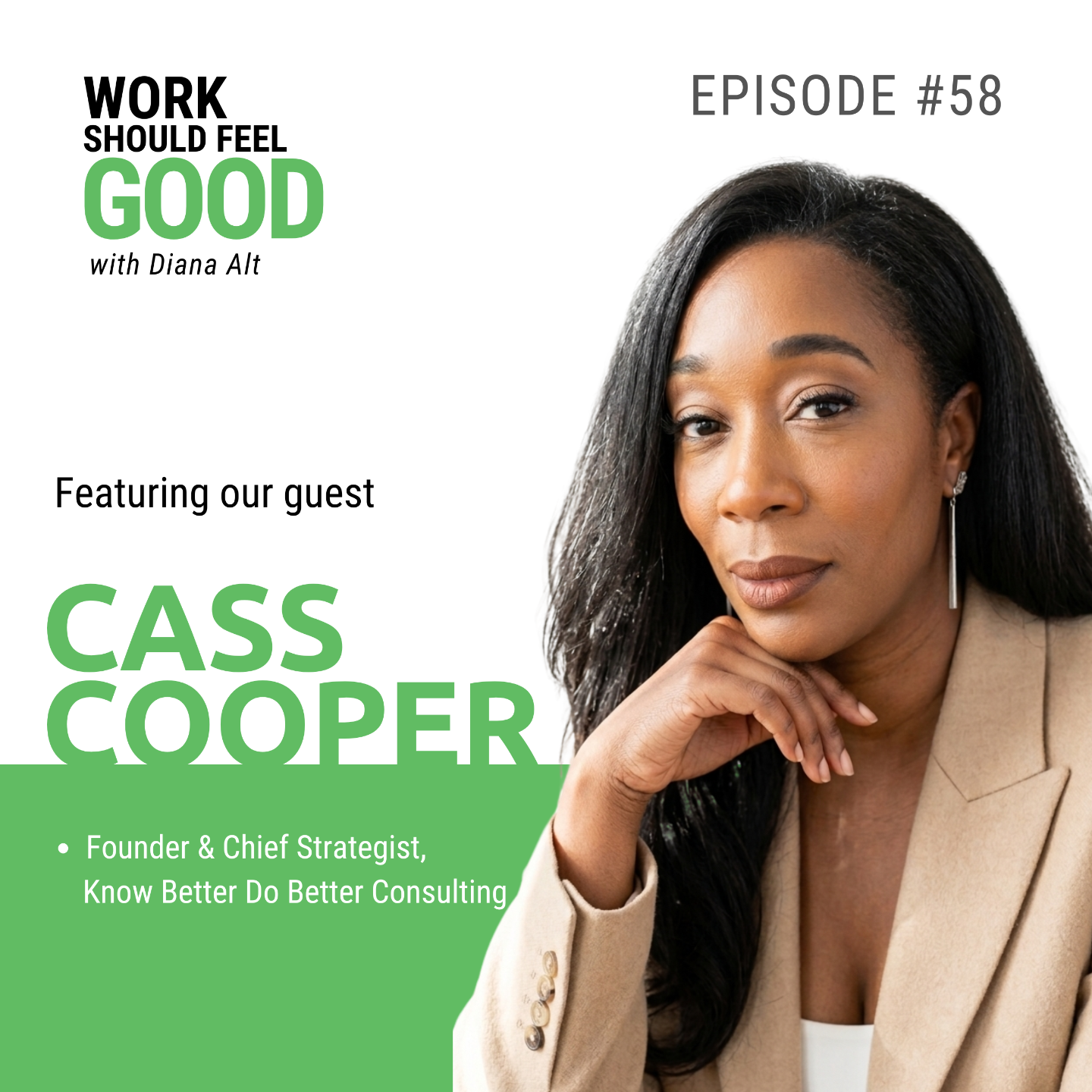
Work Should Feel Good with Diana Alt
Episode 58: How to Fix Burnout Without Fixing Yourself with Cass Cooper
Diana sits down with Cass Cooper to explore why burnout isn’t a personal failure, but a signal that something in your environment isn’t working. They unpack how high performers often become the most burned out and why trying to “fix yourself” can actually make things worse.
They also dive into the hidden systems inside organizations that drive burnout, from meeting culture to constant notifications, and what both individuals and leaders can do differently.
If you’ve ever felt exhausted despite doing everything “right,” this episode will challenge how you think about work and what needs to change.
You’ll learn:
- Why burnout is a systems issue, not a personal weakness
- How high performance can hide serious exhaustion
- What leaders should look for in burned-out employees
- How to set boundaries and say no without backlash
- Simple, practical steps to start recovering from burnout



Episode 58: How to Fix Burnout Without Fixing Yourself with Cass Cooper
Episode Description
Burnout isn’t a personal failure, it's a systems problem. In this episode, Diana sits down with Cass Cooper to unpack how high performance often masks exhaustion, why “fixing yourself” won’t solve burnout, and what actually needs to change at work.
-
Why burnout is a systems issue, not an individual weakness
-
How high performers unknowingly mask exhaustion
-
The role of meeting culture and notification overload in burnout
-
Why “soft skills” are actually critical infrastructure
-
How to say no without damaging relationships or performance
-
The connection between personal boundaries and workplace behavior
-
Practical ways to start recovering from burnout immediately
⏳ Timestamps
02:30 Cass’s burnout story and pandemic wake-up call
06:00 Realizing burnout isn’t just fatigue
09:00 First steps to recovery: saying no and creating boundaries
13:00 Therapy, health, and systemic barriers to recovery
17:00 When burnout becomes a systems problem
21:30 How workplace culture contributes to burnout
26:30 Notifications, distractions, and attention overload
30:00 Why entrepreneurs recreate burnout patterns
33:00 “No one is coming to save you” — personal responsibility vs systems
36:30 High performance masking exhaustion
40:00 What leaders miss about burned-out employees
43:30 A real leadership intervention that worked
47:00 Soft skills as critical infrastructure
50:00 How to say no without saying no
54:00 Small, actionable steps to reduce burnout
57:30 Worst career advice and closing thoughts
💡Take Action
🔥 Subscribe for future episodes → https://www.youtube.com/@dianaalt
📖 Grab my Resume Don’ts Guide → https://www.dianaalt.com/resumedonts
❌ Avoid these common job search mistakes → https://www.jobsearchmistakes.com
🚪 Wondering if it’s time to walk away? → https://www.isittimetowalk.com
💼 Work with me → https://www.dianaalt.com
📢 Connect with Cass Cooper
🌐 Website → https://www.knowbetterdobetter.co
🔗 LinkedIn → https://www.linkedin.com/in/cassrcooper
📲 Instagram → https://www.instagram.com/just_cass2.0
📲TikTok → https://www.tiktok.com/@just_cass2.0
📲 Follow Me On Social Media
LinkedIn → https://www.linkedin.com/in/dianakalt
YouTube → https://www.youtube.com/@dianaalt
Facebook → https://www.facebook.com/dianakalt
TikTok → https://www.tiktok.com/@thedianaalt
Transcript
Diana Alt [00:00:04]:
Hey, Diana Alt here. And this is Work Should Feel Good, the podcast where your career growth meets your real life. Each week I share stories, strategies and mindset shifts to help you build a work life that works for you on your terms. Hey there everybody, and welcome to Work Should Feel Good, the show where your career growth meets your real life. I'm your host, Diana Alt, and today my guest Cass Cooper and I are going to dig into burnout broken systems at work and why trying to fix yourself is not the answer to your burnout. Cass is a leadership strategist who helps organizations get results without burning out their people all the time. After recovering from burnout herself, she now works with leaders to rethink how work actually gets done. Identifying where productivity is prioritized over capacity and where high performance masks exhaustion.
Diana Alt [00:01:04]:
That, God, I feel that so hard. She's known for reframing bird out as a systems problem, not a personal failure. And for treating so called soft skills which fell out of favor for a while as critical infrastructure. Not the nice to have. Welcome to the party, Cass.
Cass Cooper [00:01:21]:
Hey, how's it going? Really well, thank you. I'm, you know, it's a beautiful day. I'm here, I've got some water. I'm talking about some of my favorite
Diana Alt [00:01:32]:
things and I know we would, I mean, Cass and I don't know, I know a lot of the people that come on the show. I know fairly well. You and I just met like one time for 25 minutes. I was like, oh, I must have this woman on my show because of like you're, you're speaking from what you've lived. And I think like academic degrees are great. I have PhDs and authors and all that on the show. But there's something about, I got burned out where I had the thing happen and then I went and fix, like addressed it for myself and then I went and studied how we actually fix it, you know, on a larger scale. And now I do that.
Diana Alt [00:02:11]:
There's something about that that is so scrappy and practical and it suits my vibe because that's how I do everything.
Cass Cooper [00:02:19]:
So I love that you presented that as if it was like a tactical choice. It kind of just fell into place because I was burnt out, right? I just was like, I can't do this thing anymore. So. And we'll get into it, I'm sure. But I got, it's always a wine,
Diana Alt [00:02:35]:
it's always a winding path. You know, I, I got into what I do and career and executive coaching because, well, early on I started working with People on job searches because I got laid off twice during the tech wreck of the early 2000s. And I'm like, I gotta eat and live indoors. Like, I gotta. I gotta figure this out. And then later on, as I expanded my practice, it was about, well, how do we make this not suck? You know, I used to always say work shouldn't suck, and then I switched it to work should feel good because let's have a positive spin from time to time.
Cass Cooper [00:03:10]:
So.
Diana Alt [00:03:10]:
But I do love a good origin story, so why don't we just start with it? So, burnout, you started out this whole business of yours with burnout. What were you doing? So led to that.
Cass Cooper [00:03:24]:
Yeah, so let's take. Let's go Back to like 2018, 2019. On paper, I was killing it, right. I was top shelf at my organization. I was sales leader of the year twice in a row. I always met or exceeded my goals and strategy and I was working my way up. I started sharing my strategies with our organization internally and started speaking on stage about how to be a better salesperson. My LinkedIn was growing.
Cass Cooper [00:03:58]:
I was, you know, learning and thriving and traveling and all these things. And then the sales.
Diana Alt [00:04:04]:
Were you in?
Cass Cooper [00:04:05]:
I was in event. Event sales. So I work for a company where, you know, we sold meetings. And I used to say that my job was to take people to dinner and make them laugh and get them to sign a contract. That's it. And so it was, it was a good time. It didn't, as you said, it didn't suck. It was really, really fun.
Cass Cooper [00:04:23]:
I got to travel. I got to do events all over the DFW Metroplex and be in places that a lot of people don't get to experience. You know, who, who gets just be backstage at, at and T Stadium or on a regular basis? Not a lot of people. Right. And then the pandemic hit and I had actually started to work for a new organization, doing the same job, but, you know, at a director level. My first day was the first day of Shelter in place. And so, yeah, so an event company with no events. We all went home and we're like, oh, it's only going to be like six to eight, eight weeks.
Cass Cooper [00:05:02]:
And at the time, I was very much, oh, six to eight weeks. Be inside, relax, no travel. I was like, oh, that sounds really great. And then I realized that I could not stay awake during the day and I could not sleep at night. I started drinking a lot. I had a lot of challenges with my kid in general. She was four at the time. And I Quickly realized I am not an educator.
Cass Cooper [00:05:31]:
I was super high, stressed, mostly because I had been out in the public and I had cultivated this strategy of being out and always being busy. And therefore I wasn't able to pay attention to the things that were making me unhappy. Right. Yeah. Like I said on paper, I had all the things. I had the house, I had the partner, I had the kid, the suburbs, all the things. And so having a little bit of. Of a relaxation sounded like a great idea.
Cass Cooper [00:06:02]:
But I quickly realized that I was very depressed and extremely burned out.
Diana Alt [00:06:07]:
That's. How long do you think, like, when you retrace it back, how long do you think you'd actually been in a state of burnout that you were masking before?
Cass Cooper [00:06:16]:
Probably. Probably at least two to three years. At least. You know, we define burnout as it's different than fatigue, because fatigue you can maybe sleep through or you change, like one or two things. But burnout is a combination of emotional distress, physical distress, and for a long period of time. So, yeah, it was probably about maybe two, three, maybe even longer, because like I said at the time, my kid was 5, 4, 5. So maybe even before I got pregnant, I just kept going. I was always a high achieving person, always goal oriented, very studious, lots of degrees.
Cass Cooper [00:07:01]:
I read a lot. And chasing that dream that everybody says that they want to have. And so then I got there and realized I don't love any of this.
Diana Alt [00:07:12]:
Yeah, this is, like, not right.
Cass Cooper [00:07:15]:
It's not right.
Diana Alt [00:07:16]:
Like, one of the most. One of the most important tenants of what I do is that I want people to pursue success on their own terms, which means they have to define it.
Cass Cooper [00:07:26]:
Yeah.
Diana Alt [00:07:27]:
And I was listening to a podcast. It was actually an episode of the Tim Ferriss show. And I'm blanking on who the guest was, but the gal was talking about how she had done an exercise a few years before, trying to figure out, like, what's standing in the way of defining my own success. And she was like, I'm afraid to do it because what if I. What if I tee up? This is my own definition of success, and then I can't do it. Like, how. How much more of a failure will I feel like if I can't even beat my own bar? And like, stuff like that. I'm so wild.
Diana Alt [00:08:02]:
But I'm just. I'm tired of chasing stuff that everybody else says we should chase. Could we just not do that anymore? That'd be great.
Cass Cooper [00:08:08]:
Yeah. And I think that that is actually where to start. It's. It's what defines happiness, joy, success, peace, rest, relaxation, understanding what those things mean and actually look like for yourself, but then also what it feels like in your body. We're working so quickly to keep moving forward that a lot of us don't even recognize the tension and the anxiety that we hold in our body. We don't take full breaths, we don't sleep well, and. And we just kind of keep going because that becomes like the normalized state for our. Our nervous system and for our state of being.
Diana Alt [00:08:52]:
The sh. The shallow breathing thing. That is something I've been really conscious of lately. And I start. I joined a yoga studio, like, a couple months ago. Like, I'd been. Yeah, I've been doing it at home, and I'm, you know, terrible at it, but I'm like, I gotta leave the house. I'm single, and I work at home.
Diana Alt [00:09:08]:
Like, we gotta do something here. And whenever there's one lady that does a restorative yoga class. And the degree to which I became conscious right after I joined that studio of how shallow I'd been breathing was unbelievable. I'm like, I never. I never breathe like that. I feel like I have oxygen now. So. So you had all this burnout.
Diana Alt [00:09:33]:
What. What did your path back from, you know, you. And I said, like, right before I hit record, you're not. You're. You think you're still working on recovering from it. It's not necessarily something you've passed, but to get from that state, that was probably more of a crisis state, if I understand you correctly, to where you are now. What are some of the things that you did?
Cass Cooper [00:09:54]:
So I'm a big fan of reading in general and education. Like I said before, I've read Glennon Doyle's book Untamed, and there's her and some not fans of her. But I will tell you what, that book revolutionized and changed the way that I saw the options for happiness for myself. I think one of the biggest things that I started was saying no to things that did not feel right or feel good. I didn't know. So much times we think about, okay, I want to do this thing, or I want to add this thing. A lot of that has to start with saying no to something first.
Diana Alt [00:10:34]:
Yes.
Cass Cooper [00:10:34]:
So it's like, okay, I want to, you know, drink more water. Well, I'm going to not drink as much juice. Right. Clearly I have small child because we don't drink soda, we drink juice. But so I can make space for this other thing. Right. And so I just started saying no to stuff I was like, you know what? I'm not going to do that. And it's things that, that especially as a woman who was staying home with her kid at the time.
Cass Cooper [00:11:02]:
And I ended up getting laid off through the pandemic and all of that stuff. But I. There's certain things, like around the house that has just became like necessary for me to do. So I just started saying no to some stuff. I was like, you know what? I'm not going to do the dishes and make sure the house is clean. I'm just not going to do it. What's the worst that could happen? We're going to be here tomorrow, I'll do the dishes eventually, but I'm going to say that so I can go to bed early, right? Yeah. I started instituting.
Cass Cooper [00:11:34]:
One of my big rules is mama clocks out at a certain time every night. If it's not done by 8:30, I'm out. Being able to say no to that allowed me to say yes to all these other things. Getting back into reading, having time for that, restorative breathing. I. A big part of it to me also was therapy. I'm privileged enough to have great health insurance and being able to. I've been seeing, I actually am seeing my therapist well before the pandemic.
Cass Cooper [00:12:06]:
And I just kept with it. I started going back every week, speaking with her, telling her the truth about what was going on. And she was the one who recognized like, okay, there's something else going on here other than just you have anxiety or there's something else going on here. And she was able to be like, okay, yeah, we need those outside references to be able to hold us into a healthy space. I'd say the last big thing. I still tried my best and I maintain my community. Having other women who are high achieving, who are also going through the same thing is such an important part of, of recovering from burnout. Because it makes it okay to not be okay, to not have the answer and to be able to crowdsource, like, okay, this is how you're managing these things? This is how I'm managing things.
Cass Cooper [00:12:59]:
Where are they similar, where are they different? And how can we work together in order to do that? I mean that. So saying no, clocking out at a certain time, maintaining community and being in therapy, those things, I mean, that's a
Diana Alt [00:13:14]:
pretty damn good list for the rest of your life, in my opinion. I started therapy in late 2020 because I did not think I was going to make it out of 2020. Like there was a thing that they were Talking about at the time, which was that anytime that there's a long crisis, you can handle it. Like at the beginning, you're like, what the heck? And then you settle in and you're doing the thing, and then around six months, it starts to really suck. Like, you all of a sudden go, oh, I don't know when this is ending. And it becomes a stronger weight. And then we all globally did that roughly at the same time. And I had a really tough time.
Diana Alt [00:13:54]:
And I. I started therapy right around then, and I did not have the kind of health insurance that paid for the therapist that I needed. I reached in my pocket for that, and it's the best thing I ever did. So it was. And I also, like, my therapist was very conscious of the physical things that can lead to depression too. And so he's like, okay, we need to do A, B and C together. Also, could you please go get some medical tests?
Cass Cooper [00:14:20]:
Yeah, yeah.
Diana Alt [00:14:21]:
And I. I literally found out I had a freaking pituitary tumor.
Cass Cooper [00:14:26]:
See, and this, this is where I say that so much of our burnout that is especially. Especially for women, especially for high achieving women. So much of our burnout is sustained by the systems and processes and the policies we have in place. So the fact that you did not have access to health insurance to enable you to get the tests and the help that you needed in order to either prevent or to monitor your burnout is a systemic issue.
Diana Alt [00:14:55]:
I've had insurance. I want to be clear on that. I'm not disagreeing that it's systemic, but one of the structures that we'll talk a lot about work and how work leads to that. But in my case, I had health insurance the whole time. It didn't cover the therapist that I wanted. So that was like a diva thing for me. But I. I needed kind of a certain thing, and I found the person that I wanted, and they were not on insurance, but I made it work.
Diana Alt [00:15:22]:
But the wildest part is I discovered a pituitary tumor and like a couple of autoimmune tumors type things all at the same time. Because my therapist pushed me to go get private tests. And the whole time, years before that, of course, my PCP is like, well, you would be fine if you would just lose 50 pounds. And I'm like, well, if my endocrine system is. I fired that guy as soon as I could. But if my endocrine system is jacked, how do you expect me to lose £50? How is that going to work?
Cass Cooper [00:15:54]:
And that again, goes back to the way that we talk to women about our health and like that is a systemic issue, and that is a way that sexism and misogyny personifies itself in our health system. So when we continue to look to these healthcare professionals to help us and listen, I too have an autoimmune disorder. I am thoroughly enjoying the health care that I am privileged to have. However, comma, there is something to be said about that kind of access should be available to everybody. And, and what does it say about our culture and our society, about our workplaces, when we're allowing all of these things to continue and, and really disenfranchise women and make it difficult for us to just even work in this, stay atop of our lives and our livelihood? It's like we're so tied to being unhealthy that we have to work in order to get healthy. And then once we get healthy, we don't have any time because we're working so much. Right. So it's, it's, it's this.
Cass Cooper [00:17:07]:
Where can we interrupt that system? Where can we interrupt that cycle?
Diana Alt [00:17:12]:
So you, you were going through your personal burnout stuff like dealing with that, getting, getting, figuring out your four rules and putting them in place. Was there a point in that where you had the aha that it was a systemic problem instead of a personal problem? Because that's one of the most, like, you're on this show. Because I find that whole conversation so interesting.
Cass Cooper [00:17:33]:
Yeah, figured that out. So actually my degree is in women's and gender studies. And so understanding that the personal is political has been a critical part of just all of my sense of knowing and understanding of the world around me. I went to a shout out to DePaul University. I had an amazing program there. And so understanding that nothing just happens just to us and it's something that happens globally is something that is, is critically on that.
Diana Alt [00:18:05]:
You've been wired in on that for a long time.
Cass Cooper [00:18:08]:
But I think the burnout issue specifically is more of a recent thing. The aha moment, I think came to me when I started talking to other women who were having similar issues and challenges and problems. You know, perimenopause is a huge thing that everyone is talking about right now. And when I started to really look into why we're having more and more issues and challenges and talking to my friends, it did kind of like light bulb of, oh, this is not just a me thing. I think also. So my dad passed away in 2021. And when, when that happened, I, I wasn't, I was, had just started the business and I wasn't working and I had a couple of clients and the ability to be able to pull back in the way that was healthy for me. And realizing that like my sister couldn't do that was a huge aha moment, right, because she got what, three, maybe four days of bereavement where I was able to say, hey, client, this project is on hold indefinitely, or I can do this much and then we'll have to offload it and here's some other people that could help you with the end of it or whatever that looked like at the time.
Cass Cooper [00:19:22]:
But really understanding that some of us have these certain privileges and some of us don't, and that is a failure of how we don't support underrepresented people or just people in general. It's not even underrepresented.
Diana Alt [00:19:38]:
It's, it's interesting because like you, you came in at, you come at it a lot from the women and gender studies lens, but you're also a smart woman. So I know, you know, like when this, the statement that confuses a lot of people is that patriarchy hurts men. Oh, you know what I mean?
Cass Cooper [00:19:56]:
I mean, where do you work?
Diana Alt [00:20:01]:
We can go there for a little bit, but people don't understand it. My, my client base, I have a lot of men in my client base, like white, you know, 40 year old men, 45 year old men in my client base because I've worked with leaders in tech for so long because that's where I came from. And it's very interesting because a lot of times when you are a woman coach, you know this, people assume, well, you just work with women because that's just how people's brains work. And if I had to pick one gender to work with, I would pick men. Because for whatever reason, they find me safe to tell the things that are bothering them in a way that they don't feel like they can tell men and they don't feel like they can tell a lot of other women. And I'm like, this is just as important to you as it is to.
Cass Cooper [00:20:54]:
That right there is what we mean when we say patriarchy hurts men. Because how sad is it that you have to outsource to essentially a stranger, you become known to them, but you're a stranger. You don't have people in your community and in your life and in your family that you can talk to about your feelings and what you're actually experiencing at work and get actual help and feel, have access to vulnerability. That in and of itself is a
Diana Alt [00:21:23]:
byproduct of patriotism, swallowing our feelings, which, I mean, I'm a Gen X, so our whole generation has been swallowing our feelings since we were children. But anytime you're doing that and you're being told that not showing any needs is a symbol of strength, is you gaslighting yourself or the organization that you're in gaslighting itself?
Cass Cooper [00:21:45]:
Yep, a hundred percent.
Diana Alt [00:21:46]:
So when you think specifically about applying the. The principle of, okay, light bulb, cast knows. Cast is figured out. Burnout is systemic. And then deciding to work inside organizations. When you go and start working inside an organization, what are some of your first tells? That there's significant burnout and that there are specific things that the company has put in place that can be changed to address that.
Cass Cooper [00:22:21]:
So I look at your meeting culture as a huge thing. I did a series recently on we need to cancel all meetings. And not forever. Right. But I had a client last year who, my suggestion was, you know, cancel all the reoccurring meetings on your schedule and then add back in what you actually need. Because a lot of times we just have a reoccurring meeting just because we have it, and then you end up with back to back to back to back to back to back. And when are you supposed to actually do the work that you talk about in the meeting? Well, you're doing it either one, in the next meeting, which decreases your productivity, or two, you're doing it after hours, which decreases your availability to. For.
Cass Cooper [00:23:02]:
For a life outside of work. And so that's the first thing I look at is what is your meeting culture? How often are you.
Diana Alt [00:23:08]:
What does a healthy meeting culture look
Cass Cooper [00:23:10]:
like versus I. I think healthy meeting culture. It's. It's a couple of different levels. It depends on what level in the organization you're in. Try keep your meeting short. Right. Does it have to be 30 minutes? Schedule the default to be 25 or 20 and have that little bit of space in between.
Cass Cooper [00:23:30]:
Can we get these things done in 45 minutes instead? I really love how there's some organizations, Amazon specifically, one of the things that they do is, is they have a brief and they spend the first five minutes, 10 minutes of the meeting, everyone reading the brief. And then you come back with the question. So everybody's on the, on the same page and aware of what the meeting is for. So many times people show up to things and it's like, why was I invited to this? What does this have to do? And then there's no agenda, and nobody is really clear about what the desired outcome for this conversation is meant to be. So rather than having these and then you have to have the meeting after them, let's just do all of that. Let's not do any of that. Let's be concise and be clear and make sure that we're able to communicate. I think the other thing is people having.
Cass Cooper [00:24:26]:
When I'm working with individuals, not necessarily the system itself or the organization itself, I look at what are your notification settings? It seems so small, but the constant, like, buzzing of notifications, that's distracting from you actually getting work done. And then recently there was a study that came out from Harvard that talked about how people are getting like, AI fry and what do they call it? It was AI Fry and notification overload because they're getting so many. You got notifications on your phone, you got it on your computer. The. The washer dryer has a specific sound.
Diana Alt [00:25:06]:
The.
Cass Cooper [00:25:07]:
Your car is buzzing. And all these different things that are distracting from your attention. Each app has a different sound. So now your brain has to say, okay, is that email or is that TikTok? Like, it's so much overload that can be solved by doing a reset of your notifications. Either turn them all off, mute some of them, or even most of the time you can just get a summary of them and you just read the things that you need. You don't need to know everything every time.
Diana Alt [00:25:40]:
The notifications thing is very interesting to me right now for two reasons. Number one, one of the things, if I had to add to your four rules that we talked about earlier, mine is never have a work email on a personal device.
Cass Cooper [00:25:55]:
That's interesting.
Diana Alt [00:25:56]:
So, okay, this is one of my favorite ones because people are like, how'd you get by with that? So I worked in product management, my last corporate job, before I left for good in 2019. And even when I was in product management, my rule was I already work 45 plus hours most weeks because I was way overloaded. My. What I did is on my phone and my iPad, which are personal devices. I had the account set up like it was there, but it was always turned off. So the only time I would ever turn it on is like, if I got a text from one of a couple of people. Like, if my boss, who was very good at knowing what is and isn't an emergency, texted me and said, I really need you to look at this, you know, this evening. Then I would open up my settings, turn it back on, go find that email, deal with it, and turn it back off.
Cass Cooper [00:26:50]:
Mm.
Diana Alt [00:26:50]:
And I've maintained that I did that for at least two years when I was in corporate. And now I'm now almost seven years into full time working for myself. I still don't have my work email on my phone. The other thing is I just moved all of my clients, like the asynchronous coaching access they had me. Usually before it was like during email, through email or text. And I am constitutionally incapable of dealing with a red. Like a notification bubble. I can't handle it.
Diana Alt [00:27:22]:
I'm an inbox. I try to get my inbox down to zero. Like, I'm not. I feel like people either have like five unread emails or they have 43, 622 unread emails.
Cass Cooper [00:27:32]:
It's maddening. When I open people's, my mom's that way.
Diana Alt [00:27:36]:
So many people I know are that way.
Cass Cooper [00:27:37]:
I just go in and delete all of, like, just delete it.
Diana Alt [00:27:40]:
I that so for me, I turn all that stuff off so I don't have to deal with the bubbles. And then I just moved everybody into slack, though, for asynchronous access. And I told them Monday through Thursday, at least once a day I will read and respond to stuff. Sometimes you'll get it right away. Sometimes it'll take me like, I gotta go be thoughtful about it. But I said, you have to put it in there and you have to be patient because I do not have any notifications on. I don't get an email. If I get a slack, I don't get anything because that's how I actually am able to serve them better than if I'm fragmented.
Cass Cooper [00:28:20]:
So anyway, and I think that right there, it's, it's having the ability because this goes into the soft skills thing. Emotional regulation is so hard. Yeah, so hard. And a lot of times we're asking people to be patient and emotionally regulate themselves at work in a way that they are not capable of doing at home. So when we're constantly on and someone's pinging you and they expect an answer right away, they ping you and you don't answer within five minutes. And then they call you. And also that is their anxiety. That is the equivalent behavior.
Cass Cooper [00:28:56]:
It's the equivalent of you yelling at a kid for not being able to. Mommy, mommy, mommy, mommy, mommy, Mommy. I need, I need, I need, I need. And so all this, all these things that we keep doing and we keep holding on to, we think that those skills are just something that, oh, we're gonna work on outside of. It's like, no, they all bleed into each other. They all. Your inability or your desire to always be on and always be answered is probably deeply rooted in some sort of shadow self. And listen, I'm not a psychologist, I'm not a therapist, so I'm not my jam.
Cass Cooper [00:29:34]:
However, I do believe that, like, the way that you show up at work is influenced by the soft skills that you have or don't have in your personal life. And those are the hardest things that we have to work on. Who wants to go and unpack their childhood so they can be more productive at work? Nobody, really. But if you do, you probably are going to be better because you're going to be able to manage your own emotions and your own expectations in a way that will get you to that executive presence, executive gravitas that we're all seeking on some level.
Diana Alt [00:30:03]:
Yeah. When we. When you deal with your. Whatever that is, when you deal with your. One of the things you find out ideally is that all the stories that you've been telling yourself about how you don't have worth if you're not helping someone else start to fall away. They don't 100%. Like, we are humans and most of us like to help people. But I deal.
Diana Alt [00:30:29]:
I watch it, you know, among my fellow entrepreneurs and then I watch it among my clients that are in corporate. And I have a. I have a few entrepreneur clients, too. So I run the gamut. And it's very interesting to see how many people leave corporate because of the meeting culture and the notifications and the mommy, mommy, mommy equivalent of whatever the hell your boss is doing, only to go and build the same for themselves in their business.
Cass Cooper [00:30:56]:
That's all you know?
Diana Alt [00:30:58]:
That's all you know? I have to, for my client, I'm like, you have to tell your client how you work together and you tell them that when you're selling to them so that they know what they're getting into.
Cass Cooper [00:31:10]:
And I think that for me, with my burnout challenge is that was all I knew. I only knew being on all the time about working, getting up at 5 so I could do a little bit of yoga and have some coffee and getting the kid ready and driving across town in traffic and then starting my jobby job and having meetings and taking people to lunch and then going home and making dinner, and I'm already tired just describing it. Right. And so. But that's all we knew. And if we never take the time to say there's another way to do this, we could have chose anything and we chose capitalism. Like, okay, but how are we going to work within that. So that we don't.
Diana Alt [00:31:53]:
Thank you for saying that. Because here's the thing. I know, you know, I talk to people. I talk to people that have all sorts of different perspective on politics, capitalism, society, et cetera. And the thing that not enough people are saying is basically we have to figure out how to work within the system that we are in. Sitting around complaining about it while you continue all the behaviors that further your burnout is. That's the definition of insanity. And it's out.
Diana Alt [00:32:30]:
It's like outsourcing to the world. Your health, in my opinion, and I don't really agree, that's not a great move.
Cass Cooper [00:32:38]:
This is the thing I always come back to. And I had to tell myself this, Cass, no one is coming to save you. You have to save yourself. You have to put your oxygen mask on for yourself first. First. That whole adage of you can't pour from an empty cup is so true. But why are we trying to pour ourselves out in the first place is really the question. So I have to be able to be okay with myself so that I can be in community.
Cass Cooper [00:33:08]:
I have to be okay with myself so that I can be the best version of me, so that I can show up for my family and for my friends and for it just you. No one is coming to save you and you have to do the first thing now.
Diana Alt [00:33:24]:
Yes.
Cass Cooper [00:33:24]:
Could there be more systemic things? Like two things can be true. Yes. We need to save ourselves and we need systems and strategies and policies in place that allow us the space to do that. But they have to work in tandem. Neither. No one's going to.
Diana Alt [00:33:41]:
We can't sit around like, waiting for universal health care to decide that our health is important.
Cass Cooper [00:33:47]:
Yeah.
Diana Alt [00:33:49]:
Yeah, I. I understand.
Cass Cooper [00:33:51]:
Yes. Is it doable also? Yes.
Diana Alt [00:33:54]:
So I want to turn. I want to turn to something that I like. It was one of those phrases that I've seen you use, like, I'm on your email newsletter. Join Cass's email go to our website. It's a good one. But you talk about high performance, masking, exhaustion, and the people that are doing this and are the most vulnerable often are the ones that their leaders most rely on and should be having an eagle eye on. So if you're an executive, you know, if you think about somebody that was a layer or two above you when you were burning out as a director, what would you want that executive that's looking at their high performing leaders and employees to keep their eye out for, um. That their people might be burned out?
Cass Cooper [00:34:43]:
Yeah. So it's Such a hard thing. Because you want to say that the people who are doing the best are the ones you don't have to worry about. But those are actually the. Like I said, the, the people that you got to worry about the most because they're going to keep doing the things I would watch out for. There are also probably people who are sending emails at 9 o' clock at night who are answering emails within five to 10 minutes, who are less. Actually, they're probably the people who are answering emails within a minute or 30 seconds. Like, did you read all of that? Because I don't think that you did because you just answered all copilot summary at the top.
Diana Alt [00:35:25]:
That's what they're reading.
Cass Cooper [00:35:27]:
Well, you know, this was six years, seven years ago, so we didn't have all that. But also true. Like it's those, it's the people who are, are so quick, right? Not speedy in a way that the business needs, but speedy in a way that they're just trying to complete tasks. I, I would definitely. It's the. It. It's the people who are like, it doesn't matter what time you email or call them, they're gonna answer. Those are the people.
Cass Cooper [00:36:01]:
I remember I was sitting at a restaurant. My dad had come into town and I was there with my kid and my husband at the time. We're now divorced, which also helped get rid of my burnout. But that's another story for another day. And we're sitting there and we're just having dinner and stuff. And my work cell phone rang and I answered it and my dad was so annoyed and he was. I was like, well. And then in my head I'm like, well, how do you think we're paying for this dinner? Like, how do you think we're doing all this? And he was like, no, this is family time.
Cass Cooper [00:36:37]:
And I didn't even salary. Well, yeah, but I'm like, no, but I need my commission, right? Because like I. But I. But it was more of. I was getting all of my worth. I also would look out like, if people don't have hobbies, like, man, get yourself an analog hobby. I love paint by numbers. That is my jam now.
Cass Cooper [00:37:01]:
I discovered it during the pandemic. I love paint by numbers coloring, all of that stuff. I would say for skip level, like people who are always on and who never say no and don't penalize people for saying no.
Diana Alt [00:37:15]:
Like, I was just gonna say. I was just gonna ask you about the saying no thing. Because so many people, especially women, are convinced that they cannot say no to their boss. And it's not just like, oh, I want to get ahead. For a lot of them, it's like of fear of getting fired. They can be like the senior director of whatever that got the only exceeds expectations in the department. And they're still convinced if they say no that they're going to get fired. When realistically, strategically saying no will probably get them even better results.
Diana Alt [00:37:51]:
So that's very interesting. So when you, when you're, when you are that leader and you identify the burning out casts, what do you do?
Cass Cooper [00:38:04]:
My boss sent me on a vacation once. It didn't solve the problem, but it did realign my commitment to working differently. I don't always tell this story, but I'm going to tell it.
Diana Alt [00:38:22]:
I don't always.
Cass Cooper [00:38:26]:
And she's afraid now. Hopefully she's listening. So my boss at the time, she put me on a performance improvement plan. She put me on a pip and I had already had the trip scheduled and, you know, I was kind of just going out of town for a couple days, just driving to the country and whatever. Don't let the, don't let the makeup for you. I am a country girl at heart. But we.
Diana Alt [00:38:53]:
You're from Texas. You got to be put together.
Cass Cooper [00:38:56]:
Like, you know, I got, I got, we got to be put together, but also we got the cowboy boots and the hat and the jeans and in the closet. So. But yeah, so she, the day before she sat me down and she was like, you're turning into that salesperson that nobody wants to work with. Are your numbers great? Yes. But nobody wants to take on your clients because it's a hot mess. You're promising things just to close deals. You're not documenting well. Like, I was, you know, quite frankly, I was being pretty shitty.
Cass Cooper [00:39:25]:
Like, let's just.
Diana Alt [00:39:26]:
Yeah, you were not at your best.
Cass Cooper [00:39:27]:
I was not at my best, but again, I was. All I was concerned about is always being like, seen as that high achiever and like someone who was like all these things. It was about the accolades. It wasn't actually about the clients or the people that I was working with. And she was like, listen, I have to put you on this thing. It's 30 days. She was like, I know, I hate to do this before you go out of town, but I need you to go out of town. Don't take your phone, don't take anything, be offline.
Cass Cooper [00:39:56]:
And she's like, if you come back next week and you want to learn all the things that will make you better, then I Will teach you. But if you come back next week and you're like, you know what? This is in place for me. She's like, I'll help you find another job in the next 30 days. I was like, that's a win win.
Diana Alt [00:40:11]:
That is leadership right there.
Cass Cooper [00:40:14]:
So she sat me down and she was like. And she literally said to me, she's like, I don't know what's going on. I don't know. It's none of my business whether it be your family life, whatever, whatever, but all of that is bleeding into who you're showing up here in these four walls, and we can't have that. So go and do the things and think about what you want to do. And here are your two paths when you come back. I came back and I thought about it and I was like, I actually do like this job and I actually do enjoy the people that I'm working around and being in the events industry and all the cool things that come with it. I don't want to give that up.
Cass Cooper [00:40:51]:
So I said, all right, girl. What? Teach me what I need to know.
Diana Alt [00:40:55]:
What's the first thing she taught you after that?
Cass Cooper [00:40:57]:
Oh, bring the contract to dinner.
Diana Alt [00:41:02]:
Wow.
Cass Cooper [00:41:04]:
Yeah, bring the contract today.
Diana Alt [00:41:06]:
We're docusigning it, but it's like, yeah,
Cass Cooper [00:41:09]:
have it, have it ready to go. And we would. We. It sounds like we're ready. We're about to work together and stuff. Why don't you go ahead and say that? Sign this letter of agreement and we'll get the details sorted out after we get back to the office. Like, that was one of the first things I was like, I'm gonna keep. That feels good.
Diana Alt [00:41:27]:
Yeah, that feels really good. Yeah. Nice. I love that. So I want to go back a little bit for a few minutes to soft skills as infrastructure. Yeah, like that was. I've been really kind of. I've been in this space for a long time, part time, for several years before I went full time in my business.
Diana Alt [00:41:47]:
And I've been watching the evolution of how people have talked about soft skills because there was about a 10 or 15 year period where nobody wanted to say software soft skills. They would say everything in the world except soft skills.
Cass Cooper [00:42:00]:
Yeah.
Diana Alt [00:42:00]:
Because it sounded squishy. It sound. It didn't sound fuzzy, feel good and it didn't sound fun.
Cass Cooper [00:42:08]:
This is work. You gotta be serious.
Diana Alt [00:42:11]:
I have heard the term soft skills more in the last 12 months than I had in the five years prior. So I'm locked in on this. So what do you mean by soft Skills as an infrastructure,
Cass Cooper [00:42:27]:
soft skills are. First of all, I, I high key hate the term soft skills because they are very, very difficult. Like we said before, emotional regulation is not easy, but it's the thing that separates good employees from great leaders. Being able to have hard conversations is not easy. Being confrontational and having a conversation with somebody that puts them either on edge or on, at ease, those are hard skills to learn. Yeah, it's easier. Like, listen, I can teach you how to read a piano. I can teach you how, like the Alphabet soup of whatever industry we're in.
Cass Cooper [00:43:05]:
But I can't teach you how to make people feel good when you tell them no. Like, that is a hard skill to understand. Right. And so if we create spaces where people can show up as their best selves, where they can have, are expected to have emotional regulation, are able to say no without fear of retaliation, that is the infrastructure for a better organization and a better company where people can work together and work together well and for a long time and ultimately make money. Right. I was, what made me a good salesperson was, was I was able to get a yes. What made me a great salesperson was I was able to make everybody feel good about that. Yes.
Cass Cooper [00:43:55]:
That was the difference. Right. Because then they would come back and wanna say yes to me over and over and over again. Some of the clients that I had then are still people who, now that I'm not in the event industry, they still come to me for referrals and ask me questions. And we're talking six, seven, eight years later. It's not because I have, I don't have anything to sell them at this point. I'm in a completely different industry, but they still see me as a trusted advisor. And that is what you want to be able to build as the infrastructure of your organization.
Cass Cooper [00:44:27]:
You don't want it to be just about, oh, we make people feel good and we send them, you know, hats and pizza. We want to be able to get raving fans from our clients because we're able to make them feel, feel great about the decisions that they make in our products. And that starts with the people that you have.
Diana Alt [00:44:45]:
I think there's that, that there's so much good in what you just said. Like, I'm loving all of it. So one thing is, if I was speaking to a leader out of everything that you just said, that was trying to make their organization a little more burnout proof, the ability, letting people know that they can say no or push back without retaliation is the number one thing that I would do. Because then people can say no to the meetings without the agenda and they can say no to constantly answering email right away. Like all those other four rules that you talked about, like if you can say no without retaliation, those things become more possible. But I'm really interested. I think people would love to have a little nugget of one of those skills that you just talked about. So if you can give like a quickie version on how to make people feel good when you say no.
Diana Alt [00:45:42]:
What, what are your. What are your thoughts on that? If somebody could walk away from here doing that, even 10% better, it's worth listening for an hour. So what is the. What's the recipe for that?
Cass Cooper [00:45:54]:
Yeah. So start before you even know that there is a no. Right. It has to you. A lot of times you're having conversations and you're not really sure where the friction is. So start with, hey, we want the same thing. We want the same thing. You want this widget, I have this widget.
Cass Cooper [00:46:17]:
We both want each other to. We want to exchange money for this widget. We want the same thing. We're on the same side. How can we stay on the same side as we make this negotiation? Right.
Diana Alt [00:46:29]:
I call that focusing on the mission and.
Cass Cooper [00:46:32]:
Yeah.
Diana Alt [00:46:32]:
Instead of focusing on the like the difference or the personality or whatever causes the conflict. So.
Cass Cooper [00:46:39]:
So in sales, that's how I would do it internally. If you're a project manager internally and you have internal stakeholders, it's the same kind of thing. We both want your client to say yes. Right. We both want this project to meet its deadline. Okay. But if we're going to meet the deadline, there's some things that we can't do and. And there's some things that we absolutely have to do.
Cass Cooper [00:47:00]:
Let's work together to prioritize what your list is and what my list is and consolidate them into the same. Right. Now, I never said no, but I told you no. Yeah.
Diana Alt [00:47:13]:
I had one of. I have one of those bosses that like had to have some stern talking tos with me, including. I got laid off by this. When I was working for this boss, which was fine. I kind of wanted to leave anyway. But he called.
Cass Cooper [00:47:27]:
Crazy how that happens sometimes where you're like, it's really.
Diana Alt [00:47:31]:
I literally had a draft of a resignation. I was trying to ship a product and then I was gonna leave because I was. I was burned out.
Cass Cooper [00:47:39]:
Yep.
Diana Alt [00:47:39]:
But this boss said there are so many ways to say no without saying no.
Cass Cooper [00:47:43]:
Yeah.
Diana Alt [00:47:44]:
And I'm hella direct and I. You see a much like, you know, this is 12 years later, 14 years later, something like that. I've had a few corners knocked off compared to when I was 12 years younger. But yeah, he called it saying no without saying no. Yeah, and I think that that's really good. I, I also like everything that you said because it forces prioritization. And one of the biggest lies that we tell ourselves in the world of work and business is that we can multitask, that we can do all the things when the nothing ever got done without focus. Yeah, nothing meaningful ever got done without focus.
Cass Cooper [00:48:22]:
And the thing about it is, again, we're within capitalism. We're supposed to always be working, always be on, always be fueling the financial infrastructure of our lives. Right. And, and this is why I'm like, it's the hardest work you ever do, because it is a revolutionary act to not always be working and to be able to set healthy boundaries and be able to say, I don't want to do this, I want to do this instead. Or, this is a better use of my time, this is a better use of my capital. That's hard to say. And I want to acknowledge that. But it's also a revolutionary way of thinking and working.
Cass Cooper [00:49:07]:
And if more people can do that and do that, well, I just, I really, truly, from the bottom of my heart, think that people will feel good at work. It won't be something that you aren't able to maintain. You're going to want to come to work because you have an environment that balances your. Your must of feeding the capital list mechanisms that we work in. And you as a human who has a finite amount of emotional, psychological, spiritual and physical resources, like those two things have to be able to coexist in order for work to feel good.
Diana Alt [00:49:44]:
You're basically talking about people asserting their agency.
Cass Cooper [00:49:49]:
Oof.
Diana Alt [00:49:50]:
And, and I talk about agency a lot. And I ask people like it's real. Conversations get real uncomfortable when I've had a cocktail or two and I ask one of my fellow business owners. This usually happens like at a conference or something. I'll be like, look, why are you choosing everything except for yourself? Oof. Why, why is everybody's needs except yourself accept yourself more important? Like if you got little kids, you gotta feed and keep alive. I get that. But why does what your client wants become more important than your health? Why does what the husband you should probably kick to the curb, or that you should tell what you need? Why is every their comfort more important than your health? Like that kind of stuff? But people don't believe they have any agency.
Diana Alt [00:50:38]:
And so I love trying to help people chip away at, you know, understanding that they have agency. You know, one of my favorite things to do is Cass, tell me, encourage people to say no because I don't want to like, and literally say. Literally say that. So my sis, my I, I. My sister texted me at 8:30 Sunday morning. We're recording on a Tuesday. And 40 hours, 48 hours later, I'm still thinking about this. She texts me and is like, dinner.
Diana Alt [00:51:10]:
This is the standard. Like, hey, do you want to go out to dinner? Happens, you know, once a week, probably. And I was like, sure, let's do it. And then later on that day, I texted her and I was like, actually, no on dinner. I don't. I just am grumpy and I don't want to. Yeah, I'm not fit company for anybody, and I don't want to.
Cass Cooper [00:51:30]:
And that being able to say that without fear of, like, anger, frustration, retaliation, gaslighting, guilt tripping, like, any of that, that, to me, that's a sign of a healthy space. Hopefully that's how she reacted. I didn't let you get to it.
Diana Alt [00:51:48]:
She was like, I get it.
Cass Cooper [00:51:50]:
Yeah. Because also sometimes what happens is when you say, no, I don't want to, the other person's like, oh, thank God.
Diana Alt [00:51:56]:
Thank God.
Cass Cooper [00:51:56]:
I didn't want to either.
Diana Alt [00:51:58]:
Introvert. What is the introvert joke? Like, there's nothing an introvert loves more. Like, we want to be invited places, and then we want it to be canceled.
Cass Cooper [00:52:09]:
One of my best friends, I got him. He's very introverted and he reads a lot. So I got him a shirt that says, I closed my book to be here. Because he literally will cancel plans, and he'll be like, I'm in the middle of the best book. I'm not coming.
Diana Alt [00:52:25]:
I'm like, you know what? There's somebody asked me about having dinner on Thursday night. I'm like, the finale of the Pit is coming out on Thursday. So that's going to be a no.
Cass Cooper [00:52:36]:
Yeah. No, we'll talk about Oscar.
Diana Alt [00:52:40]:
All right, we can do that. So before we go, I want to ask you what are. So let's say you're a person and you're recognizing from either this conversation or something else that, damn, I am burning out. And you're in an organization where you don't know, like, how you don't have an executive or a manager that's paying attention to this. You're kind of feeling like an island, but you want to take care of Yourself. What are two things you'd have somebody do tomorrow? Like literally very actionable small things.
Cass Cooper [00:53:15]:
Yes.
Diana Alt [00:53:16]:
Just to get 1% better on that.
Cass Cooper [00:53:18]:
Okay. I'm going to actually give you. Maybe I can give you three.
Diana Alt [00:53:21]:
Okay.
Cass Cooper [00:53:23]:
The, the first thing I would say is go take my course online.
Diana Alt [00:53:28]:
All right.
Cass Cooper [00:53:29]:
I have a, I have a bundle that I shared with your producer to put in the show notes, but it's seven videos, they're all less than five minutes each about how to recognize and things that you can do to. To not be burnt out. And I'll give you the first two. The first one is write down the things that bring you joy. Right. Just write them all down. And it doesn't have to be currently. Right.
Cass Cooper [00:53:54]:
It might be things that you used to do that you. Man, I wish I had more time to exercise. I wish I had more time to, I don't know, spend time with my friend or take my dog for a walk, whatever that. Write down the things that break, bring you joy. Right. And then the second thing is write down the things that don't bring you joy. Right. And then circle one thing that brings you joy and cross off one thing
Diana Alt [00:54:23]:
that doesn't and just stop with that.
Cass Cooper [00:54:26]:
And that's it. Just start. Start. It is. So it's the microscopic things, it's the itty bitty things that, that can make all the difference. We live in such a culture where we have to do everything all the time and everything has to, like, show up. We have to be the best partners, mothers, sisters, brothers, like daughters, sons, workers like you. It's a lot.
Cass Cooper [00:54:56]:
It's a lot. But if we could just do one thing and have be 1% better at that one thing every day, that's a pretty good life.
Diana Alt [00:55:04]:
Yeah, I think that's that. And even if it's, Even if it's only 1% better this month, you're still. Still a percent better. You know, I know how math works. So, like that whole, you know, 1% better over a year and you're like a million. That's cool. But you, you, you can just get used to one thing at a time. And if that thing is, I'm actually going to take the dog out over lunch for 15 minutes to walk for three times this week.
Diana Alt [00:55:34]:
If that's all you do, that's still progress. And that can make you more. One of the, One of the hardest things about being in a burnout state is that you lose your imagination.
Cass Cooper [00:55:47]:
Yeah, you do.
Diana Alt [00:55:49]:
When you are in an unhealthy state of any kind, your Imagination goes, and that's very difficult to deal with. But, you know, I. I think. I think the dog walk. I don't have a dog, but. And I don't want to get one. Guys, don't text me and tell me that I should just get a dog.
Cass Cooper [00:56:06]:
You can come down to Texas and walk my dog. Because I am.
Diana Alt [00:56:09]:
I mean, I'll walk your dog. We'll go walk your dog together sometime.
Cass Cooper [00:56:12]:
Perfect.
Diana Alt [00:56:13]:
But just. Just changing your environment is really. I'm glad the weather's nice because one of the things that I've been thinking about is I just want to sit on the porch and drink tea. I did that during the pandemic a lot.
Cass Cooper [00:56:25]:
Yeah.
Diana Alt [00:56:26]:
And, like, just sit on the porch and drink a cup of tea because I don't get outside enough. I'm. I'm very endorsing. I am so glad that you came. I have one question that I ask everybody before I close, and that is, what is the worst piece of career advice you've ever received?
Cass Cooper [00:56:45]:
Oh, man. I've gotten a lot of bad ones. The worst. The absolute worst. That I can't do something. I do whatever I want. I have free will now. Should I do it? That's another thing.
Diana Alt [00:57:01]:
That's a whole. We can have a whole conversation about that.
Cass Cooper [00:57:05]:
But you can't do it.
Diana Alt [00:57:07]:
Yeah.
Cass Cooper [00:57:08]:
Hold my beer. Like, hold my beer while I figure it out.
Diana Alt [00:57:12]:
Yeah.
Cass Cooper [00:57:13]:
Because I do. I do strongly believe that everything is figureoutable. And, yeah, I've had a lot of managers. Well, we can't do that. Actually, we can do that. And I have written out 10 steps to make it so that we could. And these are the departments that we need to talk to in order to make it happen. You still think we can't do it?
Diana Alt [00:57:39]:
If you're saying we're not gonna, that's fine.
Cass Cooper [00:57:41]:
That's all. Are you saying you don't want to? If you're saying that I don't want to, that doesn't align with the business as it is right now. Okay. Those are all different answers. But. But the fact that we can't. I think. Yeah, we could.
Diana Alt [00:57:56]:
I think that's really important. It goes back to agency. I'm choosing not to is way different than I can't.
Cass Cooper [00:58:03]:
Correct.
Diana Alt [00:58:05]:
And when you say I can't, you are absolving yourself of responsibility.
Cass Cooper [00:58:11]:
Yep.
Diana Alt [00:58:13]:
Sometimes we don't need to take all the responsibility in the world on, like. I get that. But just understand where your choices set. That's a really good place to end. Cass. I'm so Glad that we ran across each other.
Cass Cooper [00:58:25]:
Me too. I'm so honored to be here. Yeah, yeah, you're.
Diana Alt [00:58:29]:
You, you're gonna help people make work feel good. You're gonna help leaders put attention on this. And I really enjoy that you mentioned the course. Can you, can you just say your like your website real quick?
Cass Cooper [00:58:41]:
It's very easy. I'm easy to find. I am casscooper. Com.
Diana Alt [00:58:45]:
Wow.
Cass Cooper [00:58:45]:
Very easy to find.
Diana Alt [00:58:47]:
Wait, Is it Cass cooper.com or I am.
Cass Cooper [00:58:50]:
I am Cass cooper.com. you can find all the things there. You can find link to my podcast, links to my courses. I have a patreon that you can participate. You can find me on Tick Tock. You can find me on LinkedIn. I'm in all the places.
Diana Alt [00:59:07]:
I feel like I'm gonna be stitching some stuff on the Tick Tock, you
Cass Cooper [00:59:10]:
know, the tickety talks. I was going hard for a little while, but, you know, I'm picking it back up.
Diana Alt [00:59:16]:
But I, I don't spend like, I enjoy it. It's not like a primary channel for me, but it's fun and I like to get salty on Tick Tock. I feel like it's the best place to get salty.
Cass Cooper [00:59:27]:
It's the best. Listen, I love a good clap back in the comments. Please argue with me in the comments.
Diana Alt [00:59:32]:
Oh, well, will you argue with me in the comments?
Cass Cooper [00:59:34]:
Absolutely. 100%.
Diana Alt [00:59:36]:
It'll be amazing. We'll have a great time. All right, everybody, thank you so much for listening. Thank you, Cass, for being here and we'll see you.
Cass Cooper [00:59:48]:
Hey there.
Diana Alt [00:59:48]:
Do you ever find yourself wondering, is it finally time to walk away from this job? You might want to go over and check out my free mini video training@isittimetowalk.com it's going to walk you through the four pillars of an aligned career and let you know whether it's time to start making your move. That's isittimetowalk.com. And that's it for this episode of Work should feel good. If something made you laugh, think, cry, or just want to yell yes at your phone, send it to a friend, hit follow, hit, subscribe, do all the things, and even better, leave a review if you've got a sec. I'm not going to tell you to give it five stars. You get to decide if I earned them. Work should feel good.
Cass Cooper [01:00:34]:
Let's make that your reality, Sam.