Work Should Feel Good with Diana Alt
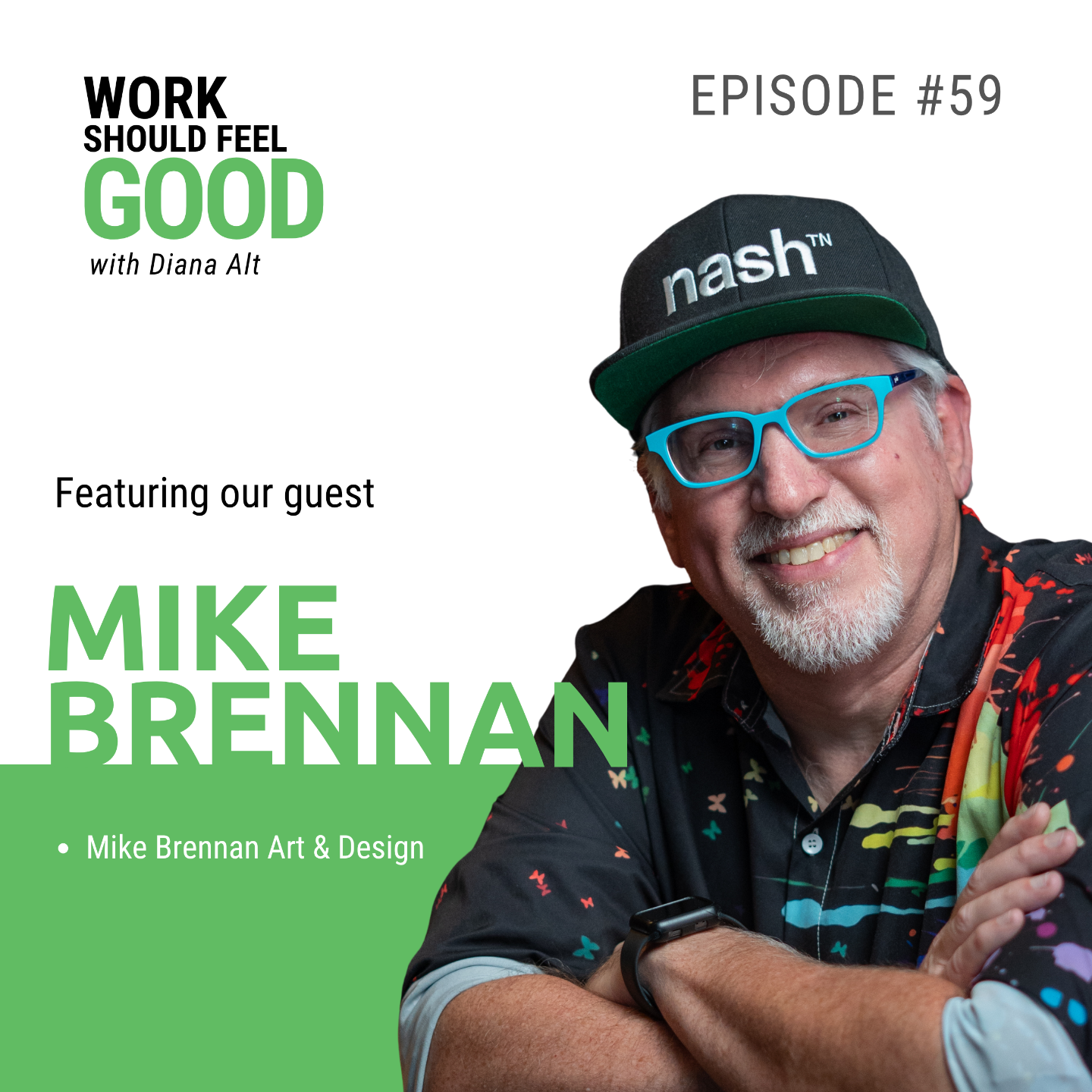
Episode 59: Creativity Practice to Fuel Innovation with Mike Brennan
Diana sits down with artist and creative mentor Mike Brennan to explore why creativity isn't reserved for artists—and why it may be one of the most important skills for innovation, problem solving, and meaningful work. Mike shares his journey through burnout, depression, and a decade away from creativity before rebuilding his life through a simple daily practice.
Together, they unpack how creativity can be developed through consistency, curiosity, experimentation, and play. If you're feeling stuck, uninspired, or looking for new ways to help your team innovate, this conversation will give you a fresh perspective on what creativity really means.
You’ll learn:
- Why creativity is a practice rather than a talent
- How small daily actions can lead to meaningful change
- The four pillars of the Daily Creative Habit
- How creativity helps teams innovate and solve problems
- Why curiosity and play are essential to growth



Episode 59: Creativity Practice to Fuel Innovation with Mike Brennan
Episode Description
What if creativity isn't something you have, it's something you practice? In this conversation, Diana Alt sits down with artist, speaker, and creative mentor Mike Brennan to explore how a simple daily creative habit transformed his life after burnout and depression. Together, they unpack why creativity matters far beyond the arts and how consistent creative practice can fuel innovation, resilience, curiosity, and fulfillment at work and in life.
-
How Mike rebuilt his creativity after a 10-year hiatus
-
The connection between burnout, alignment, and creative expression
-
Why creativity is bigger than art
-
The four pillars of a sustainable creative practice
-
The power of starting small and building consistency
-
Creativity as a tool for innovation and problem-solving
-
How play and experimentation unlock new ideas
-
Lessons learned from Mike's health scare and forced pause
-
Identity, purpose, and living a more colorful life
-
Applying creativity within teams and organizations
⏳ Timestamps
00:00 Intro & Meet Mike Brennan
01:16 The origin of the Daily Creative Habit
04:51 Creativity, career choices, and burnout
07:04 Returning to creativity after depression
10:09 The first sketch: embracing imperfect beginnings
13:19 Why Mike picked up the sketchbook again
17:40 The four pillars of creative practice
22:43 Why consistency is so difficult
24:10 A heart attack, forced rest, and identity shifts
31:43 Why everyone is creative
38:11 Bringing creativity into teams and organizations
45:42 Creativity, purpose, and living a colorful life
💡Take Action
🔥 Subscribe for future episodes → https://www.youtube.com/@dianaalt
📖 Grab my Resume Don’ts Guide → https://www.dianaalt.com/resumedonts
❌ Avoid these common job search mistakes → https://www.jobsearchmistakes.com
🚪 Wondering if it’s time to walk away? → https://www.isittimetowalk.com
💼 Work with me → https://www.dianaalt.com
📢 Connect with Mike Brennan
🌐 Website → https://www.mikebrennan.mei
🔗 LinkedIn → https://www.linkedin.com/in/mike-brennan-ad
📺 YouTube → https://www.youtube.com/@mikebone
📘 Facebook → https://www.facebook.com/Mikebone
📸 Instagram → https://www.instagram.com/mikebone/
📰 Daily Creative Habit Newsletter → https://www.mikebrennan.me/dch
📲 Follow Me On Social Media
LinkedIn → https://www.linkedin.com/in/dianakalt
YouTube → https://www.youtube.com/@dianaalt
Facebook → https://www.facebook.com/dianakalt
TikTok → https://www.tiktok.com/@thedianaalt
Transcript
Diana Alt [00:00:04]:
Hey, Diana Alt here. And this is Work Should Feel Good, the podcast where your career growth meets your real life. Each week I share stories, strategies, and mindset shifts to help you build a work life that works for you on your terms. Hey there, everybody, and welcome to Work Should Feel Good. I'm your host, Diana Alt, and this is the show where your career growth meets your real life. Today, Mike Brennan and I are going to talk about what happens when we start to think about creativity a little bit differently, even if you're not, or maybe especially if you're not creative in your own mind. Mike is an artist and a creative mentor who helps individuals and teams develop creative practices so they can bring ideas to life boldly. Through his art, his speaking, and his newsletter, which is called the Daily Creative Habit, he guides people back to consistent, engaging, and fulfilling creative work.
Diana Alt [00:01:09]:
Mike, welcome to the show, pal.
Mike Brennan [00:01:12]:
Thank you so much.
Diana Alt [00:01:13]:
How are you?
Mike Brennan [00:01:13]:
I'm good, I'm good. I'm so happy to be here with you.
Diana Alt [00:01:16]:
I'm happy to be here, too. I'm happy that you were in the mode that you were ready to, like, do some interviews and stuff because you've had some craziness in your life lately. But I want to talk about this thing, this daily creative habit thing first, because this is sort of. If you. I'm not sure you can understand Mike as a creative mentor, if you don't understand what it is, that's the daily creative habit. So can you tell people a bit about that, what. What that is and why you created it, how you got there?
Mike Brennan [00:01:50]:
Yeah, I mean, simply put, it's a practice. It's a living, breathing practice for me in my creativity. And where it came from was, you know, I was the kid who was typical drawing things when I was, like, you know, younger and greeting cards, giving it to family members, like, all the experiences that younger artists have, and went into graphic design. And so it was like, okay, creativity is my livelihood. Now I'm monetizing it. Now I'm doing all those things, and it gets attached to a whole different set of expectations and pressures and. And essentially, I got burned out, and then I walked away from my creativity for about 10 years.
Diana Alt [00:02:26]:
That's a long time.
Mike Brennan [00:02:28]:
Yes.
Diana Alt [00:02:28]:
Like, if you were a little tiny one running around doing art things.
Mike Brennan [00:02:34]:
Right.
Diana Alt [00:02:34]:
You were doing art instead of sports ball, weren't you?
Mike Brennan [00:02:37]:
Yes, absolutely. Yes.
Diana Alt [00:02:38]:
Okay. Did you ever get coerced into sports ball or.
Mike Brennan [00:02:44]:
Yes. Well, my dad enrolled me in football because he, quote, wanted to toughen me up because I was the child and I hated every minute of it. And he just said, finish out the season, and then you can do whatever you want there. And so I tried, but I never felt like I fit in with sports.
Diana Alt [00:03:03]:
Yeah. So you're like, from the time you're a little bitty thing.
Mike Brennan [00:03:06]:
Yep.
Diana Alt [00:03:06]:
You're kind of rejecting a lot of the traditional, like, boy stuff, like football and whatnot. Yep. To do art, what is the first art that you remember doing? Was it painting? Was it?
Mike Brennan [00:03:19]:
It was.
Diana Alt [00:03:20]:
Was it?
Mike Brennan [00:03:21]:
Yeah. Drawings. Greeting card that I made for either my mom or my dad. And what it looked like then for me was I was into a lot of cartoons, you know, Looney Tunes and other things. And I would draw my own version of these cartoon characters on these cards and then give it to them as a present to be like, hey, I made this. And then they would be like, you made this for me, and hanging up on the fridge. And, you know, looking back, I had that moment of like, oh, there's something that happened there where I could create something, and it impacted somebody else's life. And there's that transformation and that.
Mike Brennan [00:03:55]:
That power to be able to bring something out of nothing and impact somebody else's life. I want to do that for the rest of my life. Obviously, as a kid, you're not thinking that, but later on, when I was looking back, I realized that was the moment that it reinforced in me. There's magic here.
Diana Alt [00:04:12]:
How old were you when you were doing that?
Mike Brennan [00:04:16]:
Probably like, six, Maybe. Maybe eight. Yeah.
Diana Alt [00:04:21]:
Oh, eight seems old to start the greeting cards. Feels like you were. Feels like you were getting a late start. So you felt like, I'm bringing forth something out of the ether. Yeah. Yeah. When did that change? Because, like, you did all the stuff and you went to college. College.
Diana Alt [00:04:36]:
And then at some point, you started monetizing or something happened to make it so not fun that you gave up for 10 years. Yeah. Where were you at when you decided, I'm out?
Mike Brennan [00:04:51]:
Well, and it was. It was a process that unfolded with a series of decisions. The first decision was talking to my parents and going, I want to go to art school. And them kind of going, are you sure you don't want to be a doctor or a lawyer or something that makes money? You know, like, all that? And I was like, no, I'm stubborn. I want to do this. And so they were like, okay, well, the happy medium might be graphic design, because then at least you can work for companies. You can. You know, there's all sorts of different ways that at least you can monetize that and be, you know, quote, successful.
Mike Brennan [00:05:24]:
Yeah. And so I thought to myself, well, that's. That sounds okay. Maybe I can do something in entertainment or music or use design somehow in that capacity. And. And so I went along with that. But there was a click, right? It was if there's a bullseye, and here's what's really lighting you up and what you're wired to do and what you're gifted at, and then you kind of accept something that's adjacent to it, but not quite the bullseye. You take yourself off course a little bit.
Diana Alt [00:05:53]:
Yeah.
Mike Brennan [00:05:54]:
And so while it still feels familiar and probably a little safer, there's. There's conversations of practicality, responsibility, you know, those things. The adult words.
Diana Alt [00:06:04]:
But. But being five degrees off, when you keep going in the wrong direction, eventually you're thousands of miles off.
Mike Brennan [00:06:11]:
Exactly.
Diana Alt [00:06:12]:
Yeah.
Mike Brennan [00:06:12]:
So.
Diana Alt [00:06:13]:
Yeah.
Mike Brennan [00:06:13]:
And so it was really then I'm. I'm using my creativity in service of others, which is. Nothing wrong with that. And that's. I think we should serve others. But I didn't have a place where I was expressing the things that were important to me, and client projects were certainly not the place to do that. So I found myself on this hamster wheel of I'm using my creativity all day long for everybody else, and when I get home, I'm exhausted. The last thing I have is energy to be doing the things that I want to do, the passion.
Diana Alt [00:06:43]:
And guess what makes you the most burned out? Guess what. I'm sorry, Guess what makes you the most burned out with a career?
Mike Brennan [00:06:51]:
Oh.
Diana Alt [00:06:51]:
It's not the number of hours you work. It is whether you are out of alignment. So the farther you go with five degrees off, the more out of alignment you are, the harder it is.
Mike Brennan [00:07:04]:
So, wow, Coming back to the habit, Right? So it was 10 years of nothing then me suffering from depression and me asking the question, can I even come back to my creativity? And what would that look like? I don't know. And so I decided to do this. Just show up every day and do something. Do a piece of art or do something creative every single day and track and measure that and just see what happens. Give myself kind of creative briefs of going, let's experiment. Let's try some things and see what happens. What's the worst that happens? Nothing. That's what I'm doing right now anyway, so let's try.
Mike Brennan [00:07:39]:
And that set in me the intention of showing up, of starting small, of getting some handles around this and going, okay, I'm letting this be organic enough, but I'M also measuring and tracking enough that I know something's happening and I want to keep leaning in. And so that daily creative habit took root so that I knew every day I'm going to show up, I'm going to do something. If I didn't like what I did today, no problem. I got, tomorrow I'll start fresh. And then at the end of the year, I put together this little mosaic of here's all the work that I did so I can see it all in one place and celebrate that. And then I just kept going. And this past April was 14 years of me showing up, choosing myself, leaning into my creativity and practicing. That's really what this comes down to is it's my practice.
Diana Alt [00:08:26]:
Yeah, I think a lot of people don't. If they aren't in certain fields, they don't understand the term practice. Like we hear it applied to medicine. We sometimes hear it about, like, consulting or coaching. And I gotta tell you, I didn't get the word until I think I was two years into full time in my coaching business before I really started to grok the term practice as it pertained to coaching because I was finally doing enough of it.
Mike Brennan [00:08:56]:
Right. Well, there's something about practice, that word
Diana Alt [00:08:59]:
different people, you know?
Mike Brennan [00:09:01]:
Yeah, there's something about that word that makes people think, like, well, I don't want practice. I want, like the real deal. I want the game. Right. Like in sports, your practice practicing for the actual game that's coming. And you're like, well, let's just get to the actual game already. I don't want to practice. It seems frivolous, it seems wasteful.
Mike Brennan [00:09:19]:
It seems like, you know, this is amateur hour practice, but get me in the. Get me in the real, real game.
Diana Alt [00:09:25]:
And I find it really interesting that in a lot of countries, they do not with their sports teams refer to practice, go. Okay. No. You don't like sports ball. Did you ever watch Ted Lasso or does your no sports ball extend?
Mike Brennan [00:09:40]:
Yeah, I tried one episode and I couldn't get into it. I'm like, I'll go back.
Diana Alt [00:09:46]:
But there's a thing, like, there's a thing that outside the US A lot of people refer to training instead of practice, which I think is chef's kiss. Yes. So it feels. Feels a little bit more serious for some people. What's the first thing you drew when you started this? What do you remember?
Mike Brennan [00:10:09]:
Yes. So when I came back to my creativity, the first thing I did was a really awful Starbucks coffee cup. I remember sitting there with my cup and Going, I have a sketchbook that I blew the dust off of. I got this pen, and I'm just going to draw this cup. And I did it, and I looked at it, and I was embarrassed because I was like, this is horrible. Proportions are off. I'm like, if anybody knew I went to art school and saw I did this, like, man, they'd be like, what happened to you? And it was a defining moment for me, honestly, because I had to be okay with a couple of things. One, that my capacity was not what it once was, because I wasn't in it.
Mike Brennan [00:10:44]:
I wasn't exercising those creative muscles, like, you know, over a long period of time.
Diana Alt [00:10:49]:
Well, and you had been pushing pixels around before that, right?
Mike Brennan [00:10:52]:
Yes.
Diana Alt [00:10:52]:
So you had like, let's push pixels and have no time to pick up a pen and a sketchbook, and then let's just not for 10 years.
Mike Brennan [00:11:00]:
Right. And the other thing I had. And the other thing I had to be okay with was. Was going remind myself, this is day one. And I actually wrote that at the top of the book of the page. And I said, day one. I know that although I feel embarrassed by this drawing, I'm going to close the book, and tomorrow I'm choosing day two with a fresh, clean page, and I get to do something new. And it was more about acknowledging the journey and the process than it was about the individual piece.
Diana Alt [00:11:24]:
Yeah. Did you hate it at first or did you immediately like it? Or, like, what were those feelings in the first? It was weeks or months.
Mike Brennan [00:11:33]:
Awkwardness. It was a. There should be something familiar about this, but yet there isn't. There's a. In my mind, here's what I'm seeing, and the gap of what I'm able to actually produce versus what my vision is was pretty wide. So I had to embrace that and go, okay, like, lower your expectations and do something that's manageable, but build on it. Like, let yourself get to places where you do start to feel a little bored. And then up the end, you know, change the creative brief you give yourself, change the materials you're using, change.
Mike Brennan [00:12:14]:
You know, maybe I introduced something where it was a limited color palette all of a sudden, and I'm like, oh, okay, well, that's a different parameter. How does that affect my work? And so always exploring, always being curious, always adapting to some new challenge to keep it interesting enough to be engaged, but not so much so that I wanted to just quit because it was too challenging.
Diana Alt [00:12:35]:
Yeah. Well, that's. Thank you for sharing that. I've heard you talk a Little bit about it from this stage before, but I haven't always gotten asked some of the questions that I wanted to ask. I literally could spend the whole hour talking about, like, those first couple of years of when you started doing that. We're not going to do that today, guys. I'm not going to. I'm not going to do that whenever.
Diana Alt [00:12:56]:
We have so many other things we can talk to Mike about. So what made you realize, though? Like, what was the thing that happened that made you pick up the sketchbook and draw the shitty Starbucks cup? Was there a specific instance or a specific incident?
Mike Brennan [00:13:19]:
It was, I think, a couple of things. One, me realizing I needed this for me and not necessarily for a business or, again, for other people. Focused. It was me, my soul needed this to reconnect somehow if I could, and suffering from depression and going, this might actually help some healing. So there was that. And then I had taken this printmaking class that was locally, just because someone encouraged me of, like, go do something, like, take some kind of action. And I was like, okay, I haven't done printmaking in a long time. And it was during that that one of the professors was like, hey, here's this book from this guy, Danny Gregory, and it's called the Creative License.
Mike Brennan [00:14:03]:
And in this book, he starts to talk about how he's just showing up and drawing and doing things and being okay with drawing things that are kind of wonky in proportion and imperfect, embracing the mess. And then also going, like, if you want photorealism as a style, you can always take a picture. And for whatever reason, that really spoke to me because I had measured my own creative abilities against one slice of what it could look like, that being photorealistic rendering. And for me, photorealistic rendering was difficult and frustrating. And therefore, I convinced myself I wasn't a true artist or a real artist. I could be a designer. Sure, I could work with fonts and colors and all that stuff, layouts. But when it came to actually making art, like fine art, I disqualified myself because I thought it had to look a certain way.
Diana Alt [00:14:51]:
And so ask a really dumb question.
Mike Brennan [00:14:54]:
Okay.
Diana Alt [00:14:57]:
What the hell is the difference between, in particular, a graphic designer and a graphic artist? Yeah, because I've heard people, they're very different, and I'm like. Like, I use Canva to make, like, carousels for LinkedIn. Like, I don't know what the hell you're talking about.
Mike Brennan [00:15:15]:
Sure.
Diana Alt [00:15:16]:
What is the difference between those two things?
Mike Brennan [00:15:19]:
Yeah, I mean, it really depends on who you're talking to.
Diana Alt [00:15:22]:
And I'm Talking to Mike Brennan. Okay, so creative habit today.
Mike Brennan [00:15:27]:
I don't really get bound up in the definitions of either one. I would say if I had to be cornered on something, give, give a definition. Designer is really someone who is more thinking about the communication of somebody's, or positioning or using design in a way to communicate an idea, a message. And so they're employing a lot of layout and design principles to do that.
Diana Alt [00:15:56]:
Graphic artists, is there also an aspect of I'm making a system that the brand can exist in or that we can tell the story different ways that
Mike Brennan [00:16:05]:
could be part of it? If it is like a, the visual communication and like a brand identity, certainly that is, that is in there. But if it's, if it's, you know, like I did magazine layout, I did packaging design, like that's kind of a different animal within design. But essentially it's really about communication. I mean, if you put it in one word, graphic artists, sometimes people refer to that and if there's, occasionally, if there's not as much training, perhaps they may refer to graphic artist as opposed to a graphic designer. Designer might be a little more like, of the elitist category, if you will. But then also, sometimes people use graphic artists when they're talking more about a design sensibility that is more expressive to one's like self expression. Right. They're introducing that into their design and they're still communicating, they're still driving with a message.
Mike Brennan [00:17:04]:
It just is done in a way that, that's more tied to self expression than it is to solely thinking about
Diana Alt [00:17:09]:
expressing somebody else's self. Correct?
Mike Brennan [00:17:11]:
Yes.
Diana Alt [00:17:12]:
Okay, cool. Thank you for that. I've wondered that for a long time and I was like, I'm asking Mike this today. This is great. So. So you've been doing this thing, you've been doing it for 14 years and now you're encouraging other people to do it. Yeah. Because you have a nifty, like, talk about what you have been doing to encourage other people to adopt a creative habit and what you've seen happen in some of those people as a result.
Mike Brennan [00:17:41]:
Yeah. So somewhere around year four or so, I realized that there was this process that was at work and I looked at it and said, I need to actually make this into something that is more tangible for me. So it's not just this intuitive thing that's happening in the background and identified kind of these, these four parts of this process that, and it's not a linear process. It's just these are things that, that I've. That have helped me engage and practice my creativity. And so say, for instance, the first thing, starting small, it is embracing small amounts of time. Because so many times we're like, hey, we need to get into this. We need big, you know, large blocks of time for the muse.
Mike Brennan [00:18:24]:
We need large, you know, materials, expensive materials. We need. Everything's a big bias. And so that became apparent to me early on because I was like, I don't have big blocks of time because I'm suffering from depression, and all the energy I have can go into maybe 10, 15 minutes of that. And so something that was at first a liability became a huge strength because it taught me the power of small. And that started to develop in. In more. So me going, okay, this isn't just for me.
Mike Brennan [00:18:57]:
I don't think. I think this is for people creating anything. Any. Anybody creating anything, not just even visual art. It could be someone who's creating, you know, a business system. It could be someone creating a book. It could be whatever that looks like. There's a creator.
Mike Brennan [00:19:12]:
Yeah, Network. I mean, there's a creative process at work. And whatever it is, that is the outcome that you're looking to, the thing you're producing, that's almost secondary in this, because it's the process that gets you in there and gets you moving and gets you engaged and consistently showing up. That's the key.
Diana Alt [00:19:31]:
What are the other four? So you mentioned there's, like, four principles. Yeah. So starting small, what are the other ones?
Mike Brennan [00:19:38]:
The other one is schedule it, which sounds really uncreative, but, you know, because a lot. A lot of times people, especially if they're more of the. The free artists people, free, creative people, they want to just be like, when I feel it, I want to just do. And then, you know, don't put me in a box and do that too. But it's. The thing is, the way I talk about it is like, give yourself a container, and then inside the container, go nuts. Do whatever you want. Exercise your creativity, be free, but just do it inside that container.
Mike Brennan [00:20:05]:
But, you know, knowing when you're showing up is huge, because then you can protect that time. And you're not just simply going with the flow, because, let's be honest, most of these things won't happen unless we're being really intentional about it. And so that's what that part is. Put it on the calendar. Be intentional. Know when you're showing up. Have your space ready, have your materials ready, dive in, and don't waste the time that you've earmarked to create, getting ready to create, and Then I talk about play and experimentation, which is basically giving yourself the ability to have a place where you break things, where you ask questions, where you follow your curiosity. Because if all we ever do is try to be as efficient as possible in our creativity, we will miss opportunities to find solutions and ideas that would not be readily apparent.
Mike Brennan [00:20:53]:
And so putting yourself in a play place where you're playing, you take the pressure off you go, I'm not trying to create this in order to market this or do anything other than just have an experience in this moment right now and be open. Maybe something happens, maybe it doesn't, but that's okay. It's really more about me being present right now with my creativity. And then the last thing I talk about is celebrating your wins, which goes back to me talking about tracking and measuring things. Because if we don't really know what we're doing, it's hard to replicate. And it's also hard to celebrate. And what we celebrate will get repeated. It's often been said what gets rewarded gets repeated.
Mike Brennan [00:21:34]:
And we need to reward ourselves for even the smallest things that we do creatively so that we keep going. It's encouraging ourselves and going. I'm recognizing the progress that's happening, even if it seems slow, because I don't know if you're like me, but, like, sometimes you do stuff and you're like, I know I did something, but I don't really know it didn't end someplace that there's something tangible for me to walk away with, but yet I know something happened. And this idea of tracking and measuring and celebrating helps you have a system to be able to look at that. And for me, visually, right, the tiles that I talked about, the mosaic of images, that's visual proof to me. Visual data that says, you showed up and this is what it looked like when you showed up. And I think that's an important part of things, so that we can keep going and keep challenging ourselves and celebrating so we're not on the hamster wheel of always the next over the now.
Diana Alt [00:22:29]:
When you think about the people that you've kind of spread this whole habit to, that you've taught about this process, what do you find is the step or the principle that people have the most trouble with?
Mike Brennan [00:22:44]:
I would say, by and large, it is consistency and time are the things that they say, I don't. I'm failing at this. I don't have enough time. I don't. You know, And I'm like, everybody has the same amount of time. It's just that we're not making, we're not prioritizing for it. And so it's identifying a value that we're not aligned with or need to be aligned with and then going, how am I going to leverage things towards that end? And so getting people to be consistent is also telling them value small, value that starting small. Because it's far better to show up seven days in a row and put in 15, 20 minutes worth than it is to shoot for.
Mike Brennan [00:23:31]:
I need an hour to three hours every time I sit down and do this thing. And then feeling like you fail miserably because I don't have that available right now. And then you beat yourself up, you feel guilty, you feel shame, and then you don't want to engage and you go, well, this doesn't work for me or I'm never going to be able to.
Diana Alt [00:23:49]:
Well, of course it's not going to work. You made yourself feel terrible about not being perfect.
Mike Brennan [00:23:54]:
Exactly, yeah.
Diana Alt [00:23:56]:
Is that the one? Now, as far as I know, the only time that you've ever missed was after you had your whole health incident in November. Had you ever missed any other time in the 14 years?
Mike Brennan [00:24:10]:
No. No. Yeah. Year 14. I just kind of shared some insights around that because the anniversary just happened a little bit ago. And my reflections were it was an imperfect year. And what it. Yes, well, it taught me, again, this is not about a streak.
Mike Brennan [00:24:31]:
It's not about, I gotta make sure I'm in there every day for the sake of keeping the system alive. It's more about me and my relationship with my creativity and the consistency. And sometimes consistency looks different from day to day, week to week, but it is that I'm going to keep showing up no matter what. And in the moments where I can't physically do it because of some, some health concerns, I had to be okay with that. I had to sit with that for a little bit and go, well, now I'm feeling a little bit under the weight of I've broken my streak. What does that mean? I am the daily creative habit guy, you know? Right. So. And I've.
Mike Brennan [00:25:07]:
I've missed some days. What does that mean? It messes with sometimes an identity. And I had to realize that even with like the, the, the tricky thing about having a daily creative habit and pushing yourself and achieving, if you're not careful and you haven't done some work on yourself and identified some of these things, it can very quickly become a thing where you're using it to prove your own worth. Am I good enough? Have I done enough work? Is this now. Will you love this now? You, you know, can I. Can I now have success after doing this doing this doing. And that is a very sneaky thing that can creep in there if you're not careful. And I didn't have that this past year because I couldn't.
Mike Brennan [00:25:56]:
Right. It was like I couldn't show up.
Diana Alt [00:25:59]:
Do you want to share with. Are you open to sharing what happened?
Mike Brennan [00:26:02]:
Oh, absolutely. Yeah.
Diana Alt [00:26:03]:
Okay.
Mike Brennan [00:26:03]:
I've shared on my own podcast and elsewhere, too. Yeah. Yeah. Basically, I was with you, right, In Orlando, Florida.
Diana Alt [00:26:10]:
I'm letting you tell your story, not me. Tell the story. Sure.
Mike Brennan [00:26:13]:
And at the thing event, and I was on stage speaking and got off about two hours later, I started feeling kind of something in my chest. And I was like, I don't think this is anxiety and I don't think this is lunch repeating on me. I'm like, I. Something about this is completely unfamiliar. And I started to get in my head attack, but I'm like, I don't. I don't know. I don't have any experience with that. So I grabbed our friend Ian, who has some really experience with some of that, and I said, hey, man, how do you know if you're having a heart attack? And the next thing I knew, I'm in the next room with some people around me, and the EMT has called and they're hooking me up to some stuff, and they're like, yep, you're in the middle of having a heart attack right now.
Mike Brennan [00:26:56]:
We need to get you to the. To the emergency room. And I was whisked away in an ambulance and got to the hospital. And then it was like the pit crew and the flurry of activity. And then they confirmed, yes, there is blockage, and yes, you need a stent, and we need verbal consent. And that just kind of was like a big event that happened. They placed a stent, and then I'm in the hospital for a couple of days recovering. And the way they went through my arm, it was my right arm where I, you know, that's where I do.
Mike Brennan [00:27:22]:
I'm right handed. I draw and write and do all my things with my right hand. They're like, you can't use that. Because they were worried about some internal bleeding along the way. And also just the swelling and it needed to heal because that was.
Diana Alt [00:27:35]:
That's a little internal bleeding, right? Yeah, no big deal. It's fine. Yeah.
Mike Brennan [00:27:40]:
So that. That basically said, like, you can't do this. Like, even if you want to, you can't. Like, this is it this is a forced rest.
Diana Alt [00:27:49]:
So here's an interesting thing about that though. There's a lot of interesting things, including the fact that at that conference, Mike was not the first person to be trundled off in an ambulance. So if you want to hear about the rest of the crazy, go find the episode with of work should feel good with Terry Weaver because we get into a lot of that with that. Anyhow, what I was going to say, I think we did that. I think we did that on, on my show. If not, I'll cut that out. I'm going to have to go look anyhow. There's another decision you could have made though, because you could have gotten out the iPad and drawn a stick figure with your left hand.
Diana Alt [00:28:32]:
What made you decide not to do that? Is it just that you were so wrapped up in everything of the hospital or did you just feel at peace with like, I can let this go. What was going through your mind at that time?
Mike Brennan [00:28:45]:
I don't know that it was necessarily peace. There was. There was a lot going on, honestly. But I think it was mostly
Diana Alt [00:28:56]:
I'm
Mike Brennan [00:28:56]:
getting the message, I'm getting the message of you need to stop shaking the snow globe that you have been shaking for 10 years straight with activity and adding so much to what you do and how you do it and let the plates stop spinning, let the snow globe stop and let it settle and just rest, just pause and be okay with that. And then in that pause, reflect and pick up things and look at them and ask questions of, does this have a place in my life anymore? I don't know. Maybe it does, maybe it doesn't. There's no right or wrong answers. But that process of sifting through the pieces and then making choices intentionally about what you pick up again is more valuable and it becomes less about maintaining this beast that you've created and this, this hyper active experience that you. You've been having or I've been having, right? And it going more intentionality, more purpose, less things. And it's hard for me to subtract when it feels like I'm killing one of my babies. Because in creativity, right, it's like, well, I created that.
Mike Brennan [00:30:10]:
I made that. I don't want to. You know, I feel bad if I. Or what does that mean? Is it.
Diana Alt [00:30:13]:
They're not asking you to like delete your icloud and like throw your laptop that has all your art in it and burn all the paintings behind you. It's just, you know, and it's, it's very interesting. Health things plus just like getting older and looking at all the crap in our houses and like, why do I have this shit if I can live out of a carry on for seven days? Like, why do I need a 1600 square foot house full of crap? Or whatever. But it's interesting because thinking about business and systems and all the things that we hear people talk about as entrepreneurs, people talk a lot about the whole notion of to scale your business, you need to get things off your plate. So you've got to either delegate it or automate it or eliminate it. And I think that the eliminate or delete is so underrated. It's so underrated. And so when you have a forced delete situation, I think it can be really good.
Diana Alt [00:31:18]:
So I actually had an argument with one of my friends that is really into AI consulting stuff and they were saying, oh yeah, I'm looking at every single business processes. Automate first, automate first. And I was like, forget that, how about delete first? How about say no first? And then if you want to automate some things, let's automate them and just leave the things that are essential for a human to do.
Mike Brennan [00:31:41]:
But
Diana Alt [00:31:43]:
so let's think about how this applies to other people that did not start doing art when they were six years old with birthday cards that had Looney Tunes characters on them. Like maybe the people that don't consider themselves creative because they're not writing music, they're not visual artists, that kind of thing. How can people that are in that bucket benefit from what you have been modeling for 14 years online?
Mike Brennan [00:32:11]:
Yeah, well, the first thing I say to someone who goes, I'm not creative. And I'm like, hang on, says who? Well, yes, right. And because what typically they're saying is I'm not artistic. They're saying, I can't draw, I can't paint, I can't dance, I can't play music, whatever. And I'm like, that's the arts, right? In quotes. Which is fine if you can't do those things or you don't want to do those things. That's not what we're talking about when we talk about, or at least what I talk about creating creativity. I'm talking about something that is much bigger than that.
Mike Brennan [00:32:40]:
I'm talking about how you see the world and what you do and what you make and create. I'm talking about figuring out what does that look like for you when creativity does come for you. So maybe that's, you are really gifted at organizing things and you never thought about that in terms of creativity. It's creating processes and systems and, yeah, order out of chaos. That is. That is creativity. And when someone can identify that, then it's a lot easier for them to go, okay, now I can do this on purpose. Now I know how to lean into this and identify, yes, I am creative.
Mike Brennan [00:33:16]:
It just looks different than the person next to me. And that's totally cool and fine. And it should be that way.
Diana Alt [00:33:21]:
A really interesting way that I think about it a lot is that your creativity is the external expression of something that's core to who you are. I don't draw anything. I don't make anything but dinner. And, like, I'm just not that person. Although during the pandemic when people were, like, making sourdough and doing whatever we were doing, I did buy a few art supplies off of Amazon. And I entertained myself with that for a little while. Cause I was going crazy. And you know what? I didn't keep it up.
Diana Alt [00:33:58]:
And you know why? So that's not my thing.
Mike Brennan [00:34:00]:
Sure.
Diana Alt [00:34:01]:
Right. It's not my thing. It doesn't have to be my thing, exactly. But I build connections with people really easily. So trying to create a web of people that care about me and care about each other, like, that's something I create.
Mike Brennan [00:34:14]:
Right.
Diana Alt [00:34:15]:
And create confidence in people.
Mike Brennan [00:34:17]:
Yeah.
Diana Alt [00:34:17]:
By coaching them. Well.
Mike Brennan [00:34:19]:
And the thing is, like, people, too often I think, get messed up with the vehicle. The vehicle being, okay, art or whatever, the delivery mechanism, if you want to call it that is. And I'm like, really? What I'm talking about is process underneath that. And also I'm talking about maybe soft skills, if you will, that happen, that get developed as you engage with your creativity. Meaning the more I leaned into this, the more I fed my curiosity and the more I realized, like, oh, there is so much more to learn and process and be curious about. And when you're curious, possibilities are endless. And I moved from my mindset of going, there doesn't seem to be any opportunities around me or everybody else seems to be doing this, and this is happening in my life. And like, you can.
Mike Brennan [00:35:14]:
You can get a very skewed sense of what's happening in your life and you. Your work. And you can fall into ruts and patterns and things that end up blocking you. This idea of really leaning into that and going, it's curiosity. It is play. Not going. Play is like frivolous. Play is something like, you know, I talk about in terms of fun.
Mike Brennan [00:35:38]:
Right. Like, fun for many people is the reward at the end of something. I'll defer to fun. Like, when I retire, then I'll do the fun things. When I have a long weekend, then I'll do the fun things. And I'm like, what if fun was part of the process instead of at the end of the process? Like, how can you.
Diana Alt [00:35:55]:
I think about it as along the way, like in the activity. And what's very interesting is a few years ago, I was in therapy and I. One of the things that I was telling my therapist is that I didn't have enough fun. And I said it enough times that he's like, okay, we need to stop. Like, we gotta unpack this. And I said, why? And he goes, because I don't think that your problem is that you're not having fun. You tell me about stuff you do. Like, a lot of it was work related because, hello, that's a lot of what I do.
Diana Alt [00:36:29]:
But he's like, I hear you talk about this and this and this. And you just have, like, happiness in your voice. You can talk about it all day like, you're having a lot of fun. What you're not doing is playing with the other kids. And so for me, having the distinction between something that's fun, something that's a reward, and something that's play ended up being important. We use those things interchangeably a lot, especially fun and play. But they aren't necessarily the same thing because I live alone and I'm like, I need to hang out with other humans, not through zoom. Like, just doing stuff that isn't my work.
Diana Alt [00:37:15]:
That's what we figured out. And if I would have just stuck at the fun definition, I would have been, like, lonely as hell but still having fun, which sometimes happens. I also think about our pal Liz Wilcox, who loves to ask the question, what would this look like if it was fun? So she likes to design fun into whatever she possibly can. Okay, so you have four steps. You have a mindset about creativity and that. It's kind of like this is the expression of who you are as a person. Or if you have a team that you're trying to work with, what is the mission of this team? What is this team about? How does this actually get implied to a team? Because I know you've done workshops and things with some teams to try to help infuse this. What does that even look like? What is the value in that? Whenever most people are worried about producing more than they are anything else.
Mike Brennan [00:38:11]:
Yeah, yeah. And innovation. Creativity are words that are thrown around that people say like, yeah, we value these things, but very rarely does Anyone have a process built around that to engage and do so consistently and effectively. And so it's usually left to the creative department, you know, in quotes, for them to just figure it out and employ some of the things they've learned along the way or just, I don't know, get creative, because that's who you are. It's in your job title.
Diana Alt [00:38:41]:
Right?
Mike Brennan [00:38:41]:
And I'm like, well, I think first off, again, going back to. I think everybody's creative. I think everybody in a team and everybody in an organization needs to benefit from creativity and harness that. And a lot of times it's reconnecting with creativity, it's processing it and identifying some things, defining some things so that people get on the same page and get that understanding first, and then it's moving into, okay, practicing. What does that look like? Practically? Here are some things that we can do, some exercises that will help reinforce and maybe teach and unlock some things, give you an experience that can then be taken away from this. So it wasn't just sitting in some seminar collecting notes that you never look at it again, you know, but it's something that is going, oh, this is giving me some ideas now. This is. This is helping me see how I can apply this to what I do and where I do it.
Diana Alt [00:39:37]:
Okay, I want to dig in on that for a minute, and here's why. So I think one of the kind of domains that is in the most desperate need of these types of activities, exercises, programs, whatever you want to call it, is actually anything related to technical product development, whether it's software or hardware, because it feels so impersonal. The level of integration of AI in the workflow is making a lot of people feel like the skills that they've worked on to develop for many years don't matter nearly as much as they used to, because how work happens is changing. And then there's the added dynamic that anytime people hear of activities, exercises, let's be creative, there's a lot of eye rolling around. Oh, is this like more corporate mandatory fun? So when you have people, and this is not people that are just being jerks, they're just a different vibe than you or me. How do you reach an audience like that to help them realize they need to tap into something other than their JIRA boards and their GitHub code repositories?
Mike Brennan [00:40:54]:
Yeah, yeah. Well, there's a. There's a sense of, like, how's that working for you? Is that working for you? Right. Because let's be honest, if somebody is kind of a little Frustrated with their experience. You need to be open to trying new things. And sometimes trying new things means I'm going to go in with my eyes rolling, but at least I'm going to try to engage.
Diana Alt [00:41:16]:
Like, all right, yeah.
Mike Brennan [00:41:18]:
And like, just be open that maybe something happens in this process and you walk away, the other side changed a bit or have a tool or an idea or some connection even internally happens for you that goes, oh, got it. Now I feel like this was valuable. And so many times it's the suspending, the disdain for maybe the packaging of something or the process that seems like it's silly.
Diana Alt [00:41:45]:
I feel like it's a little like watching science fiction.
Mike Brennan [00:41:48]:
Yeah.
Diana Alt [00:41:49]:
When you watch science fiction, you have to do a little bit of suspension of disbelief. Same thing with fantasy. You just gotta like, okay, all right, I get it.
Mike Brennan [00:41:59]:
There's the trust the process phrase, which we.
Diana Alt [00:42:01]:
Exactly. Okay.
Mike Brennan [00:42:02]:
But it's true. And like. So for instance, here's an example. I worked with some people who were in the education system and they were in charge of like, after school programming. And they have a lot of hoops they have to jump through. They have a lot of red paper bureaucracy. Yeah. And so they're struggling with, how do we make this fun, how do we make this creative when we have all these demands that we need to fill? And yet the reason why we really started doing this in the first place is because we want to be able to care about these kids and give them an experience that actually helps them, changes their life some way.
Mike Brennan [00:42:42]:
And we're in this tension. What do we do about that? And so to be able to sit with them and go, okay, your particular experience in that, I don't know what it's like to be in your seat, in your shoes, to be trying to do your job. And I don't need to, but what we're going to talk about is something that is kind of a process that you can take and then apply to your specifics. And so I started to say, okay, like, let's start to brainstorm around this particular exercise where it seemed like it had nothing to do with what they do. But what it did was it opened them up and it started giving them a place where it was like, the stakes are low here. I can say things, I can do things, and it's not going to harm anything, break anything, cause me to get fired, whatever. Like, I can do this thing. And all of a sudden there's an openness and then the curiosity comes and then it goes, oh, what about this idea? And then they're feeding off each other, they're collaborating, and.
Mike Brennan [00:43:38]:
And it's, it's starts to get exciting. They're engaged all of a sudden. And I'm like, yes, now we're someplace.
Diana Alt [00:43:45]:
I feel like if you get nothing else like this, you know, a lot of times when you think about P. Ls and dollars and cents and everything, you'd want to go, well, how is this going to change the work so that we make more widgets or whatever? And to me, probably partly because impacting actual people directly with content and coaching is my thing. I immediately look at if I get nothing else out of this other than I understand that actually Jerry in accounting, minored in art, and he's really good at xyz and this person over here in graphic design, we figure out, actually kind of hates that and really, really is coding on the side. And this person that's really quiet is the most hysterical person on the whole team. And we've never tapped into it. That kind of stuff just creates the social WD40 that makes stuff happen even if you can't directly tie it to, well, I implemented this technology or we changed our workflow in this way. So that's kind of how I look at it sometimes.
Mike Brennan [00:44:59]:
Having the table that you're sitting around inviting people who you would say, well, I don't know if they, quote, belong there or they haven't maybe earned a seat at that table. Inviting people in that can give you a different perspective and experience can sometimes be the game changer because maybe everybody else around that table is so invested in something or so trying to prove something or so of the same thought and language that you need somebody who's kind of the outsider to come in so that you can see it through their lenses and get fresh ideas and then take that and go, let's be curious. Let's ask more questions. Let's apply creativity. Let's. Let's make this something that is more collaborative, you know, thank you for that.
Diana Alt [00:45:42]:
What are some of the things that you're seeing shift in. Like, we've talked about how this is kind of an identity thing. And when I first met you in late 2019, early 2020, somewhere in. Somewhere in that pre pandemic to pandemic era, you were the guy that was posting a picture every single day on Instagram at Mike Bone. Go follow that. It's a good, good follow. But I saw that every single day and I looked forward to it. That became like your identity to me, not to you.
Diana Alt [00:46:18]:
And then you had to break that in 2025.
Mike Brennan [00:46:22]:
Yeah.
Diana Alt [00:46:24]:
What has changed in how you view yourself, especially over the last six months or so, since you had to not do the habit for a little while. How has that evolved for you?
Mike Brennan [00:46:39]:
It has been sitting with and examining what I do, who I am, and really doing some deeper self awareness work of going, okay, again. It could be very easy for me to hide behind my creativity, my artwork, and be so prolific because I'm trying to prove something. And that's a very different place than if it is coming from a place of I'm doing this and putting it out there just because it's part of who I am, not that I have anything to prove. And so there's that and then also realizing like creativity and art is a big part of my life, but it's not the whole of my life. And so the things that I do that don't fall neatly into the category of visual art. In the past, I've wrestled with, well, how do I talk about this? Do I talk about this? How does this show up? Meaning sometimes I'm writing things and it's,
Diana Alt [00:47:37]:
you know, well, you had like, how many books out?
Mike Brennan [00:47:40]:
I've got eight books.
Diana Alt [00:47:41]:
Yeah, eight books included. And some of them are visual. But make fun. A habit is more of a writing thing. That's a fun book. That's a book I requested. And so he wrote a book. I like to say you wrote a book for me, even though I know that's not what happened.
Diana Alt [00:47:58]:
That was mostly written. So you tapped into a lot of different things.
Mike Brennan [00:48:03]:
Yeah. And so what it looks like now is me going, you know what, I am creative, I am fun. I am bold in not just what I wear, but in who I am. Embracing that and stepping out to go. I want to help inspire other people to create and to live a colorful life. Because that's what I want. I want to live a colorful life. Not just produce colorful artwork, not just wear colorful clothes, not just surround myself with color, but I actually want rich experiences that are life giving.
Mike Brennan [00:48:40]:
And sometimes that means me going. And you know, if people, some people follow me on social media and they're like, dude, you're always someplace, you're always doing something. And you're like, yeah. And I'm like, yeah, that's by design. It's on purpose. Because I'm like, I want to be in a place where I'm experiencing some new things and making new connections. I love meeting people, having conversations, connecting them with me and with each other. And that's not going to happen.
Mike Brennan [00:49:05]:
If I just sit at home, it's not going to happen. If I accept a lesser than life.
Diana Alt [00:49:10]:
Yeah.
Mike Brennan [00:49:10]:
And so the thing that I found that's interesting is that the more that I do that, and I'm doing it just because I'm like, I feel like this is what I need for me, but I'm living out loud and on purpose. The more that I do that, the more I have people going, dude, you're inspiring me. Like, you're making me want to go and do things and try things and be open and. And live a different kind of experience. And I'm like, that is so much bigger than just visual art. My visual art's a part of that. But my existence here on this planet is more. And the purpose and drive behind how I want to live, how I want to show up, how I want to impact other people is much larger.
Mike Brennan [00:49:50]:
And so it's embracing a multitude of tools and experiences towards that end of going, you know what, I want to help you have those experiences. I want to help you embrace your creativity. I want to help you see creativity as a tool and again, take it outside of art if art is a tripping mechanism for you. And let's just talk about what kind of experience do you want to have? Like, at home, at work, as a whole person, integrated, right. Wherever you show up, there you are. What kind of experience do you want to have? What kind of life do you want to live? And make it a colorful one, because we get a limited amount of time on this earth and I had the brush with sitting with that and going, how do I feel about that? And now I feel like I got bonus time. And it's like, okay, oh, that's a
Diana Alt [00:50:33]:
good attitude that you got bonus time. Yeah. So I have a weird question before we kind of go into, like, my very favorite wrap up question and then go on with our day. What does it mean for you to be bold as a person? Like, I think a lot of times we throw adjectives around, but I dig a lot into values work. And I think tying it to, like, what are the actions or behaviors that make you that thing is important. What does it mean for Mike Brennan to be bold?
Mike Brennan [00:51:08]:
Yeah. Well, if I can get a little bit therapy, like for a minute.
Diana Alt [00:51:12]:
Yes, I love it.
Mike Brennan [00:51:13]:
Yeah. My examining of my experiences was such that I had some, some things happen as a kid that taught me to hide. That said you're, you're safe if you hide, if you shrink, and also don't talk back. And that don't talk back was Me not being able to express my voice and not being able to express my voice left me in a place where I had big emotions and there was no place for them to go but internally. And so I was just stuffed.
Diana Alt [00:51:45]:
Mike just gave you the recipe for major depressive disorder. Yeah.
Mike Brennan [00:51:51]:
And realizing I've worked on this my entire life, but realizing that there are still places where that shows up, where that 8 year old kid who was hiding to be safe still shows up in a room when I don't know anybody at all. And I would call it introvert, but really it was hiding. And I had an experience recently.
Diana Alt [00:52:13]:
Oh, I just got the chills. So many people say that they're introverted when they actually are hiding.
Mike Brennan [00:52:20]:
Yeah. And I had an experience recently where somebody, some people gave me some feedback and they said, you know, when you hide, we miss out. We don't get Mike in his full color, full strength.
Diana Alt [00:52:29]:
We.
Mike Brennan [00:52:30]:
We get like the top part of the iceberg, but we know there's so much more and we feel cheated. And I was like, oh my gosh. Like, I never thought about it like that because for me it was this unconscious wiring that told me hide to be safe. Hide. Yeah. And so boldness for me is going, oh, no, no, no, I'm not going to hide anymore. And it's not a boldness that's obnoxious. It's more of like a.
Mike Brennan [00:52:54]:
It's a confident standing in who I am and radiating from the inside out.
Diana Alt [00:53:01]:
Yeah.
Mike Brennan [00:53:01]:
Being comfortable with who I am and how I show up and going, I'm gonna let that out and let other people benefit from me being me. Because when I'm not, I lose and they lose and I don't want to.
Diana Alt [00:53:13]:
And if you're. The other thing is like, we're not for everybody.
Mike Brennan [00:53:16]:
Right.
Diana Alt [00:53:17]:
And one when, when you hide. Yeah. You might be, you might think and maybe in reality actually be keeping yourself safe. But the thing that you're not keeping yourself safe from is people that are not for you. Because when you try to be beige, you're not drawing in the right people and you're not repelling the wrong people. So you can end up kind of in the wrong rooms with the wrong people doing the wrong things. What's something you just don't give a shit about anymore?
Mike Brennan [00:53:50]:
Whether or not people like my art, like the way I dress, like the way I show up. Cool.
Diana Alt [00:53:58]:
I mean, yeah. Like you don't. I can look in the mirror. Why are you so worried? Yeah.
Mike Brennan [00:54:06]:
And like you said, you know, I know I'm not going to be for everyone. And that's fine. That's cool. But I think the more that I can be me, the more people have come to me and said, there's something about you that it feels like it's inspiring me. Something in me.
Diana Alt [00:54:21]:
Absolutely.
Mike Brennan [00:54:21]:
And maybe they can't even articulate it just yet, but that's so good. It's huge.
Diana Alt [00:54:26]:
And I had a. I had a call, a coaching call yesterday with a gal that I met 10 years ago, and she lived in Kansas City at the time and moved to Pennsylvania. I don't know, like, seven or eight years ago. So I had not spoken to her in that long. And she told me that she's been getting inspired by what I knew, like, the whole time. And I was like, oh. She said, I've been waiting for this. She's finishing a PhD and then working on her job search.
Diana Alt [00:54:57]:
And she came to me. I was like, I've been. I've known I was going to do this for a really long time because I knew that you were the person that could push me in this way. I'm like, that's. There's no higher praise than that kind of thing from somebody that you don't realize how. And I met her CrossFit dredging, of all things, like, had nothing to do with this. Yeah. So my last question before we wrap up is, what is the worst career advice you've ever received? I feel like artists always have the best answer to this question.
Mike Brennan [00:55:31]:
Yeah. I mean, there's a million places I can go. The one that's coming to mind right now is follow the rules and gross. That, especially for a creative person, is stifling. I spent years sitting in a cubicle trying to be the best worker bee I could be. And what that did, it kept me from a larger experience. It kept me from realizing that I had more to give and live and be. And also certainly didn't feed my curiosity because all I cared about was doing a good job checking the boxes, making sure I didn't do something to upset somebody or not follow or don't break the rules, whatever.
Mike Brennan [00:56:12]:
And sometimes you need to know the rules and then break them on purpose, because that's what needs. That's the right next step.
Diana Alt [00:56:19]:
Yeah.
Mike Brennan [00:56:19]:
And if you don't have the freedom and the ability to do that. And permission sometimes. And first the permission has to start with you. And sometimes in a work situation, obviously, there may need to be a permission thing so you don't get fired, but it's really about having ownership over yourself over your work, over your life. And when you're too busy trying to rule keep, you will never arrive at having that ownership.
Diana Alt [00:56:48]:
That is a great close for this because everything that I'm about is people taking ownership of what they're doing. Mike Brennan, ladies and gentlemen. You can find him at mikebrennon Me ikebone on Instagram. Whole bunch of other places that are gonna be in the show notes. Thank you very much my friend for coming and being on. Work should feel good.
Mike Brennan [00:57:10]:
My pleasure, Diana. I always love spending time with you.
Diana Alt [00:57:32]:
Want some more career goodness between episodes? Head on over to DianaAlt.com and smash the big green let's Connect button to sign up for my newsletter. Let's make work feel good together. And that's it for this episode of Work Should Feel Good. If something made you laugh, think, cry, or just want to yell yes at your phone, send it to a friend, hit follow, hit, subscribe, do all the things. And even better, leave a review if you've got a sec. I'm not going to tell you to give it five stars. You get to decide if I earned them. Work should feel good.
Diana Alt [00:58:08]:
Let's make that your reality.