Work Should Feel Good with Diana Alt
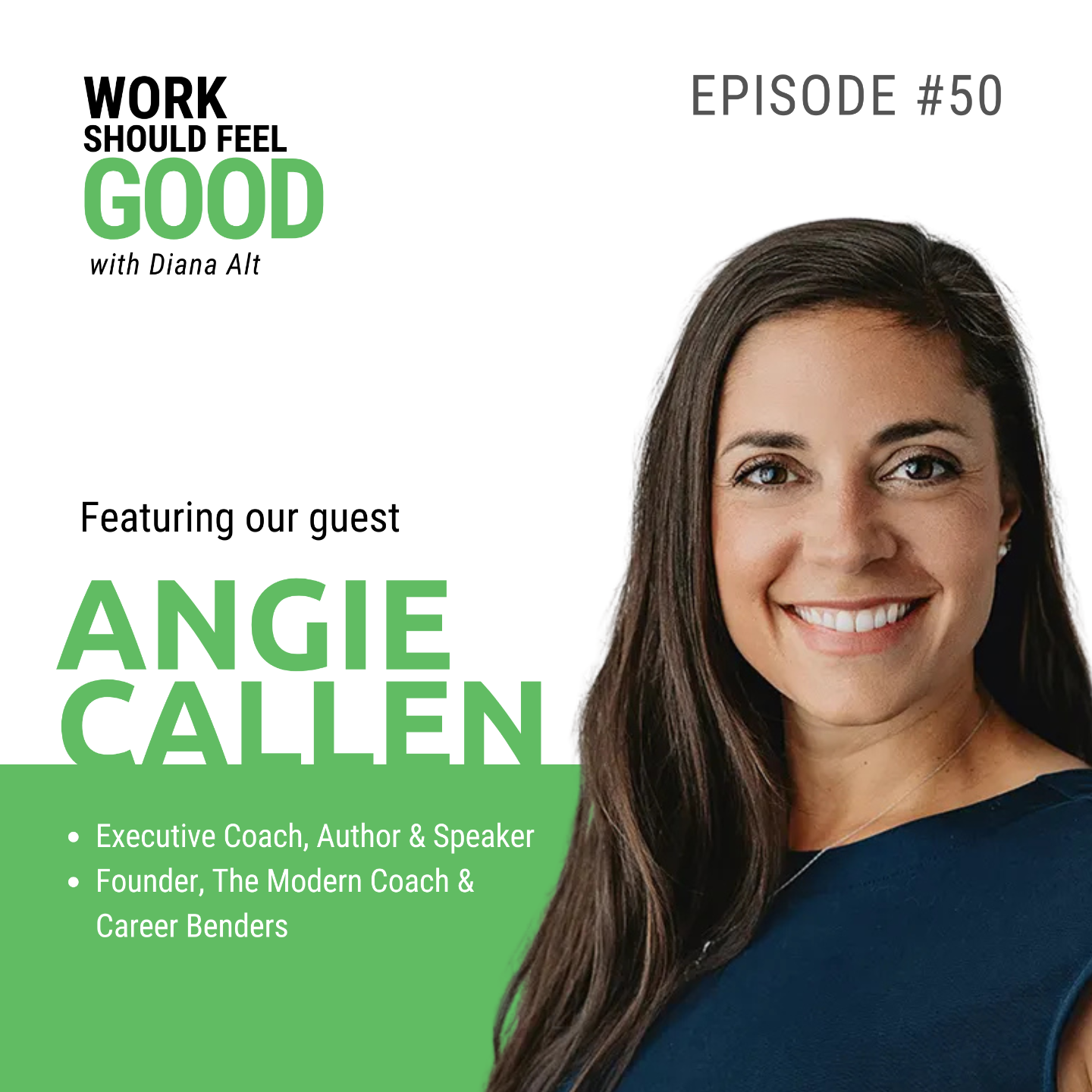
Episode 50: Gaining Confidence through Action with Angie Callen
Diana celebrates episode 50 of Work Should Feel Good by bringing back her very first guest, Angie Callen. Together, they reflect on growth, risk-taking, and what it really takes to build a career and life by design instead of default.
They also unpack Angie’s new book, the power of confidence through action, and how to navigate the rise of AI without losing your human edge. If you’ve been feeling stuck, overthinking your next move, or unsure how to adapt to changing times, this conversation will challenge and ground you.
You’ll learn:
- Why confidence is built through action—not waiting
- How to shift from living by default to living by design
- What most people misunderstand about control and worry
- How to use AI without losing your human value
- Lessons from podcasting, entrepreneurship, and writing a book



Episode 50: Gaining Confidence through Action with Angie Callen
Episode Description
In this milestone 50th episode, Diana reconnects with Angie Callen to explore how confidence is built through action not before it. They unpack the realities of entrepreneurship, creative risk-taking, and how embracing imperfection leads to meaningful growth in both work and life.
⏳ Timestamps
01:00 Meet Angie Callen & her new book
03:00 Confidence through action vs. perfection
07:00 The trap of over-implementation vs. overthinking
10:00 Podcast growth: lessons from 0 to 50 and beyond
15:00 Why consistency matters more than perfection
20:00 The real ROI of podcasting: relationships & community
24:00 From Sunday Scaries to life by design
28:00 The mindset shift: default life vs. intentional life
32:00 Confidence is built by doing, not waiting
36:00 Using physical challenges to build mental resilience
40:00 Letting go of control and the illusion of certainty
44:00 Worrying as a false sense of control
48:00 AI, business, and staying human in a tech-driven world
52:00 Delegation, automation, and the future of work
💡 Take Action
🔥 Subscribe for future episodes → https://www.youtube.com/@dianaalt
📖 Grab my Resume Don’ts Guide → https://www.dianaalt.com/resumedonts
❌ Avoid these common job search mistakes → https://www.jobsearchmistakes.com
🚪 Wondering if it’s time to walk away from your job? → https://www.isittimetowalk.com
💼 Work with me → https://www.dianaalt.com
📢 Connect with Angie Callen
🌐 Website → https://careerbenders.com
🔗 LinkedIn → https://www.linkedin.com/in/angiecallen
📘 Facebook → https://www.facebook.com/careerbenders/#
📸 Instagram → https://www.instagram.com/careerbenders/
📸 Instagram → https://www.instagram.com/angieonanadventure/
🧵 Threads → https://www.threads.com/@angieonanadventure
📲 Follow Me
LinkedIn → https://www.linkedin.com/in/dianakalt
YouTube → https://www.youtube.com/@dianaalt
Facebook → https://www.facebook.com/dianakalt
TikTok → https://www.tiktok.com/@thedianaalt
Transcript
Diana Alt [00:00:01]:
Hey there, everybody, and welcome to Work Should Feel Good, the show where your career growth meets your real life. I'm your host, Diana Ault, and today I am celebrating episode 50 of Work Should Feel Good, and it's my first repeat guest ever of the show. I'm bringing back my OG guest from episode 1, Angie Kallen. Angie is an award-winning coach, international speaker, and an author now who loves to empower people to lead amazing lives and thriving careers on their own terms. Her new memoir/career development book, Scary Good: Discovering Life Beyond the Sunday Scaries, blends life stories with lessons that'll help anyone level up their career, business, and life. Sounds like an Amazon review, right? That would be mine.
Angie Callen [00:00:44]:
I was going to say, I wonder whose Amazon review that is.
Diana Alt [00:00:48]:
That was mine. A former engineer who loves people, Angie is one of the loudest voices proclaiming AI is cool and also humans still matter at the same time. So we're going to talk a lot about that. Welcome to the party.
Angie Callen [00:01:02]:
Thank you. This is a party. Congratulations on number 50.
Diana Alt [00:01:05]:
How cool is it? I would not have a podcast, I don't think, if it were— I wouldn't have 50 episodes right now if it weren't for you.
Angie Callen [00:01:13]:
Well, you know, you had to start somewhere, and I'm lucky to have been number 1. And thank you.
Diana Alt [00:01:19]:
Yeah. And you answered 800 thousand questions before I did the simplest implementation in the universe of a podcast.
Angie Callen [00:01:33]:
Sometimes you just start and then figure it out versus feeling like you have to have it all figured out before you have to start. Confidence through action.
Diana Alt [00:01:41]:
On that note, have you always been able to do that, or did you cultivate that As you grow, because I— this is, this is a new skill for me during the time that I've been a full-time entrepreneur. What about you?
Angie Callen [00:01:56]:
So when you say that, do you mean the idea, implement, starting, just figure it out later?
Diana Alt [00:02:01]:
Yeah.
Angie Callen [00:02:01]:
Yeah. I've, I've always had a high propensity for implementation. And in fact, at one point in time, I worked with a coach who was like, to a fault almost, because just as much as wanting to have everything perfectly figured out before, Starting can hold you back. Constantly wanting to implement ideas in real time upon them coming, coming into your brain is equally as challenging of a trap. And so I've had to figure out how to balance that almost the other way because I am very much from an entrepreneurial personality. Like, I have an idea, let's implement it. I have an idea, let's implement it. And at one point I had a team who made the quarterly goal, Angie's not allowed to give us any new ideas.
Angie Callen [00:02:40]:
And so that was So short answer is yes. I've almost had to learn how to keep it in check as the flip side of the coin of you figuring out how to push through the need for having things more figured out than needed. I fly by the seat of my pants really well, Dee.
Diana Alt [00:02:59]:
I admire that in you. I, you know, the thing that I realized that finally made me able to do it is it goes back to old school agile software development. I just had to change my definition of done.
Angie Callen [00:03:13]:
Yeah, that's a really good point for anybody out there too, is that a lot of times we equate done with perfect, but in the world of entrepreneurship, that's just a trap because they're like, nothing's ever done, and B, there is no such thing as perfect, especially, especially when you're dealing with human subjects who are imperfect. And so changing the definition of what's releasable versus Yeah. Versus done in the truest sense. There's a big gray area in between there.
Diana Alt [00:03:42]:
Yeah. It's one perk of working on software because you were a civil engineer, right?
Angie Callen [00:03:48]:
I was a civil engineer.
Diana Alt [00:03:49]:
So you built things that could be done.
Angie Callen [00:03:52]:
Yeah. That done has a different definition when people are going to be walking into a building that could fall on them.
Diana Alt [00:03:57]:
Yeah. Software is never done. And so I think that honestly, I would probably be completely insufferable if I had been like a civil engineer or building something tangible that could be done. But I was in software for 20 years, so that's never done. So we streamed this, uh, 14 months ago was the episode 1. What are a couple things that have changed for you since then? Like, the world has been—
Angie Callen [00:04:24]:
well, this is the big one that you alluded to. Yes. Published author in the flesh. I even saw it in the wild on a shelf at Barnes Noble the other day without expecting it, and it was extremely exciting. How cool. Yeah, it was unexpected and fun. I had actually gone into our local store.
Diana Alt [00:04:43]:
We got—
Angie Callen [00:04:44]:
we're really lucky. I live in the kind of the middle of nowhere, and somehow we were fortunate to get this brand new kick-ass Barnes Noble that opened just a couple months ago. And I was like, how perfect is that? B&N opening one, you know, 3 miles from my house right as I'm about to launch this book. So I went in to talk to them about having it on the shelf, and she goes in her computer, she's like, let me see if we can order it. Oh, there's already a couple here. And so I like, I went over and was like, ah, in the crowd.
Diana Alt [00:05:09]:
I'm sure everybody that has written their own book in a gritty way and self-published it in particular is like, how did that happen to get on your shelf? Were you working through a hybrid publisher?
Angie Callen [00:05:22]:
Like, what did you do? I actually think there's a very simple and less than exciting answer to it. However, uh, I'm not gonna Steal the Celebration. I'm pretty sure my neighbor went and ordered it. And when— and a lot of times when somebody orders a copy, they'll order 2 or 3 and stock the extras. And I'm pretty sure that's what happened because her 8-year-old son has been dying to have my book. And so they were like one of the first people to buy the physical copy.
Diana Alt [00:05:49]:
That's hilarious. The 8-year-old son.
Angie Callen [00:05:51]:
Fans of all ages over here, y'all.
Diana Alt [00:05:52]:
Fans of all ages. I love that. So has the 8-year-old read the book or had his parent read the book to him?
Angie Callen [00:05:58]:
I need to find out because there's definitely some material in there that I'm not sure is, uh, you know, rated G or PG. Yeah. Uh, so I actually need to find that out.
Diana Alt [00:06:09]:
Yeah, you should. I want to know what, what lesson the kid learned.
Angie Callen [00:06:13]:
I feel like— yeah, I think I'm gonna have to— I'll have to ask him and I'll have to see if he can put— I'll have to get a quote from it.
Diana Alt [00:06:18]:
That's a good idea. That'd be funny. Or you should have the 8-year-old on No More Mondays. That would be funny.
Angie Callen [00:06:25]:
Gosh, this— I mean, this kid's hysterical and adorable, and like, he's actually Jim as an 8-year-old. Like, loves, you know, outdoor things and sciencey nerdy things. And so that would be fun.
Diana Alt [00:06:37]:
I like it. Um, okay. So on the subject of podcasting, um, I just did Zero to Fifty. What do you remember about No More Mondays Zero to Fifty?
Angie Callen [00:06:50]:
Well, first of all, I'll tell you, Zero to Fifty in 14, 15 months is, you know, that is worthy of even medical leave. More congratulations when there was a medical leave in the middle of there. Because I don't know, for those of you that have never had a podcast, this is a— it's a lot of work. It's so much fun, but it is a lot of work to show up very consistently to an audience. Statistically speaking, most people don't do it past 10. So yeah, uh, for me, I'm trying to think back because that was like 5 years ago. So No More Mondays is, uh, just about to have 250. Episodes, which is like absolutely bizarro.
Angie Callen [00:07:28]:
And I, what I remember is in that first year, a lot of it was just figuring it out, which I would guess you would say in your first like 10, 12 episodes, it's like, how am I? I can talk to anyone. I am a former engineer who loves people, but how do I talk to someone in a way that someone else wants to listen to it? It was definitely something to work through in the, in the early years. And somewhere around 50, 60 episodes is when I feel like it really hit the stride. Of how do I get to the heart of a matter and dive in with somebody in a way that I can get meaning out of them without having to set a whole lot of context. I'm a contextual person. And so I could fall into that trap a little bit. And so that was a big thing that I remember happening within that first, like, year of episodes and really figuring out what topics people wanted to hear. And at that point, No More Mondays was much more of, I would say, a career-centric show where it was really, let's talk to people who actually like what they do for work to inspire all of you to like what you do for work, because I also agree that work should feel good.
Angie Callen [00:08:28]:
And it's evolved since then. And all of those conversations were part of the things that help you pick up on the common themes and what people are going to gravitate towards and what I enjoy talking about and who made good guests.
Diana Alt [00:08:40]:
I think that's really an excellent point. Like when I started this whole thing, my biggest concern was I'd been on like, I don't know, 25, 30 podcasts, something like that. And I was on hardly any other ones last year because I was so focused on mine. And I didn't know. I knew I got told a lot that I was a good guest, but I didn't know if I could translate that to being a good interviewer. And about 20-something episodes in, I had a huge boost in my confidence because Mike Kim, who has done roughly 7 million podcasts, of which No More Mondays is also one, right? And he's He basically came on my show and I don't know him real well. Like we run in the same circles, but I made a mention of it being episode 20-something. And he's like, wait a minute, what? Like you've only done that many episodes.
Diana Alt [00:09:34]:
Did you have a podcast before? I'm like, no. So I've had some confidence from somebody that was really good at it that I kind of don't suck at it. So, you know, that's, that's a nice thing to hear. So what about the journey from 50 to 200, which is a long time, but what are some of the things you remember shifting for you? And I know you said it used to be more of like corporate career focused and now it's evolved.
Angie Callen [00:10:04]:
When did you start making that shift? The somewhere around 125, which was about 2 years ago. I decided we're gonna, we're gonna go for a 1-year sprint because up until that point, for the first 100 episodes or so, we did seasons where there would be like 12 episodes and a break and 12 episodes and a break. And what I realized is the lack of consistency there, or the lack of consistent weekly releases, was actually like hurting the traction. Uh, and I also had a, a change in producer So I had a producer who had helped me start No More Mondays, and that changed over. And it essentially gave us, I would say, a little bit more creative freedom to test out some things, adapt a show format, roll off some things that I think have become cliché. I used to do a rapid fire. We used to have— we used to heavily produce things. So there are two real milestones in the 50 to 200.
Angie Callen [00:11:10]:
That stand out to me. One is somewhere around 100, we decided to do a full-year sprint. And I was like, we're going to release an episode every week for a year and see what this does. And I think 45 of those were new. So that's where I realized how big consistency mattered. And then somewhere around 175, I started producing the podcast as a LinkedIn Live. So that it went live to LinkedIn, Facebook, and YouTube instead of only going out to RSS feeds. It kind of went both directions.
Angie Callen [00:11:42]:
And that was— that helped a lot. But the bigger change there is we stopped editing. And so, we just make them live. They're live conversations. Taco has been in some of them. Dogs bark. Like, you never really know. Now, if there's a huge issue, we'll edit it.
Angie Callen [00:11:56]:
But we just started making them really live, raw conversations. And not only did it make our workload way easier, The traction in them really, really picked up because I think that's what people are gravitating towards now is like real human content. And that just like, ums are in there, a pause is in there, the sss are in there. Okay, cool. No big freaking deal.
Diana Alt [00:12:17]:
And it has a nice— 20 seconds is in there. Like, who cares? Yeah. So the only reason that I was able to do this is because you showed me that that was possible for a podcast because I was like, I always said I'm not doing one until I can just show up and have the, like, curate the people and have the conversation. And then you go into, like, the podcast groups on Facebook where these people that clearly have 5 listeners, 2 of whom are their mom and dad, are like, you should get rid of every, um.
Angie Callen [00:12:48]:
And so I was in my head, and you need to have a studio, and right, all of this stuff that's like, holy cow, how much lift are you gonna make me go through to see if I even like this?
Diana Alt [00:12:58]:
Exactly. And so I organized, it was only LinkedIn Live for 4 months, 5 months. I finally got it to, cause I'm like, I don't want to learn RSS Libsyn. Fuck it. We'll do it later. Um, and then I got all that stuff done right before I went out for surgery. And then my VA team that has been doing admin production type stuff, very little editing just for the audio, like stapling a beginner and ender on. They got the whole back catalog up.
Diana Alt [00:13:30]:
So in one sense, I've had the podcast for a year, but in another sense, from an RSS perspective, I've only had it for like 7 months. So, and it takes a year plus to get traction on that angle. So I'm like, people ask me my downloads and I'm like, I don't know. Yeah.
Angie Callen [00:13:46]:
Who knows why I didn't even try to have a download. That's the thing. You have to know why you're starting it. And so when people are like, hey, I want to start a podcast, or also now I want to write a book. The first question in either is why? What do you want from it? Because for me, podcasting had to— and I would actually put this back in the what I realized thing, and it was somewhere around the 50 to 100 mark. I realized one of my favorite things about podcasting and one of the biggest areas of ROI for me is the community I've been able to build and the conversations I've been able to have and the type of people I've been able to engage. Because I have a specific ask and a reason to sit down with them, which is just easier to put out there and easier to say yes to than randomly meeting somebody at an event and saying, I would love to have a virtual coffee with you every once in a while, right? This creates something much more longer-lasting and tighter-knit. And that's been one of my favorite outcomes of it.
Angie Callen [00:14:46]:
And it doesn't matter if you've got every single little T crossed and I dotted to have the conversation and to start somewhere.
Diana Alt [00:14:55]:
Yeah. Um, that all was just kind of going through what I wanted to get out of it was really important because people are, are so confused by me because I'm like, I don't, I don't know. Like, I don't know what downloads I had. Am I supposed to care about that? Um, I said I started this podcast for two reasons. One, I wanted to talk to cool people. And build a network. And number 2, I wanted fodder for content. And everything else is gravy.
Diana Alt [00:15:29]:
And it's really interesting because I'm starting to take some bigger swings for guests because almost everybody I've known fairly well out of the first, you know, we're at 50, like almost, I think 40 of them have been interview episodes. I've done some solos and then I realized I had too many people I wanted to talk to. So I'm taking a different approach. Um, but I mean, I'm having people that have hundreds of thousands in their social following now. And on my list in Monday, I have a big old list in Monday of people I want to talk to. One of them is Seth Godin and someone I talked to about that, that is like a small podcaster like you and I are, is like, good luck with that. And I'm like. I have 100% confidence that I will have Seth Godin on this show.
Diana Alt [00:16:18]:
Yeah, 100%, unless he drops dead, because he does shows. You gotta have a good, like, not pitch slap ridiculous gross approach to him, but you can get Seth Godin on your show if you have a solid established show. Yeah. So, okay, let's, let's shift to the book. Okay, so you have this cool book Some of the best cover art ever. I will have to thank you, the COVID artist, whenever I decide to do a book. But let's talk about the principle behind the book. What are you like? What made you— you've had a newsletter called Sunday Scaries for a long time.
Angie Callen [00:16:55]:
Yeah, I was going to back up and say, because to me, the principle behind—
Diana Alt [00:16:58]:
there's so much to you, like even getting to this theme for the book.
Angie Callen [00:17:05]:
And the principle, I think, was always there. It was the shell that took a little while to figure out. So I have always believed that we have way more potential than we use and that we're way too accepting of mediocrity in this country. And that came— that really came into view for me about 10 or 15— well, no, it would have been 16 years ago when I moved to Colorado. This is when the plant, the seed was planted. Okay. When I moved to Colorado, I moved from Boston to a ski town, which was the goal. And I got to transfer through the engineering company I still worked for at the time.
Angie Callen [00:17:40]:
And when I did, I remember my friends in Boston, my ski friends were like, oh, I'm so jealous. You're doing what I've always wanted to do. And I just kept thinking, well, I'm nobody special. You could do this too. And that was the beginning of me realizing that we have a ridiculous risk tolerance that keeps us from, from living fully on our terms. Now engineers are the worst, and engineers are the worst because, you know, overanalyzing. And it took years for that to really manifest into the clarity it has today. But I do know that in hindsight, that seed almost 20 years ago is the tree that has, you know, completely manifested today.
Angie Callen [00:18:18]:
And so 5 years ago, well, 212 episode editions ago, 212 weeks ago, I started a newsletter called Combating the Sunday Scaries, and it was just 7 tips to improve your week. And for the first 2 years, it was very much just 7 tips to improve your week. You know, meal plan, write down your goals, things that are just like generally professional development oriented, right? With this goal of helping people not dread Mondays so much. What's interesting is over time that evolved into what antics did Angie and Jim do this week and what can city person over there learn from them? And so, like, it really happened. I remember specifically writing a newsletter about 7 things I had learned by going to, like, 8 ski clinics in a season. And it was like the amount of response I got to the email and the open rates, like, blew up. And I was like, okay, we're on to something that when I give people a snapshot into my life, there's something they're able to take away from it, even though we're earthy, crunchy mountain adventure people and you might live in a concrete jungle. There's a relatability in the way it's presented that helps people think about life and work differently.
Diana Alt [00:19:30]:
Well, and I think one of the things, especially for people that are kind of in the elder millennial and, and older category, is that we were raised with this weird-ass idea that you were going to be a different human at work than you were going to be in the rest of your life, which Even if that was a good idea, which it's freaking not, we live in a digital age where you can't— unless you want to live in fear of ever standing for anything publicly, which a lot of people do. Again, is that a good idea? I don't think so. But I like the melding, and that's something I always try to do too.
Angie Callen [00:20:13]:
So yeah, is it— it's this, uh, and, and, you know, Combatting the Sunday Scaries evolved from here's some tips to hate Monday less into here's how to have a more intentional life where your career and life complement each other instead of compete. And that's our shared platform of no more Mondays or work should feel good, whatever way you want to look at it. That's kind of our shared platform. And so what I realized, it was actually last summer, is what I had been doing over 200-something editions of The Sunday Scaries was essentially chronicling what it looked like for me to live a life by design instead of default. And years ago, I had hammered out about 20,000 words of what basically was just a memoir. And I had been trying to think about what to do with it. I've wanted to write a book for years. But I just didn't know that I didn't have this.
Angie Callen [00:21:06]:
I did not have the COVID art quite literally. And so I didn't know how to put it together. What's the thread? And so I had this, I had this chronology that I had hashed out of all of these milestone moments of good, bad, and ugly that have happened over the years. And what I realized this past summer was that we were about to hit 200. And in honor of the 200, I wanted to publish the book because smack me in the face, that was the COVID That was the common thread to take all of these things that show you what a life by design looks like now and weave them into a chronology of how I even got to this point and just be super honest and vulnerable and treat it more like a storyteller than a should-all-over-you self-help book.
Diana Alt [00:21:52]:
Yeah, I can't with the should. I mean, I, I can't. It's, it's not nearly as interesting as— and you can't apply shoulds. I— you can apply, I was open to picking up this stray kitten in Kansas City and naming it Taco.
Angie Callen [00:22:10]:
Right around the corner.
Diana Alt [00:22:11]:
This is one of the first things that I ever learned about you, which I love.
Angie Callen [00:22:14]:
Which is so hysterical since he was right around the corner from your house and you love tacos. It was like we were all meant to be together.
Diana Alt [00:22:20]:
Yeah. I was like, well, we're friends forever now. Angie and I met, we just had met, like been orbiting each other for a little while. And then we decided to get on Zoom. Within the first few minutes, I got the Taco Cat story. Which I think we talked about in episode 1. And then we found out that we both knew Terry Weaver, um, which was another wild thing.
Angie Callen [00:22:43]:
That was, that was some worlds colliding right there.
Diana Alt [00:22:46]:
That was really wild. So, um, hi Terry if you're listening. I was just gonna do the same thing. Yeah, we love you Terry. Um, so there's so much in writing a book, and a couple things I want to know because we're not going to rehash the book. Like, go buy the damn book.
Angie Callen [00:23:03]:
It's good. It's good.
Diana Alt [00:23:03]:
It's worth it. But one thing I will say is to kind of tease people a little bit. If you— if people would only read one chapter of the book, which one would you have them read? What do you think's the most important?
Angie Callen [00:23:21]:
I have two. Okay. One, because I think there's really one answer, but there's also like a little bit of a side note. To me, I think it's Chapter 11, which is confidence comes through action, not the other way around, which goes back to where we started this entire conversation today is this idea of reframing what done means in order to take a little bit more risk and do the thing. Yeah. Hi, Terry. Right? Because we get so caught up in it needing to be the right time, it needs to be perfect, conditions need to be met. I will wait until the kids are out of school.
Angie Callen [00:23:57]:
I will wait until they're older. I'll wait until, until, until, until. And speaking of shitting all over ourselves, we wait until conditions are right and we can feel more confident to do the thing before doing the thing. But ultimately, you know, why put off to tomorrow what you could do today? And in doing that builds confidence. And the reason I'm going to say 2 is because my favorite chapter is Chapter 8, and it is very much the mechanism with which I discovered Confidence Through Action, and that is that play is power. So, we are huge, you know, mountain adventure nerds, and I have done some ridiculous things like stand up on a paddleboard in Class III whitewater rapids. I learned how to mountain bike at almost age 43. I switched from snowboarding to skiing in my 40s.
Angie Callen [00:24:42]:
I didn't even learn to snowboard at all until I was 23. And so, for me, it's been like physical. Physically challenging myself is what helped me build the confidence that spread into other places. And so in a way, chapter 8 is very pivotal to my story and how I came to build confidence through action and just taking one brave step at a time to get somewhere that really meant something.
Diana Alt [00:25:06]:
I really love that you brought that up, that it was physical that helped you become more confident in other areas of your life, because I think a lot of times people aren't very creative Even people that in some ways, like, they don't do a good job mixing the parts of their life. So they might be creative about work problems at work, but they're not very good at trying to figure out how does this thing I learned at work apply in my real life and vice versa. So for you saying like, look, I started going out and doing all this weird shit in the mountains and it made me feel confident to. Leave a job I hated, you know, start a business, et cetera, et cetera. Um, it's all really good. And I think some of my favorite parts were about your whole journey of building the bus. So we talk about this in episode 1, guys, but Angie and her husband basically lost everything and they had, they went and bought a school bus and rehabbed it and had that as their tiny home for a while. And there was a lot of emotion about that that does not come out when you do talk about it on a podcast that did come out in the book.
Diana Alt [00:26:18]:
I was like, oh, this is my good friend that I just— now I know her better. So yeah, very cool.
Angie Callen [00:26:26]:
I say this from the stage when I talk about AI. However, you want to know how human you are, you shove your dog, your cat, and your husband in 225 square feet and call it home full-time for 4 years. Like, you know, I'm divorced. And not get divorced while going through complete financial and near life ruin, right? I mean, the people now— so then, you know, the, the, uh, the resolution to all of that is I was able to— my business bought us our house. Like, we were able to buy a real house. It does not have wheels. It is more than 225 square feet big. And that's kind of the resolution to, you know, to the whole upheaval and, and, uh, it's the other side of the bell curve journey.
Angie Callen [00:27:05]:
But it's so funny because people would say to us like, oh my gosh, buying a house is like the hardest thing a couple does. And I'm like, you ain't never lived my life, right? I mean, this was—
Diana Alt [00:27:16]:
I have a lot of things that I would put above that, above.
Angie Callen [00:27:21]:
And I don't even have the kid part to add to the list. But, um, yeah, I think it, you know, it goes back to this idea that We don't, we don't believe we can do hard things until we either have to do or choose to do hard things. And by keeping ourselves from that, whether it's intentional or circumstances, right, uh, you learn a lot about yourself and you become a more complete human. Doesn't mean I like everything that I discovered. However, I'm a more complete and self-aware, uh, emotionally intelligent human for going through challenges and taking risks, some of which panned out and some of which really didn't. Yeah.
Diana Alt [00:28:02]:
So, um, on that, a question that I just, I wrote down on a Post-it a couple days ago, like before I even was really preparing for this, was what is something that the act of writing and launching the book forced you to face about yourself? Oh, you know, in a way, you— I've done 50 episodes, so I'm asking good questions.
Angie Callen [00:28:32]:
I'll be back next week. You know, I'm actually going to come back to— the answer is Chapter 11 again. And here's what's interesting: I didn't realize that what I was doing is building confidence through action until I was talking about all of the experiences that had helped me do it and that I brought it together, and that all brought it together. And it was so— it was really interesting. It's so fascinating to like— it was like a walk down memory lane for myself, which was really fun, by the way. Also, side note, writing the book is the easy part. Everything that comes after is the what you want— what you want to do, what, uh— but it was—
Diana Alt [00:29:06]:
I was—
Angie Callen [00:29:06]:
I actually had so much fun because I were— I was recalling stories and memories and things that like I hadn't thought about in years and years and years. Or like in reading through a chapter, I'd be like, oh my gosh, I totally forgot to tell the story about when Jim made me go to bed crying in a tent because he told me he wanted to have kids after a year and a half of me thinking he understand we didn't, right? Like, just these things that you realized were like more pivotal moments than you may have thought of. And putting all of those together and stringing all of that together made me realize what I was really doing and almost synthesize how I had discovered life beyond the Sunday scaries over the course of 272 pages. And so it almost became my own cathartic exercise while being able to give it to other people for the same goal.
Diana Alt [00:29:54]:
Thank you for sharing that. That's very cool. I think that confidence through action and focus on controlling what you can control and not on everything else, or if, if people listening to this could learn two lessons in life that would change absolutely everything, those would be the two. Because it keeps you from being stuck. Like the both, both waiting for confidence and trying to control things you can't control keep people paralyzed and miserable.
Angie Callen [00:30:27]:
Yes.
Diana Alt [00:30:27]:
Or if not miserable, just— I like that you said life by design instead of by default, like just operating by default.
Angie Callen [00:30:35]:
And allowing— and I'll put a stamp on that— allowing yourself the freedom to explore that, because I think that's also something that lingers from old school mentality, by the way. I started my career, I went to school, chose my degree and started my career in the old way. And then the Great Recession, I think—
Diana Alt [00:30:55]:
You were really good at math and science.
Angie Callen [00:30:57]:
My dad said, "Andrea, you're good at math and science, go to engineering school." Okay. And so, and then Great Recession was, I think, the tipping point that started that along with some other factors that all came at the same time, really started to change the way that we can live and work and what was available to us. And I continue to be glad that I'm an analog kid who had to adapt to the digital age early in my career. And now middle of the way through, I am figuring out how to adapt to AI with all of the foundation and memory of analog and digital before it. But because of that, starting in the old way of thinking, that a lot of that still, I believe, is still rooted in, in society and in our thinking. And a big part of the message that I wanted people to get through this story in through more of a show than a tell is that you deserve and you have the freedom to explore what it means to design instead of just taking default and status quo as your only option.
Diana Alt [00:31:54]:
Yeah. Um, I feel like default, it's when you see what living by default does, you can't unsee it. And then when you see people that are doing it You can't unsee it either. And it has nothing to do with what they're actually doing, whether they're in corporate or own a business or climb the ladder or stayed to be kind of a craftsman in their chosen area, has absolutely nothing to do with that. It has everything to do with how they got there, why they're staying there, and how they feel about it. So, um, when people say to me things like, well, everyone knows XYZ sucks, like XYZ kind of job sucks, or I'm like, it sucks for you. For you. And it might be that a majority of people think that sucks, but there's somebody out there that finds purpose in that.
Angie Callen [00:32:50]:
So everything is a choice. Our friend Eric Neerlich wrote a book that's called You Have a Choice. Yeah. Accepting default is a choice. In making no choice, you've made a choice. And it doesn't mean you have to like burn your whole life down to the ground or leave engineering in the middle of a Great Recession and take a job in a shitty gallery in downtown Aspen. You're going to make no money. You don't have to do that.
Angie Callen [00:33:11]:
Just so happens I did, and that's how I can tell you you don't have to do it. However, making no choice is a choice. And I think the control thing is so important because it is one of the things that keep us from inaction, because what we do is we control the wrong things. We don't, we don't exercise control where we actually do have it and don't think we do in making choices in our career. We control everything else to essentially keep us from having to make the choice or exploring what design looks for— looks like, and relinquishing some of that futile control and surrendering a little bit where it isn't needed and exercising it where it is and where it's useful makes a huge difference.
Diana Alt [00:33:49]:
Can I tell you one of the, um, acts of control that people do and they don't even realize that that's what it is? Please tell me. Worrying. Oh, worrying is just an emotional act of attempting to control things. And sometimes there's not even action taken. But if you are just sitting in your house worrying about what's going to happen at work tomorrow, that's trying to control stuff from an emotional standpoint. From an emotional. And I have had, I've had people challenge, I don't try to control. And I'm like, you just told me that your top worry right now is that, you know, there's going to be a big layoff and you're going to get cut.
Diana Alt [00:34:33]:
Yeah, but you're not doing anything to prepare in case that happens.
Angie Callen [00:34:37]:
You're just worrying and giving yourself anxiety.
Diana Alt [00:34:40]:
Exactly. You're just freaking yourself out for no good reason.
Angie Callen [00:34:43]:
So let's— you know what somebody said to me once that was a good, uh, a really good response to that is, what, why put yourself through it twice? Oh, oh, that's very good. Yeah, especially because you don't even know if it's gonna happen once. So why put yourself through the emotional trauma of projecting an outcome that you don't even know is going to happen? Deal with it when the time comes. I know that sounds like a procrastination move, but it's just—
Diana Alt [00:35:13]:
Nobody got time for that. Yeah.
Angie Callen [00:35:13]:
Nobody got time for that. No, exactly.
Diana Alt [00:35:17]:
Let's shift a little bit. I want to talk about AI and humans and let's mash them all together. Let's mash it all together because you're that person. So that whole, like I said earlier, the former engineer who loves people, you are a kind of, I wouldn't call you a loud advocate for AI, but what you are is the person that loves humans and you're also like, and AI can be really cool. Yeah. Which I think is probably the healthiest place to be, especially if you're not trying to be a tech bro. So let's first chat a little bit about what you kind of, what's your evolution of using, adopting AI in your business? What's that been like for you? Super fun. And what have you, I'm real curious what you've changed, like what kind of has shifted in how you do business?
Angie Callen [00:36:14]:
And I'll go, I mean, I can go super nerdy with this. And there was a, there was a catalyst to it that I'll tell you about. But I'll go back to the former engineer who loves people has finally figured out why she went into coaching. And it's because I have the ability to bring the dual mindset, right? I do intensely love people. I am extremely emotional and intelligent and can really connect with humans. However, I have this odd duality of extreme analysis and quick adoption to things. But also, some of that goes back to, and how I've brought into my business, goes back to the fact that I have that perspective that has spanned analog kid adapting to the digital age early in career and now adapting to AI mid-career. And it comes down to a couple of things.
Angie Callen [00:37:01]:
First of all, I believe that we can be and we should be and we need to be AI-enabled humans on purpose. There's a lot of double meanings in there, right? You need to be a human, use AI purposefully to be enabled, not replaced. Because if you are anything more than 5 years from retirement, I'm sorry, you cannot stick your head in the sand and pretend like AI is not here and is not changing the way that we live and work. That's just ignorant. I'm sorry, I'm going to call you out. And so for me, I think about how do I want to purposefully bring this into my business to replace or enhance or potentially even expand things that don't disrupt the human experience, right? So it's not about scaling me. It's about removing things from my time that can be put into an AI system with little to no disruption of human connection, human experience. And human-centered business.
Diana Alt [00:38:11]:
Have you in general, uh, been good at delegation? Because I know you've had a VA that worked with you for quite a while, mostly focused on marketing systems and stuff. So when you have worked with team members like that, has it been a struggle for you to delegate? How difficult has that been for you? And if it was, what made it hard?
Angie Callen [00:38:35]:
Uh, so this actually comes back to the AI conversation in a way, so I'm glad you went there.
Diana Alt [00:38:40]:
So yeah, If you can't delegate to a person, you can't delegate to AI.
Angie Callen [00:38:46]:
And I'm going to answer that question in a second because there is a response to it. But in general, you have to know how you would delegate to a human, even if you haven't and you want to go straight to AI. You will be able to onboard and create AI and automation processes that are better, less disruptive, and more human and more integrated if you know what the manual human process was. That's how I treated the onboarding of AI and automation in my business was to look at, okay, what is my VA? And also, by the way, my VA had to leave me. And so it provided this very weird timing that I also went to AI Marketing World at the exact same time. And I got the catalyst to start thinking about this of like, what is my VA doing as a manual process? That really could be an agentic process. And so what I did was look at everything she did when she left and say, what of this could be moved to an automation? And then what really needs to be human? And now when I bring a VA back in, I have more resources to put towards more human creative things that I can't, can't process out. But the big thing was we already had a process mapped out.
Angie Callen [00:39:57]:
And I think that's important because I've had people who have said, I have one of my, my automations and my, my AI, my agents is a podcast operating system that takes like all my content, emails, guests, does all of these things and saves me about 12 steps in every single episode. But all of that had to be— was just a click, click, click, mindless clicks, right? So, why not have a mindless thing do the mindless clicks? And I had somebody who was like, I want to use this. I want to use your OS. And I'm like, okay, let's beta test this. But it was somebody who didn't even have a podcast yet. And I was like, hold on, why don't you go figure out your human process and then build your system to align with that versus having to shove your—
Diana Alt [00:40:39]:
That's very much— —human process into an AI framework. I've always believed in that because like, I, I mean, I spent 20 years in software in various roles, and one of the top rules that one of the people I worked with early in my career had, she was basically what we, we would now call like the senior product manager over the CRM platforms. Her rule was, I am not automating a process that you can't prove to me that you've done on paper for 3 to 6 months or from another system because it was heavy. We used Siebel and it was heavy to configure. So I actually have a very well-working SOP for all the podcast administration. You can vouch for that. Which I did not have on episode 1, but I have for episode 50. And so I'm looking at like, okay, this works like a charm.
Diana Alt [00:41:30]:
What can I do? So, because I want to burn less VA hours for this and have them do more with other stuff.
Angie Callen [00:41:38]:
So, well, and, and that to me goes back to this idea of the, this like seeming contradiction of loving humans and loving AI is that if used responsibly, thoughtfully, and intentionally, it actually gives us as a human a way to augment ourselves. And, and, and so if you really think about man and machine, not man or machine or machine or man, if we think about the fact that like, you know, this is now a team and they are part of it, how do I leverage those resources for maximum effect of the human product that we already have? And that's what I think is, is really important. And the delegation piece, to come back to that, I tend to lead the way I want to be led, which is, here's a project, don't talk to me, tell me when you want it, and I will come back and meet expectations. I need nothing. Unfortunately, most people can't be led that way. And so, I've had to learn kind of a mix between leading and managing. And when that comes to delegating, I can be very hands-off and just be like, own it, I don't care about it, once the trust is there. But sometimes there are things I'm oddly picky about, and I know that.
Angie Callen [00:42:51]:
And what are you oddly picky about?
Diana Alt [00:42:52]:
What are you oddly picky about?
Angie Callen [00:42:54]:
I mean, it just, it's, it's, it's, it could, it could be random. It could be, it could be a graphic where I'm like, for some reason I'm going to nitpick the shit out of this one. But the one you made 3 days ago for something totally different, I didn't care about. Right. It's just, yeah, there's a, I don't know, I could be, I'm particular in some regards, but otherwise have been, have figured out what to compartmentalize and delegate. And that's helped then figure out what from those compartments can go into You know, N8N agents and automations. Cool.
Diana Alt [00:43:24]:
Um, for me, like I'm weirdly picky about content. And so, but what's interesting is I will go try things every few months that I didn't want to let, um, like ChatGPT or whatever write for me. I'm like, oh, it's getting better and better and better. And now I realized the other day that I hadn't looked at show notes in like 6 weeks. 'Cause I just made a GPT and my person does it. And are there mistakes? Probably. But I just go into Libsyn and fix it and it pushes it out and it's fine.
Angie Callen [00:43:58]:
So definition of done.
Diana Alt [00:44:01]:
Well, and I write good show notes. Like I wanna serve the people. It's very important for me to have the people on my podcast feel like they are respected. I don't care if it's somebody that has no business aspirations or, you know, media aspirations of their own. They're just a regular-ass person that comes on the show talking about their career, which I do have. Or if there's someone like you, I'm like, I don't want to do anything to damage Angie's brand because I've screwed up, but it's getting a lot easier. So I'm at the point now where my VA agency I've worked with for 6 years is starting to do more automations. So I think the next generation is—
Angie Callen [00:44:44]:
And that's a big thing to think about because I know there's people out there. I mean, if you look at the statistics on people that have adopted AI, it is astronomically low. We just tend to run in a circle of people who have, so we don't realize it. And that's why—
Diana Alt [00:44:59]:
Adopting AI like—
Angie Callen [00:45:01]:
Oh no, I mean just plain old using ChatGPT, right?
Diana Alt [00:45:03]:
Like just plain basic research. Making a grocery list. Is falls under the adopting AI. I don't have a single agent yet.
Angie Callen [00:45:10]:
And most people don't. So, but even what I'm saying is the number of people have even gotten to that point is astronomically shockingly low. And yeah. And so, and here's the thing, and you just made the perfect point and gave the perfect example of the fact that there is a fear around AI in this whole, like, it's going to replace me. Guess what? If you stick your head in the sand and pretend like it It doesn't. It unfortunately will because you can't be the VA who knows how to run the agent. You're still stuck trying to just do the work. Right.
Angie Callen [00:45:42]:
And that's a perfect example of what it means to be displaced versus replaced and where we have the ability to control what we learn, how we use things, being an AI-enabled human on purpose so that there is a place for us in the future of work versus being left behind because we weren't willing to accept that's where the future of work was going.
Diana Alt [00:46:03]:
Yeah. So I want to pick, I want to poke, this is my own more of a curiosity, but somebody else that like is running a business or starting a side thing will probably gain from this. So you have shifted your content strategy both in terms, like you've clearly been shifting topics because you've gone more and more towards executive and business coaching. That's not necessarily what I'm talking about. I'm talking about kind of the how, what you decided to do to get your message farther onto more platforms more easily and how you used AI to do that. I would love to hear you unpack that because I think I'm on the cusp of this and I like to crib off of you. So what did you, what were you doing? Like talk people through the transformation. Like what were you doing? Where were you doing it to? How much time was it taking you or your team? And then what are you doing now and what are you seeing as a result?
Angie Callen [00:47:01]:
Well, and all of this is the perfect dovetail off of the conversation about VA time, where it's spent, you know, automating things that were a human process and don't need to be and opening up time, but augmenting ourselves in the process. So essentially my VA handled like 90% of content. And so essentially it was, this is one of these things where You know, I would write the Sunday Scaries and put it in a Google Doc and then that was it. I never had to touch it, put it anywhere or do anything with it. She would put it, she would then manually process SOP it onto, into the email, into LinkedIn. And that was it at the time. So when it was a human process, those were our channels and the content was also not being repurposed.
Diana Alt [00:47:46]:
Was it a LinkedIn newsletter? It was the late '80s.
Angie Callen [00:47:49]:
It still is. And so its primary channels were traditional, like our email list and a newsletter, and that was it. There were things in there I always wanted to do, like repurpose it into social media content. We just never kind of had the time. And then there was also the podcast, which basically released as a live on my content platforms and on the RSS feeds once a week. And the buck kind of stopped there. All of our social content was more driven by events or things that she would create. And so in a way, we were toiling a little bit and not using content in all of the possible distribution channels only because it was a lot of work.
Angie Callen [00:48:29]:
Yeah. Enter AI. I am now creating probably 10 times more content across 3 or 4 times as many channels as I was before. Because we have the ability to do it. So for instance, one of my, my podcast OS takes the transcript from a recording and pushes it through a series of steps that create a post on my website, which we weren't always following through the cracks before, repurposes it into a Substack post, a Medium post, and creates 7 pieces of content for social media through the week. Nice. And I'm doing that. Oh no, that's even, that's, that's the Sunday Scaries.
Angie Callen [00:49:14]:
That, okay, so that's Sunday Scaries. Now we do the same thing with No More Mondays, but it takes those and makes like 20 pieces of content. Plus I have video snippets going out. And so what was probably 4 social media posts a week has turned into 20 to 30 across twice as many channels. And that might not sound like a big, a big deal, but it's driving a lot more visibility. For us. And it's helping me use my, my best content in a bunch of different ways. And we weren't able to do that when it was a human process.
Diana Alt [00:49:44]:
I'm so glad that you brought this up because literally tomorrow at 7:00 AM, I'm meeting with my VA team to say I want to do an experiment and I'm not going to disrupt the podcast. But our mutual friend Mark LeBron is like, You're too good on video. Gotta do this. He's, he's a big YouTube guy. So I'm going to start doing what I'm referring to as like an anchor video every Friday. I think that's what I'm going to do it. And then I'm going to record this and record a few shorts, not clips, shorts. Um, cause I have clips galore from the podcast and they don't perform.
Diana Alt [00:50:24]:
If you're all clips everywhere, it doesn't perform as well. So I'm just gonna give them 6 things and tell 'em to do their best and see what comes up for a few weeks. And then if it goes well, I'm gonna like potentially kind of overhaul what I'm doing. And I don't even know what they're doing on AI and automation on their end. I have written them SOPs for the podcast, but my whole goal is to say, I'm not giving you anything. I wanna see what you do and how you do the process and how it works. And then if we need to rework this stuff, it's good. So I'm a content from my cold dead hands kind of girl.
Diana Alt [00:51:00]:
So—
Angie Callen [00:51:00]:
Oh, I was too. I mean, I used to, and to just kind of go back, I wrote, write, I still write every word of The Sunday Scaries. Sometimes I'll use a GPT to help me like with blank page or fill in a tip, but they're all still written. But like, for instance, LinkedIn is my main platform. I would show up every single morning and handwrite a post for it. I've backed off of that some just because the algorithm doesn't make me want to do that as much. And I'm also distributing stuff elsewhere. And so there's places where I know I need to show up.
Angie Callen [00:51:32]:
LinkedIn is one of them. And there's places where I know, you know, an image that looks like text can be, can be put up that AI created, but that I like what it says. Right. So you'll know kind of where that falls. But the big thing is now, though, and to go back to the displacement thing, those VAs are now managing the agents that are working for you instead of doing the work. So now you can produce more. Their time is equal. It's just spent in a different capacity.
Angie Callen [00:52:00]:
And your, and your impact is greater. And our impact is greater.
Diana Alt [00:52:04]:
Two more questions on this. And, you know, I'll just probably call you and ask you 500 other questions in the next few weeks. So the first one is, are you actually approving content before it's posted? Like, how are you incorporating quality check?
Angie Callen [00:52:20]:
What does that look like for you? So I have, I have an agent that pulls the transcript repurpose or pulls Sunday Scaries and repurposes it into multiple different formats, some of which go through trained GPTs in order to output something as close to what I want as possible. And then at the end, it pushes it somewhere that I then have to come and finish. So for instance, it'll push like the Medium and the Substack Sunday Scaries to a Slack note for me where all I have to do is go copy and paste it from one place to put there versus having to go into a GPT for Substack, put it in there, pull it out, copy paste, go into a GPT for Medium, you know, pull it out, copy paste. I go to one central place and pull two things out and put them where they go, but I have a chance to read it. Cool. Same with all of the social content. It pushes them into drafts. In my social scheduler where then I go in, finalize, choose what I want.
Angie Callen [00:53:16]:
There's always some bad eggs in there, ditch them and actually schedule them.
Diana Alt [00:53:22]:
Yeah. Cool. Because I think for me, the answer is probably going to be some of the stuff lands on a Google Doc or like the Slack notes, an interesting idea. But there's no reason the email couldn't be a draft in Kajabi. There's no reason that most of the social pieces can't just be a draft in Publer. So thank you for that. And then are you truly creating 20 different pieces of content or are some of them being used? Like, are you repeat, are you using the same thing on same exact post across any platforms?
Angie Callen [00:53:56]:
Both. So it is creating, so for instance, from a no, from a No More Mondays episode, uh, GPT will create for me about 25. Text as images. Now there's a nerdy reason that we do it that way. And it's a workaround because of what you can and can't do with some of these things. And so it'll make it look like it's one of those like white text on the dark background that you typed in and formatted, right? So it'll create like 25 of those for me. I usually end up using about half of them because half of them suck. And so that I'll take, I'll take those and I'll schedule them out across Facebook, Instagram, and LinkedIn.
Diana Alt [00:54:32]:
Okay. So you're basically, if you like it for all platforms, you'll use it. If either like this is only going to hit on Facebook, you'll use it.
Angie Callen [00:54:40]:
Okay, cool. But the important thing here, and I think this is, you'll, you will agree with this, is the, the, the, the agentic process is trunk is, is bookended by a human, human steps, which is I have to do a few things to give it the correct input and to start the process. And then I have to go back and finish what it outputted, which gives me human control. And that's how you make sure what you're outputting sounds like you, is in your voice, and is brand aligned versus sea of sameness AI jargon.
Diana Alt [00:55:09]:
Because you do not want that. That's not human. I got to tell you who I think needs this the most. It's the side hustlers. Because you're working 45, 50 hours at your day job. You're trying to build your little consultancy or affiliate market, whatever the hell you're building on the side, there's probably nobody that's in our daily lives that could benefit more from this than that. And they can probably— this is a dream. Yeah, for sure.
Diana Alt [00:55:38]:
Um, I had something else I was gonna ask and I forgot what it was. Um, human on purpose. You talk about, you talk about being a human on purpose. You talk about humans still matter. You have a whole freaking shirt that just says I do. I should have worn it. You should have. I was surprised actually that you did not wear that.
Diana Alt [00:55:57]:
When you think about the top things, so you serve job seekers and you serve executives and corporate and business owners. What is one thing that each of those groups needs to get their head around regarding being a human in the age of AI? Is it the same for everybody?
Angie Callen [00:56:21]:
Is it a little different? I would say there's, I mean, there's differences, but there's also really common foundations. There is, you have to know what kind of human you are and want to be, because you can't be a human on purpose if you don't know what kind of human on purpose you are, or if you don't know what purpose you have as a human. And that is important whether you are leading people in a team and inside of business, whether you are coaching people, uh, you know, or whether you're coding products that humans are going to use. Right? It's important for us to, you know, I, we live in a time now where we're living alongside of AI and that's never going to go away. And so leaning into our purpose as a human and our human skills is more important than ever. And that's the key, in my opinion, to setting a good foundation to then bringing your AI coworkers in sustainably. Cool.
Diana Alt [00:57:09]:
That makes a lot of sense. One of the sets of people that I feel the most empathy for in all of this is leaders, especially like middle, kind of those directors and VPs and companies where the board and the C-suite is breathing down the neck, adopt AI, adopt AI. And these people are trying to listen to both sides of it. They're trying to respect the business strategy. And meanwhile, of course, no one's training anyone on said AI.
Angie Callen [00:57:42]:
So there's, there's another hour episode, right?
Diana Alt [00:57:46]:
You can come back. Maybe we'll do episode 100. You can just come every 50 episodes until I die. So, um, what are you, what are you telling the executives that are struggling with that right now? Yeah, you work with—
Angie Callen [00:58:02]:
how? So again, well, again, I think this— you have to root, you have to root everything in your values and your purpose and intention as a human and as a human team. And so, if you don't know the purpose and where you want AI to sit in a business, it's not going to be brought in sustainably. And if you also are not connected to your why behind being a leader and what you value, you're going to have a really hard time standing your ground and vocalizing both the concerns and explaining the sustainable way to bring it into. A business to those like higher-level stakeholders who are basically just, well, do it. It's going to save us money. You know, as a leader, it is our job to buffer, right? It's our job to buffer down. It's our job to like buffer up. And we've gotten bad about that because we don't have as good of critical thinking skills.
Angie Callen [00:58:52]:
We're not as good of speaking our mind. And in this day and age, you— there's a way to do it tactfully and professionally. But rolling over and saying yes is not the way to lead sustainably as AI comes into your business.
Diana Alt [00:59:05]:
No, it's really not. And I've like, I've talked to a couple of people in the last few weeks that literally got pipped. They got pipped at work because they're technical. One's an engineer. I can't remember what the other one did, but they got pipped because they're not adopting AI fast enough and there were zero molecules of training. And don't be that leader, guys. You cannot pretend that your human, our employees are most important. Resource when you pull shit like that.
Diana Alt [00:59:37]:
We're almost ready to close, so I have one more question. Usually I ask everybody, what's the worst career advice you've ever had? But you answered that in episode 1, so we're not doing that. But what I want to know is, what is a piece of career advice in today's age that you find yourself debunking all the time? Oh, I mean, there's many.
Angie Callen [01:00:02]:
I was gonna say, I feel like I'm sorting through thoughts in my mind right now. Uh, which one do I want to pick out? You know, I'm actually gonna go because I— this feels like a little bit of a cop-out, but it actually is the number one in my mind. It just goes back to something we talked about, and that's the control factor. It feels as if we have absolutely no control over, you know, our careers, our development, our trajectory. And I don't believe that's the case. We just don't sit down and think about our priorities and our values in order to conduct a job search or to follow along a roadmap that aligns with it. And so that's why there's this illusion of no control when there actually is. And I'll put that even in the current times, you know, job searching sucks right now.
Angie Callen [01:00:52]:
Let's just call the dumpster fire the dumpster fire. And while this may seem very, very backwards and counterintuitive, the irony is if you know what you value and you're very clear about what you're looking for, you will actually find the right fit versus floating around in the wind like a career tumbleweed who no one can quite understand what you bring to the table and see you on the team. So it's almost a necessity to understand and have that clarity about where you want to go because that's how you're going to resonate in this market as well.
Diana Alt [01:01:22]:
Yep. I agree with that completely. So, well, I think we're going to end there. That's a beautiful way to button it up, talking about doing things on purpose. Thank you, Angie, for coming to the show. I really appreciate it. And everybody buy her book. It'll be in the show notes.
Diana Alt [01:01:37]:
See you guys later.