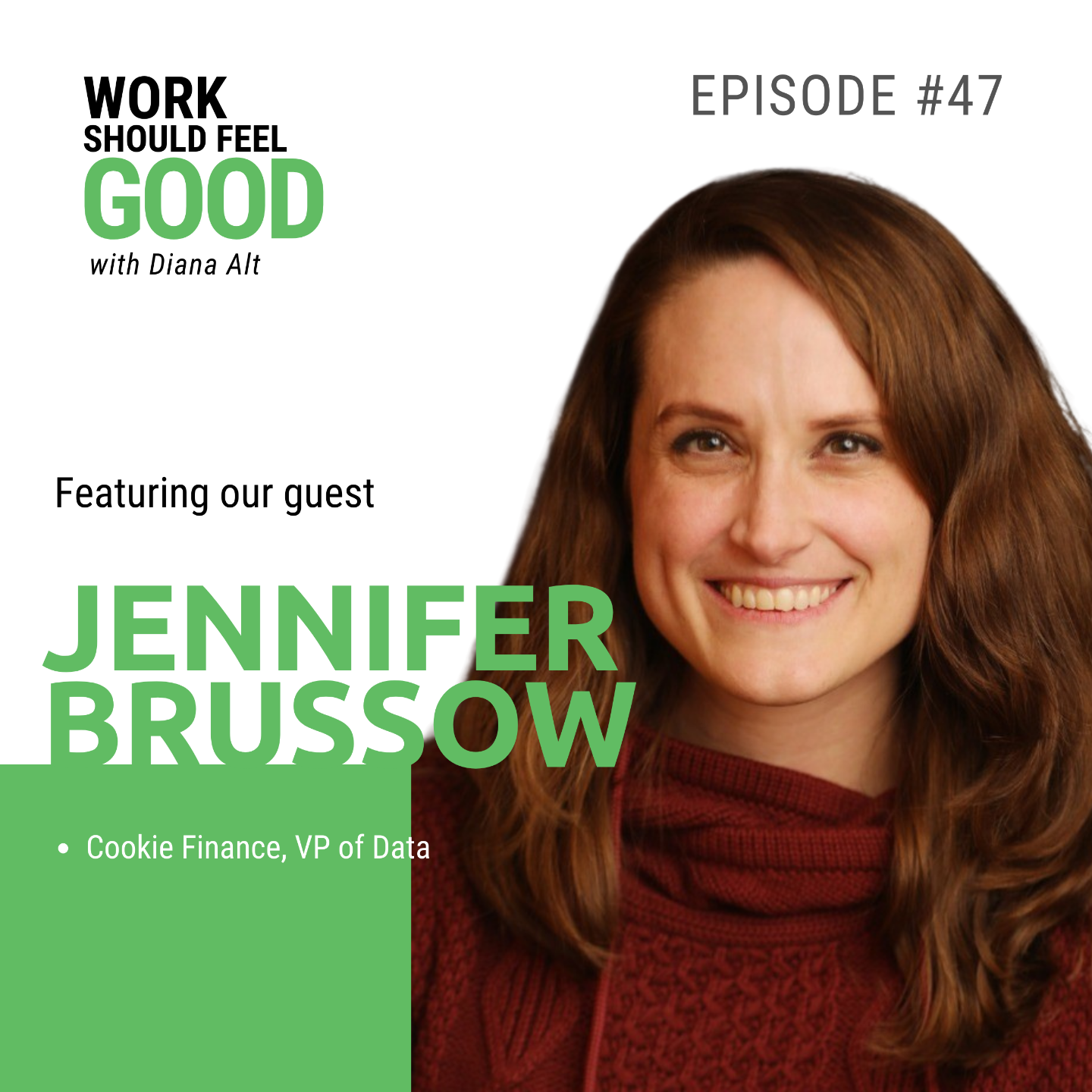
Work Should Feel Good with Diana Alt
Episode 47: Data Leadership in the Age of AI with Jennifer Brussow
Diana sits down with Jennifer Brussow, VP of Data at Cookie Finance, to explore how artificial intelligence is reshaping leadership, hiring, and decision-making in modern organizations.
They discuss the realities of deploying AI responsibly, the trade-offs companies must consider when adopting new technology, and what executives actually need to understand about AI today. Jennifer also shares her unconventional path from studying English to leading data science teams and why advocating for yourself is essential as your career grows.
If you're curious about the future of AI in the workplace or navigating leadership in a rapidly evolving tech landscape, this conversation offers practical insights from someone building these systems firsthand.
You’ll learn:
- How AI is changing expectations for technical leaders
- Why companies need intentional AI policies and governance
- What executives should understand before adopting AI systems
- How Jennifer transitioned from humanities to data leadership
- Why personal branding becomes critical at the VP level



Episode 47: Data Leadership in the Age of AI with Jennifer Brussow
Episode Description
Diana sits down with Jennifer Brussow, VP of Data, to explore how AI is reshaping hiring, leadership, and product development. They unpack the real-world implications of generative AI, what it means for job seekers, and how technical leaders are adapting in real time.
-
How AI is changing hiring processes and candidate evaluation
-
Why networking matters more than ever in a high-volume application market
-
What hiring managers actually look for in AI-assisted technical work
-
The balance between innovation and risk in AI implementation
-
Bridging communication gaps between technical and non-technical teams
-
Jennifer’s unconventional path from English to data leadership
-
The role of psychometrics in assessment and hiring decisions
-
How product, data, and leadership priorities can conflict—and align
⏳ Timestamps
00:00 Intro and Jennifer’s background
02:00 Personal branding and AI policy thinking
05:30 Wine, LinkedIn, and unconventional signals
09:30 From English major to data leadership
14:00 What psychometrics actually is
20:00 Product vs. data: tension and collaboration
27:00 Ethics, risk, and high-stakes assessment
31:00 AI in product development and business decisions
36:00 How AI is changing hiring at scale
42:00 What hiring managers look for in AI-assisted work
💡 Take Action
🔥 Subscribe for future episodes → https://www.youtube.com/@dianaalt
📖 Grab my Resume Don’ts Guide → https://www.dianaalt.com/resumedonts
❌ Avoid these common job search mistakes → https://www.jobsearchmistakes.com
🚪 Wondering if it’s time to walk away? → https://www.isittimetowalk.com
💼 Work with me → https://www.dianaalt.com
📢 Connect with Jennifer Brussow
🌐 Jennifer Brussow → https://www.jenniferbrussow.com/
🔗 LinkedIn → https://www.linkedin.com/in/jennifer-brussow/
📲 Follow Me On Social Media
LinkedIn → https://www.linkedin.com/in/dianakalt
YouTube → https://www.youtube.com/@dianaalt
Facebook → https://www.facebook.com/dianakalt
TikTok → https://www.tiktok.com/@thedianaalt
Transcript
Diana Alt [00:00:02]:
Hello everybody and welcome to Work Should Feel Good, the show where your career, career growth meets your real life. I'm your host Diana Alts, and today my guest, technology executive Jennifer Brousseau, and I are talking about how AI is changing the game in everything from leadership to hiring to all things data. And we're also going to walk a little bit down memory lane because she and I worked together a few years ago in my— the last job I had before I said sayonara to Corporate. Jennifer is the VP of Data at Cookie Finance, which is basically a company that supports creators with their accounting and finance services needs, building out data infrastructure to power the company's next phase of growth. She previously launched data science and business intelligence at Terakeet, where her patented ML systems remain in production today. Her expertise spans the full data stack from ingestion to predictive modeling and visualization. And fun fact, She actually is a data person that knows how to work with a product management team, which is not super common. Outside work, she's a Hudson Valley hiker, an avid knitter, and a longtime D&D player.
Diana Alt [00:01:10]:
Welcome to the party, Jennifer.
Jennifer Brussow [00:01:12]:
Thanks, Diana. Glad to be here.
Diana Alt [00:01:14]:
You know, one of my favorite things about having a podcast is that people that I haven't talked to in a long time, I now have a really good reason to bully them into talking to me. You're in the era of your career where you've hit like VP level in technology. That's actually an era where people start talking more about you got to have your own personal brand for the kind of growth and development of your career and keeping opportunities open both inside and outside your company. How have you been thinking about things like podcast invitations and a lot of this?
Jennifer Brussow [00:01:53]:
I'm pro them. Like, I'm really glad you reached out. I have not been a brand builder historically, but it's— I mean, it's definitely important, something I'm trying to focus on going forward. And I think especially now that I work for a company that does finances for creators, I should really probably get my act together.
Diana Alt [00:02:10]:
Maybe you should figure that out. When you think about what you would do, like, what are some of the things that come to mind for you that you might want to do in building the Jennifer Brousseau technology executive amazing brand?
Jennifer Brussow [00:02:26]:
Yeah, I mean, I think that the thing that's top of mind for me is really like AI use and policy, which has been evolving so rapidly over time. And I think a lot of businesses haven't sat down and thought about what are the trade-offs that we're going to make, right? Like, where do we want to use AI? How much human review should be involved? How responsible do we need to be with our data given kind of our clients and our space? And how can we make informed decisions rather than just, you know, a lot of places are very conservative or like full steam ahead.
Diana Alt [00:03:01]:
So yeah, it's, it's an interesting world. I have a client that I'm working with that she's kind of at the intersection of cybersecurity and AI. So she's, and she's got a research background too. I should probably introduce the two of you actually. But it's really interesting because we talk about this and I'm over here, the former product manager that's like, I don't want to touch vibe coding because I don't trust anything. If Lovable wrote it, I'm not interested because where is the accessibility in that? Where is the— how can I possibly be certain that any of that is going to handle my data well?
Jennifer Brussow [00:03:39]:
Yeah, yeah. I mean, and I think that's a really legitimate stance to take, but I also think it depends on where you are. Like if you are a super early startup or a one, one person shop, like maybe vibe coding is the only way you're going to take that first step, right? And then later on controls as you go.
Diana Alt [00:03:58]:
So I've actually refined my thinking on this a little bit and to where I think it's good. I like prototyping. Because you can— if you understand a market problem and you want to see, is this a solution? I like it. Um, I also am okay with my own data being in there, right? Like, I would not be cool with a vibe-coded app to do anything with my client's data because how, how can I be sure that I'm following my own privacy policy when I don't know how any of that stuff works?
Jennifer Brussow [00:04:28]:
So, and what kind of data do you have, right? So I mean, in the data field, we have to think about things like GDPR, CCPA, and be really familiar with the regulations But obviously it depends big time if you're a financial services company, that's a whole different ball of wax than if you are doing marketing, for example. Or yeah.
Diana Alt [00:04:47]:
Yeah. So in the, in the realm of personal branding, I went back to your LinkedIn profile that I haven't looked at in a while when I was preparing for this conversation. And you've made a very interesting choice with it. Your first Yes, you have. Top 3 skills that show on your LinkedIn profile are about wine.
Jennifer Brussow [00:05:12]:
Okay, that's spicy.
Diana Alt [00:05:15]:
Well, the— and this is funny because when I work with people on their LinkedIn profiles, whether they're looking for a job or just trying to build a brand, I always tell them in that skills section that can have 100 things, like, go crazy, put all the things on there, but take the 2 that you most want to be known for and put them at the top because that's what shows no matter what. So when I looked at yours and realized that they were wine, wine tasting, and wine spirits industry for the top, this is a conversation that we need to have. So what led you to— is that something that is an accident? Did you do that on purpose? Are we making a statement about the need for wine if you're a technology executive?
Jennifer Brussow [00:05:57]:
No, that's hilarious. No, that is, that is LinkedIn ignorance, I think. So I recently did the WSET, which is Wine and Spirits Education Trust, Level 2 of 4 certifications. So I'm like kind of good at knowing what wine is now, but not like really good at knowing what wine is. So I added that to my LinkedIn because I was like, hey, if people want to talk to me about wine, that's awesome. I'd love to do that. So I think it added those skills probably It's just, it's just recency.
Diana Alt [00:06:27]:
Now I want to just go add something to my LinkedIn skills and see if that's actually what's happening because they've changed how that works.
Jennifer Brussow [00:06:34]:
Yeah, it sounds to me like you have to take the wine certification course so that you can add that credential and find out what happens.
Diana Alt [00:06:43]:
No, about that, I'm not really a big wine person, so you can learn. Yeah.
Jennifer Brussow [00:06:50]:
I don't want to.
Diana Alt [00:06:51]:
I just, I don't care enough. I would, here's what I would like to do. I'd like to have dinner with you and then you can tell me what the good wine is that I should have. I did that years ago with a colleague that I worked with who was very into wine and we would go to North Italia on Wednesdays because it was half price wine night. You could just buy wine and give it to me. The whole mission was that I didn't drink red. So he would give me a taste of it. We did it a few times, and like the third, third or fourth time we went, he's like, Malbec.
Diana Alt [00:07:24]:
You're a Malbec person. And I was like, okay, I'll have— so we ordered me a glass of Malbec, and I'm like, by God, I am a Malbec person. So that's great. We can learn all kinds of things from the people that we work with.
Jennifer Brussow [00:07:38]:
It's true. Yeah. Well, I love that.
Diana Alt [00:07:41]:
I'll recommend you try to be like a junior deputy sommelier, or what is the purpose of this wine exploration?
Jennifer Brussow [00:07:49]:
It was really just— so we have a really good local wine store near us, Big Nose Full Body, if you're in Park Slope. And, uh, we were going there a lot and learning a lot from the owner. And he was like, well, if you want to like really learn about it— because he could tell that I'm a research person— he's like, you can read The World Atlas of Wine, which is this magical book full of topographical maps with all the vineyards labeled. And he's like, and also you can take these courses, which they offer in New York City. And so I was like, oh man, like, this is such a city thing. We might not live here for like forever. I should really like see—
Diana Alt [00:08:21]:
I should take advantage of it.
Jennifer Brussow [00:08:23]:
Do this, right? And so I signed up. It was like really intense. It was. And there was a very hard test at the end, which I have some psychometric notes about. WSET, get in touch. But it was— I learned a lot. And yeah, I know enough to be dangerous, I think.
Diana Alt [00:08:41]:
You should send them a note about the chat. I think you should do that. Yeah. Let's talk unconventional because I definitely have not started a podcast episode with your skills are wine tasting on LinkedIn ever. You have kind of an unconventional career, which I think a little bit is why we hit it off when we worked together. Your bachelor's is in English. You're now a VP of data. There's a few steps in between.
Diana Alt [00:09:12]:
Can you walk us through briefly how your career unfolded and sort of what led you from the world of studying English at KU, University of Kansas, to hanging out in New York being a VP of data?
Jennifer Brussow [00:09:30]:
Yeah, for sure. I'll give you the medium-length version.
Diana Alt [00:09:34]:
I like it.
Jennifer Brussow [00:09:35]:
So yeah, so I did my bachelor's in English and also actually in German, which is just even more useful in my day-to-day life than that English degree. And I graduated in 2009, which was kind of the trough following the 2008 financial crisis. Yeah.
Diana Alt [00:09:54]:
Yeah.
Jennifer Brussow [00:09:54]:
And a friend was like, you should just like— no one has jobs that had graduated the year before. 'Um, have you thought about just doing a master's degree?' And I was like, 'No, I haven't.' So then I got a really useful master's degree also in English language studies with a thesis on Old English medicinal texts, which were just piling up reasons that everyone wants to talk to me at parties at this point.
Diana Alt [00:10:18]:
Can I tell you something funny about me and English? My mom is an English teacher. I was always very good at I was willed myself to learn how to read as a child. I had an older brother that knew how to read, and I'm like 4 years old and very jealous. So I willed myself to learn how to read. And my mom taught composition and grammar and all the stuff at the community college level. So when I went to college at University of Missouri-Rolla, which is now Missouri University of Science and Technology, I had to take upper-level humanities because I'd taken stuff for college credit as a senior. And my first semester of my freshman year, I took an Old and Middle English Lit class that was basically a cert. It didn't have any Chaucer in it, but it had— we did Beowulf again.
Diana Alt [00:11:10]:
We did, like, all the things. I was the only freshman in the class. I was one of only a couple of people that was not an English major that was a junior or senior, and I got the only A in the class.
Jennifer Brussow [00:11:23]:
Oh, wow. I mean, that tracks for you.
Diana Alt [00:11:26]:
Uh, I thought it was weird, but I didn't think it was weird that I was in the class because, I mean, we're gonna take what we're gonna take that we have the prereqs for, and I had a slot for it. I thought it was weird that I got the only A. The people in the class were like, when we were seniors, if you had any idea how many papers we had to write, then it would make sense because this was not the most important class. It was the elective class. But yeah, so I Yeah, I liked that stuff too back in the day. Yeah, I mean, medicinal texts, that's a, that's a choice.
Jennifer Brussow [00:11:58]:
It was their syntactic structure because they are the most— like, if we think about genre studies— boy, this is not what I thought I'd be talking about with you. If we think about genre studies, like structured texts, medicinal texts are basically proto-recipes, which are one of our most formulaic types of texts that we have today. So it was really looking at What syntactic clues can we observe that are relatively static across medicinal texts that kind of point the way to how recipes will evolve later? Like, what consistency is there?
Diana Alt [00:12:31]:
That is so— that is, that is such an interesting question to ask. So let me ask you this. When you were doing that bachelor's and then subsequently the master's, what career options were in your mind?
Jennifer Brussow [00:12:46]:
Yeah, I think I was procrastinating career options a little bit and also thinking like academia, right? Like professor. So obviously the number of humanities professors has not increased since I was in college. So that is, you know, I'm not doing that.
Diana Alt [00:13:03]:
Not the best path is what you're saying?
Jennifer Brussow [00:13:05]:
Maybe not. Yeah. So I graduated. I have all these very useful degrees. I was lucky enough to get a job at the University of Kansas in a research unit where we were evaluating federally funded K-12 teacher improvement grants, basically. So educating teachers, especially with relation to students with disabilities, helping them basically teach better for those groups. So there's a lot of data collection involved in that of like you know, test scores, attendance, dropout rates, like classroom integration, etc. So I became the data analysis person.
Jennifer Brussow [00:13:47]:
I had done that for several years. I was doing a whole bunch of stats, and I thought, boy, I, I should really know what I'm doing professionally. And then I went back and got my PhD and went, went full into statistics at that point.
Diana Alt [00:14:02]:
What did you— what was the PhD actually in, and what did you do your dissertation on?
Jennifer Brussow [00:14:06]:
Yeah, so they crammed all the words into it. It was research evaluation measurement statistics. So kind of, yeah, yeah, lots of words. It's applied statistics, basically. REMS is the acronym. Yep. And, uh, my dissertation was also very fun to talk about on a podcast, which is a multi-level model for assessing differential item functioning, which is if you have— think of a test like the ACT or SAT, you have a lot of items that are supposed to measure, you know, one thing like math, for example. But to write a math question, you have to use words, right? So yeah, so how complex your syntactic structure is, your word choice, that can really negatively impact students from groups that may be non-native English speakers or have, you know, like struggle with reading but be really great in math.
Jennifer Brussow [00:15:06]:
So that's, that's differential item functioning, when an item performs differently across groups in a way that you kind of didn't intend for it to. It's a different construct.
Diana Alt [00:15:17]:
Oh my gosh, I never— you know, and all the time that we worked together and I was learning, like, you and some of the other folks in the psychometrics team were trying to beat into my little product manager head what it is to measure knowledge. I kind of got an understanding of item review, like, let's take bias out. Let's not talk about trains for people that are going to take tests that have never seen a train before.
Jennifer Brussow [00:15:46]:
Right.
Diana Alt [00:15:47]:
Whatever. Like all of those kinds of things to try to eliminate cultural and regional biases from nationally administered tests. But That is— I didn't— you got a whole PhD in it.
Jennifer Brussow [00:16:00]:
Yeah. Yeah.
Diana Alt [00:16:01]:
If I would have known that, I would have spent even more time with you on the Wayback Machine. So, um, I, I find it interesting, the whole idea of PhDs in general. Like, I never wanted one. I'm not— I'm much too, like, scrappy and practical and applied for that. My brother has a PhD though, and for me, just the esoteric, like, we're gonna dig into this one little thing so deeply, is fascinating to me. I'm the person that when my friend gets— says they're, you know, getting their master's, they're getting their PhD, they did their dissertation, I'm like, send it to me.
Jennifer Brussow [00:16:41]:
They're like, no.
Diana Alt [00:16:42]:
I'm like, I'll read it. If it doesn't make sense, then it doesn't make sense, but I'll read it. And I have read some of the most interesting interesting stuff, especially if it's qualitative research.
Jennifer Brussow [00:16:53]:
Yeah, yeah.
Diana Alt [00:16:55]:
Chemistry and engineering management were my degrees in college, so qualitative research was not something that, you know, the disciplines I was in leaned into. So is that part of what got you interested in going from English into STEM, is how to do the bridge?
Jennifer Brussow [00:17:12]:
Yeah, I think so. I mean, and I think connecting to— like, we tend to have such silos between, like, the STEM people over here and then the, like, humanities people over here. And I think bridging that gap is really important to be able to—
Diana Alt [00:17:27]:
if you—
Jennifer Brussow [00:17:28]:
even if you have really cool findings on the STEM side, if you can't talk about them or convey them, like, I don't know, you're closing yourself off to opportunities for collaboration or unique applications.
Diana Alt [00:17:41]:
So yeah, yeah, like, I rant about this a lot when people talk about, you know, I'm— 75+ percent of the people that I work with are in tech in some way. Yeah. Um, and especially the people that are in cybersecurity and engineering and things like that, they'll be like, why? I just— it's not fair that we have these interview processes and that's not testing what I'm about. And I'm like, you go find me the job where you never have to talk to anybody of the kind of problems that you say you're interested in solving. Yeah. When you can show me that, then I will agree that your written or verbal communication skills are not important.
Jennifer Brussow [00:18:24]:
Yeah.
Diana Alt [00:18:24]:
Until then, freaking learn how to communicate.
Jennifer Brussow [00:18:29]:
Yeah, I think it's really important. I think it's really important to be successful. It's a lot I think is what has enabled me to grow in my career is that I can talk to people and also convey the technical concepts, I think, pretty well to other non-technical audiences. Because if you don't have a good understanding of why you're building something, you're going to build the wrong thing and then it's not going to be useful, right? And that happens so much. So I think effective leadership is communicating well and knowing what questions to ask and how to get the right information out of people to make sure you're building things for the right reasons and that it's the right thing to solve that problem.
Diana Alt [00:19:11]:
Yeah, it's wild. Oh my gosh, they're back. Do you hear the craziness outside?
Jennifer Brussow [00:19:16]:
A little bit of jackhammer there. Yeah, just peeking through.
Diana Alt [00:19:19]:
This is very interesting. So guys, if you're hearing jackhammer in the background while you're listening to this podcast, The city decided that they needed to jackhammer outside my house today, but I've been trying to get Jennifer to interview for like 5 months, so we're just doing it. We're rolling with it and praying that we can get it all done. So you went from this world of being at KU into psychometrics in ed tech, which is where you and I met. Yeah. Talk about what the hell psychometrics is. I think a lot of people, especially today, we're seeing a lot more assessments in hiring.
Jennifer Brussow [00:20:05]:
Yeah.
Diana Alt [00:20:06]:
Or assessments because someone decided to implement like DiSC or something like that into their company for leadership development. And then you have certifications that people need. So it's relevant to people's lives, but most people have never heard the word psychometric. So yeah, what the heck is it and how'd you get into that?
Jennifer Brussow [00:20:30]:
Yeah, yeah. Well, for me, so it was kind of a logical progression from— that was the sort of data that I was handling when I was working in that grant evaluation shop, right? And so it was like, well, I should learn the techniques to work with this type data. And then it just kind of, you know, opportunities came from there and just kind of learned more and more. But basically psychometrics is, I mean, it's statistics, it's a type of applied statistics. Many of the concepts are shared with other statistical disciplines. But it's really, you know, all of measurement as a, as a science for us is trying to measure unseeable things, right? Like, if you want to know how long something is, you can get a ruler and hold it up, and that, that's cool. But if you want to assess something like Big Five personality traits or aptitude in math or whatever, you can't measure it. It's an unseeable thing.
Jennifer Brussow [00:21:25]:
So we've come up with this whole body of work and discipline of science to figure out how to measure those things as accurately as possible. And it's kind of a specialized area of statistics that really focuses in on that. So it's typically, yeah, the assessment industry is all psychometrics.
Diana Alt [00:21:46]:
Yeah. Yeah. One of the things I like to talk to people about, and I've talked to businesses about this because they're thinking about, well, should I do this, this assessment as part of my hiring process or what? And I'm like, you need to— I'm not a psychometrician, but here's a few things I learned. Number 1, you need to understand the intent of that assessment. Yep. One that comes up a lot is I'm, I'm actually a certified CliftonStrengths coach because I am long on, I'm long on that for strength, for professional development. But I literally could lose my certification if I suggest that anyone use it in hiring because it is hiring instrument. It is designed to be a development instrument, not a hiring instrument.
Diana Alt [00:22:34]:
So, um, if you're just a regular-ass person being asked to take an assessment or considering an assessment but you're not familiar with looking through, how can someone even find out what the intent behind an assessment that they're supposed to take or administer is?
Jennifer Brussow [00:22:53]:
Yeah, I mean, step one is Googling it, right? Like, you should always Google things in life. I'm a big look up the answer person. And so many assessments will publish like a test manual that tells you what it's trying to measure, how good it is at measuring it, et cetera, et cetera. And I will also say like the cheat code, I guess, kind of for being good at tests is something that in the assessment industry, we would call it test wiseness, which is basically if you as the test taker can kind of look at how the questions are structured and think about what construct are they trying to get at here? And then how can I answer in a way that makes it look like I have a lot of that construct? Like, that's test-wiseness. Test developers hate this one simple trick, right? But really, test developers do hate it. But like, trying to reverse engineer what the intent is just by kind of evaluating the questions.
Diana Alt [00:23:48]:
Is also a great— you mean the thing where I could take a Myers-Briggs assessment and force it to be any one of the 16 types?
Jennifer Brussow [00:23:54]:
I do mean that. Boy, I had Myers-Briggs, which I think it's fascinating, but it has like no statistical validity whatsoever.
Diana Alt [00:24:03]:
It's super problematic. One of my favorite articles I ever read on it was by Adam Grant, who's an organizational psychiatrist. He's famous. He's written a million books. But he basically did an article in, I don't know if it was the New York Times, it was a big publication where he's like, this thing sucks. Myers-Briggs. Yeah. Oh, people came for him.
Diana Alt [00:24:26]:
Like, let me tell you who I'm not arguing with about their opinion of a psychological assessment. That's going to be Adam Grant. I am not going to argue with him. So, um, An interesting thing about psychometrics that I learned. So for, for some background, Jennifer and I worked together at an ed tech company. When we were working on projects together, we were focused on nursing education, and I was in product management focused on analytics and data and she— and reporting. And she was hanging out in the psychometrics department focused on making sure that we did not screw up our products, that That was my job description.
Jennifer Brussow [00:25:06]:
Yes, don't screw it up. Yeah.
Diana Alt [00:25:08]:
So talk about the tension that psychometricians feel when working with product, and I'll talk about the opposite. So that— because this is a bit like— assessment is a big area. It is very conceivable that people listening to this are in one of our two positions and trying to have a little bit better understanding what did you find to be some of the frustrating points of working with product and how did you figure out how to overcome them? And then I'll do the flip side.
Jennifer Brussow [00:25:40]:
Yeah, absolutely. And I think this is true kind of across data as well. Like, like we're still typically deploying a statistical model. There's, you know, more or less rules and regulations associated with what space you're working in, but I think it's kind of generally applicable. Right, so if we take the pure science approach, we of course want everything to be super by the book, maximally defensible, right, just really buttoned down. I think the tendency is to try, especially in assessment, sorry assessment folks, to be very conservative, right? You don't want to branch out, there's a lot of legal liability in assessment, so you don't want to push the envelope, you want to be really careful about what we call validity or using scores for their intended uses. Basically like not inferring too far. And I imagine that all of that is really, really frustrating because product's job, as it should be, is to come up with new stuff, right? Come up with new applications, figure out how to push the envelope, and like come up with novel applications for stuff.
Diana Alt [00:26:47]:
So I would argue that's not product's job.
Jennifer Brussow [00:26:49]:
Okay, interesting.
Diana Alt [00:26:51]:
Fundamentally, people misunderstand the job. Of product management.
Jennifer Brussow [00:26:55]:
Educate me, Diana.
Diana Alt [00:26:57]:
Product management, number one hill I'll die on. If your product manager in your organization knows the most about the product itself, you're screwed. Because what they should know is about market problems. The job of a product manager is to figure out how to bring forth into the world solutions to market problems that people will pay for. Yeah, which oftentimes means saying no. Like, to me, one of the things that most companies suck the most at is sunsetting stuff that is no longer relevant, which means then you have bloat, then you have technical debt, then you have all this kind of stuff. So, um, in product management, the least important thing in some ways is the product. The most important thing is the problem.
Jennifer Brussow [00:27:47]:
I agree with you so much. I am so on your side. And I will say, personally, a frustration that I have experienced again and again is I'll be in a conversation with product, not you, Diana, and they'll say, "We want to build X," which is typically what I get. And I say, "Why do we want to build X? What problem are we trying to solve?" And they'll say, "Blah, blah, blah, blah, blah." They don't know. And/or I'll say, "Well, what data did you gather?" that made you come to this conclusion? Like, what data supports that this is an actual market problem that you need to address? And there's typically none. There's been no research, no data gathering. That, that's— yeah, yes, that's usually it.
Diana Alt [00:28:32]:
It's really a common thing.
Jennifer Brussow [00:28:35]:
Yeah, yeah. So this is actually part of my job now is I've, I've actually been doing a lot of user research with our clients to gather feedback and make sure that we have product market fit. It's so important. Why are you building something if no one actually wants it, right? Or if only one person wants it? So I'm very behind that.
Diana Alt [00:28:56]:
Nice. I'm sorry to interrupt you. No, I don't know where we were. I just had to throw that in there because it is so important that people misunderstand product. And if what product management is about. And if you misunderstand that, then everything else that your company is doing is wrong, right? Or it's accidentally right. That sometimes happens, which is awesome. Great.
Diana Alt [00:29:19]:
Then you can make money off of that. Maybe you can right the ship and start doing marketing. But if the product was the most important thing, we would never have had a smartphone or an iPod. Apple didn't set out to make a smartphone. They definitely set out to make an iPod. Amazon did not set out to make the Kindle. They set out to do something entirely different.
Jennifer Brussow [00:29:44]:
Yeah, well, that is always what I would prefer to receive for product is a need, because then on the data side, then I can say, okay, what data do we have that could help solve this problem right now? What are some of the possible approaches that we could take? Do we need a traditional statistical model? Do we need to go to ML? Do we need to deploy generative AI? How can we best address that problem? But it's usually just like, we need X.
Diana Alt [00:30:12]:
We've been getting a lot of we just need AI in the product the last couple of years.
Jennifer Brussow [00:30:17]:
Yeah, I think I've been fortunate enough to work with people who are a little more thoughtful than just put AI in it, but I think everyone, and this is not just my experience, I have, you know, a lot of professional colleagues too, but everyone is feeling the pressure to integrate it. I think that the challenge is integrating AI in a meaningful way that again, like balances risk to your business. If it goes wrong, what's the worst that could happen? And are you okay with that? Right? And also provides actual value in a way that, you know, improves your margins as the company owner actually improves customer experience, right? You need to be positively impacting something financial that outweighs the cost of deploying generative AI, which is often pretty high.
Diana Alt [00:31:10]:
So yes, it is expensive for sure. Let me tell you what I need to figure out, and I'm sure it's a setting. I should probably just ask Perplexity. I don't like the suggested replies from Gmail. They're terrible. And that kind of functionality with terrible suggested replies is everywhere. So small, but I'm like, I have to delete it anyway. I'm sure it's something that I just need to turn off.
Jennifer Brussow [00:31:39]:
But yeah, I think it's funny. I mean, I have screenshotted the suggested replies, like, to my husband, and I'll say, like, oh, this is what the AI wants me to say to you. And of course, it's never very good. And, like, yeah, your face, what you just did. Sometimes I get back No laughing. I'm on a meeting because—
Diana Alt [00:31:57]:
Yeah, that's hysterical. So basically, when you were hanging out, whether it's now in your VP of data role or whether it was back in the day when we worked together and you were in psychometrics, you're like, you're basically a 4-year-old. Whatever you give me, I need you to tell me why I need it and what do we know about the data that justifies that need. And there's a nature of wanting to go slow and be methodical and make sure that everything's right. Whereas product, no matter whether they come to you with make this or they come to you with a market problem, we want to innovate and have speed to market. And so from my perspective, when I worked with you, I appreciated the empathy that you had for the need to innovate. Yeah, I don't know that I ever would have understood it. One, one of our colleagues sat me down one day and explained the ethics of test development.
Diana Alt [00:32:55]:
Yeah, it was Mandy Kumar-Layman sat down and explained to me. We had— we hashed it out for like an hour and a half one day. She's like, this is the discipline. This is what psychometrics is. This is what reporting is. This is what test development is. This is the ethics behind it. This is the way that it can ruin careers.
Jennifer Brussow [00:33:18]:
Yeah. Yeah.
Diana Alt [00:33:19]:
Do it right. And it was so eye-opening for me, which is why I say I'm trying to understand the need because weirdly the psychometrics and test development teams were both, they were users of the things that we were creating in ed tech assessment as much as they were SMEs to help us develop the product because there's that whole, yeah, we need to capture this knowledge, but we need it to be defensible. We need every single time we release a test to have trust in the marketplace. So yeah, yeah.
Jennifer Brussow [00:33:52]:
And especially in, you know, we were in nursing education, which— that's why I say think about what the worst thing that could happen is. And are you—
Diana Alt [00:34:00]:
people could die if we screw up, right?
Jennifer Brussow [00:34:02]:
Like, I mean, yeah, if you're not doing—
Diana Alt [00:34:06]:
and people die.
Jennifer Brussow [00:34:07]:
So right, people don't know how to be good nurses, that's really bad. But I mean, equally so, if we say someone is not doing well or not on track to be a good nurse and they would have been a great nurse, then like we've negatively impacted that person's career.
Diana Alt [00:34:24]:
Nursing— we killed some people.
Jennifer Brussow [00:34:26]:
So the stakes are pretty high on both sides, right? So that is a pretty high-intensity situation, and a lot of the assessment industry is— it's settings like that. Um, so we kind of have to be Statisticians in those contexts have to be a little more buttoned up than other contexts, I think.
Diana Alt [00:34:45]:
But then you can go have wine later.
Jennifer Brussow [00:34:47]:
But then you can go have wine later. That's right.
Diana Alt [00:34:53]:
We've kind of been meandering into some AI conversation. I want to go there, especially for you as a tech leader. Like, you own the data and you own all the AI projects and products implementation on the technical side. What I talk to my clients a lot about, whether they are, especially if they're job seeking, but anybody that I touch cares about this, there's kind of 4 areas that they need to be able to be cognizant of or speak to. If you're a job seeker, you need to understand what are actually effective ways to use AI. I'm not gonna go there with you cuz you use your network. Get jobs, and I love that. But there's, there's the hiring side, like how you're using it in hiring, which a lot of people think of AI like ATS bots screening you out.
Diana Alt [00:35:44]:
I want to hear a little bit about how hiring has changed for you as a technology leader as AI has become more and more part of both the products that are sold by the companies you've worked for and how you make the products. So what are you doing different to hire people now than you were 3 or 4 years ago?
Jennifer Brussow [00:36:06]:
Yeah, it's wild, I think, is the very short answer. Like, everything is so— has been so upturned by generative AI. Um, so I have personally seen, you know, you open a role, you have thousands of applicants very quickly. Many of the applications are clearly AI-generated. Um, And so it's just like very difficult to sort through.
Diana Alt [00:36:29]:
It is my least favorite thing.
Jennifer Brussow [00:36:31]:
Yeah, it's really, it's really hard. And this isn't necessarily like, oh, pity me, the hiring manager, right? Like, that's not going to get a lot of sympathy, but it's much more difficult to find the, the real people, right, the quality candidates, when there's so much cruft floating around out there.
Diana Alt [00:36:49]:
I'm gonna get bold for a second again. I think that the tools that are allowing for the AI auto-apply or are unethical and exploitative. And I cannot— like, if I could pick a segment of business to freaking fold under their own stupidity, that would be it. Because they are charging people money for something that is actively harming both their clients and everybody else in the market. Everybody else. So, um, When you— are you working— your company right now is pretty small, right?
Jennifer Brussow [00:37:25]:
Yeah. So I actually am at a startup right now. We've got about 80 folks on board.
Diana Alt [00:37:29]:
So, uh, you guys have recruiters that you're working with, or when you post a role, are you ending up with all 538 people that you're screening? How is that going in your company?
Jennifer Brussow [00:37:42]:
Yeah, so we do have HR that supports us, and we do have, I know, a recruiter that we partner with, but I have access to the, you know, recruiting portal, and I see it's more than 500.
Diana Alt [00:37:53]:
Diane, what are you doing? What, 500, 1,000, 50? It sucks no matter what the number is. So when you, um, what's, what's a role that you've posted in the last few months that you've been there? Just a type, like an engineer role or leader?
Jennifer Brussow [00:38:10]:
Yeah, we're currently hiring for a data engineer that would report to me. We're also reporting for some full-stack developers that would report to our CTO and also a QA analyst. So we've got several openings right now that are all up.
Diana Alt [00:38:23]:
How many apps are you getting? You're getting 1,000 apps in a couple days, is that what you're seeing?
Jennifer Brussow [00:38:28]:
Yeah, pretty much. I mean, so mine, we posted them very— yeah, great question. So we have a platform, I don't— I guess it's ATS, I guess you would call it ATS. So it does do some screenings and it flags things in resumes. And so if you're a job seeker, it flags whether or not your resume is a good match to the role, but it also highlights if there are phrases that seem to be directly copied out of our job description. So if that's something that you're doing and hyper-customizing, like, maybe don't do that. Um, and it also flags that—
Diana Alt [00:39:05]:
thank you for saying that, because there are people out there— these are the coaches that need to jump off a cliff, that are all to exactly match terminology. And yeah, keywords. Yeah, I mean, talk about what you did and what the impact is. Yeah, if you know Python, don't leave it off.
Jennifer Brussow [00:39:25]:
Right.
Diana Alt [00:39:25]:
But like, if you know Python, don't leave it off. But don't copy paste bullets out of the job description.
Jennifer Brussow [00:39:33]:
Right, exactly.
Diana Alt [00:39:35]:
Don't do it in 4-point white font at the bottom.
Jennifer Brussow [00:39:39]:
Yeah, we're— I hope we're past that. But I will say some other things that pulls out, it checks to see if the impact you've listed seems reasonable given the company, your role, and your tenure. So if you are tempted to inflate your impact, like, don't. This kind of stinks for me because I've gotten this feedback multiple times that my resume looks too good to be true.
Diana Alt [00:40:04]:
And I'm like, I'm not sure.
Jennifer Brussow [00:40:06]:
Cool. That's nice. So apparently that is a real thing.
Diana Alt [00:40:10]:
Yeah. Sorry for being amazing. So when you get all those applicants, are you— how many of them are you looking at? Because you've got your whole HR team and they're doing whatever there is. I don't— if I want to know what they're doing, I'll talk to them. But when you have 1,000 people applied for a data engineering role, How many people are you looking at and how are you deciding? Is it a shortlist that you're given by your recruiter or are you doing something else?
Jennifer Brussow [00:40:39]:
Yes. So I will say, the importance of your network is just even greater now than it's ever, ever been. Right? Like, if you are someone that is a referral from someone within the company, like, you are going to go to the top of the line just because we know you're a real person. It's not even like Oh, like we're giving you preference because you're a friend. It's like, we know you actually exist, which is candidate fraud is a thing. Yeah, it really is. So leveraging your network and getting that foot in the door is really important. And then I would say I'm probably looking at 10 to 20%, probably.
Jennifer Brussow [00:41:17]:
I mean, hundreds. I look at hundreds because, I mean, I feel I feel like I shouldn't entirely rely on just the strong-weak match stuff that gets spit out. Like, it feels like I need to sample. As a statistician, I need to look at, is their algorithm working? Like, should I trust its classifications? How much should I trust them? And like, I look at quite a lot of them, actually.
Diana Alt [00:41:45]:
So when you, when you see— so something I've heard from recruiters, because they're usually the first line of defense against the thousands, is that they have a much higher or a much lower signal-to-noise ratio than they did a few years ago. And it's not uncommon for upwards of 90 to 95% of that thousand to not meet even the basic qualifications that are in the posting. Has your experience been similar?
Jennifer Brussow [00:42:16]:
Yeah, I think, yeah, unfortunately so. I mean, if we say 5 years of experience— and it's super interesting because, just to tangent a little bit, I at least received this advice in maybe like 5+10 years ago of basically, if you meet 70% of the qualifications, you should apply anyways, especially as a woman, because the men are all seeing those job qualifications and they're applying even if they don't meet them all. So If you're not applying, you're shooting yourself in the foot. I think we've taken that to the extreme somehow. It's just like, you know, if I'm applying, if I'm hiring for a data engineer and I say 5 years of experience, like, I want you to have 5 years in seat because it's a senior, it's a senior role. Like, there's going to be significant ownership. And frankly, at a startup, I don't have time to train someone. I'm really sorry, early career people.
Jennifer Brussow [00:43:10]:
Like at a larger company, I would try to have a more distributed team. But as a manager of a small team, if I only get a couple folks in each role, yeah, we just don't have the bench to train people up.
Diana Alt [00:43:22]:
So, yeah. So the advice I usually give people is particularly more— a lot of postings, especially for larger companies, will have a basics and a nice to have.
Jennifer Brussow [00:43:36]:
Yeah, we do that in the year of our Lord 2026.
Diana Alt [00:43:40]:
Make sure you have all the basics.
Jennifer Brussow [00:43:43]:
Yes, absolutely.
Diana Alt [00:43:44]:
You have half of the rec— of the nice-to-haves, or even a third of the nice-to-haves, then go forward. But yeah, you're just— you're gonna get kicked out.
Jennifer Brussow [00:43:55]:
There's—
Diana Alt [00:43:55]:
there's really a point. Um, there's a story to tell because there's something that's very close that's you have that smells a lot like something on the basics list, but is a little bit different, then fine, do it. But don't look at it and say, well, I have 70% of the basics, I have half of the basics, I'm going to apply because that is not going to— that's a waste of your time. It's a waste of everybody's time. How about somebody is in the interview cycle? Are you having people do things like prototyping using generative AI tools as part of your hiring? Like, is any of that going on? I know in product that's a thing.
Jennifer Brussow [00:44:36]:
Yeah.
Diana Alt [00:44:37]:
What are, what is, what are you doing and how are you including testing for competency in AI skills during the hiring process?
Jennifer Brussow [00:44:48]:
Yeah, this is a great question. I think it's a really rapidly evolving space too, just really transparently as generative AI evolves and gets better and better. And like, Claude code is excellent, right? Like, if you are able— and it becomes if you are able to write a good prompt, right? And so you need to have the expertise, the wisdom, the confidence to write a good prompt. So what we've actually moved to is it is kind of create a prototype, more like create an application or create a data product, kind of depending on the role, and use generative AI to get there because that's which is kind of the expectation for devs these days, and share with me your history as you interacted with Codex or Claude or whatever so that I can see how you're prompting because your prompts are going to—
Diana Alt [00:45:38]:
Make me a thing, but don't just show me the thing, show me everything you did to get to the thing.
Jennifer Brussow [00:45:43]:
Yeah, which is actually great because I really want to know how you got there, why you made the choices you did, like you're probably going to be setting forth your architectural decisions and your design preferences in your prompts, right? So it tells me, the hiring manager, a lot about you as an employee too.
Diana Alt [00:46:03]:
So this is interesting because I love being able to have this conversation with you in particular because we, you know, the talking heads on LinkedIn and wherever else will say, well, you need to walk in and be able to do this. Okay, cool, I will grant that, but I don't sit in the room. So when you, when you are doing that, what is good to you?
Jennifer Brussow [00:46:27]:
Yeah, yeah.
Diana Alt [00:46:28]:
Good. How are you evaluating that, that little coding session that somebody did with their tool of choice is good, and that this is a person whose skills you were interested in talking about further?
Jennifer Brussow [00:46:42]:
Yeah, sort of really high level, there are kind of two things, and one is the initial context that you choose to provide, right? How do you structure that initial prompt? What all ancillary information are you including? How are you organizing it?
Diana Alt [00:46:57]:
Are you—
Jennifer Brussow [00:46:58]:
how are you structuring it? Is it structured like a tech spec? Is it structured like a Jira ticket? Is it structured like an email? Kind of, right? Not that any of those is necessarily right or wrong, but what are you doing? Do you include enough context in there? Are you proactively making design decisions up front? Because I know from my own work, in order to get good results, you need to be pretty prescriptive of, like, you know, make these directories, don't touch these files, do touch these files, here's what your structure should look like. I have, like, an agents.md file that I use to guide with just just like basic programming principles, you know, foundational stuff. Don't repeat yourself, parsimony, don't over-engineer, just kind of stuff like, so what are you doing initially? And then what does your redirection look like? Because it's not going to get it right the first time.
Diana Alt [00:47:56]:
What does bad redirection look like?
Jennifer Brussow [00:47:59]:
Really vague stuff. So like, if it comes up with the wrong thing, you as a good experienced engineer, you should be able to say why it's wrong and what you want it to do differently, right? It's really similar, honestly, to if you are coaching a more junior employee, because you wouldn't just say like— well, if you're a good leader, you wouldn't just say like, hey, this is wrong, try again, which is something you're making sure that they are not doing.
Diana Alt [00:48:26]:
You're making sure that engineers are not doing the equivalent of what every graphic designer on the planet hates, which is they do a draft design and then someone comes back and says, make it pop more.
Jennifer Brussow [00:48:37]:
Yep. Yes, right. Yes, exactly. Because make it pop more is not, you know, if you're a super senior graphic designer, I'm sure you know what that means under the hood.
Diana Alt [00:48:50]:
No, you don't, because it's a matter of taste. I will confess I've said to my designers, make it pop, but I also tell them what's missing.
Jennifer Brussow [00:49:00]:
That's really good. Yeah.
Diana Alt [00:49:02]:
So I need this to come out from the page more anyway. Okay. So basically, you're looking to see— what I'm hearing from you is that you're looking for engineers who, through this conversation with their coding AGI of choice, show that they know software engineering or data engineering. And that they're using the tool to make it faster to implement their expertise, not as, "I don't have to know code, so enjoy making my code for me." Yes?
Jennifer Brussow [00:49:39]:
Yeah, absolutely. I mean, to do it well, to get good results, you really need to know what you're talking about because you need to provide clear spec, you need to be a good enough communicator to provide adequate context and know what needs to go in, uh, you need to redirect very clearly with, this is what I didn't like, this is what you need to do differently. Only by having that foundational knowledge of the discipline are you going to be able to get a good result without just spinning in circles.
Diana Alt [00:50:10]:
Cool. Well, thank you for— I really appreciate you going over that. I'm really looking forward to— I have another person I'm interviewing soon that actually is a lead recruiter at Zapier.
Jennifer Brussow [00:50:21]:
Oh, cool.
Diana Alt [00:50:22]:
Right? Yeah, I'm really excited to talk to her in a week or two, but I'm really interested in her perspective because I think she knows more broadly what people are doing. Can't wait to hear it. And she's been telling people like, guys, it was 2023 behavior. I've seen her post something-ish like this. And like, it was basically 2023 be free behavior to say, I use ChatGPT to do this.
Jennifer Brussow [00:50:46]:
Right.
Diana Alt [00:50:47]:
Instead, like, don't say you're familiar with a tool or just drop the name of the tool. Say how you— to where you're doing things. And she went so far as to suggest that people could consider adding personal projects that I automated my life by building these agents using whatever tool. Yeah. As a bridge, because there are so many companies companies that are conservative. And it's really hard if you are a technical person at a company that's stuck in the Stone Ages and just trying to figure out how do I get out of that.
Jennifer Brussow [00:51:21]:
So yeah, I think recruiting looks really— that would be very interesting because I think recruiting looks really different across companies. And like, as much as I'm a regular-ass human, like, I'm also not. I'm this apparently wine-forward person who works at a startup, Right.
Diana Alt [00:51:37]:
You are a wine-forward D&I leader that knits and works at a startup. Everything I say makes you sound cooler, at least to me. I don't know what other people like, if you like wine or not. I don't know.
Jennifer Brussow [00:51:49]:
I guess we'll see in the comments, right?
Diana Alt [00:51:52]:
Right. We'll see.
Jennifer Brussow [00:51:53]:
We'll see.
Diana Alt [00:51:54]:
Talk to me about how AI impacted you getting hired as a leader because you went through You've searched for a job. Granted, you used your network to help find your opportunities, but once you get that connection and they're saying, yes, we want to talk to Jennifer, how are the conversations different in your most recent job search than they were when you started 4 years ago or whenever that— you were in Terakeet for like 4 years, right? 4 or 5 years ago. Terakeet.
Jennifer Brussow [00:52:24]:
Many moons ago at this point. Yeah, I think it's— yeah, I don't know. 2022, 2023, 2024, 2025, 2026, 2027, 2028, 2029, 2030. It's been a minute. Anyways, whatever. Yeah, I mean, it's really different at this point. So you need to know what you're doing. And I think especially at the leadership level, I have personally implemented generative AI in production, which is more rare than it sounds.
Jennifer Brussow [00:52:43]:
So being able to speak to that is really important. And then I think having a really clear view of how to intentionally approach AI development. I think that is really important. So kind of the things we were talking about before, honestly, is being able to speak to product-market fit, being able to speak to the trade-offs. Everything is a trade-off in terms of cost-benefit, right? Um, more complicated systems cost more but theoretically do more, right? So how can you capture the anticipated— I have to think about cost of that system versus time saved or new clients or retention or whatever, right? So I think that those are really the conversations happening now is it's about, I mean, A, you need to show that you've done something to be a player in this space. And then B, having a thoughtful perspective on how you would approach making those choices because every company is facing, do I want to use AI? How much should I use it? Where should I use it? Because realistically, you don't want to AI everything, right? It's going to just be really expensive and not provide bang for your buck.
Diana Alt [00:53:59]:
I've had— I, I'm really grateful for my early career experience because my first job out of grad school, which I went straight through my master's too, was at a consulting firm. So I went into IT consulting in 1999 when all the baby smart analytical kids were going into IT consulting at E&Y and Andersen and all this business. And my initial 8-week consulting boot camp said that our job is to help our clients solve problems with appropriate use of technology.
Jennifer Brussow [00:54:33]:
Yeah.
Diana Alt [00:54:34]:
And I distinctly remember one of the trainers that was guiding us saying, if the appropriate technology is a whiteboard and a marker, then that's the appropriate technology. Yeah. So I've always had that in my mind. And for me, in my lifetime, I've kind of always been a little bit of a late adopter. Like, I don't want the newest iPhone, I want the N-1 iPhone. Sure. Then, you know, and then sometimes I'll leapfrog because I'm like, okay, I'm good for like 3 years, and then I'm like, okay, I need another N-1. I don't need to go through every number.
Diana Alt [00:55:12]:
So that's how I've operated. Before we, before we get to a couple of lightning-ish round questions that I have, I want to first, and then we'll close. I want to know from you, you've worked in a lot of different environments. You were in an academic research environment. You worked at Ascend, which was not a huge corporation, but there were a lot of different business units, a lot going on. You're at a startup now. How did you figure out the right vibe for you? The right size, right environment? Because this is something super underrated. And I have a, I have a model that I built that I call the Align Career Cornerstones.
Diana Alt [00:55:57]:
Short version is you got to have the right work, actual work, the right leaders, the right environment, and the right culture. Yeah. So, and I— and to me, culture is values and actions. So how did you land on, um, the right environments for you?
Jennifer Brussow [00:56:14]:
Yeah, I mean, first off, I wholeheartedly endorse that framework because I think those are all of the relevant things to think about, right? Um, I think it's tough to know until— yeah, I mean, I think it's tough to know until you've worked a lot of different places, right? And of course you can read stuff online and, you know, get an idea of what it's like to work at a big corporation versus a startup. But everywhere is different. You kind of have to find your path, I guess. But for me, it was really— I really like— this goes out awful— I really like being able to steer things pretty well. Like, I like being in charge enough to say, like, hey, I have expertise and someone's going to listen to it. And trust me that I know what I'm doing and I can come up with a good idea and just have that latitude to steer the ship based on my years of experience and my training. So that's pretty important to me, is have somewhere where culturally I feel like people are willing to listen to each other because that's not always the case. And frankly, that the— it's a small enough shop that you can get things done without a ton A friend.
Diana Alt [00:57:21]:
So have you— like, I guess I made an assumption that startup life is what you like, but I don't— I realized I don't know how big your couple of companies were. I just know you're where you're at, and then we were at the big place and you're not there.
Jennifer Brussow [00:57:35]:
Yeah, no, I think I've been scaling down a little bit over the time. Startup makes— I really like it because I think you can get things out that— I like to build stuff. I like to build it. Resiliently but also quickly get it out the door, like kind of a crawl, walk, run approach of develop something, get it into production with all the appropriate, you know, have logging and, you know, error handling and all the important stuff to have it production ready, but then see how it's going, collect feedback, do qualitative research with your user base, iterate, and then continue to build things from there. So I really like being able to put together a roadmap that's informed by like the products we've developed.
Diana Alt [00:58:21]:
You like being— you, you are— and you enjoy when you have enough structure that people will accept the idea that we're going to do a roadmap and we're actually going to have rigor in the product, right? But not so big that the bureaucratic load is insane.
Jennifer Brussow [00:58:36]:
Yeah, exactly. Like, I want— we need to be ready for a roadmap, understanding that the roadmap is going to be flexible and change over time, especially in a startup context, right? But that we will have a plan for, you know, a year or whatever, um, and then not have a ton of barriers to implementing that plan.
Diana Alt [00:58:57]:
Yeah, I love that. And I, I think the small— I talked to a lot of people that, um, have entertained being the first product hire at a startup. Yeah, that is a very— it takes a very special kind of person to do that because, fun fact, the founder and CEO is the product person.
Jennifer Brussow [00:59:17]:
Yes, that is always true.
Diana Alt [00:59:18]:
Yeah, you can't handle that, then you can't handle being the first product person. Um, but I would rather not. Yeah. And I saw, uh, maybe like a Medium article a year or two ago, somebody talking about you don't want to be the first, first product person. But when that person gets fired and they've learned some lessons coming in to be the second first product person, can be a really interesting and unique place to be because you kind of let them knock the corners off of that.
Jennifer Brussow [00:59:48]:
But that's funny.
Diana Alt [00:59:50]:
Yeah, my, my last two questions before we go are, number one, what is something that people are getting utterly, utterly wrong about data and AI that drives you crazy?
Jennifer Brussow [01:00:04]:
Yeah, that's a good question. I think people are asserting that we can understand AI models in the way that they are, that we can— there's lots of explanations floating around, and I think that that is where people don't appreciate it's truly a black box. Observability and interpretability for large language models is its own thing. And like a lot of the big companies, especially like Anthropic, does a ton of research into this because we just don't know. The models have grown so large after all of the scaling wars that there's so many parameters, we just have no model interpretability.
Diana Alt [01:00:48]:
So when people are, you know, making assertions about how it works, this is how it works. How it works. Like, they don't— yeah, sure, you don't know, right? We say some broad stuff, but I always refer to it as combined intelligence of the internet.
Jennifer Brussow [01:01:07]:
Yeah, yeah.
Diana Alt [01:01:08]:
I mean, most of the training data is from the internet, billions of different ways, inputting lots of data, and then it's like a big soup, and then out comes information. Um, and days when it works, whether I'm being generous that day or not, What is something people do understand well?
Jennifer Brussow [01:01:25]:
Yeah, I mean, I think people— I have been surprised, I think, with all of the ways that people have figured out how to use AI for their daily lives in a productive way.
Diana Alt [01:01:36]:
What's something you do?
Jennifer Brussow [01:01:38]:
Yeah, so I use Claude personally for a lot of stuff, and I use it to help me sound more professional in my emails, which I think is a pretty common use. Um, then I also have it help me on my side projects that aren't necessarily work. So if we want to return to wine, we'll just bring this sucker full of wine. Yeah, so we actually have a small house in the Hudson Valley as well where I am planting our empire, our gardening empire. And this year I've ordered 10 Riesling vines to plant, and so I was like, boy, I really don't like doing.
Diana Alt [01:02:14]:
I knew that before, I knew that before I figured out that I like Malbec too. But continue.
Jennifer Brussow [01:02:19]:
Riesling is great, that's my favorite. Um, so I was like, boy, this is exciting and I don't know what I am doing. So it's a great way to have your own research assistant. I basically was like, here's the results of my soil analysis, like make a plan for me of what I need to do for like soil amendments and make also a diagram of how I can plant these vines for like maximum productivity, uh, make a schedule for the entire like year of when I need to do, you know, pesticides and pruning and all this difference. You have to like refertilize, all this stuff. So I think it's great for organizing weird side projects also.
Diana Alt [01:03:02]:
Yeah, I've been working on content strategy Yeah, it's been really helpful for me because I think I'm about to make some leapfrogs in how I think about content in my business to increase the quality.
Jennifer Brussow [01:03:15]:
Nice.
Diana Alt [01:03:16]:
My time spent. So yeah. Okay, last question.
Jennifer Brussow [01:03:21]:
Okay.
Diana Alt [01:03:21]:
What is the worst career advice you've ever received?
Jennifer Brussow [01:03:26]:
Oh boy. That's tough. Probably like don't negotiate when you get a job offer. Like, just take it because you're lucky to have a job offer.
Diana Alt [01:03:41]:
That is super terrible advice.
Jennifer Brussow [01:03:44]:
I mean, I was very early career when I got that, but I think being happy to have a job.
Diana Alt [01:03:50]:
Yeah.
Jennifer Brussow [01:03:51]:
Yeah. And I think coming from a Midwestern background too, like you want to be very Midwest polite, like Midwest nice also. So sometimes it's tough. I've worked pretty hard to overcome that and bring out my inner East Coaster, but it's tough to want to stick up for yourself.
Diana Alt [01:04:09]:
So yeah, well, I think ending a show called Work Should Feel Good with the theme of you need to stick up for yourself and what you need is a great place to end. Jennifer, this was like way more fun than I ever even expected. Thank you so much.
Jennifer Brussow [01:04:23]:
Yeah, thank you.
Diana Alt [01:04:25]:
And hopefully we will talk sooner than like 5 years or whatever it's been since we talked.
Jennifer Brussow [01:04:31]:
So absolutely.
Diana Alt [01:04:32]:
All right, have a great day, everybody.
Jennifer Brussow [01:04:34]:
All right.