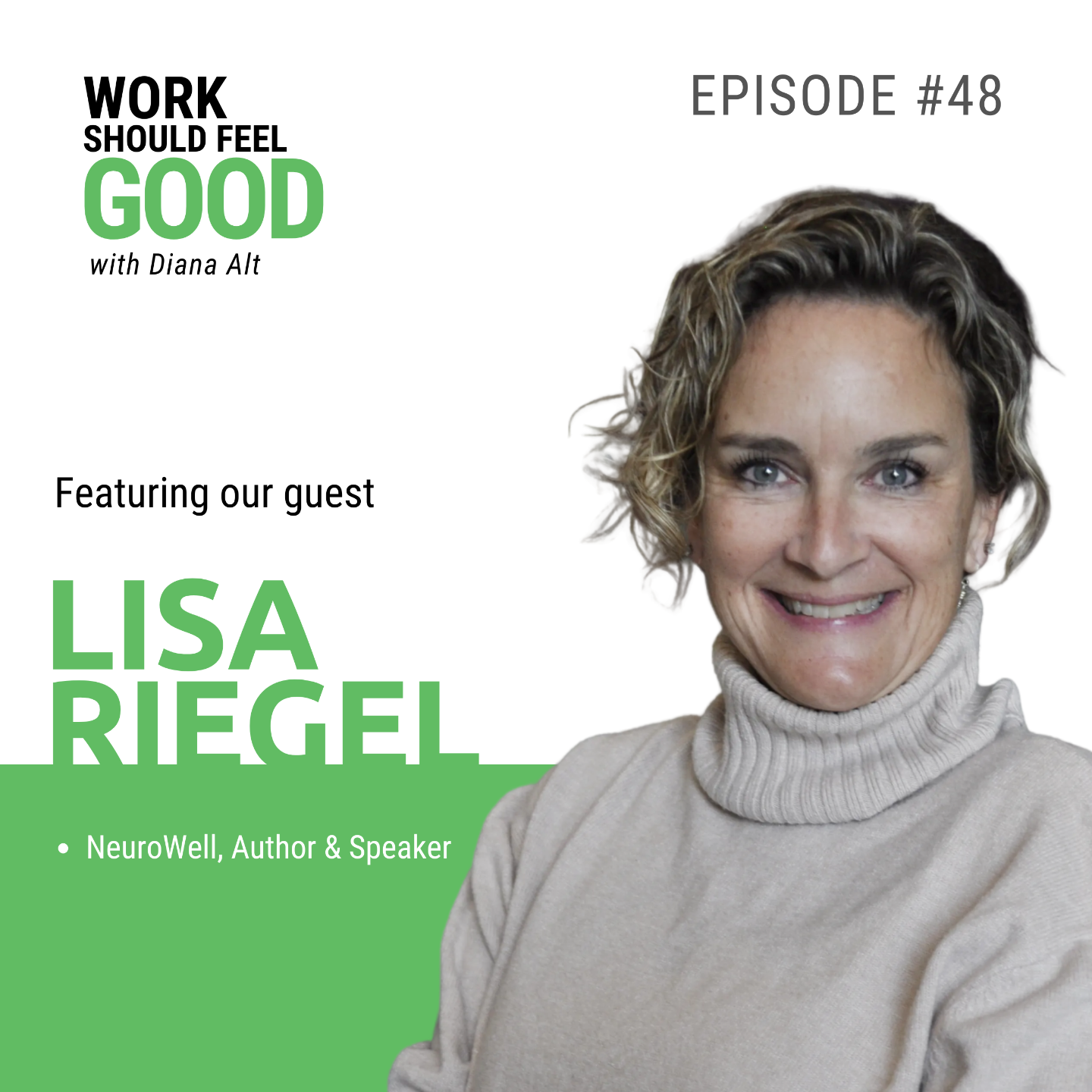
Work Should Feel Good with Diana Alt
Episode 48: Brain Science & Self-Care for Management with Lisa Riegel
Diana sits down with Dr. Lisa Riegel to explore how systems, mindsets, and leadership habits shape meaningful workplace change. They unpack the real reasons change fails and how brain science can help leaders build healthier, more aligned teams.
From the power of culture to the importance of clarity, cadence, and coaching, this episode breaks down the 8C Commitment Framework and offers practical ways to rehumanize your leadership.
You’ll learn:
- Why “outputs” matter more than “outcomes” in early change
- How cadence helps teams align without overwhelm
- The four conversation types every manager must use
- Why celebrating the right behaviors improves adoption
- What to do with the “able but unwilling”



Episode 48: Brain Science & Self-Care for Management with Lisa Riegel
Episode Description
What actually makes workplace change succeed or fail? In this episode, Diana sits down with Lisa Riegel to break down how brain science, leadership behavior, and systems thinking all play a role in creating sustainable change at work.
-
Why most leadership advice stays too conceptual and how to make it operational
-
The difference between outcomes vs. outputs (and why it matters for burnout)
-
How workplace culture is shaped by actions, not stated values
-
The 8C Commitment Framework for leading change effectively
-
Why people resist change (and what’s actually happening in the brain)
-
The role of identity, fear, and perceived loss in workplace resistance
-
How to structure meetings for clarity, engagement, and better decisions
-
The four types of conversations leaders must understand
-
Coaching strategies based on willingness and ability
-
Using AI and automation without losing the human element
⏳ Timestamps
01:00 Lisa’s unconventional career path and pivot into leadership and brain science
05:30 From education to leadership coaching and organizational transformation
09:45 Outcomes vs. outputs—and why leaders get this wrong
13:30 Culture, belonging, and the foundation for successful change
16:00 The 8C framework: clarity, coherence, and cadence
20:15 Why leaders struggle to translate vision into action
23:00 How people experience change differently (and why timing matters)
26:30 Structuring meetings: directives, dialogue, discussion, and data debriefs
31:30 Decision-making, consensus, and accountability in teams
36:00 Coaching through resistance: able vs. willing employees
41:30 Identity, fear, and why people resist change
46:00 AI, workplace anxiety, and the future of human skills
49:30 Practical example of improving systems and workflows
💡 Take Action
🔥 Subscribe for future episodes → https://www.youtube.com/@dianaalt
📖 Grab my Resume Don’ts Guide → https://www.dianaalt.com/resumedonts
❌ Avoid these common job search mistakes → https://www.jobsearchmistakes.com
🚪 Wondering if it’s time to walk away from your job? → https://www.isittimetowalk.com
💼 Work with me → https://www.dianaalt.com
📢 Connect with Lisa Riegel
🌐 Website → https://lisariegel.com
🔗 LinkedIn → https://www.linkedin.com/in/lisariegel/
📲 Follow Me
LinkedIn → https://www.linkedin.com/in/dianakalt
YouTube → https://www.youtube.com/@dianaalt
Facebook → https://www.facebook.com/dianakalt
TikTok → https://www.tiktok.com/@thedianaalt
Transcript
Diana Alt [00:00:04]:
Hey, Diana Alt here. And this is Work Should Feel Good, the podcast where your career growth meets your real life. Each week I share stories, strategies and mindset shifts to help you build a work life that works for you on your terms. Hey there everybody. Welcome to Work Should Feel Good, the show where your career growth meets your real life. I'm your host, Diana Ault and Today my guest, Dr. Lisa Riegel and I are going to dig into how systems, mindsets and leadership contribute to success or failure of workplace change. Lisa Riegel is a workplace culture expert with extensive experience supporting leaders across education and many other industries and making workplace culture safer, more supportive and proactive.
Diana Alt [00:00:56]:
Lisa believes a real change starts in the brain and that she's passionate about helping people understand that brain so they can be more self aware, more self regulated and enjoy self control. All of which makes you happier at work and leads better. Her new leadership book, Aspirations to operations was released January 2026. Welcome to the show. I'm really glad.
Dr. Lisa Riegel [00:01:22]:
Thank you so much. Thank you for having me.
Diana Alt [00:01:24]:
I. I like this brain stuff. So how did you get into it? Like, I was looking at you, you know, when I was researching for this episode. Oh, she's. She's got these English degrees. Yeah, my mom, my mom taught English for years at the community college level. And I put myself to bed with a book every night since I could operate. A book.
Diana Alt [00:01:46]:
So that's near and dear, but it feels far away from brain science, change and management. So can you give us a little backstory of how you got there?
Dr. Lisa Riegel [00:01:55]:
Sure. So my career has been very crooked.
Diana Alt [00:01:59]:
I love a crooked career.
Dr. Lisa Riegel [00:02:01]:
Yep, it's crooked.
Diana Alt [00:02:01]:
Jungle gyms and shoots and ladders.
Dr. Lisa Riegel [00:02:05]:
Exactly. So I graduated from college with an English degree, as you noted.
Diana Alt [00:02:10]:
Okay.
Dr. Lisa Riegel [00:02:10]:
And so I got a job in sales because that's of course.
Diana Alt [00:02:14]:
And I either teach or go into sales.
Dr. Lisa Riegel [00:02:17]:
Right. And I was selling automatic greasing systems for semis and off road construction equipment, which was crazy because I was a suburban girl. I'd never even sat.
Diana Alt [00:02:27]:
You did not have that on your bingo card when you entered college?
Dr. Lisa Riegel [00:02:30]:
No, I did not. But I enjoyed it. But then after, you know, probably, I don't know, eight months or nine months, I was like, I don't care if anybody buys this stuff. Like, it just was not feeding my soul. So I had what I call my quarter life crisis where I realized I had to recalibrate and try to align kind of my values and purpose with what I was going to do with my life. And so I actually quit that job and I called off a wedding that I was supposed to have. And then I got a backpack and went and walked around Florida for a while and just did a total hard reset and said, this is where in
Diana Alt [00:03:02]:
Florida do you walk around? Because we're used to hearing like that that is usually completed by walk. But hiked around Europe.
Dr. Lisa Riegel [00:03:10]:
Yeah.
Diana Alt [00:03:10]:
Not walked around Florida.
Dr. Lisa Riegel [00:03:12]:
So I'm a beach. I was in Fort Myers. Okay. I just went with a backpack and my credit card and I was like, you know what? I'm just going to have no plans and I'm just to wander and see where the world takes me. And I've always been like a very type A controlled, you do this, this is the next step, this is how you do things. Right? And it just was not making me happy. So I just walked around and for the first time in my life, just like, let go and I can't. And then I was like, you know what? I really want to work with kids and help them be successful.
Dr. Lisa Riegel [00:03:41]:
So I went back and got another degree in education and then I taught for nine years and then I was an administrator for two years at a career center and started really getting into the workforce development area. I organized the economic education summit for the state of Ohio for a couple years. I started getting into the business realm of things. And then I had the opportunity to do my doctorate at Ohio State. And my doctorate's in leadership. But I was really more interested in the human system as opposed to policy. So I focused in. And my cognate area was really on engagement and motivation and adult cognitive development.
Dr. Lisa Riegel [00:04:20]:
And I feel like. And I taught at Ohio State for a while in their leadership program. And we're so focused on like org theory and structure, but we don't have kind of that people vision. And it's like, you know, policies shape change, but people make change. And we don't equip leaders to understand how to engage and support people. So that was really where my, my passion came from. And then from there I started doing a lot of leadership coaching and really organizational transformational work. Because of my background in education and understanding how that system itself needs to change.
Dr. Lisa Riegel [00:04:56]:
I've done a lot of work in that area. But then I started doing leadership coaching with, you know, mid level executives, C suite executives, and helping them to think about, you know, most of the training for leaders is aspirational and conceptual.
Diana Alt [00:05:11]:
Okay, I gotta stop you from there. Okay. There's some stuff I want to unpack.
Dr. Lisa Riegel [00:05:16]:
Yep.
Diana Alt [00:05:16]:
Including. Okay. What did you teach? You said you were a teacher for Nine years. What were you teaching? What level?
Dr. Lisa Riegel [00:05:23]:
High school. I taught English and I taught journalism, Bless your heart. Yeah, I taught etymology.
Diana Alt [00:05:28]:
The yearbook.
Dr. Lisa Riegel [00:05:30]:
No.
Diana Alt [00:05:31]:
You did the newspaper?
Dr. Lisa Riegel [00:05:32]:
Yeah, but I am. I'm very proud of it because when I started, they said, can you teach journalism? And I was like, I guess. But I'd never taken a class, so I was like, okay. So I went to Otterbein and took their, like, journalism 101. And I had six students, and I said, okay, I don't know anything about this, so we're going to learn together. So I'm going to go to school, and then the next week we're going to do what I learned in school. And the kids were like, okay, that's fun. So I had six students.
Dr. Lisa Riegel [00:05:58]:
And over the nine years, I went from six students and, like, a horrible paper that we produced a couple times a year to I had a weekly paper and 92 writers. And.
Diana Alt [00:06:09]:
Hell, in high school. You did a weekly paper?
Dr. Lisa Riegel [00:06:13]:
Weekly paper. It was free. We managed to find a way to.
Diana Alt [00:06:15]:
Amazing.
Dr. Lisa Riegel [00:06:17]:
And we. We traveled all over the country and competed. And it was. That was the most rewarding part of my teaching because it was, you know, the kids really saw their names in print. A lot of the students that I had are now working in PR or advertising or like, one works for the ap, one works for Reuters. So they went on to become writers and do things with their.
Diana Alt [00:06:39]:
I have two nieces that were. They were editors of their high school paper that was a monthly paper that did really well. And my sister, she took a. She teaches high school, too, and she took a job some years back in, like, an academy setting of a high school. It was. They call it E. Communications, so it's web design, like convergence journalism, film animation, that kind of stuff. She's graphic design.
Diana Alt [00:07:09]:
And when she took the job, they're like, oh, by the way, you get to do yearbook, too. She's never done her life, so she did that for a few years and then was able to pass it on to somebody else because her program was growing and she took a promotion. But I didn't have a pa. I didn't have a school paper.
Dr. Lisa Riegel [00:07:28]:
Yeah. And a lot of them don't anymore. I think it's really sad because it's like, it gives students a chance to see how their words can matter and make differences and how to be critical thinkers and objective and, you know, and of course, journalism today is way different than it was, you know, 20 years ago when I was teaching. So I don't know that I'd want to teach journalism today in the, in the climate we're in. But it was the best job ever. I just loved it. And then when I went into administration, my job was kind of the outward facing administrator at the career center. So I got to know economic developers and business leaders in town and started really understanding how the role of schools in workforce development and that really got me excited.
Dr. Lisa Riegel [00:08:13]:
And then I started to realize that, you know, we're not producing students who are ready for the workplace. And then, you know, likewise, they're not ready to be leaders once they're in the workplace. They're just thinking this huge bank of skills.
Diana Alt [00:08:27]:
All of that is like, there's so much wrapped up in all that because that the program I told you about, that E Communications program, is under the CTE umbrella, career and technical education umbrella. And I've been on the advisory board for that, which is not a big job, like a couple meetings a year. But I'm like, I'm in it, you know, and I've learned, I've learned quite a bit about it. So underrated. And also, it's also underrated what the kids that take those programs seriously can do when they're 16, 17, 18 years old. My entire branding kit for my business I developed in 2020 with a high school senior from that program who went on to be a full ride scholarship program in an art institute and landed like four job offers after he graduated from college. Like, and I've had, I've had so many compliments on it. So I'm a big fan of that because there's, there's, it's, it doesn't take that much attention to nurturing that talent to really draw some stuff out if it's right though.
Diana Alt [00:09:33]:
Yeah, I love that. Well, thank you for sharing all that stuff and the workforce side. So my background before I started focusing on career and leadership coaching was in tech and I used to teach continuing ed classes at the local community college. So I saw workforce stuff a lot, but it was for the retraining side. You know, someone worked at Hallmark for 20 years and got laid off because who buys greeting cards anymore? And, and then they're trying to figure out like, what is project management in the modern world? Because it's not going to be the same as what we did in my last job. That stuff's really important too, and a lot of states do not do a great job with it, unfortunately. So you got into the human side.
Dr. Lisa Riegel [00:10:23]:
Yes.
Diana Alt [00:10:23]:
Was there something in particular that drew you to that? Like, did you have a personal story or was it more seeing the trends as an educator of where we were just trying to shove facts in people's brains instead of teaching them how to think? What made that be the thing for you?
Dr. Lisa Riegel [00:10:42]:
I think part of it is that is what you just said, that like the transmission of content is no longer an adequate purpose for school. I mean, you can get content anywhere you want in any form. So I feel like we're just missing the human factor. And I feel like businesses are kind of that way now too because they spend so much time on short term goals and short term gains quarter to quarter that they're always chasing their tail. And so taking some time to take a breath and say, okay, what is the transformative change that I want to see longer term? And let's focus. One of the things I talk about in the book is that I see leaders focus on the outcome measures, but they don't focus on the fidelity measures, the output measures of like, I want
Diana Alt [00:11:27]:
to talk about that for sure.
Dr. Lisa Riegel [00:11:30]:
So it's like change, right? So the theory of change is what we're going to do, but we don't measure and celebrate what we're going to do. Because then we just look at the end outcome. And if that doesn't move, we say we failed. Well, maybe we did everything we were supposed to and our theory of change was wrong. And so we end up overworking people and they're exhausted. Nothing's ever enough because we're looking at something that has a million different variables that impact whether it moves. And we're not looking at the things that we control. And when we feel in control, we can feel like we did a good job and we can feel satisfied and fulfilled.
Dr. Lisa Riegel [00:12:06]:
When we feel out of control, we get burned out.
Diana Alt [00:12:13]:
Girl, I'm glad you wrote this book. When I was reading the intro and I hit on, I got to that whole you touched on the outcomes versus outputs thing. It kind of like made my brain seize up a little bit. Because a lot of what I'm doing in my work when I work with job seekers in particular, because I work with people on job, you know, job searches and career development and leadership development, I'm kind of trying to serve this professional leaders audience at multiple stages of their career. And I'm constantly on people to talk about what the outcome of work was. But that's a retrospective. Whenever we're talking about it, like on a resume, when you're networking for your next job, the notion of when we're planning the change, let's think about, yes, we want some Outcomes, but we can control the, what you call outputs. And then I wrote down intent and impact as we're four words on this piece of paper.
Diana Alt [00:13:15]:
Outcomes, outcomes, outputs, intent and impact. And intent and impact had less to do with the change and more to do with how people treat each other. Because I've been kind of on a. I've been trying to understand like what the hell is anti racism ever since George Floyd died in 2020. And a lot of people that are not in marginalized groups, we talk about, well, I didn't mean to do that. I didn't mean to hurt somebody. And so I've been learning like, well, the. In the intent, yes.
Diana Alt [00:13:52]:
Like, let's try to not have bad intent, but don't let your good intent negate that you had a bad impact. Because how do we get better otherwise?
Dr. Lisa Riegel [00:14:01]:
Right.
Diana Alt [00:14:02]:
And it sounds like this outcome output is almost like the same sort of mindset just around change in an organization. Like, yes, we want good outcomes, but. But let's think about the controllables and make sure that we're going after the controllables. Right.
Dr. Lisa Riegel [00:14:20]:
And the first C in the book is culture. And I kind of go through that. The foundation really is people have to feel a sense of belonging. Like if you've ever walked in a meeting and you're like, oh, these are not my people, you kind of shut down, you disengage. But if you walk in and you're like, these are my people and we have a shared purpose and we have, you know, practices in place, then you open up and you share and you give the best you can. So that's the first one, but then the next C. So there's three planning Cs. So there's clarity, coherence and cadence.
Dr. Lisa Riegel [00:14:50]:
And I am amazed by how many leaders I speak with who have conceptualized the change they want, but they have not gone down to the 30 foot view or the three foot view. Right. So when they tell their staff this is what I want, sometimes what they're telling them conflicts with current practices. So now the employee is going to fail either way. Either I'm doing this right or I'm doing that right, but I can't do both together.
Diana Alt [00:15:16]:
I wonder if we should zoom out because like you read the book, I read the. You wrote the book, I read the intro and we're like kind of in the seas. But can you talk first about the aspiration to operation and just kind of a quick summary of what your book is and then let's go into those. Because I wrote Some notes on the Cs, and I have questions on the Cs. Okay, sure.
Dr. Lisa Riegel [00:15:38]:
So the idea and the reason for the title is that most of the leadership training is aspirational and conceptual. It's get the right people in the right positions and engage your people and build a strong climate. But it's not operational. So leaders don't know how to translate their idea into actionable strategies. And it's really, you have to be strategic about each of these Cs. So the 8C commitment framework kind of evolved over time out of the work that I've been doing for the past 15 years with leaders and really thinking about, okay, how do you set the stage for change? By taking care of your culture. And, you know, culture is not words, it's actions. But I see a lot of companies that spend thousands of dollars on mugs and T shirts and slogans and posters.
Dr. Lisa Riegel [00:16:22]:
But then when you go in and you say, how are your operations reflective of these values?
Diana Alt [00:16:28]:
And they don't call it values in action. And. Yep, because one of the top. Most of the people that I work with are, they're like the older end of millennials up through Gen X. You know, like, usually it's like late 30s to mid-50s is the sweet spot. So people that know they have a while to work, some are more in a growth mode, some are in the. I just want to do satisfying work until I'm done.
Dr. Lisa Riegel [00:16:51]:
Yeah.
Diana Alt [00:16:51]:
And all of them that are drawn to me are looking for a better culture or a good enough culture. You know, like some. Some got laid off, and they're like, I have a standard. Some are. Are in a great spot, and they just want to make sure that they're improving it. And I have learned that it's values in action. You have to think about what the behaviors are. You have to think about what that means for you.
Diana Alt [00:17:19]:
And I've worked. I've done some business consulting, too, mostly small businesses. But when you sit down and they're talking about their culture and it's five phrases, and it's like, great. How is this reflected in your policies and your performance management? And they look at you like you have two heads.
Dr. Lisa Riegel [00:17:36]:
Right? Right. Yeah. We don't live the. Live the words. And then people know it. And then you. Then you're not controlling or leading that. And then, you know, and then once you have a foundation that's a strong culture, then all the other Cs serve to just continue to strengthen that culture.
Dr. Lisa Riegel [00:17:53]:
So the first three Cs are the planning Cs after culture. So there's that clarity, cadence, and coherence. And so it is kind of amazing how long it takes sometimes to get a leader to conceptualize. Because the question I always ask that they look at me like I have two heads, is, if everybody's doing what you want to move this change forward, what do you see and what do you hear? And they can't answer those questions. They. They go right to their KPIs or their outcomes. They go right, but they don't. They don't conceptualize in concrete terms what the humans in the system are going to be doing to achieve it.
Diana Alt [00:18:31]:
Yeah, it's like what pretend tableaus down.
Dr. Lisa Riegel [00:18:36]:
Right, right.
Diana Alt [00:18:38]:
And tell me what's happening.
Dr. Lisa Riegel [00:18:40]:
Right. Exactly. And then, you know, then the. So after you get the planning seized down and you think about the cadence, people are resistant to change. And sometimes what we don't think about, and this is where the brain science comes in, is coming in to understand how do we automate habits in our brain? How do we understand how people perceive their reality? Because all of us have different perception of the same event. And how we perceive the event is 100% grounded in the way that our brain is structured and it's individualized. And so, you know, when we think about change, oftentimes we're like, okay, here's the change I want to have, so everybody should go do it. I gave you some training, so why aren't you all doing it? But it's like we have to also think about when we ask people to change.
Dr. Lisa Riegel [00:19:21]:
You might have a resident expert whose identity is tied up in their ability to be the best at doing xyz. And now you're going to automate that, and it's taking that need for that expertise away.
Diana Alt [00:19:34]:
When I was going through, when I read through the intro and was looking at the description of the Cs, there were two that jumped out at me. And the first one that jumped out at me the most was cadence. Because I liked how you talked about people don't all implement change at the same time. And you called out new versus seasoned. And people that embrace change and are scared of change. And then a thing that comes up for me that may have been later in the book, I didn't notice it in the intro, is the leaders that are conceiving of these changes. They will talk about it sometimes for weeks or months before they decide we're prioritizing this change. By then, it's like air to them that we're going to do this and why it matters.
Diana Alt [00:20:22]:
And then they want to tell people once and when they ask again, they're like, well, we told you everything about this.
Dr. Lisa Riegel [00:20:28]:
Right, Right.
Diana Alt [00:20:29]:
Well, guys, like, we don't live inside your head. No one wants to live in the C suite type.
Dr. Lisa Riegel [00:20:36]:
Yeah, yeah, well, that's what in the book, I have some really practical tools that you can use. So one of them is to work with your team to build a strategy matrix. So to be identifying, okay, here's the resources, here's the software, here's the processes, protocols, whatever that we use. Then here's what we actually do, here's the expectation. So that's what we see in here. And then what are we going to monitor about what we're doing? And that's the big missing piece, that's that output monitoring. And then, you know, what are the outcomes that we hope this theory of change will impact in a positive way? And so working with your team to set that up and talking about, okay, what historical knowledge or practices do we have that we can evolve or revise that are going to help us be prepared for this change, Getting that kind of everybody on board. And so once you get through like the planning seas, then it becomes how do you engage people? Because change is scary.
Dr. Lisa Riegel [00:21:33]:
And there's also a lot of reasons not to change. Like, I'm comfortable or I've got a lot going on in my life right now and the idea of having more stress here to try to learn something new is going to tip the scales for me. So then there's, there's C's on coaching and collaboration. Because the other thing that I see, in fact, funny story, we have some friends who were working remotely and they have these big huddle meetings once a week and there's like 40 people on these things. So we were on vacation with them and they just put the huddle on in the background and we played cards. So it's like, it's a useless meeting. They don't need to be on it. Half the stuff that's being talked about isn't relevant.
Dr. Lisa Riegel [00:22:11]:
So part of that collaboration chapter really goes into how do you structure meetings so they're purposeful. And one of the things I talk about is that there's different types of talking and they have a different purpose. So if you as a leader, name the type of talking you're expecting out of your team, it helps keep things on track.
Diana Alt [00:22:29]:
What are some of the types of talking? Say more about that because.
Dr. Lisa Riegel [00:22:33]:
So the first one is directives. And directives are decisions that have already been made and the Purpose of a conversation around directives is to seek to clarify. We've already made the decision. So now what does this mean for action? I have seen so many meetings where the decision comes in and the meeting gets derailed. And it's 45 minutes of talking about, why did we do this? What are we doing? I don't think we should do it that way. Like unraveling the decision and making things fuzzier and fuzzier. The second is that is having a dialogue. And a dialogue's purpose is to understand an issue from all sides.
Dr. Lisa Riegel [00:23:10]:
So it's kind of like a brainstorm. There's no right answers. It's getting things out there. And the mistake I see happen is you've got a couple extroverted team members that just talk, talk, talk, and then you move right to, oh, that's a great idea, Diana. That's what we're going to do. Okay, let's do that then. Moving forward. But you're not really getting the brain power of your team because you're.
Dr. Lisa Riegel [00:23:29]:
You're jumping too quick to a decision. And then that's the third one is a discussion. And a discussion is seeking to decide. And so.
Diana Alt [00:23:39]:
Oh, okay. So that is really important. Really, really important. Because I think a lot of. A lot of people walk in a dialogue thinking that the goal is a discussion.
Dr. Lisa Riegel [00:24:00]:
Right. And a lot of vice versa. Right. And a lot of times you get into a discussion who. Which is the purpose is to make a decision, and it unravels back into a dialogue. And it's like if you dialogue something, you get everything a discussion should come with. Thank you for all your input. We have considered all this based on all the other factors involved.
Dr. Lisa Riegel [00:24:22]:
Here are a couple different ideas. Our goal today is to take the best of all these ideas and come to a final decision on what we're going to do.
Diana Alt [00:24:31]:
I love that. I used to work in product management and tech, and so I had. It was the role I had where I had to deal with the most stakeholders by far, like stakeholder groups, engineering, analysts, finance, legal, like, marketing, all the things. And so that is where when I was in my first product management job, like 15 years ago, I learned to put decisions that we need to make in those types of meetings. Yeah. And it changed everything. It changed who showed up.
Dr. Lisa Riegel [00:25:03]:
Yep, absolutely.
Diana Alt [00:25:04]:
The person that's like, I'm double booked. I don't care. Oh, they're gonna decide this. I better be there.
Dr. Lisa Riegel [00:25:10]:
Yep.
Diana Alt [00:25:11]:
It was really, really helpful. Well, thanks for framing those up. That's great. Is that the three Is there more? I got so excited about the last two.
Dr. Lisa Riegel [00:25:20]:
Well, the fourth one is a data debrief. And data debrief is important because it adds a layer of accountability. So I always say good collaboration, you've defined clearly the autonomy of the team and you also have structures in place for accountability. And so sometimes the autonomy is fuzzy because then you hear people talking about decisions that, that's not your pay grade to. So being able to come in and say these are the non negotiables that have been decided up high beyond us, this is the playground we have to design, you know, and then having that autonomy clarified and then the other piece is that accountability. And so when we have, you know, team meetings, we should have a data debrief every time with some metrics, those output metrics. So everybody goes out and shares. This is what we got.
Dr. Lisa Riegel [00:26:09]:
This is what I'm working on. Did you meet your deadline? Did you, you know, you were going to like looking back at the last action steps. I did this. Here's what we did, you know, giving some of that, just debriefing on the actions of the people. Because I've seen this so many times in meetings is that people are like, oh yeah, we've started some conversations, we've had some. No, they haven't. There's been nothing going on. You know, you just use.
Dr. Lisa Riegel [00:26:34]:
But when you say you expect data, then now there's an accountability. And so you can set up a structure for that and it can be super fast. You don't. It makes meetings half the length of time and much more purposeful and productive.
Diana Alt [00:26:47]:
Yeah, and it's, it's. If you, if you have the right culture and the right degree of psychological safety, let's call it. Yep, you can say I didn't do that.
Dr. Lisa Riegel [00:26:59]:
Right.
Diana Alt [00:27:00]:
Without repercussion. This, Scott, this got blocked. I know we made a decision, but we got into it and figured out actually there was a lot of factors that we had to revisit. We live in the real world where sometimes the decision you discover didn't have enough rigor. But I came from Agile software development. That's where a lot of my career was spent. I was project manager in that Scrum Master and then end product. And so we called that retrospective.
Diana Alt [00:27:32]:
Like what did we actually do? What did we build? How did it compare to what we thought we were going to get done? But it's interesting, you talk about commitments, the eight Cs of commitments. We were really careful about the use of the word commitment because it could be abused because I think accountability and commitment are terms that are often abused in corporate America. They're used as clubs.
Dr. Lisa Riegel [00:27:57]:
Yes.
Diana Alt [00:27:57]:
To beat people about the head and shoulders.
Dr. Lisa Riegel [00:28:00]:
Yep.
Diana Alt [00:28:00]:
Which is not okay. So. But you clearly have pulled things together to try to prevent that. I love this focus on the four types of meetings though, because most people couldn't tell you what collaboration is.
Dr. Lisa Riegel [00:28:13]:
Right, Right. And I've seen that. And you know what happens then is you've got people, you've got this brain trust and all these skills in your people, but because of the way you're facilitating the work that you do with them, they're disengaged, burned out, tuned out. Or, or you end up with one or two people who's the loudmouth in the group and they end up driving everything. And you might have a really genius person sitting next to them who's just like, whatever. The other thing I talked about in the, when you're making a decision is to go through a consensus process. And that's really important when you get to coaching. So when, when we do consensus, when we come to the decision, we say, okay, this is the decision the team is landing on.
Dr. Lisa Riegel [00:28:53]:
We're going to come to consensus. That means we're all committed to this decision. It doesn't mean you love every aspect of it. It means I can live with this, I will do my part and I will not sabotage.
Diana Alt [00:29:05]:
And so you may think that's really important to pick apart for a minute because, like, one of the things that, one of the things that I see, especially leaders that leads to career dissatisfaction for them or job dissatisfaction, is when they have a decision making style that is different than the culture of the company.
Dr. Lisa Riegel [00:29:28]:
Yeah.
Diana Alt [00:29:28]:
And so the way you're using the word consensus is different than what I'm about to say because like, when I was in product management, I had to take things from stakeholders and then I had to make decisions based on that information. But it was my decision. But then I had to go make sure I was getting buy in. So it wasn't like I could be like Moses and hand, you know, two stone tablets at the top of Mount Sinai. I had to have an iterative process with them. Your definition of consensus sounds like it's more around no matter what the actual decision process is for the team, we're all going to commit to it. We are all buying into it at the end. Do I understand that correctly?
Dr. Lisa Riegel [00:30:13]:
Yes. And if you've done a proper dialogue and really given people some time to think about and really seek to understand the situation or the problem, then and then you have the discussion where they're coming together to decide based on the things that they came up with. Then by the time you get to the decision, people should have ownership of that decision because they were part of it. But you have. But I always say, make the consensus activity. Everybody has to state it out loud. I agree. I agree.
Dr. Lisa Riegel [00:30:44]:
I agree across the table. Because then later on, if you're having an employee that's not following what you're supposed to do when you're coaching them, I could sit down, I could be like, hey, Diana, we came to consensus around this decision, and I'm not seeing any evidence that you're doing it right now. So help me understand what's getting in your way. Is it you don't know how? Is it you just don't have enthusiasm for it? Is there something else going on in your life that's making change really difficult for you right now? Now, is there a logistics issue that I need to step in? Because you literally can't do it, and it changes the way you coach. So that it's not about, you need to be doing this. I don't agree with you. It's, we made this decision. Now let's mitigate the barriers that are preventing us from being successful.
Dr. Lisa Riegel [00:31:29]:
And when you coach that way, by the time you walk out, if you've truly addressed, you got to kind of listen for the. The root fear in the complaint or the root problem, then the goal of coaching is that you've given them constructive feedback and put an action plan in place, and they walk out of your office feeling empowered, not feeling like they just got hit over the head.
Diana Alt [00:31:51]:
I have, like, anytime I run, I always gravitate to coaching sessions, sections of books like this. Because right now, everybody wants their managers to be coaches. No one trains them on coaching. And not very many people acknowledge that effective coaching is a discipline that takes years to develop. Just like understanding the financial domain or like anything else that you could do. It's also weaponized. So coaching is weaponized just like the word accountability is weaponized. When I first read that section and read the first fewer, I was like, oh, we're going down.
Diana Alt [00:32:34]:
Because I thought. I thought, oh, Lisa's making the same mistakes. And then I read the chapter. It's like, okay, I'm calmed down a little bit. But one. One thing that I do. I do want to kind of dial into, though, is you talk in the book and you talk just now about coaching. As you know, here's so and so they agreed to the change.
Diana Alt [00:32:58]:
I Don't see evidence that they're doing it. But coaching also is done to take people that are doing the right thing and make them even better, too.
Dr. Lisa Riegel [00:33:08]:
Yep.
Diana Alt [00:33:08]:
In the real world. So talk a little bit about coaching for the person that maybe said they were bought in, but it's showing that they're not, versus taking someone that maybe is what you called either an observer to the change or an early adopter of the change and like, really fueling them to be a change agent for you. How does that look different?
Dr. Lisa Riegel [00:33:34]:
So basically what I talk about is that any organizations like a crew boat with 10 people on it, and you'll have about two, maybe three people that are rowing like crazy in the right direction, and they're kind of your coalition of the willingness. Then you have like maybe five people that are staring at the scenery and they might stick their oar in the water and paddle. And sometimes they're going in the right direction, sometimes they're causing drag because they're trying things, but they're not clear about how to be in sync. And then you have some people who are boat sinkers. So I talk about in the book creating an attitude aptitude matrix, and so going through having, you know, who's your able and willing, who's your not able but willing? And those are the easy ones. Right. Because you just train them. Who are you able but not willing? And then not willing, not able.
Dr. Lisa Riegel [00:34:23]:
And you coach each of those quadrants differently. And so to your point about somebody who is able and willing, I think some of it is about the way you celebrate them when they are doing things. Well, I'm amazed how many times the person who is considered the top employee, the best of the best on the team, doesn't know that. And I actually, one time, this is
Diana Alt [00:34:44]:
mentioned all the time.
Dr. Lisa Riegel [00:34:46]:
Yeah. I had a woman who I was doing a big grant evaluation on inquiry learning and that style of learning. And there was a woman who was by far the best example of inquiry learning I've ever seen. It was amazing. And I said to her, would you mind if I videotaped your class a little bit as part of the evaluation? And she was like, oh, I don't know if I'm doing it right. And I was like, you're not just doing it right.
Diana Alt [00:35:09]:
You are like, you're the exemplar.
Dr. Lisa Riegel [00:35:11]:
You're the. Yes. And. And that's the part too, that when you get into the sustainability seas, it's about communication and celebration. When we have clarity of what we're supposed to be doing. And we celebrate when we see it happening. It builds collective efficacy on the team because you can stand those people up and say, hey, so and so did this really, really well. Tell us how you did it.
Dr. Lisa Riegel [00:35:31]:
And you kind of give people the opportunity to toot their own horn. So that's one thing I think is if you, you know, if you're coaching somebody who is your. Your early adopter, the first step is make sure they know. Make sure they know how good they are and then have them talk about, you know, their own journey. How did you make this change? What are the things you have to think of? How can we pair you up with somebody who is not able but willing to give you some softball experience with coaching and sort of peer leadership, and then, you know, reserve the ones who are the. And a lot of times the not willing, not able, they're actually not willing because they don't. They're not able.
Diana Alt [00:36:10]:
They don't understand. Yeah. They don't know what to say.
Dr. Lisa Riegel [00:36:12]:
Once you get them some training, they get a little more confidence around it or if you do celebrations around it. They know what you mean.
Diana Alt [00:36:19]:
Those people that, that quadrant, some of them just don't have it. Yeah, but they probably didn't have it for the. Like, they might not have had it in general even if you weren't doing the change. Right, right. But talk to us about the able and not willing.
Dr. Lisa Riegel [00:36:37]:
Yeah. So the able and not willing. I think you have to think about why are they not willing. And some people are not willing because it's. They're not putting in there. They don't want to put the effort in, or they don't believe in the change and they think that they know better what's going on. So you can mitigate some of that by running through that kind of decision making, planning process that I talked about. Sometimes I think that people don't recognize is that people don't want to do it because they're.
Dr. Lisa Riegel [00:37:05]:
There's a fear. And a lot of times what we don't pay attention to is if I've done my job for 15 years and I'm really good at it, and I am the resident expert that people come to. That's part of my identity that I'm kind of a powerhouse in the team, that I'm the person that knows what I'm doing. Now all of a sudden I'm not the resident expert anymore. And that can be very jarring and stressful for somebody to think. Now all of a sudden I'm on equal playing field with these other People that have seen me as a leader. So there's an emotional side to change that. I think we can coach some of those people out of the not willing category.
Diana Alt [00:37:43]:
But to your point, that's one of my favorite quadrants that I've worked with and I've also been in that because I'm like salty, I'm kettle corn. I'm a little sweet sometimes, but I'm salty too. But one of the really interesting things in my experience with that able but not willing set of people is depending on the reason, if it's not just like, ugh, I don't feel like doing it. A lot of times it's skepticism of either is the change going to work or what's going to happen to me, that fear of what's going to happen to me. The minute you assuage that concern, they go from being in that quadrant to being in quadrant one to being your early adopters. And I like to do maps of people. Like when I, I didn't have this vocabulary. Now I would maybe use some of your vocabulary doing this, but when I had key people that were going to be impacted by a change, I liked to map out who is going to be the person that we want to be the change agent, but we're not sure they're going to be up for it.
Diana Alt [00:38:49]:
That person needs the most attention pretty quickly because that's one or two more people that are now rowing the boat in the right direction.
Dr. Lisa Riegel [00:38:58]:
Right. And eventually, whenever, when you've got most people rowing in the right direction, even if some of them are paddling harder, then you've got the peer persuasion component of collective efficacy of like, this is what we do here. And then those people who are boat sinkers, you know, sometimes they, they choose to leave because it's not going to change or they choose to change. And I think the other thing to think about with that not willing but able group is that if you like, the other Cs, support it. So if you're doing celebrations that are authentic, that are related to the job tasks at hand, like if that woman with the inquiry learning style had had props, had had the opportunity to be showcased for her work and given some good feedback, right. Clearly she hadn't had feedback. So if a leader has been clear about the change and is giving positive and constructive feedback, then that person is going to start to get a lot of recognition. Well, if you're a local expert who's been really good at your job and always the go to person for somebody, part of your identity is I'm the one that gets recognized.
Diana Alt [00:40:03]:
Right.
Dr. Lisa Riegel [00:40:03]:
So when other people are starting to get recognized in a clear way because they're doing what they're supposed to do and they're excelling at doing, creates dissonance in the mind of the person who considers themselves a local expert. And it can lets them know, hey, you know, either way, you're not going to be the recognized employee anymore because you're doing practices that we're leaving behind and you haven't left them behind. Yeah.
Diana Alt [00:40:29]:
And it's interesting too, because I think, you know, when you think about AI, one of the things that's happening is it's reframing what is the expertise that's important in that subject matter expert. Because it is oftentimes less about just the actual subject matter and more about the combination of the people and the subject matter.
Dr. Lisa Riegel [00:40:52]:
Yes.
Diana Alt [00:40:53]:
So, yeah, I can look up on perplexity, like how this audit process works, but how can I think about this process that feels contentious and how do I make the people feel comfortable being forthcoming and on and on and on like that's not proprietary. Perplexity is not going to tell you how to do that. So.
Dr. Lisa Riegel [00:41:13]:
Right. Well, and I talk in the book a lot about just sort of the mental health state of workers right now, and it's not good. And there's some research coming out about the level of anxiety that people have about AI because it is going to displace those resident experts. And so really being mindful of that and paying attention to what happens to our brain when we have anxiety and stress is we lose the ability to use our thinking skills. So you get people who are operating on panic as opposed to reason and logic.
Diana Alt [00:41:45]:
Such a terrible spiral, too, because when you're genius, like when that. When you had subject matter knowledge and that's how you identify yourself. And then it's being replaced by tools, knowledge, AI or training others. Now, you can't take the rest of what's special about you and access it.
Dr. Lisa Riegel [00:42:05]:
It. Right.
Diana Alt [00:42:06]:
Because you're so freaked out. Oh, are they going to fire me? Because.
Dr. Lisa Riegel [00:42:09]:
Right.
Diana Alt [00:42:09]:
They don't need someone that knows 15 years worth of this. They need someone that can use this tool that we just created. Very cool.
Dr. Lisa Riegel [00:42:17]:
And people are different. They have different comfort levels with technology. You know, if you've got somebody who's worked for a company for 20 years and was really good at a process, and now we have a software solution that does that process in half the time and, and you know, more accurately, that's a real threat. It's a threat to your identity and your place in the company. And I think we, you know, that's where like I talk about, you know, policies and plans and strategy shapes change, but people make change. So if a leader is equipped to look at the human system within the organization, they're going to get better fulfillment, productivity, efficiencies. People are going to be happier and healthier at work. And it's just, you know, work should feel good and they'll feel.
Diana Alt [00:43:00]:
Yeah, I love my little podcast name. Yeah, I love it. I want to take this into something that is a little easier to grasp onto. So a couple things I wanted to ask you are, Number one, can you tell us a little bit about maybe a change effort that you either helped a client with, were part of or even just heard about where it was kind of messy and then they started applying some of the things and then they were able to recover it? I, I feel like it's like, yeah, in a perfect world, would we have Lisa's book and when we be able to do all this thing right, that ain't how the world works.
Dr. Lisa Riegel [00:43:42]:
Right.
Diana Alt [00:43:42]:
So how can someone who's in the middle of a change that feels murky recovery. Do you have an example of that?
Dr. Lisa Riegel [00:43:53]:
So one of the things, I worked for two years with the Office for Child Nutrition, which is sort of the business office that manages school lunches and things like that. And it's a very, you know, it's a very detailed process that they go through. And it was a matter of like, who's doing what and how are you handing, how are you handing it off from one to the other. And what we found was that the consistency of quality was wildly different. And so, you know, it basically your experience depended on who your kind of case manager was.
Diana Alt [00:44:28]:
Okay.
Dr. Lisa Riegel [00:44:29]:
We kind of mapped out the process places and we said, okay, where can we, instead of having every single person review something that's the exact same way, can we do that in a way that it's consistent, like whether or not it's using AI or using technology to kind of go through some of the just low level hanging fruit that provides that consistency? And then can we focus in on the customer training piece and really focus in on that being so in that particular case, it was really about shifting focus from following an algorithm and plugging things into a dashboard in the right order to really moving more toward how do we work together to address the problems that we're seeing.
Diana Alt [00:45:15]:
So, like, how do we automate the low hanging fruit or automate like a super easy workflow and then use your judgment on the hearts. This is interesting because so many people are using AI wrong. Like they're using it to do the wrong stuff faster. And that's the opposite of what you're talking about. You're talking about using it to do the easy stuff faster or AI or automation, whichever.
Dr. Lisa Riegel [00:45:44]:
Like, right.
Diana Alt [00:45:44]:
People use them interchangeably even though they're not the same thing. But. And then you can basically save that brain power to deal with the gnarly stuff.
Dr. Lisa Riegel [00:45:54]:
Right.
Diana Alt [00:45:56]:
It's shifting from using technology as just like your freaking intern to using it as a thought partner.
Dr. Lisa Riegel [00:46:04]:
Yeah. And I think the other piece is that when you like in this particular office, they were not solving the larger systemic problems around communicating and making sure that the people who were accessing the programming had a clear pathway to go through. Everybody had a little bit different flair of how they did it, even though the process was very uniform. And because they were spending so much time in the weeds, in the low hanging fruit stuff, they didn't have the brain power to do a bigger kind of transformative shift of hey, we could really, you know, what if we divided the office instead of everybody does the same job from soup to nuts. What if we had like handoffs and people specialize in those handoffs and then we could look for technology that could help make those handoffs more efficient. And so we started to transform some of that and it was, it was very interesting because we had our rowers and our boat sinkers and things because they were used to this process. But once we were able to start really recalibrating what gets done. And again, it goes back to the outputs.
Dr. Lisa Riegel [00:47:13]:
What are the measures at this point in the process? These are the things that we want to see done in this amount of time. Then you pass it off. Then each of those teams was able to monitor their metrics. You know, we had applications come in. It took us less than 48 hours to turn them around. And they had all the data in one place. Where before we had like, I think it was like 26 different people doing the exact same thing. And so we were able to start being more strategic and then to get deeper training for those people to address some of the systemic and communication issues and customer service issues that were arising at each of the various stages.
Diana Alt [00:47:50]:
When, when you have everybody doing all of it.
Dr. Lisa Riegel [00:47:53]:
Right.
Diana Alt [00:47:53]:
Well, it's just Judy, she's learning. She just started six months ago instead of, no, we have a freaking problem here.
Dr. Lisa Riegel [00:48:01]:
Right. There isn't inter rater like accountability. Right. So if I own the whole project, soup to nuts. If I'm terrible at that process, there isn't anybody else to help catch that and fill in the gaps for me. This allowed them to kind of have some inner rater reliability to each or reliance on each other.
Diana Alt [00:48:21]:
Cool. I have two more questions and then I'm going to go into like a couple lightning round. Ish.
Dr. Lisa Riegel [00:48:27]:
Okay.
Diana Alt [00:48:27]:
At the end before we close, first thing is 20 years from now when we think about we're in the baby baby infancy of AI will be more established in the world of AI doing all the things. What is something that we do are doing right now that we are going to recognize in 20 years as counterproductive nonsense. What do you think?
Dr. Lisa Riegel [00:48:53]:
I think that we are treating AI like it's the holy grail of everything. And I think the real key to success for companies is to understand where is the gap that AI doesn't fill and how do I find ways to train my humans to fill that gap. And that's going to be the creative thinking, the human to human contact AI like the way I view it is that it can make things so much faster and I love you, you can get on there, it's super easy to use. It can give you a good starting point. But I think when we look at AI as an employee that is going to do a job, we're going to roll down into a lot of problems. I think we need to look at AI as a 10 time factor for efficiency instead of starting with a blank slate. It can spit all this stuff out, but we still need the humans to make sure that what it's spitting out is actually working.
Diana Alt [00:49:50]:
I completely agree with that. And there's another aspect that I think already, I mean, we're really early and I am starting to hear rumblings of this. I said two or three years ago we were going to hear rumblings of this. And that is that we're effectively eliminating what I saw in an article, the apprentice class of people. Like we don't have apprentices, but when we are like, well, we don't really need entry level coders anymore because like a Claude code can do it. What do you want to do when you need senior ones? Because you do still hire those.
Dr. Lisa Riegel [00:50:24]:
Right.
Diana Alt [00:50:24]:
What are you going to do in five years when you haven't had any entry level that you can grow? I think that that's a really big workforce problem.
Dr. Lisa Riegel [00:50:32]:
I agree.
Diana Alt [00:50:34]:
Another thing I was going to ask you is I'm going to call this the Monday move. ChatGPT gave me that term whenever I Was sharing. If you could encourage a leader listening to this that is in the middle of some sort of change initiative at their work to do one thing different on Monday, what would it be? What could they apply? Walk in and apply immediately.
Dr. Lisa Riegel [00:51:01]:
I would say the first thing they need to do is list out the positions on their team or the people on their team and write down what do they see and what do they hear if those people are excelling in their work.
Diana Alt [00:51:16]:
Love it. That's so good. I really appreciate it. My number two from what you discussed is that meetings thing because I think a lot of the, a lot of the frustration that people have day to day with prioritizing, especially in companies with ridiculous meeting culture, if they just know what kind it is that they would do. I, I, I love that forever. So in mine, my first question is, what is the worst piece of career advice you've ever received? I ask every guest this.
Dr. Lisa Riegel [00:51:50]:
I think that I have received career advice about. Gosh, I'm trying to think, well, I mean that, that the path to success is to work your way through management as opposed to like, you know, like when I was selling Greece, like, you know, the career advice was if you do A, B and C, you can become a manager and then you can get this. But I was missing the whole purpose of the job to begin, right? So that was not.
Diana Alt [00:52:21]:
Why am I going to manage people doing a job that I don't grok, Right.
Dr. Lisa Riegel [00:52:27]:
And the other thing too, I would say is if people have said, well, we've always done it that way. Don't rock the boat. And it's like, you know what, that, that my brain is one about transformation and improvement and I think we get
Diana Alt [00:52:38]:
stuck a lot and we, I'm an enneagram. I like to joke that conflict is my love language. And so like just put your head down. Doesn't work. It doesn't work anyway. Like I just did some content about how just being really excellent at your job is not enough to get promoted and like those whole dimensions of other things that you have to consider. So yeah, how about a personal habit that has helped you be successful?
Dr. Lisa Riegel [00:53:07]:
I would say that I am truly blessed with very fast processing speed.
Diana Alt [00:53:13]:
Isn't that a blessing? I have it too.
Dr. Lisa Riegel [00:53:15]:
It is. And I didn't realize that other people don't. But one of the gifts that I have that's made me very successful is I can pull information from all kinds of different experiences and different areas and I can put them together and make sense out of it. And so it's Made me very fast at thinking on my feet. And because I'm fast, I'm also very efficient. So I manage my time really well. Because people always ask me, how do you do all this stuff? Because I've got irons in the fire doing all kinds of different projects. And it's because of that, because I'm able to really, I can focus on something and then I can shift focus and go deep on something else.
Dr. Lisa Riegel [00:53:53]:
And I've realized it's truly a gift.
Diana Alt [00:53:55]:
That context switching thing is a gift. I don't have that as well. But the ability to, like, take all the things from all the different places and synthesize. I am pretty good about that. Sounds like you're really fast at it, though. And then my last question before we have people, you know, you tell everybody where to find you, we remind them of your book names and all of that is, what's something you changed your mind about fairly recently? Could be in the last few months, could it be a little bit longer? But what have you changed your mind about.
Dr. Lisa Riegel [00:54:29]:
Unrelated to work? I changed my mind. My husband and I had talked about, like, starting to do the snowbird thing.
Diana Alt [00:54:35]:
Yeah.
Dr. Lisa Riegel [00:54:35]:
And I was like, you know what? I don't want the stress of having a second house. Like, I'd rather spend that money and go travel. So we are. I call it my just say yes phase. So, like, I'm going to Florida next week to visit a friend, and when she got her place down there, she's like, oh, you should come down. I'm like, don't invite me unless you want me. Because we are just saying yes.
Diana Alt [00:54:53]:
I definitely will come. Yeah.
Dr. Lisa Riegel [00:54:56]:
Florida. I'm going to Salt Lake next month. I'm going to go and sailing in the Virgin Islands in May for 10 days. So we're like, we have made a decision that we have worked, worked, worked so much. And I'm going to integrate more just downtime for myself and enjoy the things that we've earned.
Diana Alt [00:55:14]:
My favorite answers to that question, or almost any of those questions are the ones that aren't about work. Yeah. Because I don't believe, like, I was. I think you and I are similar in age. I was raised in that whole. You, you know, when we first started our career, you have your work Persona. You have the rest of your life Persona, especially in the online age. That's just nonsense.
Diana Alt [00:55:36]:
Like, you can't really do that. It causes burnout and internal conflict. So remind everybody how they can find you. I will have, like your LinkedIn and some things, but what's the names of the books that people need to go and buy on amaz on like right now.
Dr. Lisa Riegel [00:55:53]:
Yeah, the one to buy right now. If you are a leader, middle management C suite is aspirations to operations.
Diana Alt [00:55:59]:
Okay.
Dr. Lisa Riegel [00:56:00]:
And it's on Amazon. And I really, really hope that leaders who read it will take their time and their stop and think questions after each chapter. Because the most important skill for a leader is self awareness. And I'm always, I'm always fascinated when like I used to teach leadership courses and people would, you know, instructors would say, oh, they have to write their leadership platform. And I'm like, that should be real short. I lead so that others will follow. Period.
Diana Alt [00:56:26]:
Right?
Dr. Lisa Riegel [00:56:27]:
You need to be the leader. You need to know who you are. But you also need to be a self aware and reflective leader who understands what the team needs. Because at the end of the day, if you're running forward and nobody's following you, you're just solo.
Diana Alt [00:56:41]:
Well, I think that's a great place to end. Thank you so much for coming on the show. Thank you. And I look for. I'm going to read the rest of this book. I need to get the new one, I guess because I have the one that doesn't have all the pictures. So I need to prepare that. Great to meet you, Lisa and I hope everyone else has a wonderful day.
Dr. Lisa Riegel [00:57:02]:
Thank you so much.
Diana Alt [00:57:03]:
Hey there. Do you ever find yourself wondering, is it finally time to walk away from this job? You might want to go over and check out my free mini video training training@isittimetowalk.com it's going to walk you through the four pillars of an aligned career and let you know whether it's time to start making your move. That's isittimetowalk.com. And that's it for this episode of work. Should feel good if something made you laugh, think, cry, or just want to yell yes at your phone. So send it to a friend, hit follow, hit subscribe, do all the things and even better, leave a review if you've got a sec. I'm not gonna tell you to give it five stars. You get to decide if I earned them.
Diana Alt [00:57:48]:
Work should feel good. Let's make that your reality.