Work Should Feel Good with Diana Alt
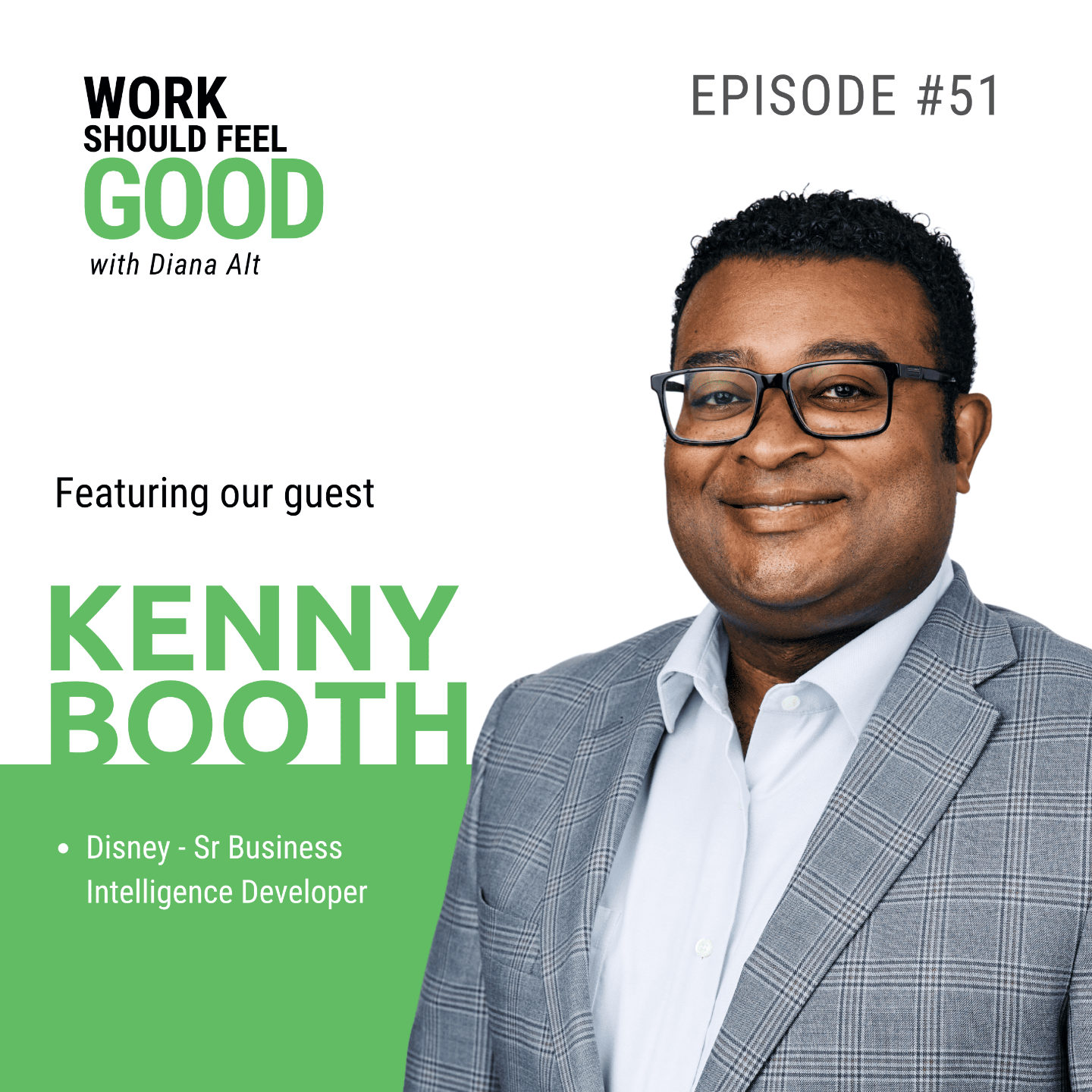
Episode 51: Betting on Yourself Can Land You Your Dream Job with Kenny Booth
Diana sits down with Kenny Booth to explore what it really takes to bet on yourself and build a non-traditional career path. From early entrepreneurial experiments to navigating consulting work and corporate roles, Kenny shares how persistence and curiosity shaped his journey.
They unpack the mindset shifts required to overcome fear, the importance of relationships over transactions, and how small decisions like reaching out or showing up can create unexpected opportunities. If you’re questioning your next move or feeling stuck, this episode will challenge how you think about career growth.
You’ll learn:
- Why betting on yourself matters more than having a perfect plan
- How to turn side projects into real career opportunities
- What most people get wrong about networking
- How to balance entrepreneurship with corporate work
- The mindset shift that helps you move past fear and take action



Episode 51: Betting on Yourself Can Land You Your Dream Job with Kenny Booth
Episode Description
What happens when you stop waiting for permission and start betting on yourself? Diana sits down with Kenny Booth to explore his unconventional path into tech, entrepreneurship, and landing a role at his dream company. If you’ve ever hesitated to take a risk, this episode will challenge how you think about failure and opportunity.
-
Kenny’s nontraditional path into tech and business intelligence
-
Turning curiosity and side projects into career opportunities
-
Why failure and risk-taking are essential to growth
-
Entrepreneurship: who it’s for (and who it’s not)
-
The difference between reasons and excuses
-
Why pedigree matters less than impact
-
The mindset required to bet on yourself
⏳ Timestamps
01:00 Kenny’s journey to landing his dream job at Disney
03:00 How podcasting started during the pandemic
05:30 Creating your own “paradise” through mindset shifts
08:30 Growing up with Disney and early influences
11:00 From stockbroker dreams to tech curiosity
13:00 Discovering automation and problem-solving through macros
15:30 Breaking into software engineering without a traditional path
18:00 Early entrepreneurial experiments (including childhood ventures)
23:00 Starting Code Blue and taking the first leap
25:30 Where confidence and willingness to fail comes from
30:00 Entrepreneurship: who should (and shouldn’t) pursue it
32:30 Reasons vs. excuses — a critical mindset shift
34:00 The energy required to succeed in entrepreneurship
36:00 Why pedigree doesn’t equal success
38:00 The downside of self-motivation and internal pressure
40:30 Balancing side business with corporate work
42:00 Taking risks, making pivots, and betting on yourself
💡 Take Action
🔥 Subscribe for future episodes → https://www.youtube.com/@dianaalt
📖 Grab my Resume Don’ts Guide → https://www.dianaalt.com/resumedonts
❌ Avoid these common job search mistakes → https://www.jobsearchmistakes.com
🚪 Wondering if it’s time to walk away from your job? → https://www.isittimetowalk.com
💼 Work with me → https://www.dianaalt.com
📢 Connect with Kenny Booth
🔗 LinkedIn → https://www.linkedin.com/in/kennethboothjr/
📲 Follow Me On Social Media
LinkedIn → https://www.linkedin.com/in/dianakalt
YouTube → https://www.youtube.com/@dianaalt
Facebook → https://www.facebook.com/dianakalt
TikTok → https://www.tiktok.com/@thedianaalt
Transcript
Diana Alt [00:00:04]:
Hey, Diana Alt here. And this is Work Should Feel Good, the podcast where your career growth meets your real life. Each week I share stories, strategies, and mindset shifts to help you build a work life that works for you on your terms. Hey there, everybody, and welcome to Work Should Feel Good, the show where your career growth meets your real life. I'm your host, Diana Ault, and today my guest Kenny Booth and I are going to talk about how being intentional and willing to bet on yourself could just in fact, lead you to your dream company. Dream job. Kenny blends data, tech, and creativity to solve complex problems at scale. His path is not traditional.
Diana Alt [00:00:52]:
He. He faced setbacks and pivots and plenty of no's, but refused to let all that define his outcomes. Kenny's willingness to bet on himself led him to land a role recently as a senior business intelligence engineer with his dream employer, the Walt Disney Corporation, or company. I don't know which it is. I'm not.
Kenny Booth [00:01:10]:
I think it's the Walt Disney Company.
Diana Alt [00:01:12]:
I should have looked that up before we did this, but he said Disney, guys. And Kenny also has a podcast, which is Paradise. I. I failed to type it because I was in a hurry.
Kenny Booth [00:01:25]:
The Paradise Podcast. Yeah. Technically, I'm on two podcasts.
Diana Alt [00:01:29]:
You're on two? Tell me about it.
Kenny Booth [00:01:31]:
I'm on two. One of them is a professional one. It's called Quick Hits. It's a healthcare it focused podcast.
Diana Alt [00:01:36]:
Oh, cool.
Kenny Booth [00:01:37]:
And then I haven't been on the last few episodes just because of my schedule.
Diana Alt [00:01:42]:
Yeah.
Kenny Booth [00:01:43]:
And then my personal, ever evolving podcast is the Paradise Podcast.
Diana Alt [00:01:49]:
Oh. That is why it just. I. I was gonna say the Paradise Podcast, but that sounded too easy. And it turns out it is exactly the right thing. Not to be confused with paradise, the dystopian show on Hulu.
Kenny Booth [00:02:01]:
Correct. Yeah.
Diana Alt [00:02:03]:
Which is a banger of a show. It's actually insanely good.
Kenny Booth [00:02:10]:
Is it okay?
Diana Alt [00:02:11]:
It's so good. I started. I did the rewatch the season one thing, and I'm now halfway through season two. But anyway, yeah, it's a really good one. But that's not what your podcast is about. So what got you into podcasting?
Kenny Booth [00:02:24]:
You know, I think I've always had a face for radio. We'll say that. No, we are.
Diana Alt [00:02:29]:
We are putting this on YouTube, so.
Kenny Booth [00:02:31]:
Oh. Oh, dang it. Okay. No, what got me into podcasting? I think I've just always enjoyed kind of just talking and. And I like the idea of just kind of turning on a mic and just saying, you know, whatever comes to mind. And so I think initially this was during the Pandemic. My cousins and I all, you know, stuck in indoors, needing some kind of creative outlet. And we've been close since we were children.
Kenny Booth [00:02:58]:
And so we were like, hey, guys, we all love Star Wars. Why don't we just get on our own Star wars podcast together?
Diana Alt [00:03:05]:
Nice.
Kenny Booth [00:03:05]:
And it was. There were five of us, eventually four of us, and then we realized, like, we don't want to just talk about Star Wars. We want to talk about pop culture. And then it turned into a show called the Gen X Reverb, which was basically a bunch of Gen Xers kind of waxing nostalgia and just talking about, like, either favorite movies or we even did an episode about our favorite commercials from back in the day, super bowl halftime show. Like, just kind of anything that. That allowed us to blend, you know, modern pop culture with a bit of nostalgia and kind of give that Gen
Diana Alt [00:03:39]:
X. I love that.
Kenny Booth [00:03:40]:
Yeah, it was great. And then. And then it wasn't so unfortunately that. That's no longer being recorded. But I'm. I'm trying to kind of carry the spirit of the Gen X Reverb into the Paradise Podcast.
Diana Alt [00:03:51]:
Excuse me. I love that. What do you guys hit on on the Paradise Podcast?
Kenny Booth [00:03:57]:
So the Paradise Podcast, initially. So it started off. I apologize, I was not coughing until you hit record.
Diana Alt [00:04:04]:
That's okay. Sorry.
Kenny Booth [00:04:06]:
Okay. The Paradise Podcast initially was me trying to kind of come up with this travel content because I was living in. In Maui, my favorite place on the planet, and I wanted to kind of help others know a little bit about it. So I was going to start doing, you know, restaurant reviews, location suggestions, and just kind of do that one that's hard to do on a podcast. And I wasn't really willing to go the YouTube route. You know, I felt like that was a much bigger commitment than I was a lot of work to do. And then it. And then it kind of changed, especially after I had to move during the pandemic, moved to the mainland.
Kenny Booth [00:04:45]:
Then it changed into this idea of me doing whatever it takes to get back to the island. And then eventually realizing, like, that just wasn't in the cards right now. And so it was like, well, now I'm just going to make my own paradise. And how am I making my own paradise? And it's just my perspective shift of, you know, just trying to kind of see the good and see the positive in things versus this, you know, this constantly cynical take that you find it's so easy.
Diana Alt [00:05:13]:
Like, even before some of the crazy political craziness, we've experienced especially the last couple of years. Like even without that, it's hard to not be cynical. So I love that. What fun. Well, I will, I, I went found it on Spotify whenever you turned your stuff in and said, hey, I have a podcast by the way, so I
Kenny Booth [00:05:35]:
will have to check it out. Yeah, let me know what you think. Always up for suggestions and, and improvement, but I'm trying to stay authentically me, so who knows?
Diana Alt [00:05:46]:
I always say nobody else is qualified for that job. I'm the only one qualified to be me. Okay, so you are doing geek stuff at Disney. Okay. Which sounds like a dream to a lot of people that I know. Which came first, the love of geek stuff or the love of Disney?
Kenny Booth [00:06:09]:
Well, I'm gonna have to say it was the, the love of geek. Well, no, I'm gonna take it back. The love of Disney started probably before I was born. My mom was going to Disneyland way before I was even a thought in the universe. So she, she grew up in Arizona, a short, you know, six hour drive to the coast. And so she and her siblings would go to Disneyland as, as you know, teenagers or whatever. And eventually that, that spread to me. And so there are pictures which, you know, you didn't ask for any images or I would have sent it to you.
Kenny Booth [00:06:44]:
But there, there are pictures of a baby Kenny at Disneyland. One of them is my favorite. It's just me meeting Pinocchio and it was like a picture my dad took and it means a lot. But yeah, so that, that love of Disney's always and you know, just kind of growing up I always kind of had this, I don't know, some people have called me happy go lucky. So I wasn't really into a lot of the, you know, I don't,
Diana Alt [00:07:08]:
the
Kenny Booth [00:07:08]:
typical like we'll say violent entertainment, you know that a kid, that a 13 year old boy would be. But so I was just more of a Disney fan and so you know, Star wars, obviously, you know, that was a big part of it. And then combining Star Wars, Indiana Jones, like kind of all of my favorite properties eventually ended up under the same. Yeah, you're like, oh, you know, so it's just a natural. Yeah, just a natural love of Disney.
Diana Alt [00:07:32]:
That's interesting because I lived in, I grew up in Missouri, outside St. Louis. I'm now like, you know, a few hours away in Kansas City area and so thinking about going to Disneyland or Disney World as a kid, like that wasn't even on the radar. I don't even know that I knew it existed Other than when you watch the super bowl, and they're like, you just won the Super Bowl. What are you doing? I'm going to Disneyland. Like, I. I don't know what that is. I knew what Mickey Mouse was, but I was more of a.
Diana Alt [00:07:59]:
Like, we watched all the movies. My little brothers. My. My younger brother is the same age as you, and from the time he's been little, bitty Lion King has been his movie.
Kenny Booth [00:08:10]:
Okay.
Diana Alt [00:08:11]:
Aladdin was mine. I was not really a princess person.
Kenny Booth [00:08:17]:
Sure.
Diana Alt [00:08:18]:
I mean, we knew him, but I was. I was way more into, like, Aladdin than I was Cinderella or whatever.
Kenny Booth [00:08:25]:
Sure.
Diana Alt [00:08:26]:
Although I do now have a favorite Disney princess that a lot of people like to argue with me about.
Kenny Booth [00:08:32]:
All right, let's. Let's hear it.
Diana Alt [00:08:35]:
It's General Leia Organa.
Kenny Booth [00:08:37]:
Oh, I guess. Yeah. She would count. She would count as a princess.
Diana Alt [00:08:41]:
I mean, I've had people. You know how there's Disney people and then there's the completely pedantic, obnoxious Disney people?
Kenny Booth [00:08:49]:
Sure.
Diana Alt [00:08:49]:
I've gotten in a couple of fights with completely pedantic Disney people, which is hilarious, because I don't care. So it's kind of fun to bait those people sometimes, but. Yeah.
Kenny Booth [00:09:01]:
Are you the personality type that loves to argue, even if you're not that passionate about the point that you're arguing?
Diana Alt [00:09:06]:
I will occasionally do that. I sometimes like to just poke at stuff.
Kenny Booth [00:09:10]:
We are on the same page.
Diana Alt [00:09:12]:
I like to get a rise out of people. I like to get a rise out of people. But I like General Leia Organa because that's like the badass. Like, not that Leia was weak in the early Star wars movies, but. Come on. Come on. It's a general. What's yours? Do you have a favorite.
Kenny Booth [00:09:29]:
A favorite princess?
Diana Alt [00:09:31]:
Princess? Do you have one?
Kenny Booth [00:09:33]:
I don't. All right, I do, but it's a weird story. Okay, I'm gonna say it's. I'm gonna say it's Ariel, but only for this one specific reason, because at a very pivotal time in my life as a sixth grader, I had a crush on a girl, and we were watching the Little Mermaid, and it was just very meaningful to me. So she became like, a favorite Disney princess, but in reality, I have to say it's Snow White. My wife and I have this running joke.
Diana Alt [00:10:03]:
I like Snow White. Snow White's a good one. Snow White is a good one. So you had this lifelong Disney thing, and you're like a Parks and a. Movies, and you like all of it.
Kenny Booth [00:10:16]:
Parks, movies. I love A lot of the old movies too, like the like 60s, like so the Absent Minded Professor Swiss Family Robinson is actually one of my favorite movies.
Diana Alt [00:10:26]:
Family Robinson.
Kenny Booth [00:10:27]:
I love, I mean just the, the adventure, you know, like so I look. Yeah, so I've always been like we had like the Disney Channel when I was a kid, you know, so like the old, the vintage cartoons, etc, like I love those.
Diana Alt [00:10:39]:
Yeah.
Kenny Booth [00:10:40]:
And the books obviously.
Diana Alt [00:10:41]:
So you, you're into all of that and then when did the geekery love start to come in that led to your career?
Kenny Booth [00:10:49]:
You know, it's funny, so I remember in, in junior high. No, high school. You know, you're kind of trying to pick this career path. Because I've always been an entrepreneur. What I wanted to do initially was I wanted to be a stockbroker. So I had this idea that, I had this idea I was going to, you know, go into business and be a stockbroker and I, I should like, I have this guy up, I wonder if he still is around. I was given an opportunity through my business class to go and basically interview someone in the field that I wanted to get into. Cool.
Kenny Booth [00:11:23]:
And so I went to this, you know, this small, you know, financial office in Omaha, sat down and, and met with a stock broker and I noticed his pants were split. And, and I realized that he was not like, he just, you know, I don't, maybe he was just having a bad day. But you're talking to a high schooler who didn't think through all, all of that. Saw were all of these indicators that he wasn't as successful as he maybe claimed to be. And so then I just started realizing like, yeah, maybe that's not me. And I just kind of started getting into more, it was more like Computer Aided Design. And just kind of, that's when I just started exploring more on the, the, the geek side of things. And so eventually I ended up in a job.
Kenny Booth [00:12:07]:
This was after I was married. And it was a very boring job. So I was trying to make it interesting. I was just answering calls. But then I realized that the interface that we had allowed us to program what were called macros, like these automated solutions, you know, these automations. And so I started playing with that and it was funny. I would sit there and I'd play my Game Boy answering calls all, all day long. And my, the woman next to me who was definitely, and she probably like 15, 20 years older than me, she would complain about me all day.
Kenny Booth [00:12:41]:
And they were like, but he's doing amazing. I don't know what your Your point is. And so it was because of all these macros that were just automating all of this stuff for me. So I started getting into that. It got me into another job in the same company. Right. Just got to kind of pursue. They kind of encouraged me to pursue it and start figuring out ways to creatively solve these problems.
Kenny Booth [00:13:01]:
And it was all out of laziness. I just hated doing the same thing over and over.
Diana Alt [00:13:04]:
I have a. I've known a guy for a long time, he's worked in accounting, finance, but he. I met him actually on a mesh of the board in like 1999 or something and later became in person friends after we decided that wasn't quite as scary as our parents thought it was. But he, his handle was retired on the job because he would always go in and implement all that kind of stuff and then be like, I'm just gonna screw around on the Internet while my job gets done beautifully. So that it was easy to do that in that time frame. So. So did you ever study like computer science or programming at university level or.
Kenny Booth [00:13:51]:
I did eventually. So what happened was I ended up saying, well, I would actually like to officially become like, you know, a software programmer. So I started going to school. I went back to school or went to school and took a. I was on the computer science track. Halfway through that, I ended up getting a job at a software developer. And it was a. It was like for healthcare it.
Kenny Booth [00:14:19]:
Right. So that was like my. That's when I finally went from healthcare insurance to healthcare it. And so I'm. I'm about halfway through this, you know, associate program and I realized, like, I'm burning myself out for a job that I already have. So I had already kind of just slid into this role as, as an engineer. And the cool thing was that it was small enough. I got to work with Dr.
Kenny Booth [00:14:47]:
Paul Kenyon. He's. He's a, you know, great leader at this company. But he would actually sit down with some of the engineers and he's writing code, teaching us how to write in objective C. And so myself and another guy were like picking all this up. We started writing our own patches for the software. I was doing a lot of database stuff, so they eventually just kind of gave me this project and said the software engineer who was working on this left, do you want to try and make heads or tails of it and go from there? I basically built a new service line for this company or at least allowed us to maintain this service line for a company and kind of developed a lot of New tools and that kind of just led into other things. But yeah, eventually I just kind of wormed my way in and realized like I really enjoy this.
Kenny Booth [00:15:44]:
I kind of have an affinity for code and affinity for solving really, really hard problems.
Diana Alt [00:15:51]:
I figured out pretty early on in my tech career that I did not like coding. Like I had to do it. I did it for a little while and I was mostly in reporting. Like when I found out. Especially when I found out you landed a business intelligence engineering. I'm like, this is as in this data lane for 20 years in corporate and now I work with a lot of clients on their career development and job searches that do exactly what you do. But it's. I like I, I finally, I had people call me technical for a long time and I was like, I went to engineering school.
Diana Alt [00:16:25]:
Like I hung out with people that, that majored in aerospace engineering for fun. Like they would. Which is one of the hardest majors you can go into.
Kenny Booth [00:16:34]:
Oh, absolutely.
Diana Alt [00:16:36]:
And I got a chemistry degree and a master's in engineering management. And my dad used to say I majored in extracurricular activities because I was like student government and all that kind of stuff. But okay, me and coding didn't get along. But I figured out like I'm analytical, I'm not technical. Like I find it exhausting to keep up with technology.
Kenny Booth [00:16:57]:
But you can talk to the technical.
Diana Alt [00:16:59]:
I can. I'm. I'm a secret decoder ring. Basically. That's. I've made a whole career off of being a secret decoder because I was a business analyst and you know, I. Business analyst, product management, project management. Like all the stuff that's like the dude from office space that says I take the requirements from the customers and I take them to the engineers.
Diana Alt [00:17:20]:
Only I actually did something. I didn't just carry paper around. That was my job. I was a scrum master for a while too. So. So you, you did all this stuff. You basically had your un. Unconventional entry into becoming a developer.
Diana Alt [00:17:35]:
And you mentioned earlier you've always been an entrepreneur. Always. Did you have. Did. Were you the kid with. Did you have a lemonade stand? Were you washing cars when you were a kid? Like what were your first business ventures?
Kenny Booth [00:17:49]:
Yeah. So as a kid I remember trying to do like the lemonade stand briefly until I realized that we lived in a weird dead end and there was
Diana Alt [00:17:59]:
no traffic, no one's driving or a warm glass of country time lemonade.
Kenny Booth [00:18:05]:
It's not right exactly that with questionable standards. But I, I will say like my most successful venture, I was in fifth grade. Okay. We had just moved to the Midwest from. From Phoenix or. Well, no. Yeah, because we were in Kansas. Then we're in Phoenix and then back.
Kenny Booth [00:18:22]:
So I've been. I've moved a lot. But anyway, so we're in the Midwest and again, innocent kid who doesn't realize optics. I. Someone gave me, like, this little fanny pack, which was. Okay. In like, the late 80s.
Diana Alt [00:18:36]:
They're back again.
Kenny Booth [00:18:37]:
I. I'll never. Well, I wear one when I run, but we don't talk about that. But that's different. What I started doing was mixing Kool Aid and sugar and putting it in these little baggies and selling it like Pixie sticks. I got called into the principal's office because I was a huge hit with the kids. I got called into the principal's office and. And they test, like, they were wanting to make sure that it wasn't like,
Diana Alt [00:18:58]:
they're like, look, you can't be selling colored sugar at school.
Kenny Booth [00:19:02]:
Exactly. Right.
Diana Alt [00:19:03]:
In.
Kenny Booth [00:19:03]:
In these little. In these little baggies, you know?
Diana Alt [00:19:07]:
Wow.
Kenny Booth [00:19:08]:
Yeah. So. Yeah, that was. That was, you know, that was one of my first. First success.
Diana Alt [00:19:12]:
I love it. I like that.
Kenny Booth [00:19:14]:
You burn.
Diana Alt [00:19:15]:
Trading time for dollars, like, that's amazing. You were. You built a product company from the ground up at the tender age of 11.
Kenny Booth [00:19:23]:
I had a good assembly line. It was great.
Diana Alt [00:19:25]:
Yeah. I mean, I was starting to. I. I think my very first thing I earned money for was mowing lawns.
Kenny Booth [00:19:31]:
Okay.
Diana Alt [00:19:32]:
And I didn't do a lot of it, but my. I had an older brother that's five years older, and I was around that age, like, middle school, junior high, whenever I started earning extra allowance by mowing our lawn.
Kenny Booth [00:19:46]:
Okay.
Diana Alt [00:19:47]:
Which wasn't super huge. And then. And my brother was, like, in high school, like, with a paid job outside the house, but he had a couple people from the neighborhood that he mowed their lawns, and if my brother was unavailable, I would get the job.
Kenny Booth [00:20:00]:
Oh, there you go.
Diana Alt [00:20:01]:
So I'm like, I'm sure gonna go get Ms. Viola's 20 bucks.
Kenny Booth [00:20:04]:
Oh, absolutely.
Diana Alt [00:20:05]:
Down for that.
Kenny Booth [00:20:06]:
The older paid spectacularly when it came to mowing lawns. And I did do that.
Diana Alt [00:20:11]:
Worst thing ever. The worst job ever. I hate it. I have not mowed a Lawn in almost 20 years. So I would rather move than mow the lawn. Yeah, it's not great, but you had to do it.
Kenny Booth [00:20:26]:
You had to do it.
Diana Alt [00:20:27]:
I had. I mean, it has to get done. I will. I will go with that. But, yeah, money was a big motivator. I like that. Because $20 was $1 million when I was 12 years old.
Kenny Booth [00:20:39]:
No, absolutely.
Diana Alt [00:20:40]:
That was 1986.
Kenny Booth [00:20:42]:
I mean, all the things you could do with that.
Diana Alt [00:20:44]:
Yeah, you. You could buy all your Christmas presents for a couple of lawnmowers, which was nice. And I liked having. I liked being able to buy my own gift for somebody with my own money. That meant a lot to me when I was a kid. Sometimes I'd get a little bit from, like, my dad, go buy your mom a Mother's Day present, whatever. But it. It felt good to have my own money.
Diana Alt [00:21:05]:
So what else? Did you have any other ones? Because we're gonna. We're gonna talk about Code Blue here in a minute, but I just wondered what else you had done. Entrepreneurial.
Kenny Booth [00:21:15]:
So I did stuff like that. I mean, you know, mowing lawns. I. And then I actually ended up just getting into the working world as a kid. So it wasn't until much later when I started getting into building websites and kind of solving issues for people and that. And that's kind of eventually when Code Blue was born.
Diana Alt [00:21:36]:
Okay, what was your first. What was your first. Like, someone else paid you a W2 paycheck? Do you remember?
Kenny Booth [00:21:47]:
Yeah, it was. It was actually. It was a website. Oh, no, no, it was software. Someone. I built, like, a really, really terrible Visual Basic program for someone just to solve, like, a very simple problem for them. But I was like, this is real money. Yeah, I think it was.
Kenny Booth [00:22:06]:
It was after I was married. So, you know, we were. I was young, you know, we didn't have any money. My. My wife was staying home with our then, you know, infant son. And so I was like, I need to make extra money. And so in talking to someone about their business, that's when I. I realized, okay, I can solve this problem for you.
Kenny Booth [00:22:26]:
And I made, like, 1500 bucks at the time. You know, hey, it paid a bill
Diana Alt [00:22:31]:
or two, so it was a million dollars when you have a baby.
Kenny Booth [00:22:34]:
I look at it now, and I'm like, wow. But, yeah, absolutely.
Diana Alt [00:22:38]:
It's a lot. So Code Blue Data Solutions. Is that right? Because I wrote down. What? What. First off, why'd you name it Code Blue?
Kenny Booth [00:22:52]:
Well, being in healthcare, it. I like the idea of, like, a Code Blue being. You know, we have to resuscitate this business, and I just. I like it.
Diana Alt [00:23:01]:
You can look at that positively or negatively if you want.
Kenny Booth [00:23:06]:
It was an alliterate. I like the alliteration. I thought it just kind of rolled off the tongue. It's an extremely long email. I acknowledge that and we'll eventually change that, but I haven't really felt a need to. But yeah, it was, it was just. It was that idea of resuscitating a business back to life. And I really, you know, found out later, kind of made people think I only helped in the healthcare space.
Kenny Booth [00:23:30]:
But, yeah, it worked. It worked since most of my, you know, since I wasn't really advertising, it was.
Diana Alt [00:23:35]:
More people are hiring Kenny at that point. They're hiring Kenny because Kenny can get it done.
Kenny Booth [00:23:40]:
Yeah.
Diana Alt [00:23:41]:
So did you do. And you. You've had this business for over 10 years, if I remember.
Kenny Booth [00:23:47]:
I have, yeah.
Diana Alt [00:23:48]:
You've had it for a very long time.
Kenny Booth [00:23:50]:
Yeah.
Diana Alt [00:23:51]:
What gave you the nerve to even do the first project?
Kenny Booth [00:23:58]:
You know, I've always been the let's just test it in production kind of person. Like, let's see what we get into.
Diana Alt [00:24:06]:
I was the QA manager.
Kenny Booth [00:24:10]:
You would have hated.
Diana Alt [00:24:11]:
No, I wouldn't have. Because you can communicate, get things done,
Kenny Booth [00:24:15]:
you know, and, And I, I love getting into a situation. Like, I, I love finding out what I didn't know when I get into it, you know, And I realized later that that costs me money. Right. But initially it was like, hey, this is. One, it's, it gives me a reason to spend time doing something that is going to teach me that I'm enjoying. And then two, I, I needed the money. That was a pretty big motivator, and I knew I was going to do whatever it took to. To get the project done.
Kenny Booth [00:24:48]:
So I think those are the motivators, honestly. And then just like this, I don't necessarily fear failure, so if I couldn't get it done, I knew I would, you know, like I said, just do whatever it took to get it done. Whether it's, you know, calling additional support. Like, I knew people that could help me code my way out of a problem.
Diana Alt [00:25:06]:
We're going to wander for a minute because you said something that is unusual among us Gen Xers that worked in tech. And so I want to know where it came from, because anybody listening to this that can capture something from that huge. You. You're not being afraid to fail. If there is anything that keeps people stuck, that's what it is. Have you always been that person? How do you think you did your. Like, is that how your parents were and kind of wired you that way? Did you have experience as a youth that made you that way? Because that is my God, if I would have had that when I was young.
Kenny Booth [00:25:48]:
Yeah, I, you know, that's a good question. I, I definitely Attribute it to my parents in a way. I know. Like when I was in middle school, they had really high expectations in terms of, you know, I was. I was. I needed to get the best grades possible. I needed to. I was in a lot of, like, the AP courses, but then I kind of turned into a slacker in high school.
Kenny Booth [00:26:10]:
And I think that's where I just developed like this nonchalant attitude and. And whether it was friends I was associating with or just realizing that this is all kind of. And I think I had like this weird, like, hippie vibe for a while, and it was just like, what's the point of all this? You know? And so you're in Omaha with a hip.
Diana Alt [00:26:27]:
Right? Fantastic.
Kenny Booth [00:26:29]:
Yeah, I love that. A guy in Gene Co's who can't actually skate but plays pretty good hacky sack. It's just. Yeah, it's. It's a weird look. I know. But I. Yeah.
Kenny Booth [00:26:42]:
So I think it was just like this idea that it's gonna be okay. It's fine. So, you know, if the grades weren't perfect, it's okay.
Diana Alt [00:26:53]:
And. Oh my gosh, what did your parents do for a living?
Kenny Booth [00:26:59]:
So my mom was kind of like. So she worked at Mutual of Omaha for 30. So a million years.
Diana Alt [00:27:05]:
Yeah. She.
Kenny Booth [00:27:06]:
What did she do? I don't really know what my mom did. She. She was like in. I think she ended up in something to do with like the. The legal. I mean, she wasn't like a legal. She wasn't like a lawyer or anything like that, but she helped out with the licensing of agents. I mean, she was just a hard worker.
Kenny Booth [00:27:24]:
Right. And then. And my dad was actually. He was like a truck driver all my life. Like a. Like a local kind of truck driver. So truck driver and delivery.
Diana Alt [00:27:32]:
It makes. It makes sense because your parents were in the. Like, we just got to get it done.
Kenny Booth [00:27:39]:
That's it.
Diana Alt [00:27:39]:
Like, you just got to get. You got to not break too much stuff on the truck. Don't get pulled over, don't get in a wreck. Get the stuff there on the right day. And then your mom probably had detailed work. But still, it's like, there's always going to be more. There's always going to be another agent sign up. My parents were in academia, so junior college level professors.
Diana Alt [00:28:03]:
My mom taught English. My dad basically was the pre engineering department. He taught all the things except chemistry at the school he was at. And they were both exceptional teachers. But in my house, you got A's.
Kenny Booth [00:28:16]:
Yeah. There was no other.
Diana Alt [00:28:19]:
Funny, because my dad Actually was not a straight A student. I didn't learn that. Like, I think my mom despaired when I learned that. He was a farm kid, so he was constantly, like, working the farm, sometimes had another job and, you know, doing school all through. All the way through college. So he's like, I'm gonna get good enough grades to get these degrees. But my dad was also brilliant, so my mom valedictorian, like, on point. So, yeah, it's hard to grow up in that because we.
Diana Alt [00:28:52]:
And they are a little bit more wired for the rules and the things like that. So I'm definitely the sheep. But I, I did have perfectionism. Wiring and it took me. You know, we're like Gen X, Gen Xers. Embracing the idea of entrepreneurship. Young is pretty rare. It's a lot rarer than it is with Millennials and Gen Z.
Diana Alt [00:29:15]:
So it took me. God. I finally got an LLC in 2018 and I'd been doing side stuff for money for a few years, but it was like a couple of coaching clients a year and like a little bit of speaking and training stuff. It was never like, I, I just did it. I did not think I could kill it and bring it home so I could actually eat. And I finally decided, you know what? I can, I can do this. I can make it real. Took forever.
Diana Alt [00:29:43]:
I wish I would have had the wiring to do it 15 years earlier. So I don't begrudge. I mean, this. The experience I had before, that is knowledge and wisdom that informs how I help people now. So I'm not mad that I had that experience, but I'm more entrepreneurial. But it was covered up under. This is how the people in my orbit operate.
Kenny Booth [00:30:07]:
So interesting.
Diana Alt [00:30:10]:
So in entrepreneurship, who do you think it's good and bad for? It's like I, you know, there's this. There's such a lot of messages about doing your own thing. And I think it can feel really weird for people. Like, I talk to people that are looking for corporate jobs in product management, but they also, a lot of them feel like, well, if I was really a serious product manager, I would be a founder or I would have a consultancy. Like, they. There's a lot of this kind of Gary Vee induced entrepreneurship porn. But then there's other people that'll be real and say, like, this is not for everybody. Who do you think? What do you think are the hallmarks of somebody that can do what you've done and have, you know, basically a consulting or software development agency.
Kenny Booth [00:31:04]:
Yeah.
Diana Alt [00:31:05]:
And who shouldn't be doing It.
Kenny Booth [00:31:07]:
So I know, I think, I don't know. I feel like entrepreneurial ship kind of runs somewhere in my family because I've got a, you know, I've got family that, that as entrepreneurs and I've got, you know, close, like second. Yeah. Second cousins. Etc. There's a lot of people I know that, that kind of had that entrepreneurial bone. What I've seen though, I think for people that it, it's not for people who make excuses for themselves. And, and so like, I'll say, like, when I see someone who's, who's failing or not failing or they're just not, they're not excelling as an entrepreneur, it's because they need help.
Kenny Booth [00:31:47]:
But when you offer what can help them, they have excuses as to why that won't work. That person immediately, like, you've got to change your attitude because you're never going to go anywhere if you're always giving.
Diana Alt [00:32:00]:
I think it's also important to know that there's a difference between a reason and making excuses.
Kenny Booth [00:32:09]:
Absolutely. Yeah. A reason is a reason is like,
Diana Alt [00:32:14]:
this is a thing in my life. Yeah, you continue.
Kenny Booth [00:32:17]:
No, I mean, yeah, reason is like, look, I, I hear what you're saying, but here's why I can't do that. And then if I offer a solution to that, it's like, okay, so is there going to be another reason or, you know, at some point it's just like it, there's always going to be.
Diana Alt [00:32:33]:
Yeah.
Kenny Booth [00:32:33]:
If there's always a reason. Those are all just excuses, right?
Diana Alt [00:32:37]:
Yeah.
Kenny Booth [00:32:38]:
And there's legitimate reasons why things can't get done or why you, you know, things. I mean, there's been times when I wasn't able to take advantage of an opportunity because my reason was I wanted to prioritize family.
Diana Alt [00:32:49]:
Yeah.
Kenny Booth [00:32:50]:
You know, I, I don't call that an excuse. That was legitimately a reason.
Diana Alt [00:32:54]:
Yeah. But yeah, I committed this level of availability to my wife and my kids. Like, that's the reason. That's like a values line drawn in sand. But yeah, to me it's when it. Whenever, whenever. There's always an every single suggestion has why I can't do that. That's when I start to get concerned.
Diana Alt [00:33:17]:
And I see it in coaching, too.
Kenny Booth [00:33:19]:
Oh, I bet. Yeah, I bet you do.
Diana Alt [00:33:20]:
I see it in coaching. I see it in the most infuriating is job search coaching. When people are like, I am going to lose my house, but I can't go, like, try to have coffee with three people a week. Like, you don't have A job?
Kenny Booth [00:33:35]:
Yeah. What are you doing?
Diana Alt [00:33:36]:
What are you doing with your. I have coffee with three people a week and I work 50 hours a week. What are you talking about? Yeah, so. And I, I don't expect everybody to be able to have the same energy, but it's, it's the constant. Like, this works. Like this works and you refuse. Like, is there a different way to do it? Huh?
Kenny Booth [00:33:56]:
You said a word. That's really important energy. So that. Yeah, you have to have energy. Like, you got to realize entrepreneurialship isn't 40 hours a week. It's 50, 60, 70. Sometimes it's late night.
Diana Alt [00:34:08]:
Depends on the kind of business you have. But definitely for the kind of business you had where you are making the thing. You're making. You're making software, apps, etc, websites, you're making the thing. There's no like, oh, we just have it on a CD in the back or we'll just download it to your. To Google, whatever. That's not the life that you live. So.
Diana Alt [00:34:30]:
But yeah, it's, it's definitely also, no matter what the time is, energy can be a thing. Like I have autoimmune stuff. I've literally had freaking brain surgery last year. I had several years where I could not put the energy in. But you know what? I, you know what? I would have been even less likely to be able to do 50 hours a week in corporate tech, which is what I averaged during my time that I was in that.
Kenny Booth [00:34:55]:
Wow.
Diana Alt [00:34:56]:
Because sometimes it demanded it and sometimes I'm. My parents were teachers and farmers. Like, I'm wired for overwork.
Kenny Booth [00:35:07]:
There you go.
Diana Alt [00:35:07]:
Because the crops, I mean the crops have to come in and the semester ends and you've got to get the grades out. So I was kind of raised with that.
Kenny Booth [00:35:14]:
Yeah.
Diana Alt [00:35:15]:
So yeah. Making excuses. Anything else that comes up for you is like, yeah, I don't think you should. I don't think you're ready for this.
Kenny Booth [00:35:24]:
I, I think like a person, you can't have like this. How, how am I going to phrase this? So I don't offend people. You can't come from a place of privilege in your mind. Like a person can have privileged circumstances. But if you come to the table and say, because this is, this is my pedigree or because this is my education, I deserve a seat at the table. I, I don't think it's for you because you're not. It's. And I know it works for some people.
Kenny Booth [00:35:56]:
Right. Like there are people that continue to, you know, because of their background, because They've. They've been networked in the right circles. They're going to succeed, but they're not. I don't think that they're a success
Diana Alt [00:36:09]:
if you only re. I think I know how to phrase this.
Kenny Booth [00:36:13]:
Yeah.
Diana Alt [00:36:13]:
If you are only relying on the pedigree.
Kenny Booth [00:36:16]:
There we go.
Diana Alt [00:36:17]:
That's where it's a problem.
Kenny Booth [00:36:18]:
Absolutely.
Diana Alt [00:36:18]:
Because having a pedigree might get you into the room and sitting down at the table, but you aren't going to stay invited to that room if you can't make an impact.
Kenny Booth [00:36:29]:
Yeah, there you go.
Diana Alt [00:36:30]:
Or if you make other people feel like you think you're better than them.
Kenny Booth [00:36:33]:
Yeah, exactly.
Diana Alt [00:36:35]:
Well, there we go. Look at that. We did it. How exciting. When people talk about pedigree too. Like one of. One of the things I'll talk about with people that are kind of like you and I, where it's like we had our. We had our very good tech corporate careers and we also want our side thing.
Diana Alt [00:36:51]:
Or we want to pivot entirely to that. We'll hear this. Well, I'm not an expert. I wasn't the vice president of anything. I didn't get my degree from an Ivy League whatever. I like to tell them.
Kenny Booth [00:37:01]:
Look,
Diana Alt [00:37:04]:
every single person I've hired that was business coach adjacent has been. Two of them had GEDs but helped me immensely. And nobody else has had like a degree in business. The people that I haven't have learned the most from and have paid money to be coached by. None of them have an MBA. None of them. Like two of them had. Don't have college degrees that have GEDs for high school.
Diana Alt [00:37:36]:
So you can learn. You want to learn from the people that know the stuff, not necessarily the people with the pedigree. So.
Kenny Booth [00:37:42]:
Yeah.
Diana Alt [00:37:43]:
What is one of the most interesting things you've learned about yourself while being, you know, running code blue?
Kenny Booth [00:37:54]:
So I learned pretty early on that the way I motivate myself can really be toxic. Unfortunately. Yeah, it's not.
Diana Alt [00:38:03]:
I gotta hear about. I think this is common.
Kenny Booth [00:38:06]:
Okay.
Diana Alt [00:38:07]:
I don't even know what you're about to say.
Kenny Booth [00:38:09]:
I feel like I'm gonna say something.
Diana Alt [00:38:12]:
So. So let's hear it.
Kenny Booth [00:38:14]:
Let's say, okay, so I'm working on something, working on a deliverable. And I can't get this code to work. Right.
Diana Alt [00:38:19]:
Yeah.
Kenny Booth [00:38:20]:
And for the life of me, I. And I'm. Sometimes I'll. I'll obsess. And now I'm not sleeping, I'm up to 2 in the morning. Gotta get this done. Gotta get this done. Back of my mind knows, dude, go take a nap.
Kenny Booth [00:38:34]:
You'll have the answer when you wake up. Right. And 99% of the time, that works. When that doesn't work. Right. That 0.1% of the. Or that 0.01% of the time, I start to tell myself, like, you know what? You should just hang it up and go. Go work at McDonald's.
Kenny Booth [00:38:50]:
Because that's like. It's this internal monologue, and for whatever reason, it kicks me out of. Like, I snap myself out of it, and I'm like, oh, there was a typo in line 45.
Diana Alt [00:39:01]:
It's just squirrely bracket or whatever.
Kenny Booth [00:39:04]:
Exactly. Or do that. Or it's like, oh, you needed to go back because two weeks ago you committed some code that is screwing you right now. You know? So, like, yeah. For whatever reason, like, my mind just kind of. It's like, it. It's like I hit the reset.
Diana Alt [00:39:17]:
So you basically take yourself to it. I'm going to the lowest of the. Of the lowest thing I can think of. Yeah. The.
Kenny Booth [00:39:25]:
The.
Diana Alt [00:39:26]:
The job that you swore you'd never had, and then that gets you out of it. I don't know if that's toxic or
Kenny Booth [00:39:32]:
genius, but I'll tell you the sad part is, like, if. If my family needed it, I would. I would absolutely be. Of course I'd be on the fry machine, you know, so it's so nothing against anybody that has that job.
Diana Alt [00:39:43]:
Yeah. But that's not. That's not what you were built professionally to do. So thinking of having to go and do that, there's a lot of things when I, like, I don't want to. I don't want a W2 from anything but a company I own ever again. That's. But if I have to, I'll go do it.
Kenny Booth [00:40:03]:
Yeah.
Diana Alt [00:40:03]:
I did tell my mom one time I would rather move to Latin America than have a W2, because I. My financial advisor likes to tell me, you can't retire here now the way that you're accustomed to living.
Kenny Booth [00:40:17]:
Sure.
Diana Alt [00:40:18]:
But there are plenty of places that you could go.
Kenny Booth [00:40:21]:
Yeah.
Diana Alt [00:40:21]:
And retire. So you're fine. Like, if I'm freaking out, I'll be like, you're fine, you're fine, you're fine, you are fine. So that's interesting. Did you. So you've had code blue. Like, it's been an interesting journey for you because a lot of people think about starting something like that, and, well, that's going to be a side hustle. I'm going to do that to earn beer money.
Diana Alt [00:40:43]:
Or learn skills or, you know, or I'm going to do it till I can build it up and say goodbye to corporate forever. But you've been kind of in and out though.
Kenny Booth [00:40:52]:
I have, yeah. So it was always just initially it was like, okay, this is, this is pay, pay extra bills money. This is make sure we can go to Disney World with the family. Right. And then we moved to Maui in 2014 and I was sorry that you had to move. It was the worst. No, and I'll tell you, I, that had been a dream and I was just like, we're gonna make it happen. I remember people patting me on the head like, oh, you think you're gonna move to Hawaii? And then like a year later we're the Brad are going away party.
Kenny Booth [00:41:24]:
My mother being one of those people, she didn't believe that I was serious until I bought the one way tickets for us. But I. So we're in. We're in. So it was always just a side gig and we get to, we get to Maui and I'm like, it is more expensive here than any, it is a lot, any of the research that I. So I immediately start looking for web jobs and I start, you know, posting, you know, and, and developing and stuff like that. And so, and that was great. And then I started.
Kenny Booth [00:41:51]:
A friend of mine reaches out to me and he's like, hey, I'm, I'm at the startup. We need somebody to help us with, you know, design the UI on this, the software. Are you in? Absolutely, I'm in. So I get this job again, it's just on the side and I don't know, I always feel like, you know, I'm a religious person. God is always going to set up the, the next thing before the current thing ends is how I feel. Six months of consulting and I basically get a call from my current employer saying, we would like to invite you to move back to Omaha. Because they were based out of Omaha. They let me work remotely for about three years.
Kenny Booth [00:42:32]:
So it's 2017 and they said, we'd like you to come back or else. And so I was like, like, I'll take the orals.
Diana Alt [00:42:41]:
I'll take else.
Kenny Booth [00:42:42]:
Yeah, I'm, I was like, guys, I'm in Hawaii. Back to Nebraska in the winter, by the way, it would have been like January. I, I would have just stayed outside and frozen to death. I would have rather done that. So I, at that point I just said, well, I'm going to take the orels. Before I even reached out to the company. I had been kind of moonlighting with. And I just said, I, I, I got off the phone, went and talked to my wife.
Kenny Booth [00:43:08]:
And I said, I reached out to Greg, Greg Giorgiotos. He is the, you know, one of the founders of this company. And I said, hey, man, I think I'm gonna need a little bit more hours. Are you guys in? And he's like, tell you what, why don't you fly to Palo Alto this weekend and we'll talk, we'll do like a hackathon thing. So I spent, you know, I took like the last, you know, 600 bucks I had and I flew out for the weekend. We had a great, you know, we vibed and he's like, yeah, you're in. And so I was like, employee number three, you know, and it was, it was not a W2 situation. I was contracting with them.
Diana Alt [00:43:44]:
Yeah, but you had enough to, it was enough.
Kenny Booth [00:43:47]:
Oh, yeah, yeah. It paid the bills. It was great. And then actually I ended up getting a call from a client at, at the old software company. It was, it was a hospital, basically reaching out to me, asking, hey, can you, we need you to be our, our admin for this. So software that you guys developed or your former company developed. So I had like, basically two. I went from, you know, this brings in, you know, a couple hundred bucks a month to now it's paying all the bills.
Kenny Booth [00:44:16]:
And we were doing pretty well. I mean, we, I, we were able to, to travel. I was able to go back and visit, you know, my parents when I needed to. We took a trip to, you know, to Disney World from Hawaii, which was, you know, that's a lot pretty expensive. I mean, it was taking care of us. It was great. So it was, yeah, it surprised me how, how well, the consulting world, how well I took to the consulting world.
Diana Alt [00:44:42]:
So thank you for sharing all that because I think people, what I hear going through all of that is you have to constantly be listening and open and know what you're about. Because if you just get into the mindset of, well, it's gotta be full time w2 40 hours a week and 2 weeks vacation a year, like, you're going to miss what you had, which is more flexible than that, and you still were able to provide a good life for your family. When you have been in this situation where you were an employee and you had code blue on the side, how did you handle that? Because that's a big concern. A lot of people have is, is my company going to get pissed? Should I disclose it? Like, what do I do? About that. That. Have you found that the places that you worked when you were kind of more inside mode were supportive of that? How did they react? How did you handle that stuff?
Kenny Booth [00:45:41]:
Yeah, that's a good question. And. And that actually has gotten me in trouble in the past. It's kind of long. Yeah.
Diana Alt [00:45:49]:
What aspects of it got you in trouble? Let's maybe. Let's do that. Because there's all kinds of reasons why it can be a benefit.
Kenny Booth [00:45:57]:
Yeah.
Diana Alt [00:45:57]:
But. But also, sometimes people just dismiss the idea that it could be a problem. You know, like, well, your company's a jerk if they won't let you do that. Let's talk about what actually became a problem and how you dealt with it.
Kenny Booth [00:46:11]:
Sure. So conflict of interest is a real thing. Even when. So I'll give you the scenario. Right. Because I have no shame. I don't. It's okay.
Kenny Booth [00:46:20]:
Everything's a learning opportunity. I had someone reach out. This was after I had decided to go ahead and become a full time, you know, at. At this. The startup software. At the startup.
Diana Alt [00:46:31]:
Yeah.
Kenny Booth [00:46:32]:
And so now I'm. I'm full time for them. And an opportunity came up for a potential client servicing a software that I had experience with that no one else in the company had experience with.
Diana Alt [00:46:45]:
Okay.
Kenny Booth [00:46:45]:
Our company as a whole was not interested in pursuing that as a business line.
Diana Alt [00:46:50]:
Okay.
Kenny Booth [00:46:51]:
So I took that as a side gig. I was. Because I basically said, hey, guys, here's job abc. It's an opportunity. It's not a huge contract, but it's a good opportunity. They didn't pursue it. So I just said, well, I'll do it. I'll do it on the side and no big deal.
Kenny Booth [00:47:09]:
Well, a few months go by and come to find out that my company was really interested in being an approved vendor with this hospital. It's actually Advent here in Orlando being an approved vendor with them. So they are in there, they're sitting down, meeting with. With this transplant team, and they say, oh, yeah, well, we know Ken Booth. He. He works for you guys. And they got blindsided with that. And I end up in a call with the founders, basically saying, dude, we.
Kenny Booth [00:47:43]:
We have trusted you, and how could you go behind our back? What are you doing? So it was a moment of me not communicating, not being open in my communication.
Diana Alt [00:47:53]:
Yeah.
Kenny Booth [00:47:54]:
To what I considered not to be a conflict of interest. Turns out it was sort of a conflict of interest. Right. Because I was here now working for. I was basically an approved vendor.
Diana Alt [00:48:06]:
Yeah.
Kenny Booth [00:48:07]:
That's what they were.
Diana Alt [00:48:07]:
You were. You were an approved vendor. Which is what they were trying to be.
Kenny Booth [00:48:11]:
And I was like guys, I tried to give this to you. You know, and, and, and so, you know, we ended up working things out. It was fine, but left a black mark on, on my reputation with, with a few of them for a while. Yeah. But I mean, and it worked out. It was fine. That contract eventually ended and fortunately, you know, I was still in good with, with my company.
Diana Alt [00:48:34]:
Yeah. So is the lesson there that if you're doing a side thing that is related to your day job that you need to be crystal clear? Sure. You understand like the, the, the disclosure and moonlighting policies and follow them to the T. Is that kind of what it is?
Kenny Booth [00:48:53]:
Yeah.
Diana Alt [00:48:53]:
Or did you come or did the startup even have that? Because that's another thing.
Kenny Booth [00:48:57]:
Well, so I had never signed anything because I think I was early enough. I was, I was, you know, single digit employee number. They didn't have a lot of that in place. So I never signed anything like that. However, had I just had that conversation, they might, they might have said hey, I, we're not okay with that or okay, we're going to bring this under our umbrella. Right. And so if you're going to do
Diana Alt [00:49:21]:
it anyway, then let's figure out how to do it. I got it.
Kenny Booth [00:49:25]:
Yeah.
Diana Alt [00:49:26]:
That's really interesting. So one of the things that a lot of people do not realize and it's particularly important when you're doing any technology development, whether it's software engineering, anything, and that is that a lot of employments agree employment agreements have buried in there something that says any code or any product that you develop while you work here is ours.
Kenny Booth [00:49:53]:
Yeah.
Diana Alt [00:49:54]:
And they don't just mean what you're doing in the scope of your employment with them. They mean everything. Everything.
Kenny Booth [00:50:02]:
Yeah.
Diana Alt [00:50:02]:
I had worked with some people years ago who had gotten a carve out. They, we worked for a smaller company and the, this guy was working on some new technology the CEO knew. Like the CEO support aspiring founders like mentored. I don't know how many people that have successful businesses right now. But he got a carve out from the original company and then they were bought by a large company. It was emc. They were bought by a large company. And then later on after the CEO had the initial company CEO had departed like that large company tried to basically say that this carve out is not a real thing.
Diana Alt [00:50:47]:
Like there was a lot of court and a lot of expenses and a lot of it got real messy. And that was with the paperwork, let alone without the paperwork. So let's go over into how you got to Disney.
Kenny Booth [00:51:03]:
Yeah. Okay.
Diana Alt [00:51:04]:
You said in your interview prep sheet it all started with a Terry Weaver podcast.
Kenny Booth [00:51:09]:
Yeah, sounds right. Terry's such a lot of lives. He's a good dude. So after I had quit in order to stay in Hawaii, here I am suddenly full time consultant. Around that time I was, was, look, I was looking for any Disney content just because I was like, hey, I'm missing my, one of my favorite places. Obviously Hawaii was my favorite place, but
Diana Alt [00:51:32]:
my second favorite favorite place. Yeah.
Kenny Booth [00:51:35]:
And I find Terry's podcast that he was doing with, with some secular.
Diana Alt [00:51:45]:
Yeah, so you're talking about WDW today.
Kenny Booth [00:51:47]:
Yeah, exactly. So I was listening to that and then Terry mentions that he's got, you know, his other podcast, Making Make Elephants Fly. Right. So I, I listen to that and I'm like, okay. And he mentions he's got this conference and I, I have to give my wife credit for just supporting my hairbrained ideas. I'm like, yeah, I'm like, hope, I think I have to go to this conference. I'm gonna go check it out. I was like, it just happens to be by Disney.
Kenny Booth [00:52:12]:
I might, I might go in, you know, for a Parker or whatever. But I went and
Diana Alt [00:52:19]:
LA thing, or was it.
Kenny Booth [00:52:20]:
No, this is Orlando.
Diana Alt [00:52:21]:
Orlando.
Kenny Booth [00:52:22]:
Okay. And so yeah, I, I, I had a chance to meet Terry. I was really listening to a lot of just the, the ideas that, that people were coming to the floor with. And it was, a lot of it was what I needed at that time, which is like, yeah, you can do this. I was like, I'm pivoting. I think I can't remember
Diana Alt [00:52:44]:
who all
Kenny Booth [00:52:45]:
was there, now that I think about it, like who all the speakers were, but I just remember being like impacted like that. I can do this. You know, I, I think I, I briefly needed that permission, you know, and so I was like, I can do this. I ended up talking to, talking to a guy there who had an idea for some software and it was, it was Disney related. It was for the deep, for DVC content creators. Here I end up, we connected. I ended up building the software and one of the QA testers, Robin Deary, he, I later on went on to start a company with Rob, but he, he and I met basically through this, this software project. The software eventually, you know, kind of didn't work out.
Kenny Booth [00:53:34]:
It was, it was a cool piece of software though. But it, it, it helped me realize, yeah, you can build, you can make
Diana Alt [00:53:39]:
something, you can make a thing.
Kenny Booth [00:53:41]:
Yeah. I was like, okay, you don't just
Diana Alt [00:53:43]:
have to stand up a three page WordPress site. Yeah.
Kenny Booth [00:53:46]:
It's like, add that to your resume, you know, and it's not just about. It was. It was something completely different than I had done before. It wasn't healthcare related. It wasn't, you know, it wasn't middleware. It was. It was a true app that somebody could put in their hands. And so from that experience, Rob and I, you know, kind of developed a friendship and he eventually starts working for Disney and he's like, hey, I want to introduce you to, to a leader here.
Kenny Booth [00:54:13]:
And Hope and I just. This is years later, right? Hope and I just happened to go celebrate our anniversary for a weekend and I was like, I'm gonna go have coffee. And met. Met my, my leader, Erica Huerta, and she's like. I'm like, tell me about what you do. And she's, you know, data science manager. She's telling me. She's like, I think, you know, we, we literally had an hour conversation and we just vibed, you know, we could just tell that we were very, you know, we didn't talk super technical.
Kenny Booth [00:54:44]:
But she's a very much a. She's a good study of character. And so something about me she liked, you know, so we would. I would reach out occasionally, like, hey, any opportunities, you know, just kind of looking, you know, hey, maybe I could contract with. With you guys or something like that. But I, I'd say, hey, this is what I'm working on. So just every couple of months I'd reach out and one day she just woke up and was like, I'm gonna hire Ken Booth. And it was.
Kenny Booth [00:55:09]:
It was consulting for a year, and then eventually.
Diana Alt [00:55:12]:
Were you consulting full time for that year or were you like, side gigging it? What was that like?
Kenny Booth [00:55:19]:
It was. Yeah, it basically ended up being. It was kind of a side gig. Slash. It eventually ramped up and became full time.
Diana Alt [00:55:29]:
You. You were. You had enough hours that it could be full time?
Kenny Booth [00:55:31]:
Yeah. Oh, yeah, absolutely. Okay. And it was, it was at the right time because my other company, things had unfortunately just kind of. I. I went from being, you know, an internal employee to now being back to a consultant, basically. And so I took that as a demotion.
Diana Alt [00:55:50]:
Right.
Kenny Booth [00:55:51]:
That's how I felt about it. And so I was looking elsewhere at the time and here comes Disney. And so.
Diana Alt [00:55:58]:
Yeah. Oh, go ahead. Sorry. There's so much to unpack that I'm like.
Kenny Booth [00:56:03]:
There's a lot.
Diana Alt [00:56:03]:
Very excited because there's a lot of. Really inside that story. There's a lot of really practical things that people feel uncomfortable with that. I think you show that it doesn't have to be that damn hard. Like, y' all are making it hard. So number one is taking a side thing that didn't work out. A lot of people would have taken that as well. I'm not cut out for this.
Diana Alt [00:56:31]:
Because even if it wasn't the technology, like, maybe I didn't understand the client well enough or whatever those reasons were, like, they would take that as well. I tried a project, and it didn't end up setting the world on fire, so I can't do that. So that's thing number one. Then you have this. Did you say his name's Rob that you met? Okay. You have that relationship, and people want to be so transactional with a relationship like that. Like, oh, I met Rob. And either Rob gives me, like, a unicorn, or I don't ever talk to Rob again.
Diana Alt [00:57:03]:
But you nurtured a relationship with Rob.
Kenny Booth [00:57:07]:
Yeah.
Diana Alt [00:57:07]:
And then there's the part where you met Erica and you gave up an hour of your anniversary trip to have coffee with her. And a lot of people won't do that. They'll be like, well, I'm on vacation. I shouldn't have to do that. And it's like, you're there, but. But it's one hour.
Kenny Booth [00:57:29]:
Yeah.
Diana Alt [00:57:30]:
And it led to the company that you've. Did you even think it was possible to work at Disney? You know?
Kenny Booth [00:57:36]:
No, I really didn't. Yeah, that's the funny thing. I was just, like, meeting somebody cool and, you know.
Diana Alt [00:57:43]:
But you also didn't have an agenda about it. So you're like, I'm gonna have coffee. Rob introduced me. I'm gonna have coffee. We're gonna nerd out for an hour. I'm gonna leave and do the rest of my trip. But you touched and reached out every few months, like, hey, how's it going? Hey, how's it going? The things that are so important in that it's less about, you know, what. What it's.
Diana Alt [00:58:06]:
What's really important about it is that you did it and you didn't make it hard. People have so much trouble with the outreach and am I going to be bothering the person? And whatever, you send somebody a link that's like, hey, I stood up this cool website for this thing over here, or I'm farting around with Claude, and I learned how to make a new dashboard, and a 10th, 10th of the time, or whatever that is, like. Like, if it takes two minutes to read, no one's going to be mad even if they don't apply.
Kenny Booth [00:58:32]:
Right. So I think I, I appreciate what you're, what you're saying because I, I would say that I've had people reach out to me with, with very, with what felt very transactional, like, hey, you work for this company. I'd like to talk to you about this, this and this. I'm no longer listening, you know, or even sometimes on LinkedIn, which unfortunately I feel like has become the new Facebook. You know, Facebook with a tie. I'll read someone's post and I'll very quickly realize like, oh, this is just, this is literally just a sales. Like they're not. And I realized like you have to, you know, promote yourself a little bit.
Kenny Booth [00:59:08]:
But I just like to talk to people. I, you know, I, I just like to be able to say like, hey, hire people.
Diana Alt [00:59:15]:
So that's, that's a thing, that, that's the thing that gets lost in all this too. People hire people, people promote people. People buy from people. Even if you're buying from a giant brand like Google, there's a sales, like if you're doing enterprise stuff, there's a sales rep involved. There are people involved in all of this. And so just walking in with curiosity is the best way to go. I just was in a, There's a Facebook group called Women in Product. It's Women in product management and related roles.
Diana Alt [00:59:47]:
And somebody posted earlier today, hey, I have a 15 minute meeting with the new Chief Product officer. How do I maximize this meeting? How do I drive it? And my response was, this person is having 7,643 of these meetings in the next 30 days with everybody that's a stakeholder to get in front of them. You just need to be prepared to say what you do, what you're working on, and ask one or two curious questions about that person.
Kenny Booth [01:00:19]:
Yeah.
Diana Alt [01:00:20]:
You don't drive anything.
Kenny Booth [01:00:21]:
Yeah.
Diana Alt [01:00:22]:
If you are, you're. That might not go well for you. Just be like, hey, this is, I thought, thought you think this is cool. Or hey, I like, like what you're doing, but I like what you're doing at insert company. I think that you need SEO or your YouTube optimized or can I pick your brain? It doesn't go as well. Just be curious about the human. So it's really important.
Kenny Booth [01:00:51]:
That's really good advice. Yeah, just be curious because sometimes people just want to talk about the cool things that they do.
Diana Alt [01:00:56]:
Yeah. Because there, there were probably a zillion qualified people that also love Disney that Erica could have hired. But you were the one that. That tried to have a little bit of a touch and a little bit of a relationship, and it was lightweight, from what you're telling me. It's not like you were writing her a missive every month. You were sending like a DM every so often or an email, basically.
Kenny Booth [01:01:18]:
Yeah. At one point I was like, hey, boss lady, you know, just kind of messing around, just joking, you know. But, yeah, I think she just appreciated that I was just trying to be a human. Yeah.
Diana Alt [01:01:27]:
Yeah. Before we go, one thing that I have a. I have a question I ask everybody, but I've got one more for you about this. What is something people get wrong that or they don't understand about being a cast member at Disney because you're a corporate side cast member. So what might people not understand about what that life is like?
Kenny Booth [01:01:52]:
You know, that's. That's an interesting question. So technically, I've only been like a true cast member for the last three months. Right. I was a contractor up until that point, working remotely. But I think what people don't realize is, and I needed to realize it, was that everything you do, even if it's not on stage, as they call it, you're not customer facing. Everything you do is contributes to the show, as they say. Everything you do should be to drive the company forward.
Kenny Booth [01:02:27]:
And so that, and that includes, like, your interactions, like in meetings. And I always just try to come. I always try to bring like this, hey, hey, I'm just a fun loving guy. We're gonna do, you know, we're gonna joke around and then we're gonna get serious and talk about, you know, xyz. But I think, I think people from the outside might not realize, especially from the corporate side, anybody in the parks, you're like, oh, this person's, you know, they're having fun, etc. And the reality is some of them are working really, really hard. Right. A lot of them are working really, really hard.
Kenny Booth [01:03:01]:
But it's like we're doing it because we're just interested in pushing yours.
Diana Alt [01:03:07]:
So what you're saying is you're as involved in the mission of having a great show as whoever got up that day and dressed up as Elsa?
Kenny Booth [01:03:19]:
Absolutely. Yeah.
Diana Alt [01:03:21]:
And you go through the same. Everybody goes through the same, like, traditions and culture training too. Right when they start. So. So that's not just for people that are in parks. That's for people that are doing absolutely everything, including, like, wrangling your tableau dashboards
Kenny Booth [01:03:38]:
or whatever the hell it is that you absolutely Absolutely. Yeah. I was surprised that just the variety of people I got a chance to
Diana Alt [01:03:43]:
meet when I. Yeah, it's so, it's so cool. It's fun to work in data just because you end up touching every part of the business. Before I go, I have one question I ask everybody and that is what is the worst piece of career advice you've ever received?
Kenny Booth [01:04:00]:
Worst piece of career advice I've ever received was that sometimes you want to. You. Sometimes you should write people off. So I've received. Oh, I received career advice on the opposite end of the spectrum with regard to how to deal with like a toxic relationship or, or a person that you consider toxic. There's, there's been the advice that like, no, absolutely, you should, you should burn that guy down. You should do, you know, whatever, like they, they're your mortal enemy. I, I received that advice before and realized that one.
Kenny Booth [01:04:31]:
It's bad for me.
Diana Alt [01:04:33]:
That doesn't seem like who you are.
Kenny Booth [01:04:35]:
It's not who I am. But, but there was a part of me that felt that that's who I needed to be. But then I got some weird and that was like, dude, there's no need for that. Just be you. And yeah, you're not going to be best friends with this person, but treat them like a human. If you come across them, you know that you can be kind, but don't, don't just burn a bridge because, because you feel that you've been wronged. Just realize like, yeah, my, my interactions with this individual might be limited, but I'm going to move forward. We might end up in the same circles again.
Kenny Booth [01:05:14]:
And if I'm not spitting poison, it's going to be a lot more.
Diana Alt [01:05:18]:
Yeah.
Kenny Booth [01:05:19]:
Productive.
Diana Alt [01:05:19]:
And there's a difference between somebody that's hard to get along with and somebody that literally is bullying and bullying and ab you at work, I don't think that you're talking about someone. Don't keep trying to work with someone that's actively like abusing or discriminating or any of that kind of stuff.
Kenny Booth [01:05:37]:
But right. Have to accept it. You know, you don't have to accept
Diana Alt [01:05:42]:
it, but you also don't have to like you spitting poison, I think was a really good way to put that. And I know I have not always been on the right side of that. I am a salty.
Kenny Booth [01:05:54]:
Me too.
Diana Alt [01:05:55]:
So. Well, Kenny, thank you so much for coming here and talking to us about your, your non traditional path through corporate and entrepreneurship and over to work at the Mouse House. I really appreciate it. So.
Kenny Booth [01:06:13]:
No, hey, thank you so much for having me on. This has been a great conversation and I've thoroughly so really appreciate it.
Diana Alt [01:06:19]:
Good times. All right, we'll see you next time, everyone. Want some more career goodness? Between episodes, head on over to DianaAlt.com and smash the big green let's Connect button to sign up for my newsletter. Let's make work feel good together. And that's it for this episode of Work should feel good. If something made you laugh, think, cry, or just want to yell yes at your phone, send it to a friend, hit follow, hit subscribe, do all the things. And even better, leave a review if you've got a sec. I'm not gonna tell you to give it five stars.
Diana Alt [01:06:56]:
You get to decide if I earned them. Work should feel good. Let's make that your reality.